Showing posts with label Book Review. Show all posts

Tuesday, 2 September 2014

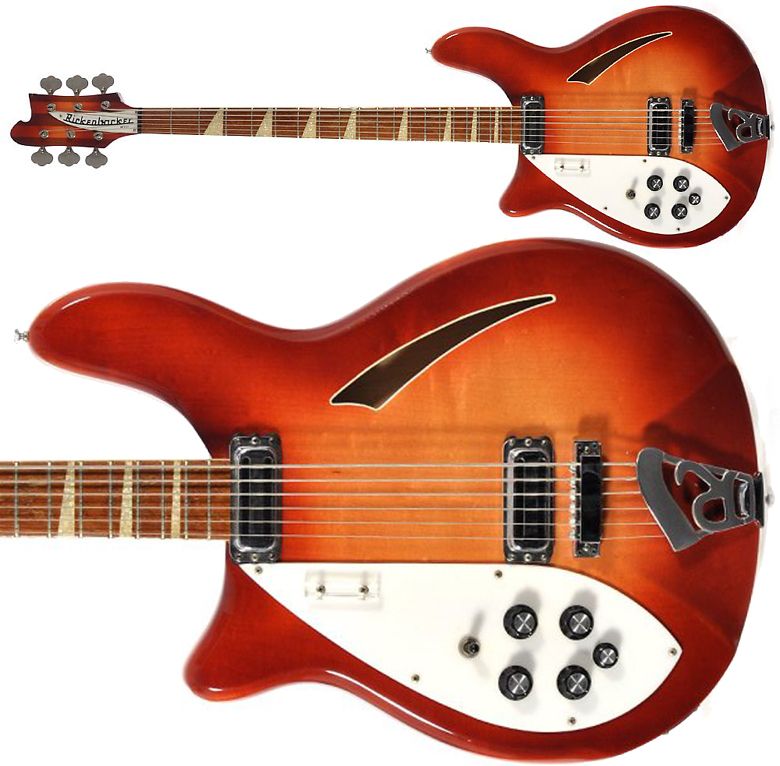
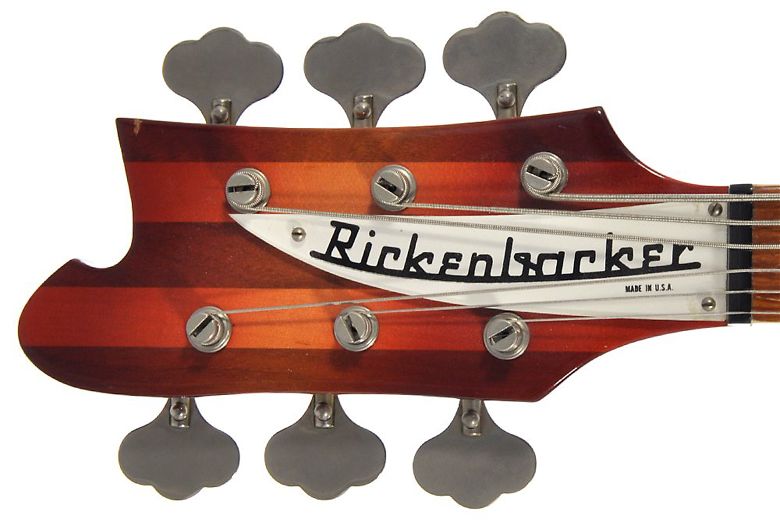
Possibly unique left-handed Rickenbacker 4005/6 semi-hollow Bass VI

guitarz.blogspot.com:
Andrew K writes:
What we have here is a Rickenbacker 4005. If that was not rare enough already, it is a lefty. Even rarer than that, it is also a Bass VI. Apparently the 4005 was introduced in 1965 and remained in production until 1984. This also applies to the 4005/6 model seen here, although perhaps the 4005 was never a production model as much as a custom model, so lord knows if any were made after the late 60s. It is a guitar very much of its time, appearing in the tiny gap of time between the rise of the humbucker and the fall of clean tones as well as the only time when bass VIs were 'relevant'. Unlike the Fender Bass VI which was a stand-alone design, or the short scale basses turned VIs made by Gibson, this appears to be the full 33 1/2 inch 4000 series bass scale, meaning chords are a distant memory here. The price here is steep, but seemingly justified. I can't say another of these will EVER see the light of day, especially not in Left handed spec.

Other weird 4005 basses to look out for are the 8 string version, the lightshow edition, and the 8 string lightshow edition.

Before I go I'd like to talk about the unfortunate tale of this bass for a second. Given the extortionate cost of the 360 model guitar in the late 60s, we can only imagine the cost of the 4005. This obviously hurt sales, and the lack of any real big names behind the model didn't help. The model is also unique in being an early example of an actual semi-hollow body bass, rather than the mis-named EB2 and violin body hollowbodies. But as 1970 approached, the disastrous pickup placement (on some bass models, the bridge pickup touches the bridge) and hollow body were seen as outdated and the thin sounding pickups were too weak for the in-crowd. By the early 80s they were so utterly worthless that the bassist for one of Steve Albini's groups, and the bassist for the Replacements, Tommy Stinson, were easily able to afford them. The closest shot at fame the bass had was with Mani from the Stone Roses (who later ditched it in favour of the underrated 3000 series bass), and only rare appearances since.

This sad history means what is a very unique design of bass basically languished in obscurity before becoming so valuable no-one can buy them. Ricks are called semi-hollow for want of a better description, but the body top is thicker and a solid piece of wood, routed out from the rear with the neck set under the pick-ups creating a union of centre block and neck rather than the slim tenon joint used on the laminate Gibsons. This basically means the body isn't going to thump like a violin bass or EB2 bass, and is likely to be far more piano like. The only basses with similar construction not custom made are the small-bodied G&L ASAT and the Gibson Midtown bass, both of which have their own tone as well. I honestly think Rick need to reissue this thing, it may have failed first time round, but times have changed, and this bass is primed to be a hit. The world has changed! We're mature enough to realise our stupidity now! We'll burn all the P-Basses if you just put this back in production!

Thanks Andrew, I've been meaning to feature a Rickenbacker 4005 bass for a long time and you managed to find a lefty Bass VI version. Very cool. I've also been meaning for a very long time to mention a really fantastic book, The Rickenbacker Electric Bass - 50 Years As Rock's Bottom by Paul D. Boyer and published by Hal Leonard. Although you might think that as the book covers a very specific niche subject that it would only appeal to the real fanatics, it is so well written and beautifully illustrated with colour photographs throughout that I think it would keep ANY guitar enthusiast enraptured for hours, and not just the bass players and/or Rickenbacker enthusiasts.

Here, by the way, is what Paul D. Boyer has to say about the Rickenbacker 4005/6 (page 42):
The 4005 served as a baseboard for some interesting variations. The first of these was the six-string 4005/6. Similar in purpose to Fender's "Fender VI," the instrument  was strung EADGBE, but an octave lower than a standard guitar. Both rounded-top and WB [i.e. non-rounded top "with binding"] versions of the 4005/6 exist, and at least one leftiy4005/6 was made. While the six-string bass was offered on price lists from 1967 to '78, very few were made.

The book also shows a photo of a 4005/6 (very possibly the very same example that we have been looking at here) being examined by David Jones of True Tone Music.

The lefty Rickenbacker 4005/6 shown above is currently being offered for sale by Chicago Music Exchange via Reverb.com and has a Buy It Now price of $18,950.

G L Wilson

© 2014, Guitarz - The Original Guitar Blog - the blog that goes all the way to 11!
Please read our photo and content policy.



Wednesday, 22 February 2012

Book review: Guitar Zero by Gary Marcus

guitarz.blogspot.com:

Gary Marcus is a professor of psychology at New York University, studying evolution, language and cognitive behaviour. Claiming to have no musical ability but a deep desire to make music, Marcus took advantage of the free time available to him during a sabbatical from work in which to get to grips with his instrument of choice, the guitar.

Guitar Zero documents his musical journey but also delves into the science of learning to play a musical instrument. It asks - and provides answers to - questions like: How did music evolve?; Are some people born to make music or is it a skill anyone can learn?; Is there such a thing as a natural talent?; and Is it only possible to learn to play an instrument at an early age or, contrary to popular opinion, can an old dog learn new tricks?

Marcus seeks out thoughts and advice from professional musicians, music teachers and scientists to help him answer these questions and makes some quite interesting discoveries. I don't think I'm going to spoil anyone's enjoyment of the book by giving away that one very interesting conclusion was that there is no cut-off age for mastering a new skill such as learning to play a musical instrument, and that there is no truth in the argument that you have to be a youngster to learn to play. However, a child learning an instrument is more likely to persevere than an adult because they simply do not have all the other distractions in life that an adult has.

I do worry that someone hitherto unmusical but with a desire to make music might be put off by reading this book, because it constantly stresses the hard work, the mental processes involved and the sheer number of hours of practice necessary. It, unfortunately, manages to make the whole process seem quite daunting and may indeed have the effect of conveying that there is simply too much effort involved. Yes, learning to play an instrument proficiently is demanding, but I feel that Marcus needed to stress more how rewarding it can be, and how much fun you can have with it.

Not enough is made of the fact that there are different levels of playing. You might not want to be proficient as such. Perhaps you just want to learn some basic chords so you can accompany yourself singing songs with friends, around the camp fire, or at an open mic event.

For the guitarist (and perhaps the readership of this blog), this isn't really a very guitary book. The guitar is there only really because it was the instrument that Marcus chose to learn. It could just as easily have been the piano or the saxophone; the book would have been essentially the same. The narrative seems to swing between two poles: the anecdotal stuff about Marcus's own personal quest (including an entertaining section on how as the only adult he joined a bunch of kids in a band at a rock camp), and the more sciencey bits about how the brain works and processes music. There was a whole chapter about how and why learning music is like learning a language and conversely how and why it isn't, much of which went straight over my head and during which I did find myself nodding off to sleep once or twice. It may be part of the bigger picture, but I could have skipped this whole chapter and still have taken away the same amount of meaning from the book.

My conclusions are that while the book sends out some very important and encouraging messages to anyone who's ever wanted to take up an instrument but always thought that they were inherently unmusical, that perhaps it is a bit too sciencey in places and needs to stress the rewards and benefits of learning to play rather than the colossal investment in time, hard work and patience.

Guitar Zero
Gary Marcus
The Penguin Press
ISBN 978-1-59420-317-6

G L Wilson

© 2012, Guitarz - The Original Guitar Blog - now in its 10th year!

Tuesday, 17 June 2008

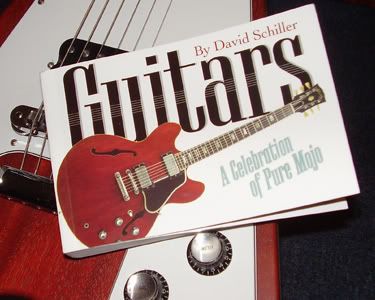
Book Review: "GUITARS - A Celebration of Pure Mojo" by David Schiller

Guitars - A Celebration of Pure Mojo by David Schiller(Workman Publishing, ISBN 978-0-7611-3800-6)
Now I've noticed that a number of the other Guitar Blogs have been reviewing this small tome, but here is my take on it. I've not read any of the other reviews so as not to be influenced.

Anyway, let's begin. This small but perfectly formed book is laid out in a landscape orientation, and the dimensions are postcard size by approx 3 cm thick (520 pages), so it's pocket-sized so long as you have reasonably large pockets.

Now, this book works on a couple of levels. You can, as is the traditional way, start at the beginning and read right through to the end, or - if you are like me - you can dip in and out at various pages at random. The book is absolutely full of full colour pictures of guitars, all beautifully photographed, so it'll even appeal to the lazy amongst you who can't be bothered to read the text, but to do so would be doing the book a disservice as the text is well thought out and informative.

If you are a regular reader of my blog or one or more of the other guitar blogs listed on my blog-roll, then you will love this book as it essentially covers much of the same ground featuring classic guitars, vintage guitars, weird guitars, bizarre guitars, wonderful guitars, etc. Possibly the more rabid shredders may think there are too many acoustics featured, but to get it in perspective the acoustic guitar does have a lot more history than the electric. And anyway, it's all interesting stuff. You may not be into baroque, classical or jazz guitar, but it's all part of the bigger picture, so any prejudices need to be forgotten.

Without wanting to sound arrogant, I thought I was quite well up on all things guitar and had more or less seen it all, but there were plenty of instruments featured in here that were new to me such as the Vivi-Tone electric guitar from 1933, Gibson's sheet metal experimental electric guitar from 1935, the Gretsch Rumba round-bodied acoustic from 1933 (made to appeal to banjo players), among others.

There's plenty in here to fascinate: I particularly like the Stroh guitar with a megaphone horn in place of its body, and the various different styles of harp guitar which never fail to captivate my interest. Willie Nelson's legendary guitar "Trigger" is also a sight to behold!

My only gripe with the book is that some photos are printed over two facing pages - which may look great in the galleys when proofing the book in the production stages - but seeing as the finished book is perfect-bound and about an inch and a quarter thick, you cannot lay the pages flat to view these pictures properly. Not without destroying the book in the process. A whole area in the middle gets lost in the inner curvature of the pages. For example, what would have been a very attractive picture of a 1968 vintage paisley Fender Telecaster (pp. 344-345) is spoilt in this manner.

But that's a minor complaint. This is a perfect book for anyone who loves guitars. I can't praise it any more than that.

One other point, and this isn't a complaint, but merely an observation: there are no bass guitars featured. Could this mean another bass-specific volume will be forthcoming? (I hope so!)

On a final note, I must add that the book comes with the warning that the book may cause G.A.S. (Guitar Acquisition Syndrome). I think I was afflicted before anyway, so I can't blame David Schiller, or Workman Publishing of New York for that.

LinkWithin

Related Posts with Thumbnails

ShareThis