guitarz.blogspot.com:
Way before this modern age of MP3s and digital downloads, before CDs even, we listened to music on records or "vinyl" as it is called now. I remember back in the late 1970s following the advent of punk rock and new wave, the music was much spikier and the records themselves were often pressed in various shades of coloured vinyl rather than the usual black. I recall in the music press there was a big noise when it was announced that the new Generation X single, "Valley of the Dolls", was to be issued in multicoloured vinyl. Of course when the record came out, the colour was a sludgy swirl of brown. As any kid that has played with Plasticine modelling clay could have told us, if you mix a whole bunch of colours together you end up with brown with little swirls of colour in it.
Which is a very roundabout way of saying that I think that may the same thing must have happened with this plastic Maccaferri TV Pal guitar. It was probably intended to be multi-coloured but ended up a brown swirly mess.
Mario Maccaferri was, of course, best known for the Selmer gypsy jazz guitar he designed. He also had a career in the production of plastic consumer goods. Believing that plastic had a previously untapped potential he produced the world's first plastic stringed instrument, the Islander plastic ukulele in 1948. By 1953 he had branched out into the production of plastic guitars. These were not intended solely as novelty items; they were supposed to be serious highly functional instruments. The TV Pal model was one of the round-hole designs which also included the Islander and Romancer guitars, but possibly the Maccaferri plastic gypsy jazz guitar with cutaway and f-holes is better known.
This Macaferri TV Pal is currently listed on eBay with a Buy It Now price of $195.
G L Wilson
© 2011, Guitarz - The Original Guitar Blog - now in its 10th year!
Showing posts with label Maccaferri. Show all posts
Sunday, 2 October 2011
Sunday, 14 February 2010
Seeing as it's (St) Valentine's Day...
guitarz.blogspot.com:
Anyone who knows me will know how cynical I am about days like these - "Valentines Day" (sic) - which are a modern media-controlled corruption of an old folk tradition. Saint Valentine's Day (to give it its correct title) used to be all about a sending anonymous cards and gifts to someone that you secretly admired, but now it's just another corporate extolled greed-fest, the sole aim of which is to spend spend spend to show your loved one that you really can be romantic at least one day out of 365.
Sorry, I went off onto a bit of a rant there.
But, despite such cynicism, the above guitar is too good to miss out on, because today of all days it is topical. It's another of Maccaferri's wonderful plastic guitars, this model being called The Romancer. These guitars were originally produced in 1953 and - despite their toy-like appearance - were intended as serious highly-functional instruments. I expect that with this particular model you were encouraged to serenade your loved one, as depicted in the images on its top.
Anyone who knows me will know how cynical I am about days like these - "Valentines Day" (sic) - which are a modern media-controlled corruption of an old folk tradition. Saint Valentine's Day (to give it its correct title) used to be all about a sending anonymous cards and gifts to someone that you secretly admired, but now it's just another corporate extolled greed-fest, the sole aim of which is to spend spend spend to show your loved one that you really can be romantic at least one day out of 365.Sorry, I went off onto a bit of a rant there.
But, despite such cynicism, the above guitar is too good to miss out on, because today of all days it is topical. It's another of Maccaferri's wonderful plastic guitars, this model being called The Romancer. These guitars were originally produced in 1953 and - despite their toy-like appearance - were intended as serious highly-functional instruments. I expect that with this particular model you were encouraged to serenade your loved one, as depicted in the images on its top.
Read more about Macceferri's plastic guitars and ukuleles here.
G L Wilson
NB: Please make sure you are reading this Guitarz post at guitarz.blogspot.com and not on a Scraper blog that copies posts without permission (and steals bandwidth) so as to profit from advertising. Please support original bloggers!
Friday, 16 January 2009
1950s Plastic Maccaferri Guitar
Let's leave the NAMM coverage to all the other blogs. I'm going to continue featuring the weird and wonderful here!
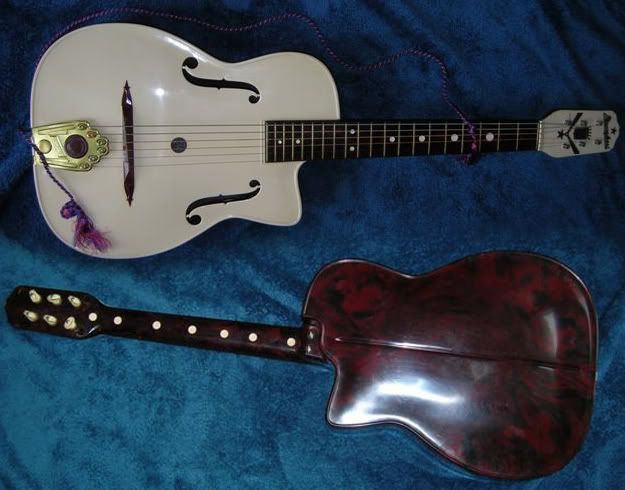
This Maccaferri plastic guitar is an early example of a guitar manufactured from alternative materials. I like how the dot markers on the fingerboard seem to go right through the neck and can be seen on the reverse.
According to the listing:

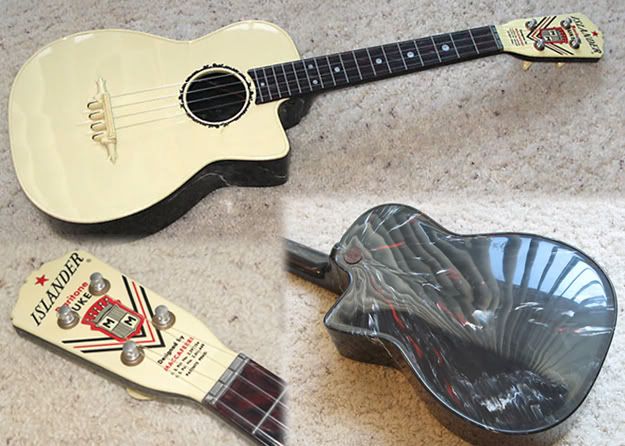
I particularly love the coloured plastic swirl on the reverse of this plastic Maccaferri Islander Baritone Ukulele.

According to the listing:
"Mario Maccaferri, a former concert guitarist and French reed maker, immigrated to the United States in 1939. While he continued his reed making in the United States, difficulty obtaining the reed itself led him to devise reeds made from plastic, a material that caught his attention at the New York World’s Fair in 1939. He filed a patent application for the novel reeds in 1941, and it was awarded the following year. Maccaferri soon began producing other plastic consumer products, including clothespins, hangers, plastic tiles, acoustic tiles, and later 8-track and cassette housings. Before the war, Maccaferri had designed a guitar for Selmer, Paris, which became famous as the guitar of choice for jazz artist Django Reinhardt. In 1949, Maccaferri combined his interests in musical instrument design with his expertise in plastic to produce the Islander Ukulele, the first plastic stringed instrument. Priced at an affordable $5.95, the instruments were highly commercially successful. In 1953, Maccaferri introduced his plastic guitars, which were not meant to be a cheap substitute for a wood guitar, but rather a highly functional instrument that happened to be constructed from plastic. In 1964, the name of the company was changed from French American Reeds Manufacturing Company to Mastro Plastics Corporation. By 1969, criticism and slow sales caused Maccaferri to cease production of his plastic instruments, the rights to which were sold to Carnival Industries, which never elected to manufacture the instruments. Following his retirement in 1981, Maccaferri continued pursuing his interest in plastic instruments with the development of a plastic violin, which premiered at Carnegie Hall in 1990. Maccaferri died three years later at the age of 92."
...and there's a Plastic Uke too!

Subscribe to:
Posts (Atom)