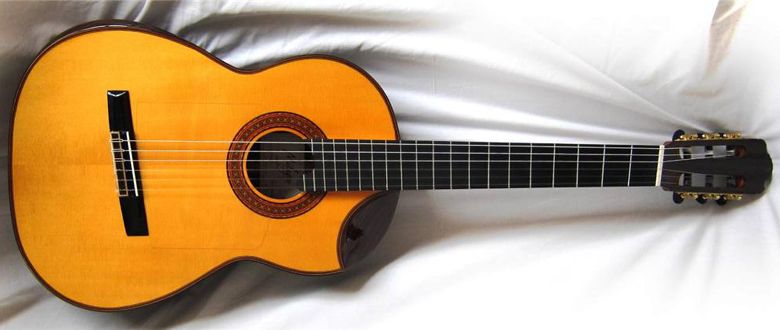
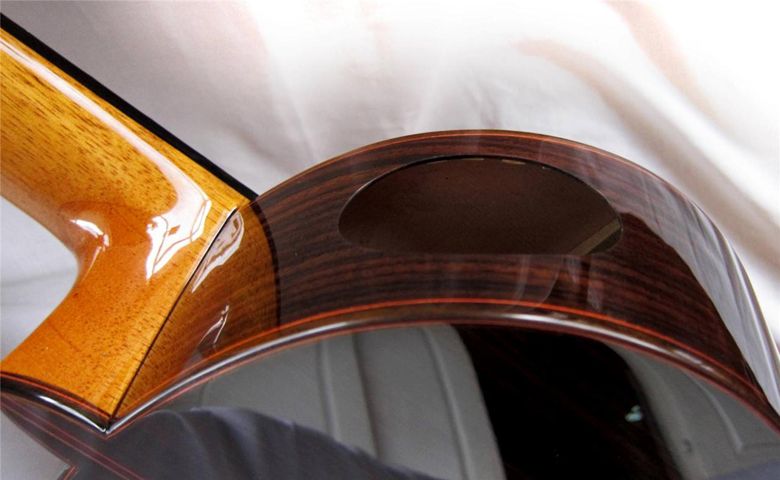
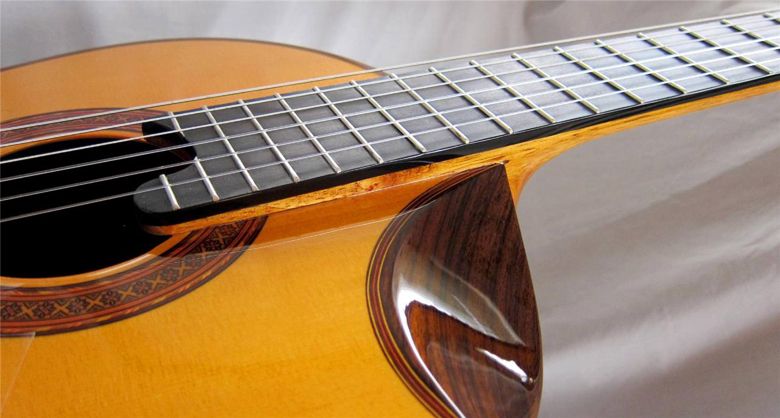
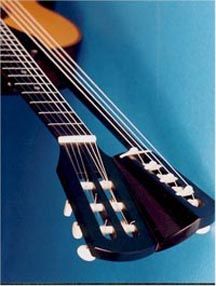
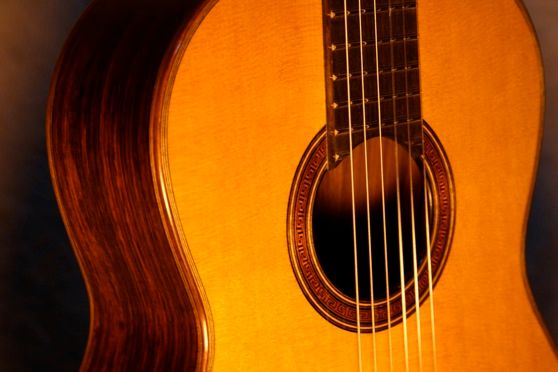
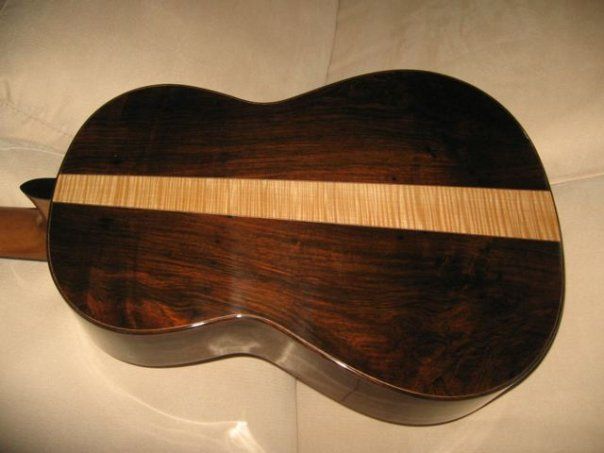
This Milagro concert series JP+ Negra flamenco guitar by Neris Gonzalez features a solid German Spruce top, solid Indian Rosewood back and sides, Ebony elevated fretboard, Spanish Cedar neck with carbon fibre reinforcements, Savarez strings, a sound port in the upper rim, built-in arm rest, an ergonomic cutaway to allow easier access to the higher frets but without compromising the size and shape of the body, lattice bracing, golden tuning machines, bone nut and saddle, 650-660mm scale, and fanned frets.
It's good to see a traditional instrument like this emrace modern innovations of luthiery.
Currently listed on eBay with a Buy It Now price of US $3,450. Hard case included!
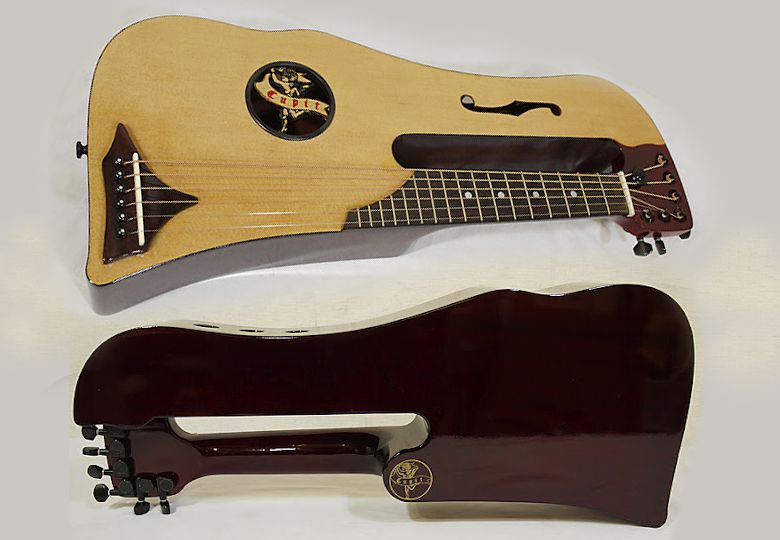
Travel guitars, particularly the acoustic variety, are all too often a compromise with sound being sacrificed for portability. The Cupit travel guitar has a length of 22.5" (which makes what? A scale length of 18 or 19 inches? That's positively ukulele territory!) but manages to produce a full rich sound. As the website explains:
This guitar's patented revolutionary unique design joins the end of the neck to the body creating an all around brace removing the need for a truss rod. The three sound holes in the top side create a better listening perspective for the player. The round hole and F hole help to distribute the tones equally along the front of the instrument.
I guess that volume-wise (I'm talking litres rather than decibels) the body is of similar size - although a very different shape - to that of a regular classical guitar. The video below gives a good indication of how good it sounds/.
The Cupit travel guitar has a list price of $499.99, but according to the website it appears to currently have a sale price of $349.99. Just one last comment: that name "Cupit"... judging by the logo it looks as if someone couldn't spell "Cupid".
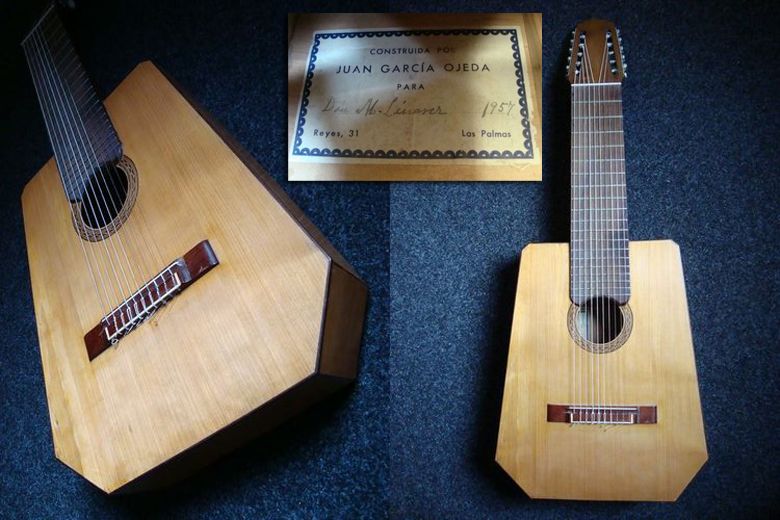
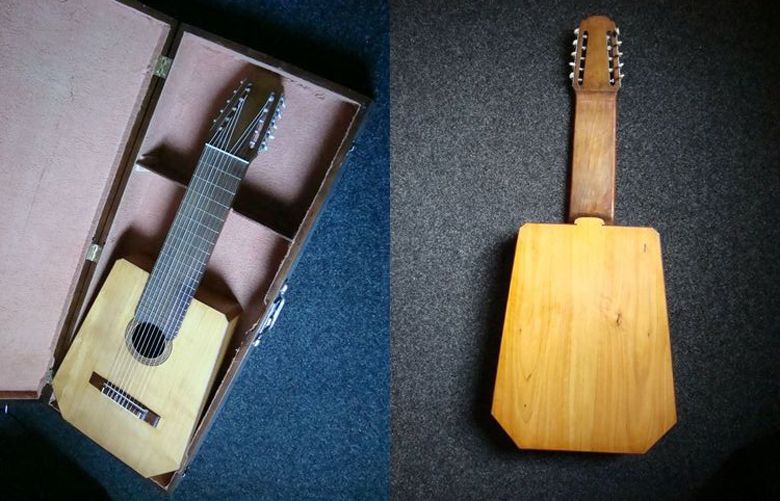
I do hope that this 10-string classical guitar does not sound as boxy as it looks. According to the information on the label inside the soundhole it was built by Juan Garcia Ojeda in Las Palmas Spain in 1957. I have to wonder if perhaps he was an apprentice luthier at the time because the construction methods with the straight-edged sides and the flat neck profile make for a much simpler design than the classically-shaped classical guitar. It looks like something inspired by the Cubism art movement of the early 20th Century. I wonder also how well this shape would work for a seated classical guitarist.
10-string classical guitars can be considered as a form of harp guitar, in that despite all 10-strings being on the same fully-fretted neck, the additional four strings are sub basses and intended to be played as open strings rather and are not fretted with the left hand. I'm not saying that this isn't possible with the correct tuning and piece of music, but that music written for 10-string classical guitar has always dictated that the sub-basses are played open.
This guitar is currently being offered for sale on eBay UK with a Buy It Now price of £550.
The 7-string guitar has in recent years gained much popularity but I hope that most Guitarz readers will appreciate that the instrument was not a creation of the new metal movement, nor was it invented by Steve Vai or Alex Gregory. The first electric seven-stringer was probably a Gretsch hollowbody made for jazz guitarist George Van Eps in the late 1960s, although he had been playing acoustic 7-string jazz guitar since the late 1930s when he used a custom-made Epiphone.
But 7-string guitars were around long before this. Both Russian and Brazilian music had developed 7-string guitars as part of their culture. The Russian 7-string dates to beginning of the 19th century and utilised an open G tuning (DGBDGbd). It was said to have been invented by Russian guitarist and composer Andrei Sychra who wrote a method for the 7-sting guitar and a whole wealth of compositions for the instrument.
In Brazil the 7-string guitar was introduced in the early 20th century as an accompaniment instrument in choro and samba music. It is traditionally tuned as a standard 6-string with the addition of a low C string, although some guitarists took this down to a (more logical perhaps) low B.
In 18th century Europe, the baroque guitar evolved from an instrument with 5 courses to one with 6 courses - initially the courses were paired strings but later the consensus of popularity favoured single strings as is common today - so it was perfectly natural that someone would take this a stage further and add a 7th course (or string). Those advocating the 7-string guitar included French guitarist Napoleon Coste (1805–1883) who composed specifically for the instrument, and the Italian guitarist Mario Maccaferri (born 1900) who used additional unfretted bass strings (known as diapasons or bourdons) on his guitars.
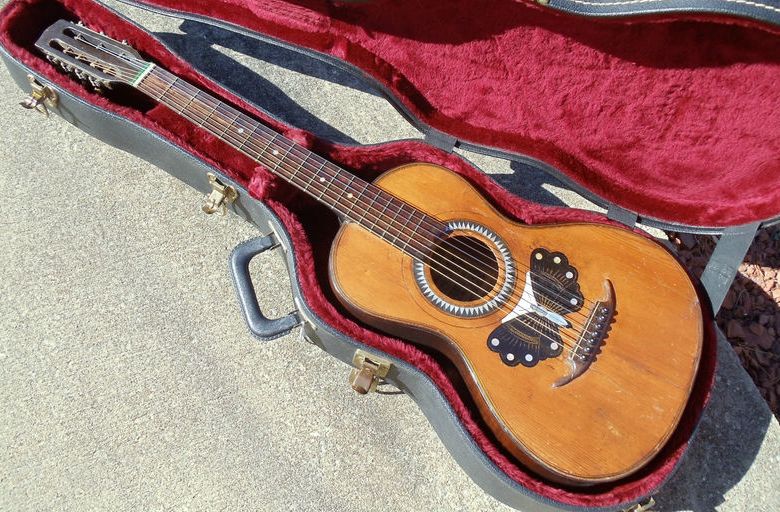
The above pictured guitar is an Italian 7-string by Ermelinda Silvestri and dates to the mid 1890s. In keeping with most of Silvestri's instruments it bears the butterfly inlay which was a trademark of sorts. The seventh string seems to be very close to the edge of the fingerboard, which suggests that it wasn't intended to be fretted and would have been a diapason (or bourdon if you prefer).
This repaired but still playable antique 7-string guitar is currently listed on eBay with a Buy It Now price of $1,450.
The Guitarz blog is supposed to cover all kinds of guitars, but there are certain guitars that I don't blog about very frequently simply because I don't know a lot about them. These include resonators, lap-steels, pedal steels, antique guitars, and classical guitars.
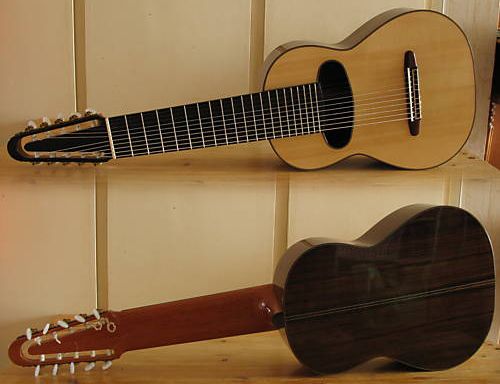
Here we see a classical 10-string by French luthier Gérard Audirac, currently being offered for sale on eBay with a Buy It Now price of $7,350. This model is known as the Cathedrale and is known for its powerful projection, rich tone and long sustain. As you can see from the photos, this is quite a contemporary design with its distinctive headstock and elongated soundhole, which is positively conservative compared with the soundholes on Audirac's Conservatoire double bouche model.
For those wanting more information, there's an interview with Gérard Audirac here, and for French-speakers, the first installment of an interview on YouTube here.
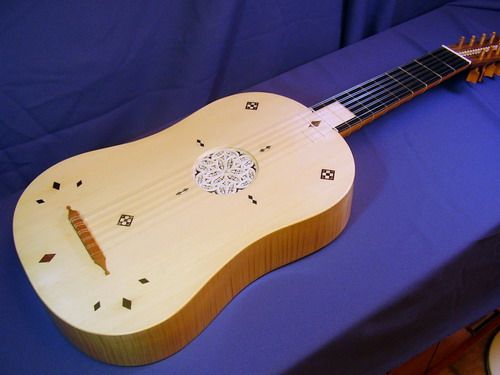
Our instrument has a long history. Dating all the way back to 1400s when an instrument called the Vihuela flourished in Spain. Vihuela featured six courses of strings - a course being a pair of strings tuned to the same pitch in this case. Much like today's guitars, the tuning was fourths and one third. In today's terms, Vihuela tuning would be E A D F# B E.
Interestingly, vihuela was really a family of instruments: they came in all sizes. There are only three original Vihuelas in existence today, and each is slightly different in scale length and pitch. Some would even be considered bass-like. There was also a four course guitar that flourished in France during the Renaissance.
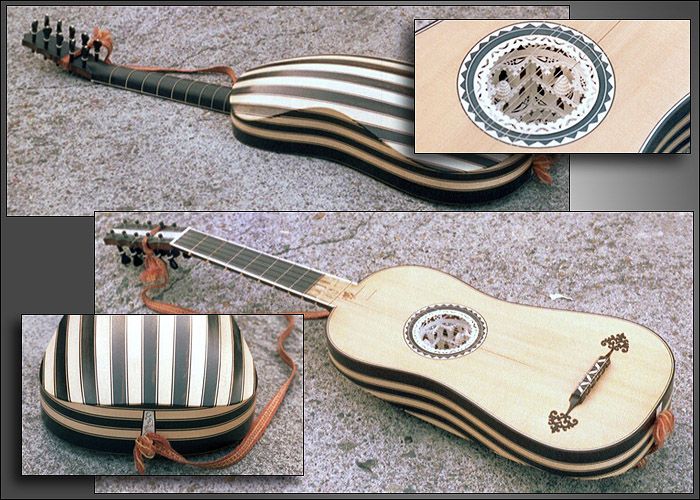
The Baroque guitar (around 1600-1800) flourished in many European countries. These guitars are as much works of art as they are instruments. They featured extensive ornamentation and inlays.
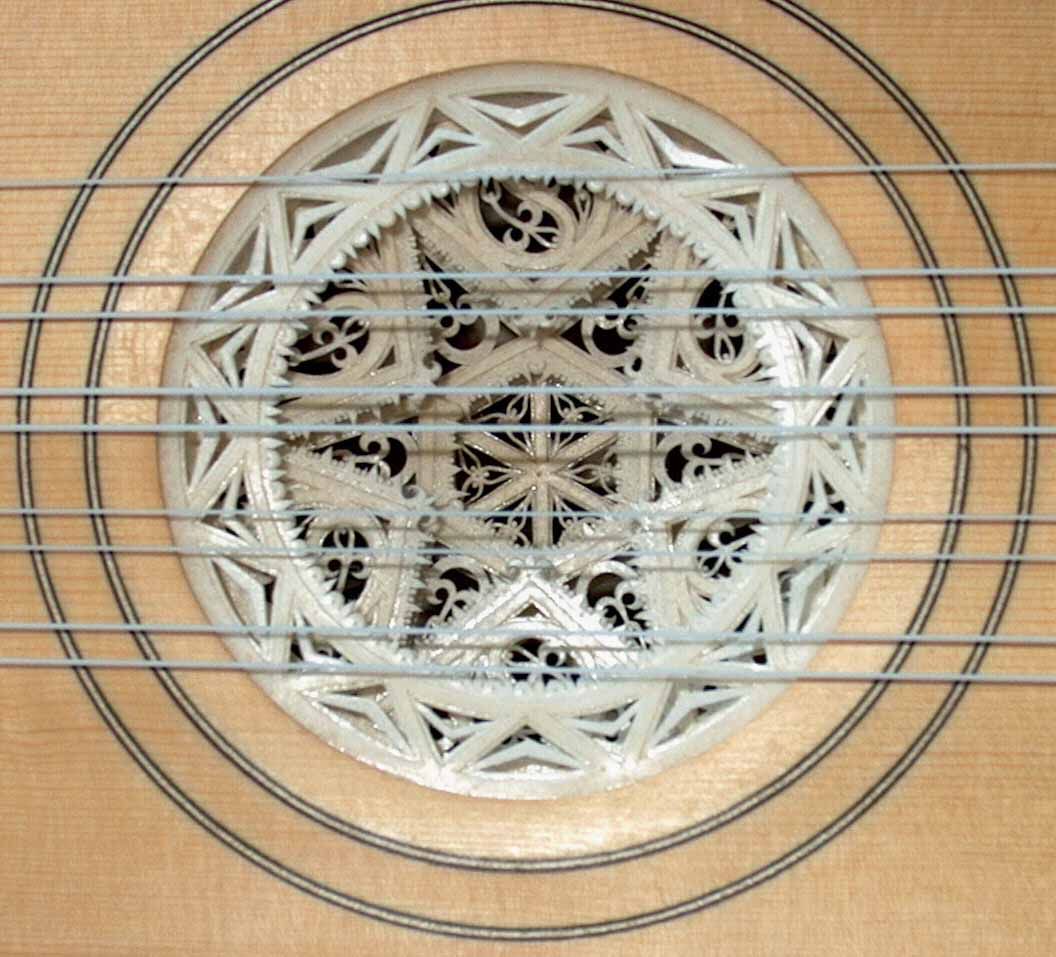
And elaborate rosettes that filled the sound hole.
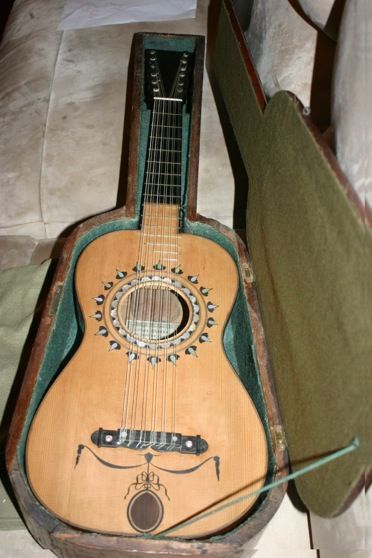
Around 1800 guitar builders gradually added a sixth course, and went to single strings. Check out this instrument, a six course guitar built around 1800.
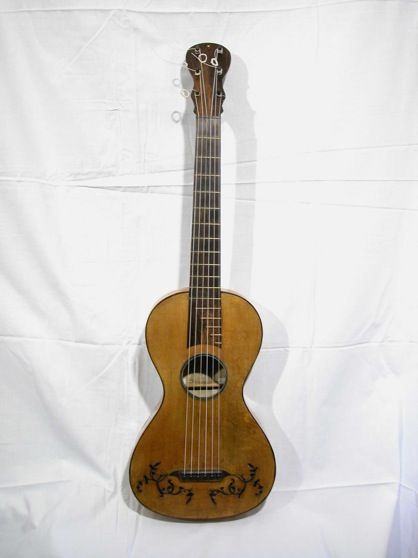
And this one built just a few years later.
Like guitarists today, guitarists in the later 1800s explored guitars with more than six strings. Composer/Guitarist Johann Kaspar Mertz played on a ten-string instrument similar to the modern harp guitar.
Napoleon Coste also added more strings and wrote music for this seven string guitar.
The ten-string guitar is still alive today thanks to the work of Narciso Yepes.
Classical, nylon-strung guitars today, however, are mostly pretty tame. And they're all descendents of the grand-daddy of the modern guitar, Antonio Torres. Torres built guitars in Spain during the late 19th century, and his instruments are the first that we consider modern. The bodies on his instruments were slightly bigger, and the braces on the underside of the top were arranged in a fan.
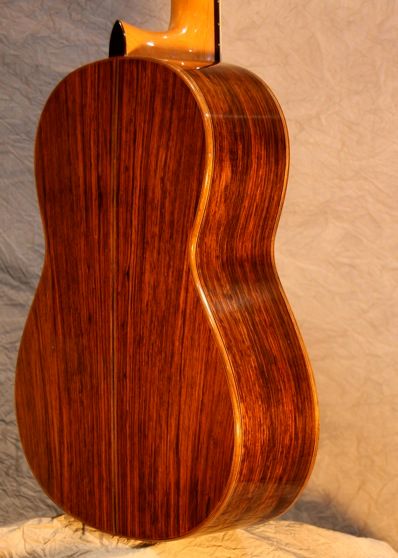
While electric guitars may feature gorgeous wood on the top, the back and sides of a classical guitar are often the most beautiful. Below is my guitar, built in 2009 by Michael Thames.
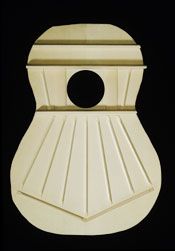
Most professional level classical guitars - called "concert guitars" - are custom shop jobs. They are built specifically for one person, and you choose a guitar builder based on the features you want. Some builders specialize is construction methods that are a bit unorthodox or strange. Check out the inside of this "lattice braced" guitar.
The tops on these guitars are extremely thin (you could puncture it with your finger), and that black stuff inside is carbon fiber. Another popular construction method today is a "double top". These guitars have a thin top, then a layer of honey-comb style material called Nomex, then another thin top is glued on the other side. Here builder John H. Dick shows off the inside of his guitar tops (towards the end).
There's a lot out there in the world of classical and nylon-strung guitars, and it's well worth exploring.
Christopher Davis
Guitarz - The Original Guitar Blog - now in its 9th year!
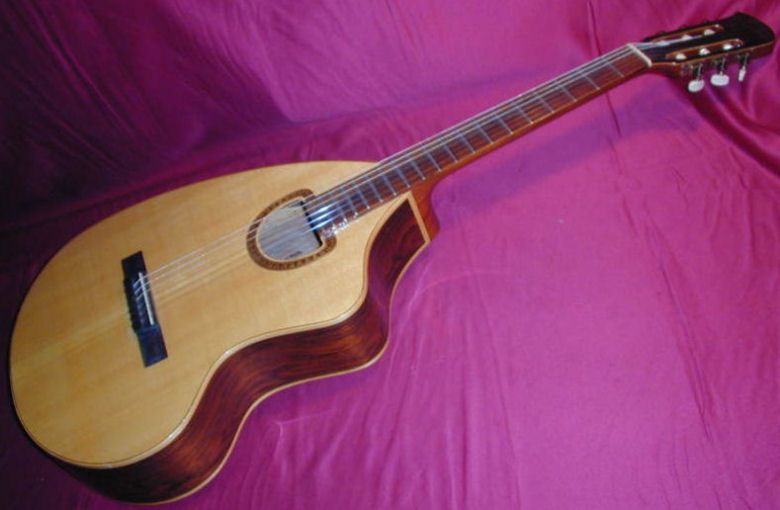
I love this design. It's practical and yet unusual at the same time. The asymmetrical semi-lute shape gives it a timeless appeal that is both modern and classical with a touch of the Bohemian all at the same time. The D-shaped soundhole also puts me in mind of the Maccaferri gypsy jazz guitar, although it is a reversed D here on the Giannini.
G L Wilson
NB: Please make sure you are reading this Guitarz post at guitarz.blogspot.com and not on a Scraper blog that copies posts without permission (and steals bandwidth) so as to profit from advertising. Please support original bloggers!
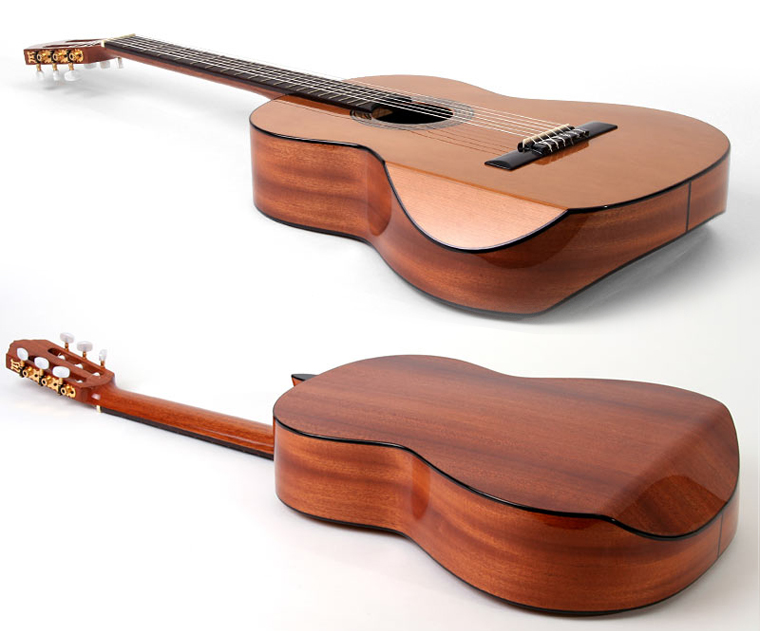
It's not necessary to say much, the picture of this Ergonomic Guitar Iberica 1C tells the obvious: you take the most regular classical guitar and bevel it a little bit where it's necessary and you have a much more conformable instrument.
Not only electric guitars deserve ergonomics improvement, and the traditional form is not obligatorily the better one!
NB: There are a lot of blogs STEALING content and bandwidth. If you read this anywhere else but on guitarz.blogspot.com then you are reading a blog that STEALS content. Please support original bloggers!
I very much doubt it's worth the fifty quid starting price, but I love stuff like this. This looks to me very like an old Classico brand guitar, just like the one I took lessons on when I was 11 (my sister still has mine at her house).
As to The Beano comic, well it was a British instituion. Absolutely fantastic! Don't accept any Dennis the Menace imposters with yellow hair, the real Dennis the Menace wore a red and black striped jersey, had black spiky hair and a dog called Gnasher.
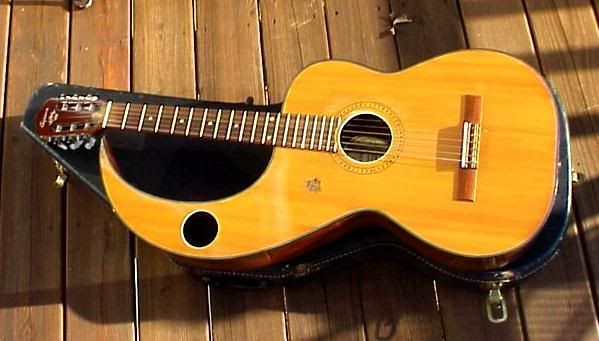
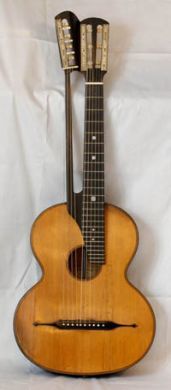
I think that most of you who commented were on the right lines when you answered "harp guitar", although I'm not sure if this Espana classical is technically a harp guitar as it doesn't have any extra strings.
I can only assume that the elongated body "wing" is there to give increased bass response.
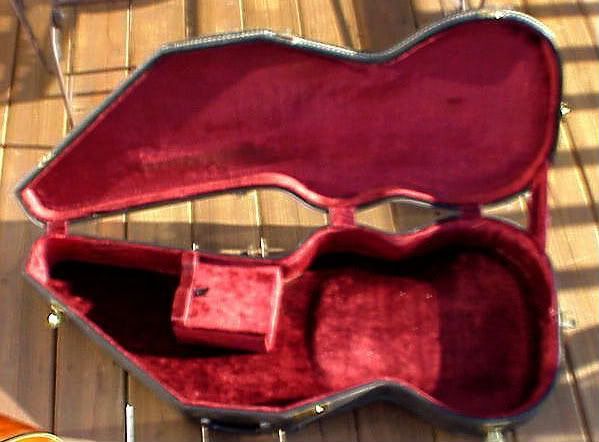
However, it's not as wild as this example which we looked at on this blog last June. Can you imagine what the case would have looked like for that guitar?
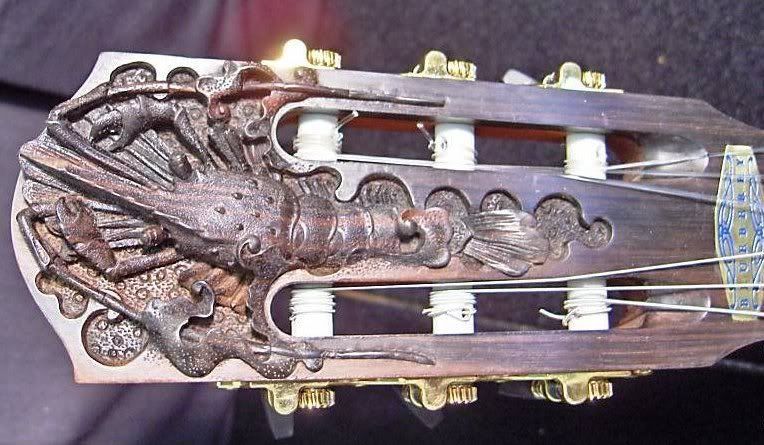
For some bizarre reason, possibly known only to the maker, this Blueberry Classical Guitar features intricate carvings on the back, sides, and headstock of lobsters of all things! It makes for a rather surreal guitar. Is it supposed to appeal to fishermen, I wonder, or just the casual lobster fanatic?
* From the poem:
Lobster
Libster Lobster Labster Lee, Living in The deep blue sea.
Libster Lobster Where are you? Gone to lunch ( - Back at two).





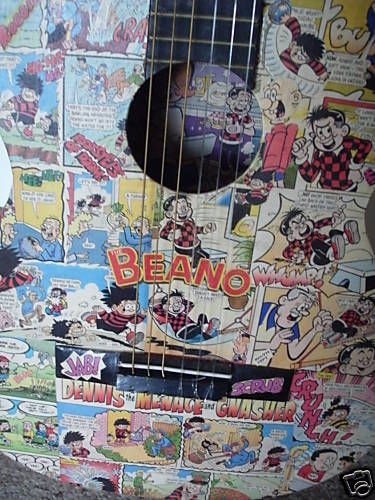 I very much doubt it's worth the fifty quid starting price, but I love stuff like this.