Showing posts with label vintage guitars. Show all posts

Tuesday, 30 October 2018

Burns Weill RP2G Super Streamline bass guitar from 1959

guitarz.blogspot.com:

Here's an intriguing and supposedly quite rare bass guitar from Jim Burns and Henry Weill, the Burns Weill RP2G Super Streamline Bass. I suppose that back in 1959 it looked futuristic and space-age. Today it looks ... I don't know what. It's an ugly bass for sure but probably not as hideous looking as those ghastly singlecut jobbies with the bass-side bout extending half way up the neck which seem to be unfathomably popular these days in bass playing circles. It's quite recognisably a design from the Burns stable, displaying future echoes of the Burns Flyte on the treble side of the body.


Here is what the eBay seller has to say about it:
Burns Weill RP2G bass
This is a very rare bass made in 1959 by Jim Burns and Henry Weill. The body, neck etc., were designed and made by Jim Burns and all the electrics and pickups within the scratchplate were designed and made by Henry Weill.
This particular bass came from the collection of Mark Griffiths - bass player for The Shadows.  It was sold in auction some time ago along with many other guitars and basses owned by Mark Griffiths. I did not manage to buy it then but a while ago I contacted the buyer and managed to purchase it.
It is totally original apart from the fact that it had been refinished in the past - possibly when Mark owned it.
It is a very rare bass regardless of previous owners and its actually the only one I have come across. It has two pickups with volume, tone and blend controls plus a pickup selector switch and two-way switch - all working well, and it is a very nice playing bass with a lovely neck, quite narrow but very playable with twenty-two frets with red dot markers and a scale of thirty inches.
Currently listed on eBay UK with a Buy It Now price of £950.

G L Wilson

© 2018, Guitarz - The Original Guitar Blog - the blog that goes all the way to 11!
Please read our photo and content policy.

Friday, 22 June 2018

Stunning Rare 1983 Burns Bandit Guitar

guitarz.blogspot.com:


Sorry that I've not been here lately. Life has been busy, and that's good, but it leaves me little time to find cool guitars to share here.

This Burns Bandit needed to be showcased.

We've looked at the bandit a long time ago here but I had forgotten that the pickups were controlled with push-button selectors. I only remember this concept on late 1980s Ibanez guitars.

This Bandit is in great shape and it's the perfect shade of green.

The only thing keeping this rare beauty out of my hands is the listed price of over $5000 Canadian

R.W. Haller

© 2018, Guitarz - The Original Guitar Blog - the blog that goes all the way to 11!
Please read our photo and content policy.

Tuesday, 5 June 2018

Gibson Grabber Bass copy by Melody

guitarz.blogspot.com:

If any of you still regularly tune into Guitarz these days, you may have noticed that when I'm not posting about piglet-shaped guitars, that more often than not my attention will be on basses. There's a good reason for this as some might call me a "born again bassist". But yes, this is where my main interest lies as the bass is what I like playing the best.

Now, moving on to the matter in hand, although we have looked at the Gibson Grabber bass before on this blog, what we have here is a cheaper copy which I'd imagine was contemporaneous to the Gibson Grabber itself, produced between 1973 to 1983. (I can't imagine that copies were being produced after the real deal had ceased production, but you never know). My feelings are that this particular example would have been produced in the latter end of that period, probably more towards the beginning of the 1980s. This gut feeling is mainly based on the headstock logo, a stylised letter "M" which does have a distinct 1980s vibe to it and which replaced the "Melody Guitars" italic script as seen on earlier examples.


Of course, the Grabber was famous for - and named after - its single sliding pickup, which admittedly doesn't have a lot of travel, and on this copy the sliding pickup is all present and correct and seems to be working properly. In the above two photographs we see the pickup in its forward and rear positions respectively.

The metal pickup cover does appear that someone may have painted it at some point, or else removed paint from the upper surface which is now bare metal whereas the sides show scrappy black paintwork. The pickguard itself seems to be made out of... well, I want to call it bakelite; it has all the appearance and texture of that very dense black proto-plastic as famously used for the manufacture of 1950s-style dial telephones.


Here's that Flying V style headstock with the 1980s-style "M" for Melody logo.


The bass is very heavy. The neck and fingerboard are Maple, and I suspect that the body is likewise. The neck is chunky and highly reminiscent of a baseball bat. Scale length is a un-Gibson-like 34", but the fact that they were playing around with several bolt-on neck designs during that whole period was another un-Gibson-like characteristic. Underneath the cover (often removed and thrown away) the bridge is a 2-saddle affair reminiscent of the Fender '51 Precision/Tele-bass style.


But of course, this isn't a Gibson, it's a Melody.

Melody were actually an Italian guitar manufacturer, and had affiliation with Eko guitars. For some history the company, I couldn't tell it any better than FetishGuitars.com, so pop on over there and have a little read up!


However, this is one of Melody's later range of guitars and basses when they moved away from original designs and got onto the whole copy guitar bandwagon, that era of instrument production often erroneously referred to as "lawsuit" guitars. It's also highly doubtful that this is an Italian-made Melody. It's much more likely this is a Melody branded instrument originating in Japan (Dare I say "Matsumoku"? I don't know, but I have seem that name bandied about on forums discussing Melody guitars). Identical guitars and basses from the same production line would also have been badged up with other brand names. Grabber basses such as this were also offered with Aria, Avon, Cimar, MIA and Eagle branding.


I'm lucky to have been given this bass by a friend, a dealer who got it as part of a job-lot of guitars he was buying. It needs some cleaning and some TLC. The action isn't too horrendous and hopefully it can be tweaked to make it more playable. The pickup seems to work fine but I had trouble differentiating between the tone of the pickup in its different positions; admittedly I haven't trialled the bass properly through my gigging bass rig yet, I merely used a practice amp to check it was working. Pots are scratchy, but you'd expect that on an old instrument like this. The E-tuner is a bit dodgy too. If this bass looks like a keeper, I'll consider swapping the machine heads for something more modern and more reliable. (Note also, by the way, the different size screw-head on the rear of the tuners in the above photo. Looks like some tinkering has taken place).


And of course, the finish could be cleaned up as well, which shouldn't be too great a problem.

All in all, a very interesting piece, and very nice for a freebie.

G L Wilson

© 2018, Guitarz - The Original Guitar Blog - the blog that goes all the way to 11!
Please read our photo and content policy.

Tuesday, 1 May 2018

Hoyer shortscale bass, a genuine relic from the late 1960s/1970s

guitarz.blogspot.com:


Ah, damn! I think I would have bid on this eBay UK listing for a vintage Hoyer solidbody shortscale bass had I seen the auction in time. It's a German-made instrument with one of those laminated necks which seemed to be popular on lower priced instruments of that era, and with a nice P-Bass meets Telecaster vibe going on too.

The seller listed this with a starting price of £100 and it eventually sold for £180

G L Wilson

© 2018, Guitarz - The Original Guitar Blog - the blog that goes all the way to 11!
Please read our photo and content policy.

Tuesday, 24 April 2018

Hamilton Custom Guitars: another example

guitarz.blogspot.com:

There has been a lot of interest in this 2013 post about this Hamilton Custom Guitar. Mark Natola contacted us to say that he is a Hamilton owner too, having recently bought a beaten-up example via Craig's List.

Mark has very kindly emailed the several photos of his Hamilton Custom Guitar that you see here. He tells us that:
...the head stock was broken when I bought it. In addition, the fret board was splitting away from the neck and the pick guard was broken in several places. Other than that, it was in fine shape, 😊.

I brought it to a luthier who removed the fret board, cleaned up the neck, glued the fret board back on and replaced the frets. He repaired the head stock based on the “Made for Raymond” photo posted on the blog. In the mean time, I had a new pick guard made based on the metal shielding found below the original pick guard. We decided to stick with the original pickup and pots as they could not be replaced. I took the bridge apart and soaked and scrubbed the chrome parts with naval jelly. They cleaned up very well. The tuning keys were also soaked and cleaned in the same manner. Finally, I made a conscious decision to keep the original laquer finish, which is checked from age. Consequently, when the head stock was repaired it was necessary to stain it using a stain similar to the body color. My guitar had a “Made for Corinne” signature, however part of the name was missing due to the damage to the headstock. We decided to remove that and leave the Hamilton Custom intact.

I have now seen several guitars and it looks like there are subtle variations in the plate below the bridge. I can send more images later if you are interested.


Mark goes on add:
...it would seem as there are at least five of these floating around including mine.
  • There is "Made for Raymond".
  • Mine, formerly "Made for Corrine"
  • A white one I saw posted on Pintrest a while back, without an inscription as far as I can tell
  • One mentioned on this blog that was bought in Boston, with case and mid 60's sheet music
  • One mentioned in recent post by guy from Long Island whose father chromed the hardware.
Am I missing any?
I wonder if the white one on Pinterest is the same one as owned by the father of Thomas who commented on our original blog post?

If anyone else has any more information or photos of Hamilton Custom guitars, please contact us!

G L Wilson

© 2018, Guitarz - The Original Guitar Blog - the blog that goes all the way to 11!
Please read our photo and content policy.

Tuesday, 8 August 2017

Superb Bulgarian Vintage Orfeus Electric Guitar

guitarz.blogspot.com:


Luckily, I was able to save some pictures of this wonderful specimen before it was sold. This Orfeus checks a lot of boxes for me as it's odd, yellow, and has the kind of curves that could make a schoolboy blush.

R.W. Haller


© 2016, Guitarz - The Original Guitar Blog - the blog that goes all the way to 11!
Please read our photo and content policy.

Friday, 10 March 2017

Fasan Holiday Guitar from 1968 with incredible "finish"

guitarz.blogspot.com:


I love the look of this German made Fasan Holiday. There is nothing better than fake plastic trying its best to look like fake wood. In a fake news world this guitar should get all the headlines. The metal embossed pickguard, and a well aged tremolo only add to the character of this late 1960s beauty.

Currently listed for $500 Canadian

R.W. Haller


© 2016, Guitarz - The Original Guitar Blog - the blog that goes all the way to 11!
Please read our photo and content policy.

Monday, 6 June 2016

1979 MusicMan Sabre fretless bass guitar

guitarz.blogspot.com:

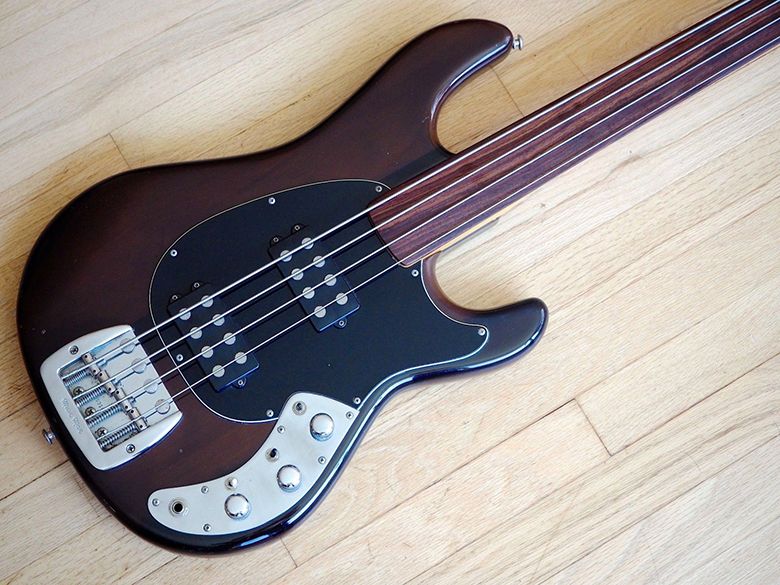
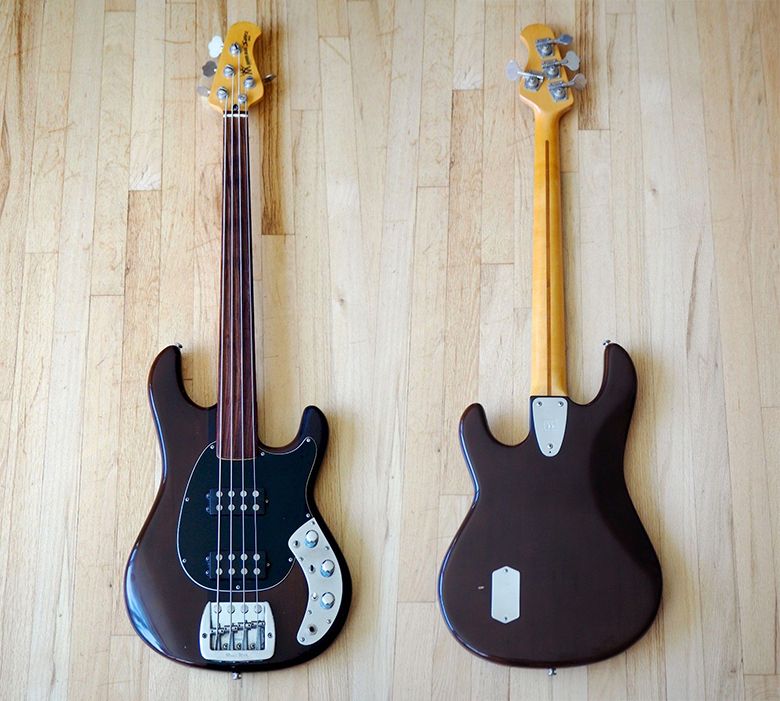
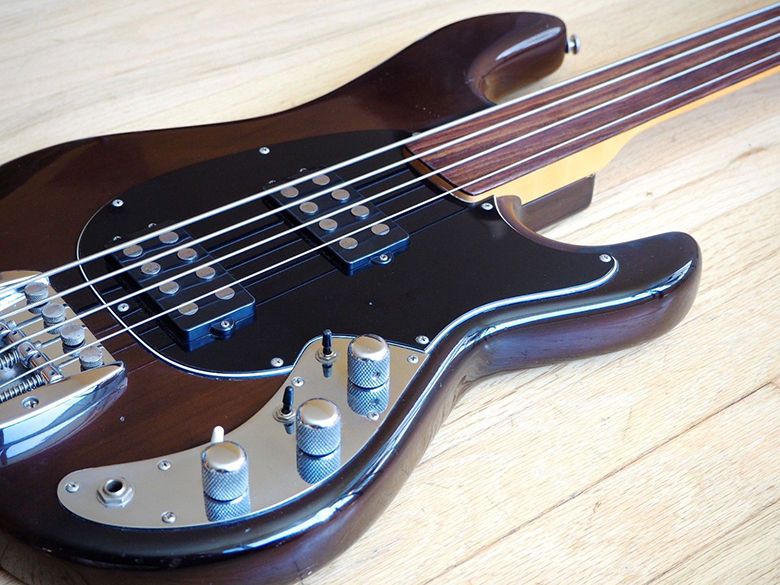
Here we see a beautiful example of the rarely seen, and some would say more aesthetically pleasing, sibling of the Stingray bass guitar, the MusicMan Sabre. This fretless example features two of MusicMan's own now legendary design pickups as opposed to the Stingray's single unit and also boasts its own unique preamp design, with Bass and Treble EQ knobs for both boost and cut, as well as a bright switch and a phase reversal switch, making for an incredibly versatile instrument. According to the seller's blurb, "the classic alder and maple tone wood combination [gives] this bass has a bell-like upper midrange and warm pleasing low end that translates well through the pickups, while the preamp allows you to dial in plenty of treble zing, or as much warm pillowy low end as you'd need, while also allowing you to dial back the bass for a tight, cutting, well defined sound."

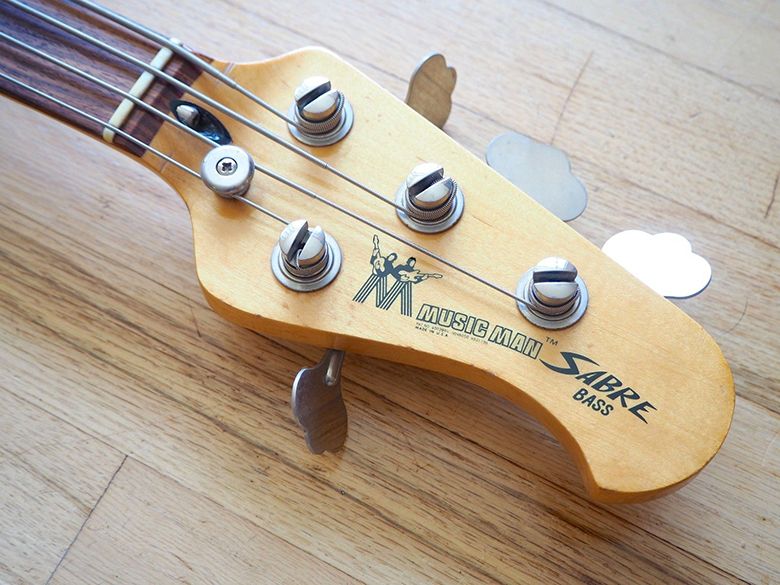
Dating from 1979 means that this bass probably pre-dates Ernie Ball's acquisition of the Music Man company which happened at around this time. Certainly the headstock does not have the Ernie Ball logo (see pics above). The Sabre would have been designed by Leo Fender and Forrest White, who also designed MusicMan's other early period instruments, and the Sabre bass itself was produced between 1978 and 1991, but apparently was not a big seller.

Currently listed on eBay with a Buy It Now price of US $2,299.99.

G L Wilson

© 2016, Guitarz - The Original Guitar Blog - the blog that goes all the way to 11!
Please read our photo and content policy.

Tuesday, 3 May 2016

Bizarro 1960s Kingston 12-string solidbody electric guitar

guitarz.blogspot.com:

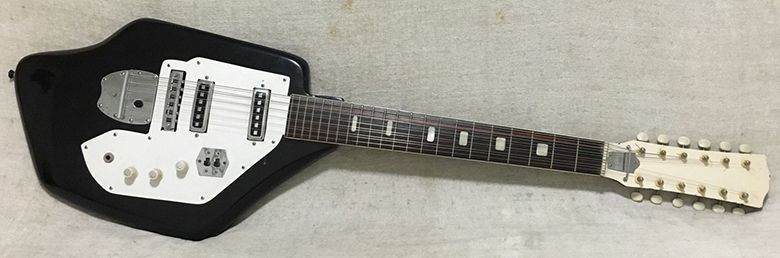
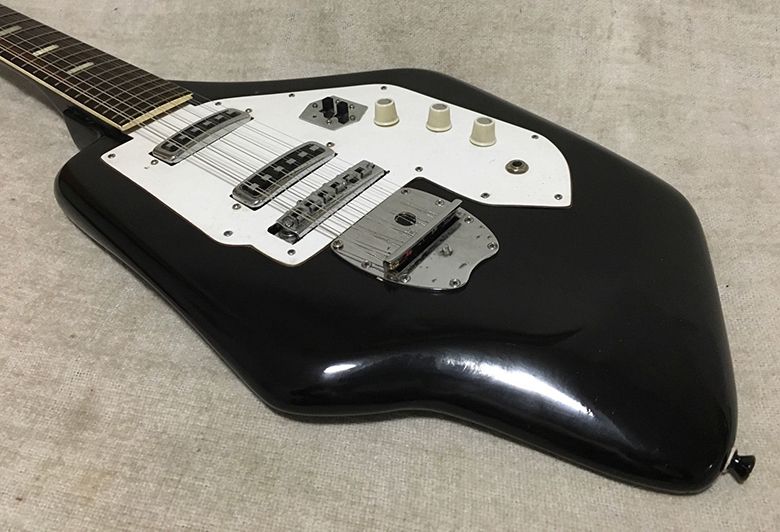
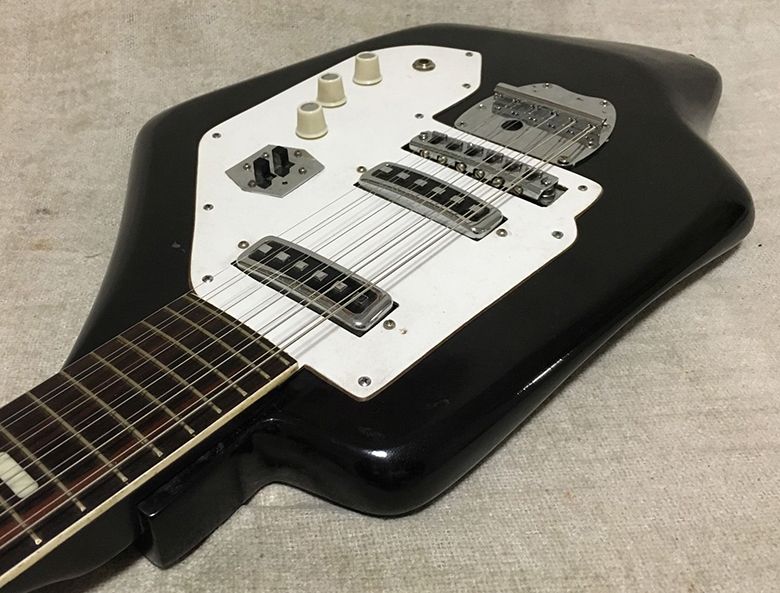
Here's a real oddity, a 1960s-era Kingston 12-string solidbody, of a peculiar design that I certainly have never seen before. It is a very odd shape. It may just be me, but I fancy that if it were finished in yellow rather than black it might resemeble a certain submersible that The Beatles made famous.

So, it's Japanese made by Kawai. What else do we know? Well here's what the eBay seller tells us:
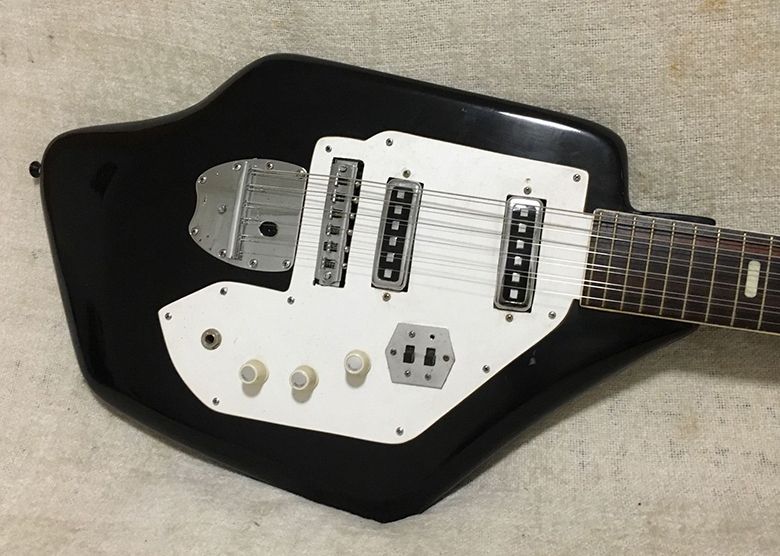
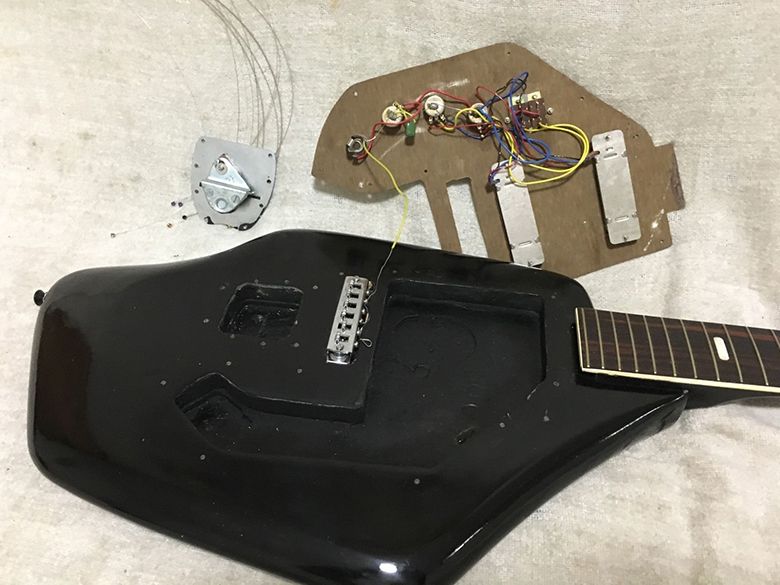
Electronics - All electronics are working including both pickups, on/off selector switch for each pickup, both volume controls and universal tone control have all checked out fine. All electronics look original and vintage. I have owned 100's of vintage MIJ guitars and this setup looks legit. The Pickguard is an interesting material however as it is not plastic. It looks like those faux wood pick guards used on Domino California Rebel guitars although the wood side is reversed. See pics.

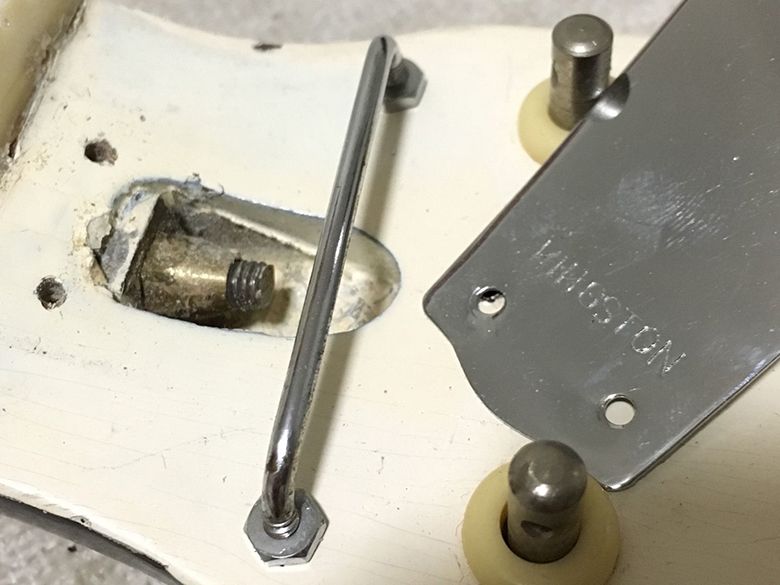
Body - Solid wood (not plywood). Finish may or may not be original. It looks like it may have been painted black although my guess is it was painted many years ago as finish has a vintage look. I believe the guitar may have been all white judging from the front of the neck headstock which looks original. There are some light areas around the edge of the headstock that have black paint. Back of neck is black finish as well and matches the body. The body pickguard holes and tremolo tailpiece dugout area look original and not modified in any way. The bridge area however looks like it was modified to be cut into the body and pickguard instead of "floating bridge" style or screwed into top of body. Tremolo tailpiece is typical of Kingston / Kawai guitars of this age and the routing area in body looks all original (I have a Kingston / Kawai S-160 listed at this time with this tremolo tailpiece if you'd like to compare these). This tailpiece is actually machined with 12 string holes (first time I've seen that on one of these tailpieces). The tremolo has been blocked off and does not include the arm stem or arm. A 12 string guitar can be problematic enough to keep in tune, never mind adding a tremolo to the mix!!! Yowza!

Neck - Neck has Gibson type "open book" lawsuit design. Tuners all match and are vintage and all work fine. Truss rod cover has KINGSTON on it. Neck needs attention as it starts straight but takes a dive where it meets the body.

The main issue with this guitar keeping it from being playable is the neck. The neck is the main problem. It starts straight all the way until 10th fret or so then dives down to body. It's not a typical forward or back bow. Also, the bridge being set down into the body (presumably to lower action?) makes the string angle wrong and the strings slip out.
Sad that the guitar has some issues and will most likely end up being a wall hanging rather than a player, but it's a fascinating pieve nonetheless.

Currently listed on eBay with a Buy It Now price of US$350.

G L Wilson

© 2016, Guitarz - The Original Guitar Blog - the blog that goes all the way to 11!
Please read our photo and content policy.

Monday, 25 April 2016

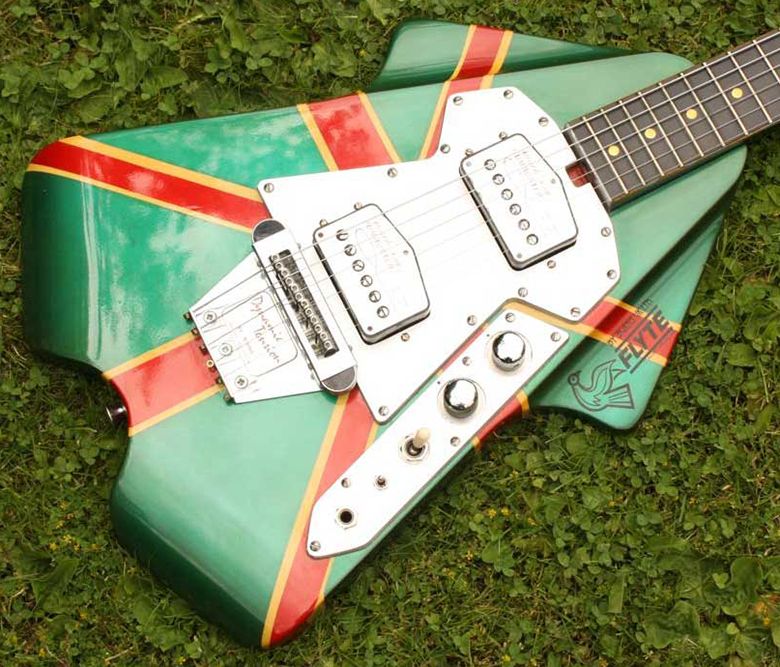
1977 Burns "Jubilee" Flyte with faded UK Union Flag finish

guitarz.blogspot.com:
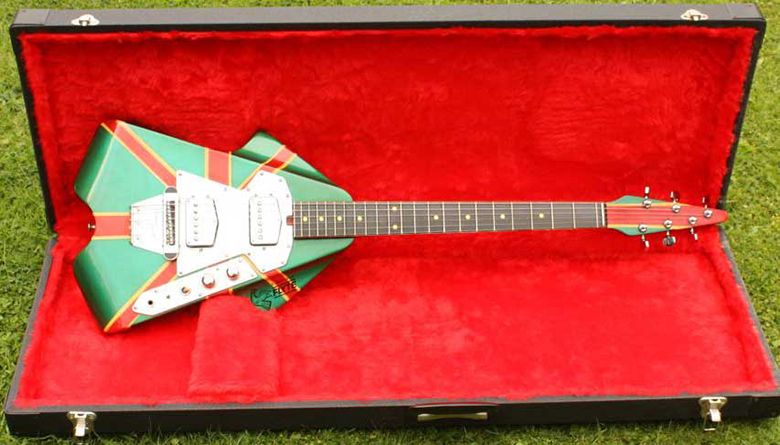
As I have mentioned many times in the past on this blog, I am a big fan of the Burns Flyte guitar, even though the only time I have actually seen one up close and personal was last year when my band was playing a psychedelic festival and Nick Saloman of The Bevis Frond, who were also playing, let me have a look at his.

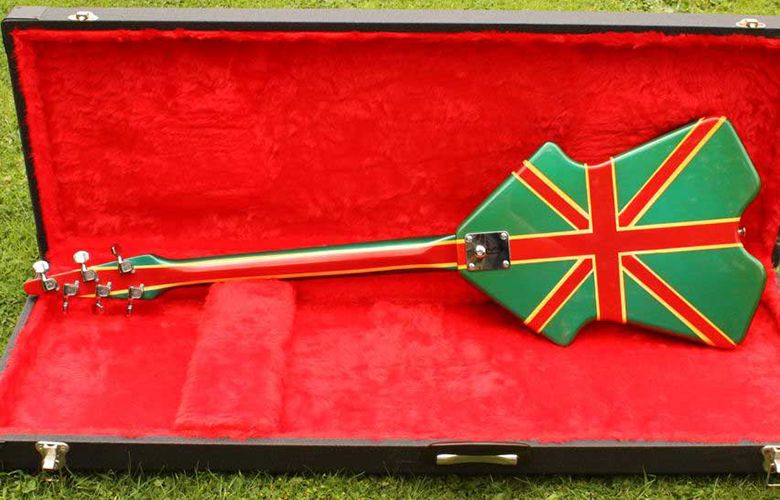
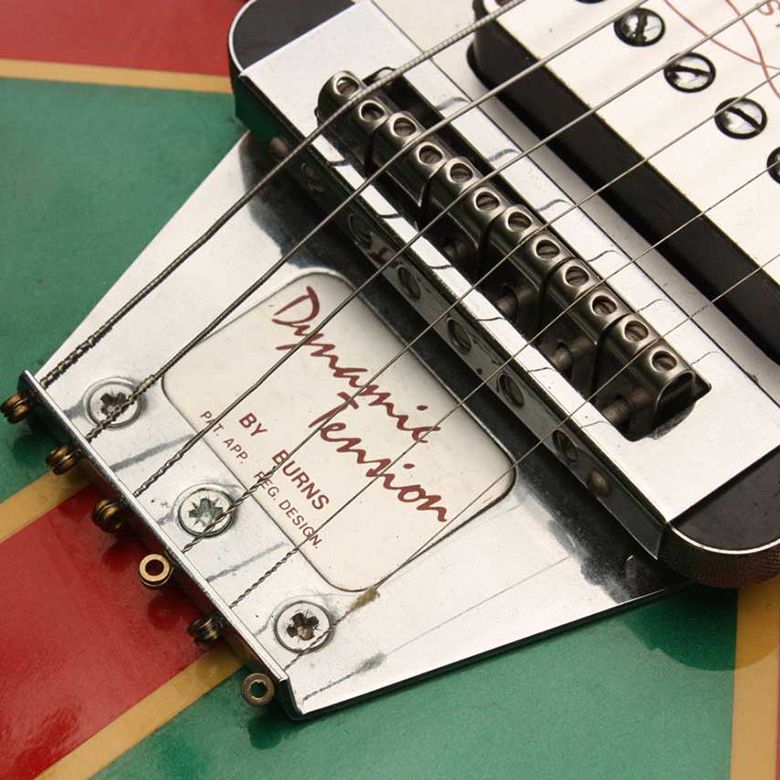
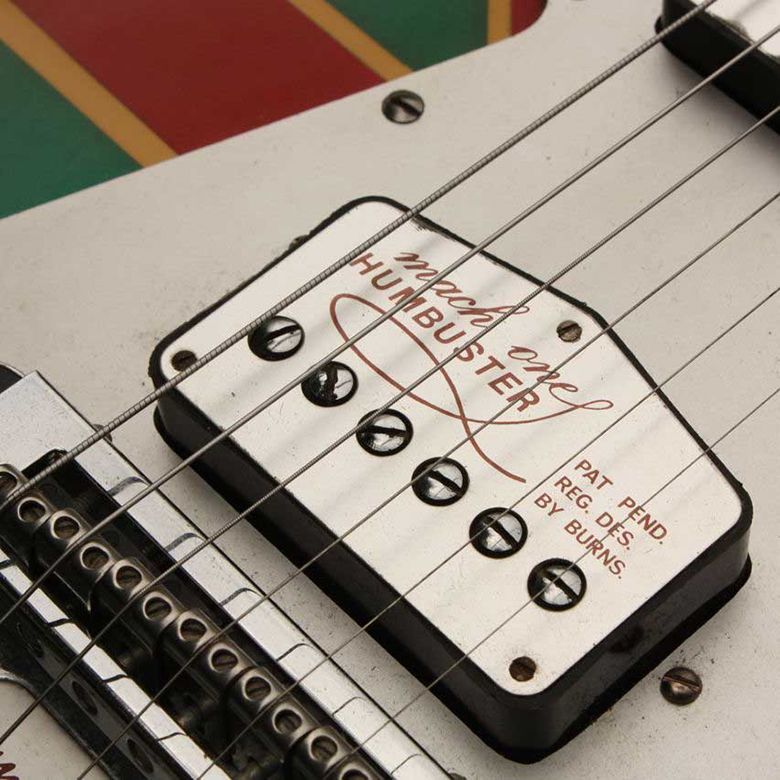
However, I'm not so sure about the patriotic finish on this "Jubilee" example from 1977. (1977 was the year of Queen Elizabeth II's Silver Jubilee, i.e. she'd been monarch for 25 years). Even though this is the original factory finish, the Union Flag - popularly known as the Union Jack but technically speaking it shouldn't be referred to as such unless flown from a ship - has been poorly rendered with very thin crosses and not enough of a pinwheel effect on the diagonals. It's made to look all the more bizarre by the process of ageing which has turned the blue background to green and the white to yellow - in fact when I first saw this I was trying to decide if it was supposed to be the Union Flag or not. If you didn't know it was supposed to represent the flag of the United Kingdom, then perhaps it'd be easier to think of it as an abstract design. Still don't think I'd like it.

Like it or not, it's still a very interesting piece. This particular example was being sold by Denmark Street Guitars in London but is marked "Out Of Stock" which implies that it has either been sold or else withdrawn from sale. Unfortunately this means I cannot give you a price or value. However, three years ago, a Burns Flyte with "supposedly" original rare red finish was being offered for sale in Germany with a price of €1444. My feeling is that this Jubilee edition would be more valuable. Burns experts please feel free to correct me!

G L Wilson

© 2016, Guitarz - The Original Guitar Blog - the blog that goes all the way to 11!
Please read our photo and content policy.

LinkWithin

Related Posts with Thumbnails

ShareThis