Showing posts with label Guitar Lessons. Show all posts

Tuesday, 30 November 2021

Playing by ear: Top tips

guitarz.blogspot.com:

Guest post by Alex Bruce

Learning to play by ear is a really important skill for guitarists. It furthers your understanding and knowledge of your instrument, prepares you a whole range of situations, and makes you a better, more rounded musician.

It isn’t necessarily an easy thing to do, however, it’s a skill you can actively cultivate and slowly but surely improve. If you practice the right things and get into good habits, your ear gets better and better.

Here are some top tips to make sure to set off - and continue - on the right kind of paths with this aural development. Good luck, and have fun!

Keep it simple

There is so much that you can deduce just by asking yourself “What do I actually hear?” And thinking critically about your response.

A note played in the 2nd string doesn’t sound exactly the same as the very same pitch on the 4th string, for example, the tone produced is quite different. Is this a high note, or a low note? Played hard or soft? is it the only note being played or one of several? How is it being played? Is there vibrato? Is there a bend or slide or legato technique present? Is the note sustained, or played staccato? The difficult thing with this stuff is figuring out which specific note or chord is being played - is it an A or a B for example?

But these questions above should be fairly simple to answer, at least after a few attempts and some practice.

So the first lesson here is to keep it simple! Assess the background information, as so much useful info is readily available

Chord types

It’s important to develop your ability to recognise whether a chord is major or minor, at first, then later whether it’s a major7, minor7 or ‘dominant’7. (Then much later, to more advanced chords too)

This is something that really helps you when figuring out chords in a progression by ear. Knowing whether a chord is major or minor is half the battle when doing this, and when combined with knowledge of what key the song is in, really narrows your options of what chords could possibly be in the chord pattern.

To get started with this, consider major chords as chords that sound upright, complete, happy, bright and resolved, and minor chords as ones that sound sadder, ‘lower’, still complete but more melancholic, melodic and less final.

Get together with a musician friend and take turns to test each other on this (and all the other elements of ear training) to make it a fun challenge.

Rhythm transcription

This is about cultivating the ability to determine, by ear, the rhythm of a riff or the rhythmic strumming pattern of a chord progression.

This is often the final piece when learning a song by ear - you may have figured out the chord pattern but the strumming eludes you. This is a very common situation, especially with complex instrumentations, or music where the guitar isn’t mixed front and centre and is therefore harder to hear with absolute clarity.

Practice this with as many songs as you can, and it’s also a good idea to learn basic rhythm notation, if you don’t already know it.

This means that you can practice rhythm transcription - i.e. Hearing a rhythm, then notating it roughly and briefly. By doing this, you make it something you can immediately play without repeated listens to remind yourself of the vibe. Simply consult your transcription!

Improvised soloing / backing tracks

This is a great tip, because it contains multiple benefits simultaneously. Besides being fantastic ear training, it also trains soloing, technique, improvisation, and is fun too!

Put on a backing track or a song and attempt to play over it. Ideally one which doesn’t reveal thekey it is in, as figuring this out is part of the process.

There are many ways to figure out the key, from rudimentary trial and error, to complex thought processes, and you’ll probably develop one that mixes various methods over time, as most guitarists do.

A really nice one is to find a note that works (as in fits / sounds good over the backing) then spread out from there. - What is the next note on that same string that works? - Go one string either side - which notes work nearby?

And so you spread out from there and within a minute or so you have a full position of a scale that you can solo with.

Jam!

As well as being a great way to work on your ear, this is also in essence one of the main applications of all of the above. This is about entering a real, lively, engaged, fun musical scenario, performing well and enjoying it, because you’re putting honed musicianship to good use.

Get together with friends who play and jam. Whether you have an originals band, or you play covers for fun, or you take turns soloing over each other playing rhythm parts, it doesn’t really matter. What matters is that jamming is a spontaneous and interactive process.

In the best jams, the musicians use their ears to ensure that they try to play things that fit with, respond to, or in some other interesting way relate to, what the other musicians are doing. This is a fantastic, fun way to put your musical ear to the test, apply your new knowledge, and keep growing on the path to becoming a better musician.

Alex Bruce writes for guitartricks.com which offers guitar lessons for beginners

Friday, 1 October 2021

Beginner Guitarists - 5 Things You Should Know

guitarz.blogspot.com:

Guest post by Alex Bruce

Image by Valéria Rodrigues Valéria from Pixabay

Hindsight is a wonderful thing, so the saying goes, and this seems objectively true in any walk of life. Learning is a beautiful, sometimes painful process, and there’s really no getting around it.

However, every intermediate or advanced guitarist can reel off a list of things they wish they’d known as beginner guitar players, quicker than you can say “Don’t-worry-the-finger-pain-goes-away-in-about-a-week”.

These aren’t ways to avoid the absolutely necessary processes of learning and practice (there’s really, really no getting around those) but they are little insights, and tricks, and shortcuts, and reassurances that should combine to help you progress faster and happier.

So, beginner guitarists, here are 5 things you really should know, embarking on your instrumental learning journey. And ironically, it could be argued that the 5 points also make pretty good general rules for life. Maybe that’s too deep for now though, so let’s talk guitar:

1 - Rapid Progress Is Around The Corner

Time after time teaching beginner guitarists, we see the same thing play out. It goes like this:
  • Beginner guitarist picks up the instrument
  • Finds it challenging (obviously)
  • Presumes they’re innately ‘not very good at it’ or it’s ‘too hard’
  • Stops playing.
There’s one crucial thing they’re failing to understand here, and it’s the difference between being bad at something, and being new to something.

So the question is - what should you compare yourself to? The answer might be yourself, five minutes ago. Or it might be other people who also only just picked up the instrument. But it certainly isn’t Jimi Hendrix, who - once upon a time, five minutes after picking up the instrument - had exactly the same ability as you have right now.

You are not bad at playing the guitar, and the guitar is not inherently too difficult. You are new to playing the guitar, and it takes a bit of time to make progress.

The good news, though, is that - with little-and-often practice - progress rapidly accelerates, especially at the beginning, where there’s so much space to progress into, and so much to learn.

Do not be deterred by something challenging being challenging. In some sense it’s a test of your commitment and resolve, a wall representing your desire to learn the instrument - beyond which is a world of creative expression and enjoyment. But never forget the difference between being bad at something, and being new to something.

2 - Your Body Will Adapt

The pain-in-the-fingers point in the introductory paragraph has already referenced this idea. Because again, another presumption beginners make all too easily is that playing guitar simply causes painful fingertips, or a sore wrist. 

The truth is - unless you have poor posture and technique - that playing guitar causes painful fingertips, for about a week. After which time this goes away and never returns. 

Your body will adapt. Your fingertips quickly develop calluses - very slightly firmer skin - and then that’s that, you’re all set. No pain, no problem. 

In some ways this is the same overall point as the first point: Don’t presume that how it is in the beginning is how it’s always going to be. It isn’t. Everything improves exponentially if you move beyond the initial obstacles and keep playing.

3 - Try Almost Everything

I mean this in two different ways:
  1. When learning your first riffs, chord patterns and songs, there’s much to be learned from all the usual beginner guitar songs and styles, but don’t stop there. You might just find - if you turn your hand to beginners’ country guitar, or thrash metal, that you one - really enjoy it, and two - have a natural flair for it too.

  2. Of course you’re going to primarily take on beginner level material, and rightly so. It’s important you follow the well-worn paths that have led so many guitarists to advanced levels, success and creative fulfilment. However, trying to play more complex, advanced bits of material gives you an insight into what’s to come, may make you learn something new, is good inspiration, and great fun. Don’t be afraid to try these things once in a while. It’s not about mastery, it’s about testing yourself.

4 - Don’t Avoid Things

If you hit an obstacle, that might feel like a brick wall - and there are some common ones: Barre chords, alternate picking, and so on - it’s so so easy to turn away. You should fight this urge, though, because there’s really only one way forward.

Furthermore, these obstacles are never the monsters they seem, especially when broken down by practice, good teaching, online lessons, repetition, determination, and so on. 

It is in the act of avoiding the challenge that you create the monster. Every time you avoid it, you unconsciously tell yourself that this should be avoided because it is something to fear. The reality is always very different.

Play your barre chords badly, then again, then again, then take on a barre chord song beyond your level, and play it badly, and again, and again, and then click - suddenly youcan play barre chords. If you don’t believe me, try it!

5 - Acquire The Tools You Need

A bad workman blames his tools, but a beginner workman often doesn’t have the tools in the first place.

No you don’t need to immediately buy every bit of guitar gear you can get your hands on (that’ll come later) but having a working version of each of the essential accessories is really important.

This might sound very obvious, but perhaps you’d be surprised how many guitarists can find themselves without a pick, tuner, or capo to hand when needed. 

Make sure you have at least one properly functioning version of each of the following to hand:
  • Guitar (the obvious one)
  • A pick
  • A tuner or tuning app
  • A capo
  • A cable and amplifier if playing electric guitar
  • Spare strings
Alex Bruce writes for guitartricks.com which offers guitar lessons for beginners

Sunday, 15 August 2021

5 Things Rock Guitarists Can Learn from Classical Guitarists

guitarz.blogspot.com:

Guest post by Alex Bruce


Image by _Alicja_ from Pixabay

As a Guitar teacher, one hour I’m teaching Hendrix songs, and the next hour I’m helping someone prepare their Classical Guitar grade 4 exam pieces. The next day it might be Jazz and Blues, the following I’m teaching songwriters - From Punk band leaders to Folk ballad weavers.  This kind of overview of aspiring Guitarists and Musical styles got me thinking about the Guitar playing discipline as a whole. What divides these styles? What unites them? And what can they learn from each other?  


What’s fascinating is to compare two styles that strike you as opposites. For example, Rock Guitar with its crowd surfing, soloing and distortion, and Classical Guitar - with its nylon strings, bow ties and sight reading.


So, here’s a list of 5 things that Rock Guitarists can (and should) learn from Classical Guitarists:


1 - Learn To Read!

OK, you don’t have to be taking sheet music on music stands up on stage at your band’s gigs, but you need to be able to write out a lead sheet for a band member or even more importantly, understand one that’s being presented to you. Whether you’re a hobbyist, performer, songwriter, teacher, jamming with friends, it doesn’t matter. It’s important to be able to read the basics of pitch and rhythm, and it’ll make you a more secure performer, and a faster learner. Go and do it!


2 - Posture Not Posing! 

Again, this doesn’t mean you should start playing your electric in a Classical Guitarist’s pose. It means you should look after your body and hands. Not bending your back right over, not developing wrist pains, but playing in a comfortable, sustainable position! Standing or sitting, you should have a straight back, and your feet on the floor. Position your elbow in such a way that your wrist isn’t having to bend dramatically to hold the Guitar’s neck. Your Guitar heroes might not always hold perfect posture for the hour they’re on stage, but if they’re putting in serious practice time (which they definitely are!) then they’re either in a good posture, or in regular physiotherapy!


3 - Cut The Noodles!

OK this is a tricky one, because from Steve Vai’s 10 hour practice routine, to the great many of you who spend every spare minute on all things Guitar, plenty of Rock Guitarists are very dedicated to playing and improving. The point here is that the Classical Guitar’s approach brings with it certain associations, one of which is a generally higher opinion of dedicated practice! Plenty of us Rock Guitarists will happily noodle out Pentatonic licks in front of the TV for 3 hours at a time, but lack the discipline to spend just 10 minutes a day with the metronome and a new chord pattern. You should separate “Practice” (learning/working on new/difficult things) and “Playing” (Existing repertoire, noodling, jamming).


4 - Finish What You Started!

In Classical Guitar, playing one section of a piece quite well, then blundering through the next section, then just stopping playing all together, short of the final section is unthinkable. In Rock Guitar, at all ability levels, we do the equivalent all the time. Whether you’re preparing for gigs, exams, personal enjoyment, jamming or anything else, learning a few songs from beginning to end is an extremely important, validating, much-overlooked skill to possess. It’s a Psychological barrier broken, a performance piece in the bank, and exactly what you’d need to do in any amateur or professional gig setup. 


5 - Play Clean Not Cool!

Rock Guitar’s cool, often aggressively played, energetic approach can be mistranslated and result in sloppy articulation or loose rhythm.  What we perceive as a laid back approach to technique and accuracy from our Guitar heroes, is in fact such mastery of technique and accuracy that the performer has been able to also switch some focus to presence, persona and energy. There has to be steel in the walls! In Classical Guitar,- clean fretting, consistent picking, and economic finger usage all come first, not thrashing the strings or jumping around! (In fact, in Classical Guitar, they never seem to jump around at all! Maybe that’s something Classical Guitarists can learn from Rock Guitarists…but that’s a different list!) Get your playing clean and correct before you speed up/jump around/pick with your teeth/play behind your head (delete as appropriate). 


Alex Bruce writes for guitartricks.com which offers guitar lessons for beginners

Monday, 29 September 2008

Guitar Weekends - Rock Weekend in Cumbria

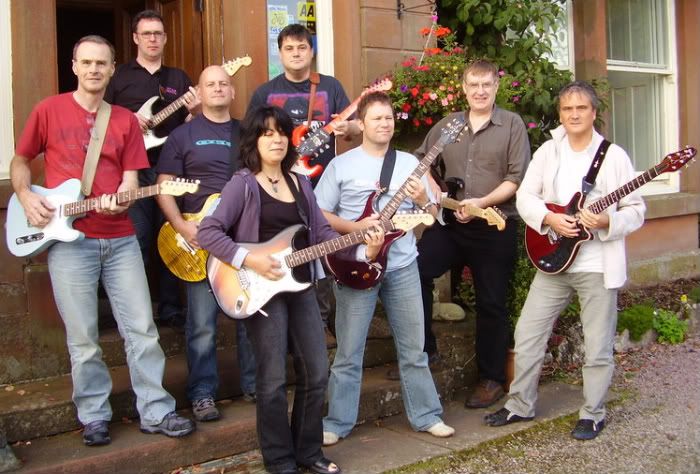
Guitar Weekends - Rock Weekend group 26-28 September 2008
Guitar Weekends - Rock Weekend group 26-28 September 2008. L-R: Iain, Gary Dunn, Tony, Yours Truly, Rachel, Mark, Gordon and Graham

On Friday morning, I took the train up north and by mid-afternoon found myself at Beckfoot House near Penrith in Cumbria. I was there for one of the Guitar Weekends that Malcolm and Lesley White at Beckfoot House run throughout the year. Now I'd been on one of these before back in early 2007. That time it was an "Improvers" weekend, albeit with a rock flavour. I had a great time on that occasion but wanted to return so as to brush up on some of the theory. The weekend I chose this time also had a "rock" theme, but it turned out that it was actually a much more advanced course.

By mid to late afternoon a group of seven of us had assembled with our guitars and other paraphenalia and after introductions, Malcolm led us through a few exercises where we looked at scales and some alternative chord shapes. As a group we played through a few songs several times with Malcolm explaining how we could improve things by sharpening up our timing and by paying attention to the rhythm patterns.

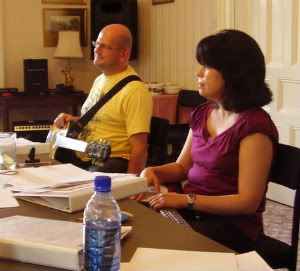
Tony and RachelAfter an excellent dinner, we took it turns to play solos using the various scales relevant to the key the song was in. Everyone was put on the spot for a few moments when we were each asked to play something for the rest of the group. That was quite nerve-wracking but a good way to break the ice - a few of us fudged our playing, but no matter, we were all in the same boat. We went on playing until 1AM. Despite not starting until late afternoon, it had been a very busy day.

But Malcolm was only the warm-up man. From Saturday morning Gary Dunn took over as our teacher. A softly-spoken Geordie with a great sense of humour and a helluva lot of patience, Gary is an excellent musician and a fantastic teacher, explaining and demonstrating everything clearly. We studied some theory, such as how chords are constructed, what notes appear in different keys and why. As on the previous day, we played through a number of songs and took turns to play solos. We spent some time looking at AC/DC's "Back In Black", breaking it down into its component riffs, and then combining them into a whole. I have to confess that I was finding some of this very tricky. The theory I could follow, but the putting it into practice was something else! However, I made plenty of notes for practicing later at home.

The NEIGH-boursLate Saturday afternoon we had a break before dinner, so a group of us took a walk out into the beautiful surrounding countryside (and nearly getting ourselves lost, which is what happens when you start climbing walls and fences and marching over fields). This was a great opportunity to socialise and get to know each other better.
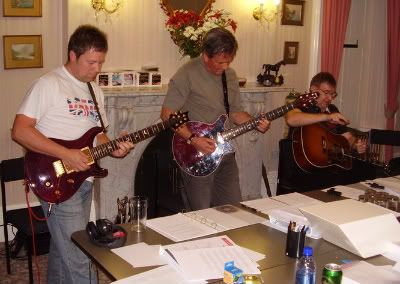
After another one of Lesley's excellent dinners, we began our project for the night. We split into two groups, each being given a song to work on, arrange, practice and finally perform. My group had "Riders on the Storm" which we had to arrange for four guitars. Luckily it's a song with several intertwining guitar parts, so there was something for each of us to do. My main job was the rhythm guitar, but they weren't letting me off that easily and it was decided that each of us would take a solo, so whilst I soloed someone else had to take over the rhythm. One of our group, Iain, was persuaded to sing, which was a nice touch.

After about three hours of arranging and practicing our parts, both groups came back together and performed our respective songs for one another and these were recorded so we could listen back to our triumphs and mistakes! We were quite pleased with our "Riders" although unfortunately Tony's Les Paul chose to develop a jack-socket fault just as he was about to start his solo so that we had a crackle-crackle-crackle solo for a few moments before he was to get stuck in properly.

Samba Pa TiRachel came out with a fantastic lead sound on her solo which caused a few heads to turn. I'm afraid I fluffed mine a little bit (although it wasn't that bad) but my main problem was that I hadn't set my relative rhythm versus lead volumes quite right and I was just too damn quiet. Iain having finished the vocals brought the song to a close with a nice solo on his Tele.

Then it was Mark, Graham and Gordon's turn, and they got up and performed Santana's "Samba Pa Ti" ("This isn't just any food. This is Marks and Spencers' food"), which allowed Mark on his PRS and Graham with his Brian May Red Special to indulge in a little lead guitar duelling whilst Gordon played the rhythm on his Gibson Hummingbird acoustic. Very nice it sounded too!

It had been another very busy - and long - day, so at 11:30 I decided to go hit the sack.

Sunday morning began with each of us independently working through the TAB for "Star Spangled Banner" whilst we waited to begin and trying to resist the tempation to add divebombing, explosions and rockets a la Hendrix.

Our venue for the weekendGary then came in and taught us about 9th chords and arpeggios - all of which we worked through, and together we played "Hotel California" which has an E9 chord and a solo which you can play using the B harmonic minor scale. He also used "House of the Rising Sun" as an example of how to arpeggiate. I'm glad to report that none of us had to refer to the chord sheet for that one! (As if!)
After lunch it was time to bid our farewells and make our respective ways back home. All in all, it was an intense course. It was very enjoyable but it was certainly no picnic. (If you go on one of these courses you must be prepared to work!) As I said earlier, the course was much harder than I was expecting and if I'm honest I was slightly outside of my own comfort zone, but then surely it's better to be challenged rather than to cruise through things that come easily.

Guitar Weekends offer a whole host of these intensive weekends for guitarists of all abilities - Strugglers, Improvers, Rock, Blues, Country, Django and Maintenance. Next year they are possibly going to introduce a Recording weekend. I've been on two weekends now (which is nothing compared to some people who keep on coming back for more), and can wholeheartedly comment on their excellence: venue, staff, food, accommodation, material covered - all are top notch. My thanks to Lesley and Malcolm at Beckfoot House and also to our tutor Gary Dunn.

Friday, 11 April 2008

Wolf Marshall

Bad Hair Decade


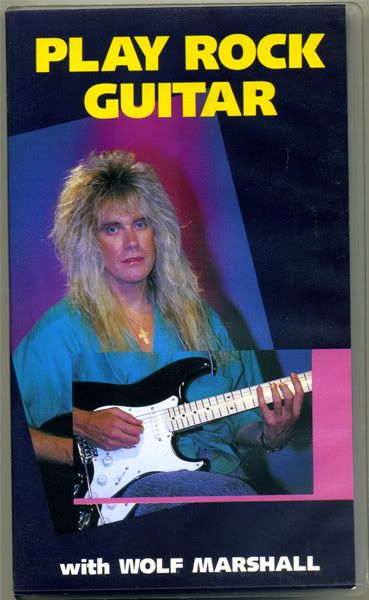
This guitar instructional VHS video was purchased for 20p in a charity shop. Blimey! The 80s were certainly a scary decade. Just look at that hair!

But never fear! I'm glad to report that not only is Wolf Marshall still going strong but also that his hair is looking so much better these days.

Tuesday, 5 June 2007

Guitar Weekends

Photo Sharing and Video Hosting at Photobucket
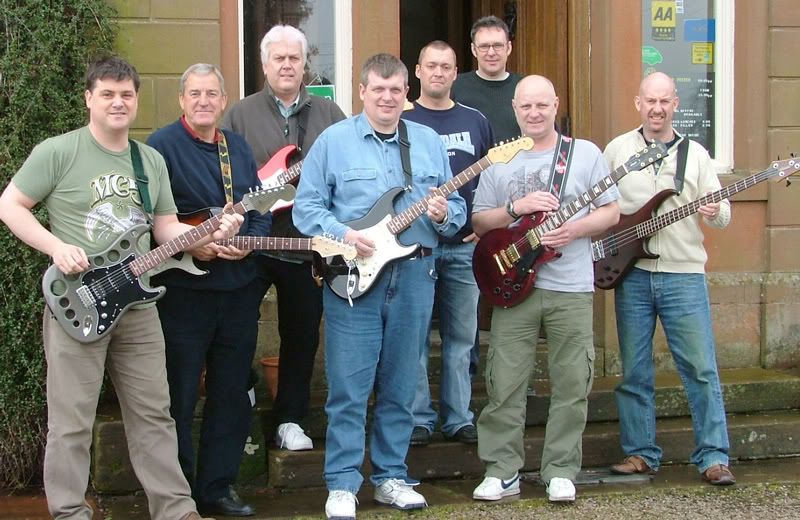
Back in March I spent a weekend in the Lake District playing guitar as part of one of these Guitar Weekends. Now despite being a total guitar nut, I'm not exactly the world's greatest player. I'm largely self-taught and have not learnt any theory over the years, so the idea of attending one of these courses seemed perfect. The course I attended was an "Improvers" courses. Other courses offered include a more basic one for "strugglers", or more advanced courses such as those for Blues and Django-style playing.

It was an intense course. We played all weekend up until midnight on Friday and Saturday nights, with breaks for meals. The accommodation and food was absolutely top-notch. It was great to play in a group situation with others and to learn some of the techniques of rhythm and lead playing (we each had spots at taking a solo), and to learn some of the music theory behind it all: how to ascertain which key a song is in, how to apply the understanding of scales and how to solo in that key.

It was so good that I'm considering going again!

BTW, guess which one of the chaps above is me? (Older readers of this blog will probably recognise my guitar).

Wednesday, 12 April 2006

Madonna Taking Guitar Lessons: so she can play "The Sound of Music" for her kids, apparently. Strange thing is, didn't she play some guitar on her last two tours?

Tuesday, 1 June 2004

Learnclassicalguitar.com: Learn how to play classical guitar. Online guitar lessons, tabs and more...

Wednesday, 18 February 2004

Learn Jeff Beck's Signature Licks and Sounds: Riff Interactive has released "Jeff Beck Style", a guitar lesson CD-ROM where you'll learn how to play like the guitar legend Jeff Beck. Allegedly.

LinkWithin

Related Posts with Thumbnails

ShareThis