Thursday, 10 May 2012

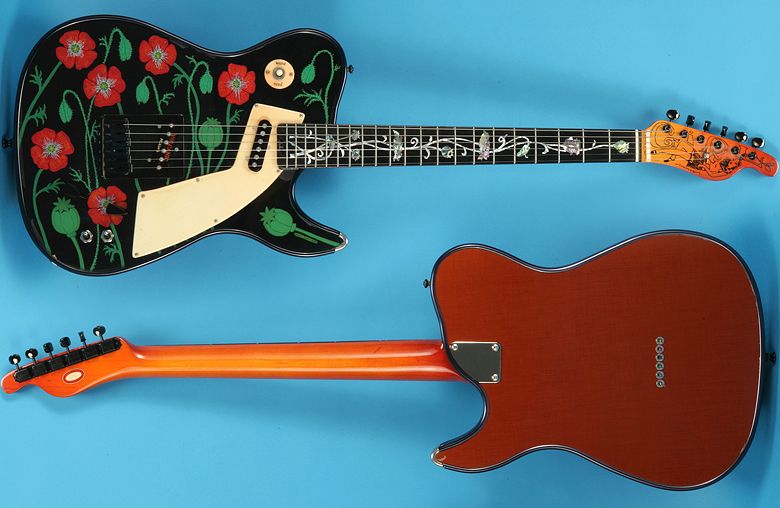
Vintage & Rare Guitar Of The Week: Girl Brand Opium Girl poppy festooned T-type guitar

guitarz.blogspot.com:
This Girl Brand "Opium Girl" guitar is quite appropriate for this time of the year when the poppies have started blooming. (Incidentally, our poppies here in Pembrokeshire in South West Wales are yellow rather than the more usual red).

Girl Brand guitars are one-off works of art by luthier Chris Larsen of Arizona, and as such do not come up for sale very often in the usual guitar marketplaces, however this example from 2002 is being offered for sale by Jay Rosen Music in the USA via Vintage & Rare.

Although the Telecaster influence is obvious, the body is actually of a hollow construction, formed from an aluminium rim supporting top and back plates. These vary from one individual Girl Brand guitar to the next and can be made from materials as diverse as formica, rusted steel, plastic laminates, street signs. Some examples even feature windows in the top of the guitar allowing you to see objects placed inside the guitar body (depending on the "theme" of the particular guitar).

This particular example is priced at €2854 / $3695.

G L Wilson

© 2012, Guitarz - The Original Guitar Blog - now in its 10th year!

Wednesday, 9 May 2012

Danish instrumentalists Tremolo Beer Gut play Kraftwerk in a surf / spaghetti western style

guitarz.blogspot.com:

Contradictory to my passion for the guitar, I am also a big fan of electronic music and in particular Kraftwerk. I've often said that my ideal band would be like Kraftwerk with guitars (perhaps something like Neu!, and come to think of it might also explain my fondness for Devo), so I take great delight in this version of "The Model" by Danish instrumental covers band Tremolo Beer Gut.

G L Wilson

© 2012, Guitarz - The Original Guitar Blog - now in its 10th year!

Tuesday, 8 May 2012

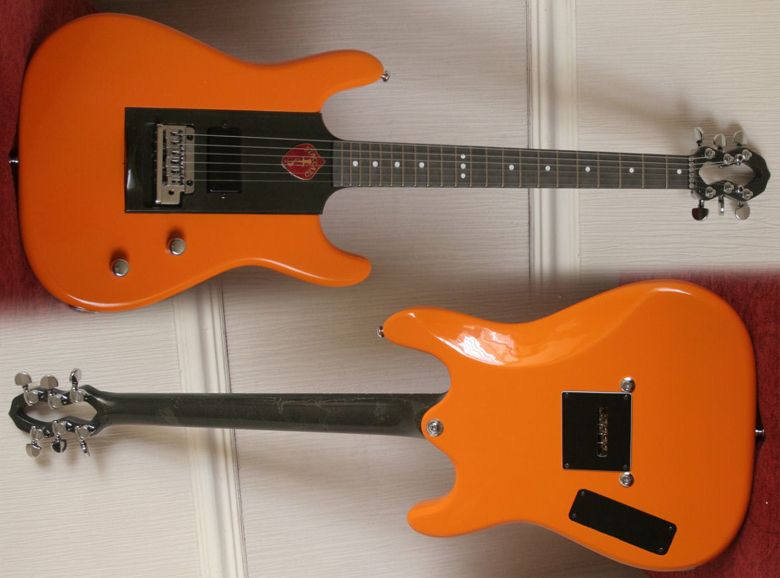
1980s Magnesium alloy Staccato guitar with "interchangeable" neck and fibreglass body

guitarz.blogspot.com:
We've previously looked at a Staccato bass here on Guitarz and today we're taking a peek at this Staccato guitar, one of the lesser known 6-stringers that they made, which - compared with the bass - is a much more conservative almost Strat-like design too. It's one of just (approximately) 200 such instruments built between 1985 and 1987 by Pat Townshend in partnership with Chris Jagger (yes, the brother of a certain other Mr Jagger).

As well as the unusual choice of materials used (magnesium alloy for the so-called interchangeable neck - which actually encompassed the centre body section too - and fibreglass for the body), the main innovation behind the Staccato was the ability to swap and change necks. I can't see that in a performance this would be any more convenient than swapping a whole guitar, but there you go, at least this company was trying something different.

This Staccato guitar is currently listed on eBay UK with a starting price of £599.

G L Wilson

© 2012, Guitarz - The Original Guitar Blog - now in its 10th year!

Monday, 7 May 2012

Porl Thompson's one-off 8-string guitar


You might have heard that The Cure's former guitarist Porl Thompson currently auctions some of his instruments - including this strange 8-string hybrid bass/guitar. 

I cannot figure out what is the device under the strings - my first idea was some kind of adjustable buzzing thing turning it into a guitar sitar, but it seems much more complicated that the buzz bridge or saddles one can use for that purpose (as you can see here). 

The instrument has 6 guitar strings and 2 bass ones with a much longer scale - hence a fretboard divided in two parts with two different nuts - simple but effective (though much less elegant than fanned frets)  - and it makes sense - when I play bass I mostly use the 2 lower strings... It's quite an inspiring instrument in my opinion, anybody know anything about it and its features - and was it ever used with The Cure?

Edit: thanks to our Facebook page, this guitar has been identified as a Carter Custom Hybrid 8 - there are no detailed explanations about what they call the "Dampler Strikers" but the photos show a.o. that there is more room under the strings that it seems... More comments are welcome!

Bertram D

© 2012, Guitarz - The Original Guitar Blog - now in its 10th year!

Sunday, 6 May 2012

Unidentified German Guitar


It's old, it's small, it's German, it's cute, it's a guitar and it's for sale - that's all I know...

So what can we see there? First the strange though simple outline (all I like in guitar design) of its small-sized archtop body - combining a 'dreadnought' shape with a minimal cutaway. It has the typically German fretless upper fingerboard, cooly shaped sound-holes and scratch-plate, and an unidentified pickup in neck position...

Can anybody tell more about it?

Bertram D


© 2012, Guitarz - The Original Guitar Blog - now in its 10th year!

Saturday, 5 May 2012

Vintage Otwin X-7 western-style acoustic guitar

guitarz.blogspot.com:
Here's an Otwin acoustic guitar which the seller on eBay dates somewhere between 1957 and 1963, telling us that:
It was manufactured by Otwin Guitars some time between 1957 and 1963, the only clue to the age of this guitar is X-7 which I am told refers to the model, X being the model and 7 being the serial number. The X series were produced in small numbers by a german luthier better known for his Archtop jazz Guitars... so this guitar has a 6 year window. The logo on the headstock is a simple screen print [...] so it is likely to be earlier rather than later.
We are also told that that guitar has a solid spruce top and maple laminated back and sides, whilst the fingerboard is maple which has been ebonised except for the block markers which have been left in natural maple.

I like that the guitar has a very hourglass shape, and in keeping with a manufacturer best known for archtop guitars rather than flat tops such as this, it has a floating bridge and strings anchored at a trapeze-type tailpiece.

As regular readers of Guitarz may have already suspected, Otwin was a brandname for guitars were actually manufactured by the Musima Company in East Germany.

This guitar is currently listed on eBay UK with a starting price of £75.

G L Wilson

© 2012, Guitarz - The Original Guitar Blog - now in its 10th year!

Friday, 4 May 2012

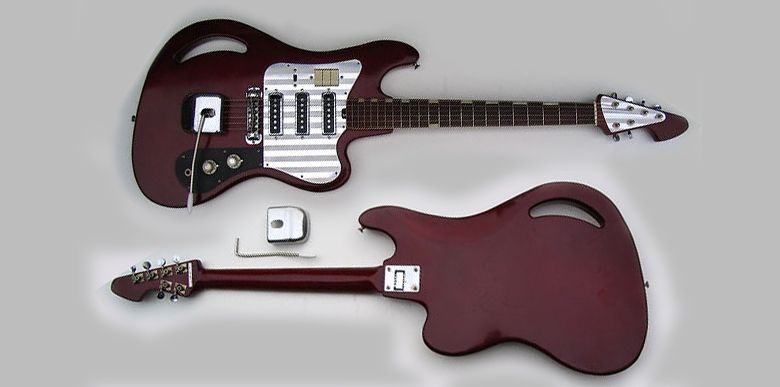
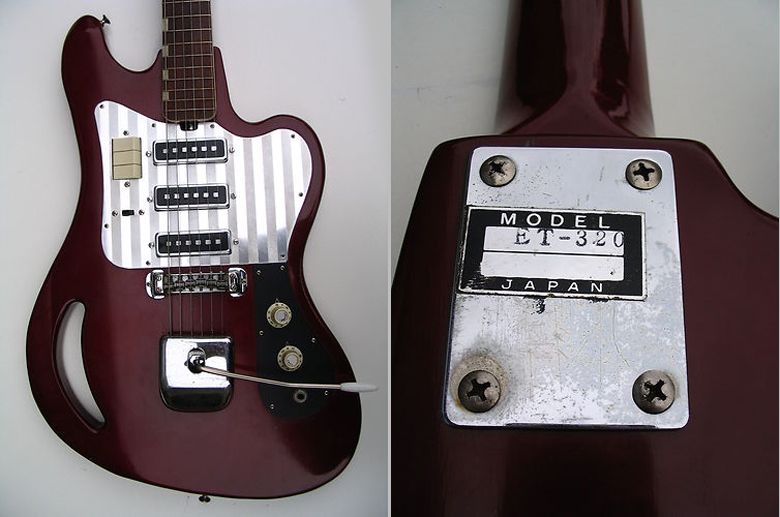
Teisco TG-64 - a classic Japanese solidbody guitar from 1965

guitarz.blogspot.com:
Continuing on the Teisco theme, here is another of their guitars, the Teisco TG-64, which carries several of their best known design features: the striped metal pickgulards, the 4+2 headstock style, the pushbutton pickup selector keys, the offset block fingerboard inlays, and the proto-monkeygrip "handle" in the body. We have actually looked at one of these guitars before on this blog (not to mention the Bass VI version, the TB-64) but it's not often you see them come up for sale on eBay, and this is a particularly clean example and in a much nicer finish than boring old sunburst or even Teisco's rather grim grey-green which always reminds me of the decor in hospitals.


This guitar is currently listed on eBay UK with a very low starting price of just £30 - I hope someone out there snaps it up! Let us know if it's you.

G L Wilson

© 2012, Guitarz - The Original Guitar Blog - now in its 10th year!

Thursday, 3 May 2012

Vintage & Rare Guitar Of The Week: 1965 Teisco Model Z Lap Steel

guitarz.blogspot.com:
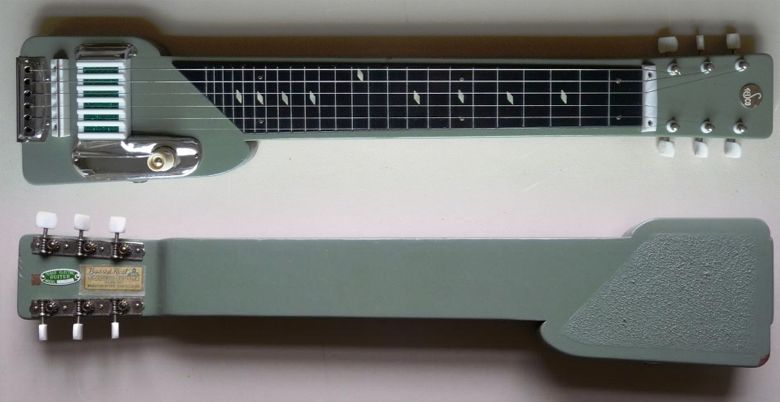
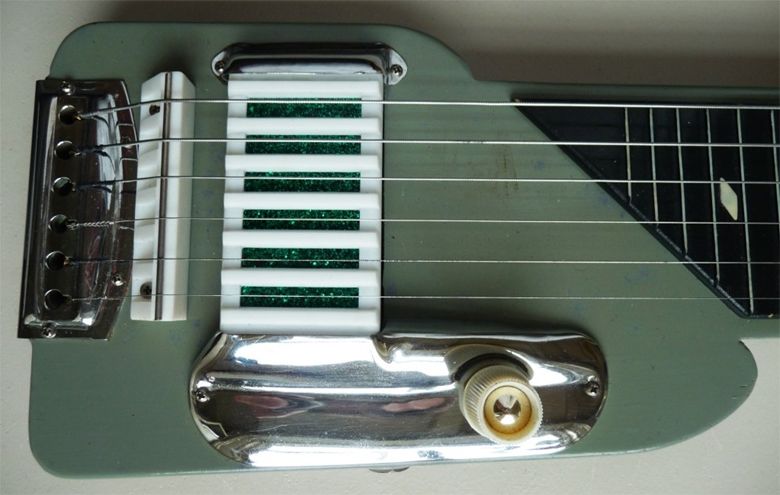
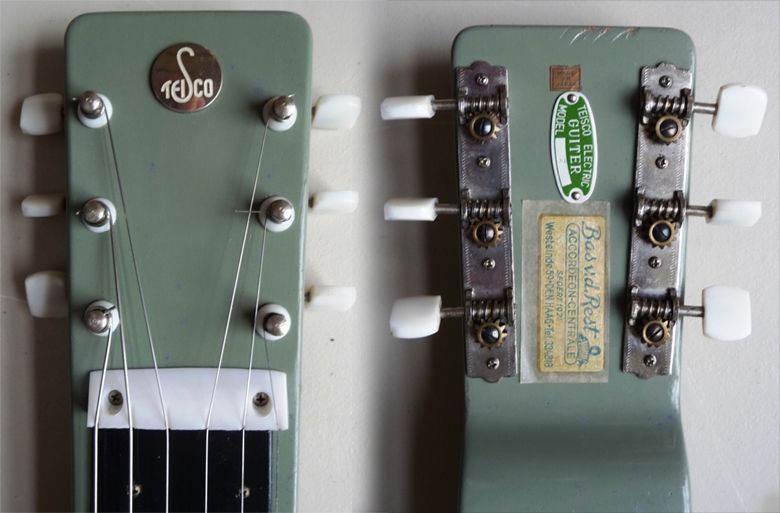
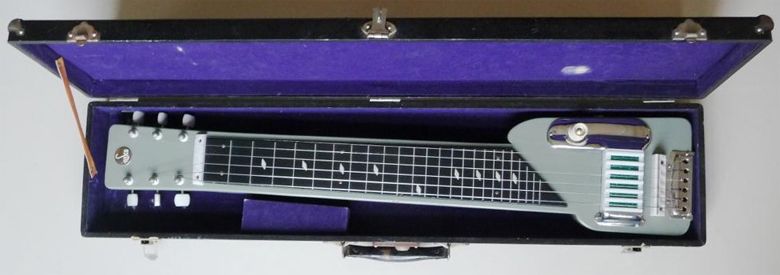
This guitar - a Teisco Model Z lap steel from 1965 - is about as simple as they come: slab-bodied, single pickup, single volume control, but I find it absolutely fascinating. I've not seen one quite like this before but that grey-green colour is a typical Teisco finish.

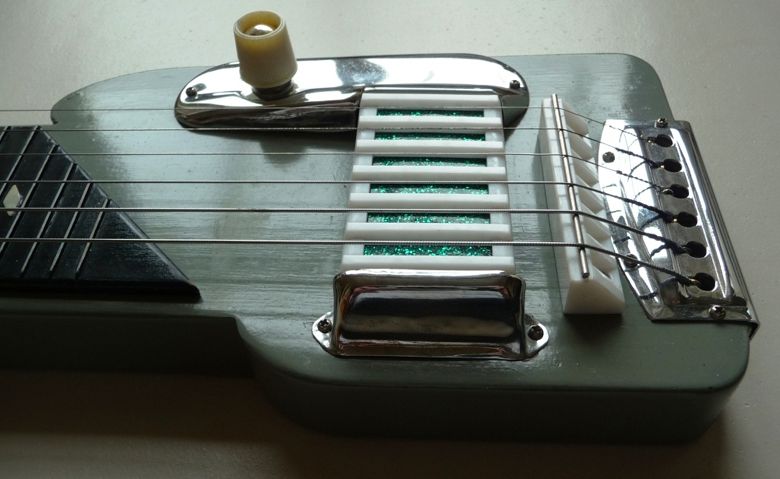
Note how the plastic-bodied pickup is not only inlaid with green pearloid but also appears to be "scalloped" with channels for each of the strings. I also like the contours of the metal components: the tailpiece, panel carrying the volume control, and the little pickup bracket. Compare this with modern lap steels with use generic bridges and Strat-like single coil pickups.

Note also that the fingerboard appears to be inlaid with real frets which is unusual on a lap steel where the only function for frets (or fret-lines as on most examples of this type of instrument) is as visual markers.

I love the Teisco label on the reverse on the head complete with a mis-spelling on the word "guitar", and also the label from an accordion retailer where this lap steel was originally purchased.

The guitar even comes in its original hard case, and is available for sale via Vintage & Rare for a very reasonable €250.

G L Wilson

© 2012, Guitarz - The Original Guitar Blog - now in its 10th year!

Wednesday, 2 May 2012

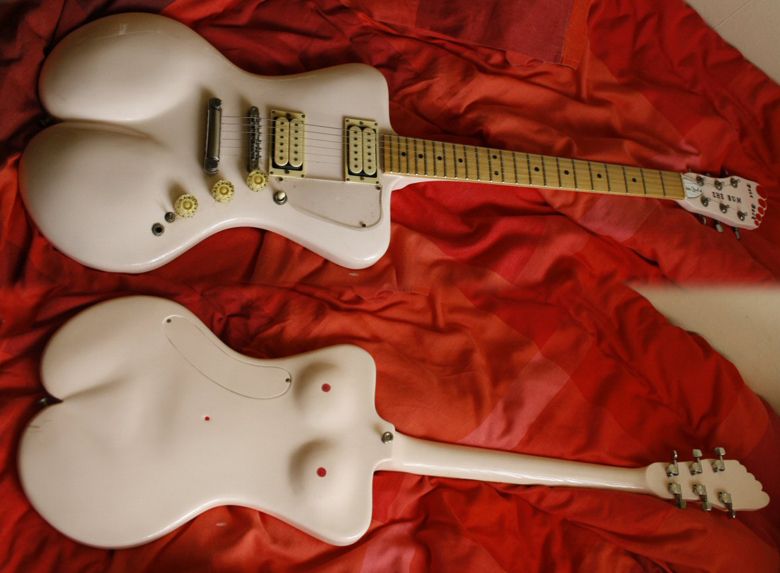
"The Bum" - a rather cheeky electric guitar from UK luthier Pete Back

guitarz.blogspot.com:
Do you really need me to say anything about the guitar pictured here? It's currently being offered for sale on eBay with a starting price of £599 - which is pretty decent for a quality luthier-built one-off guitar. As the seller suggests, it would suit a glam or Spinal Tap-type band (yeah yeah, we know "Big Bottom" ought to be played on a bass).

Check here for more of Pete Back's guitars.

G L Wilson

© 2012, Guitarz - The Original Guitar Blog - now in its 10th year!

Tuesday, 1 May 2012

Tanglewood Evolution TB Baby has teething problems ... any suggestions?

guitarz.blogspot.com:


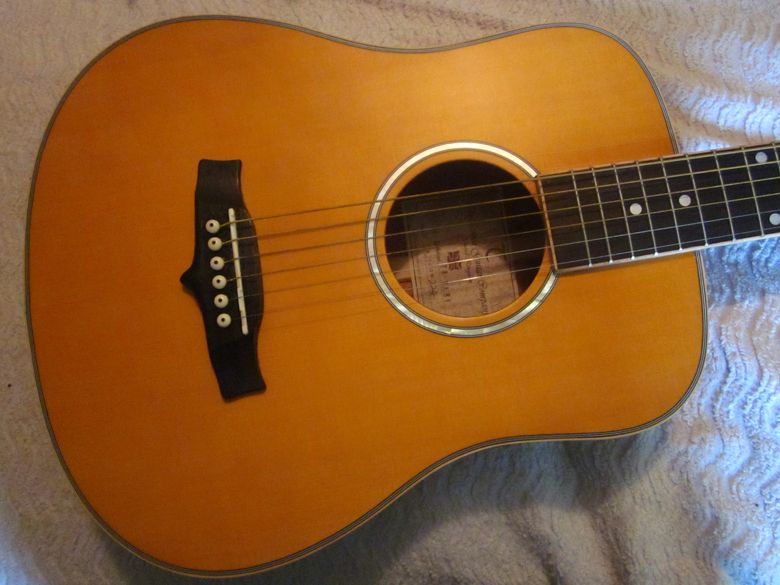
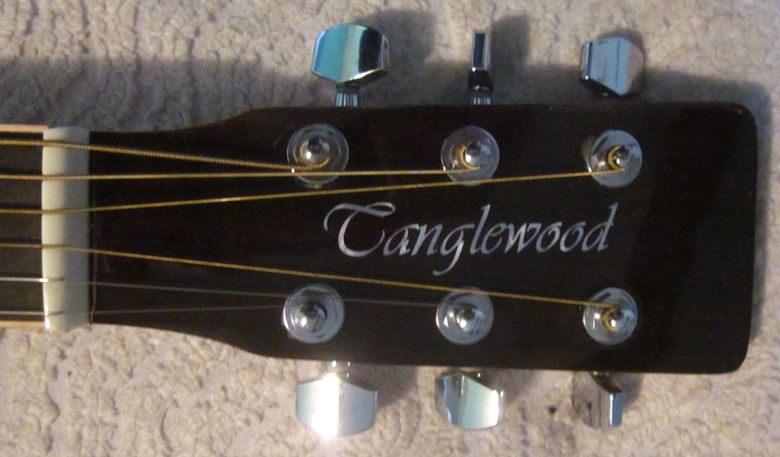
Please forgive what may look like a gratuitous photo of my cat, Elsa, but her appearance here does help to put the size of this Tanglewood Evolution TB Baby acoustic guitar into perspective. This is Tanglewood's answer to the Taylor Baby. With a scale length of approx 22 3/4", the TB Baby is intended as an acoustic travel guitar, but despite its small size it is a quality instrument as I hope these photos help illustrate.

I bought this particular Tanglewood Evolution TB Baby recently; it was brand new but I got it for about a third of the normal retail price. However - as is often said - "there's no such thing as a free lunch". In other words, there's a good reason why I got it so cheap. 

It has a cedar top, mahogany back and sides, and mahogany neck with rosewood fingerboard, attractive maple binding and an abalone soundhole rosette.

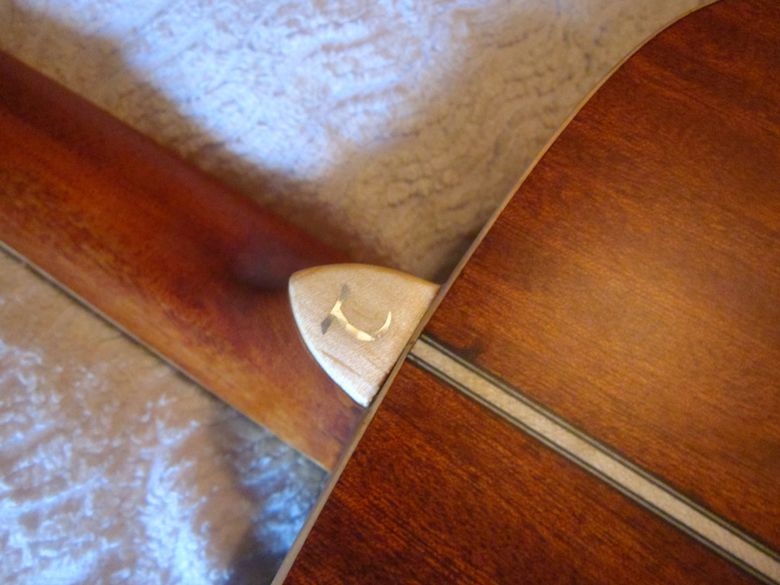
Check the detail on the heel of the neck (below), with the abalone Tanglewood "T" set in a heel-cap of maple.

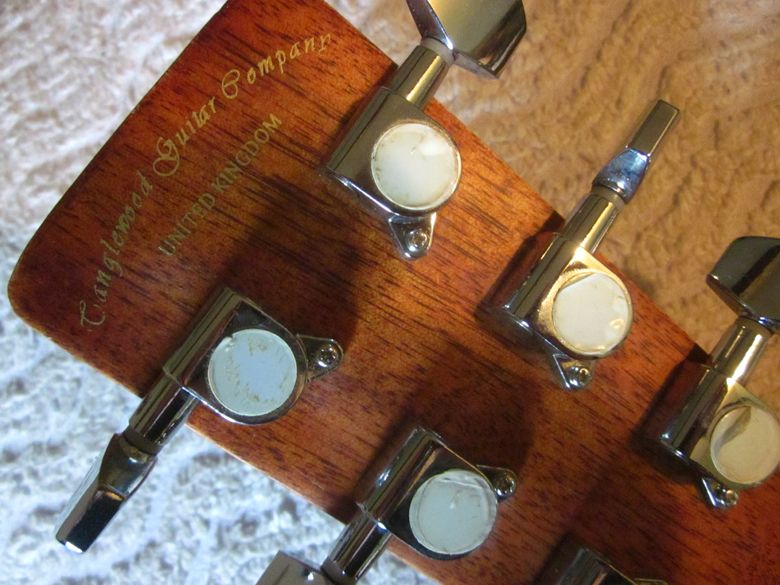
Tanglewood guitars are a British company, and you'll notice they proudly display "United Kingdom" on the back of the headstock...

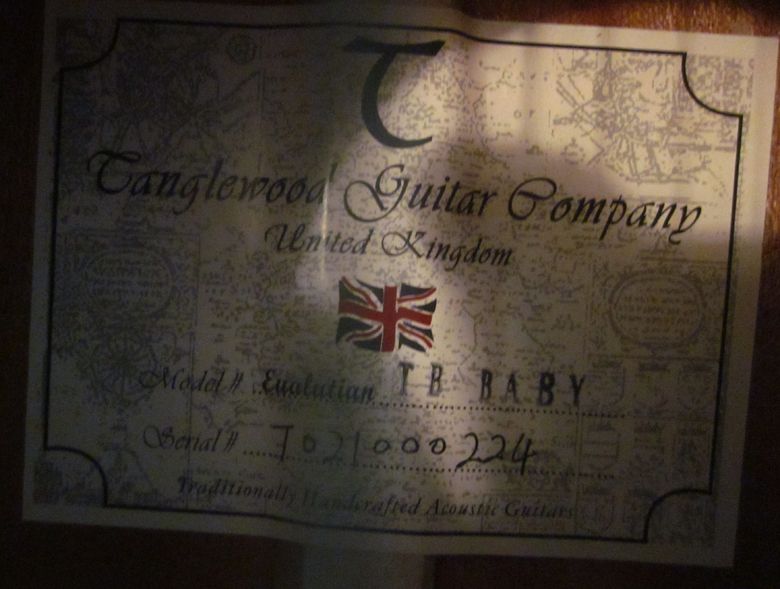
...and also on the label inside the guitar. Despite this open display of "British-ness" I can't help thinking that the guitar was probably made out in China or elsewhere in the Far East. Note it doesn't actually say "Made in..." anywhere, and the United Kingdom references may just be to the nationality of the company. But this wasn't what I really wanted to talk about...

It's actually a very sweet sounding guitar, with a very pleasing tone, quite unlike that of a full size dreadnought. Unfortunately, this guitar has issues. As I believe is often a problem with short-scale guitars such as this, the intonation is way out. At first I wondered if the bridge saddle had been inserted the wrong way around, but I have checked it and it seems fine. What I am not so sure about, however, is the fretting. I don't know what you think, but to me the distance between the nut and the first fret appears to be too large for the scale being used here. Take a look at the photo below and see what you think?
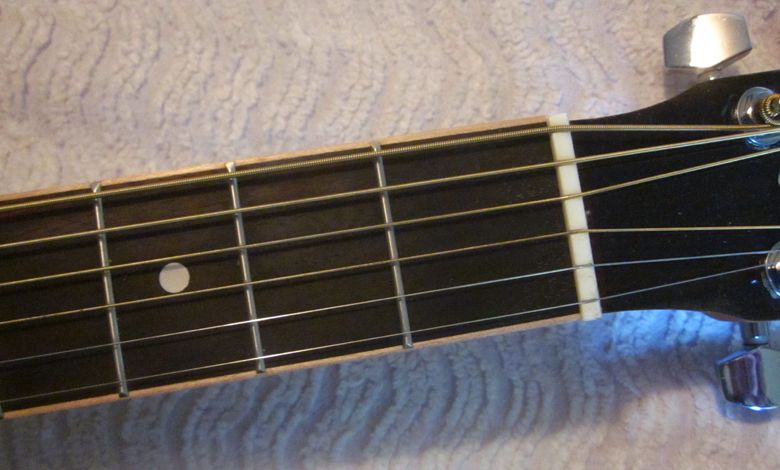
I have tried playing with a capo at the 1st, 2nd and 3rd fret positions and it does perform a little better - you can actually play so that the guitar manages to play in tune with itself. Even better, I found, is to tune the guitar up a semi-tone and then use a capo. However, this is far from ideal because it means that we're having to deal with an even shorter scale and are being forced into playing in keys we might not want to play in.

Anyway, the guitar is - supposedly - designed to play in standard tuning. If I was forced to keep in permanently in another key, just tuning it up a semi-tone seems hardly worthwhile. Tuning up to G would seem more useful, but when I tried tuning up to G, the tension on the strings was just too much. Different gauge strings might be an answer, but then again they may intone just as badly.

The way I see it I have three options:
  1. Try the guitar with different gauge strings and see if a different tuning helps. However I'm almost convinced that this option will not bear fruit because I very strongly suspect that the intonation problem stems from the incorrect distance from nut to first fret having been used (my experiments with the capo would seem to confirm this), but it has to remain a consideration.
  2. Try the guitar with nylon strings which are known to be much more forgiving when it comes to intonation. And - yes - you can get nylon strings with ball ends nowadays, but the nut slots would need widening.
  3. Get someone competent to install a (tall) zero fret or maybe some kind of compensating nut such as an Earvana (although I'd prefer not to pay Earvana prices).
So, it looks like it's a case of either spend money on a bunch of different kinds of strings to see what works, or else spend money with a luthier or guitar repairer.

Does anyone have any further suggestions? Or maybe you have had intonation problems with a guitar like this? Please let us know via the comments below.

G L Wilson

 © 2012, Guitarz - The Original Guitar Blog - now in its 10th year!

LinkWithin

Related Posts with Thumbnails

ShareThis