Please read our photo and content policy.
Wednesday, 23 September 2015
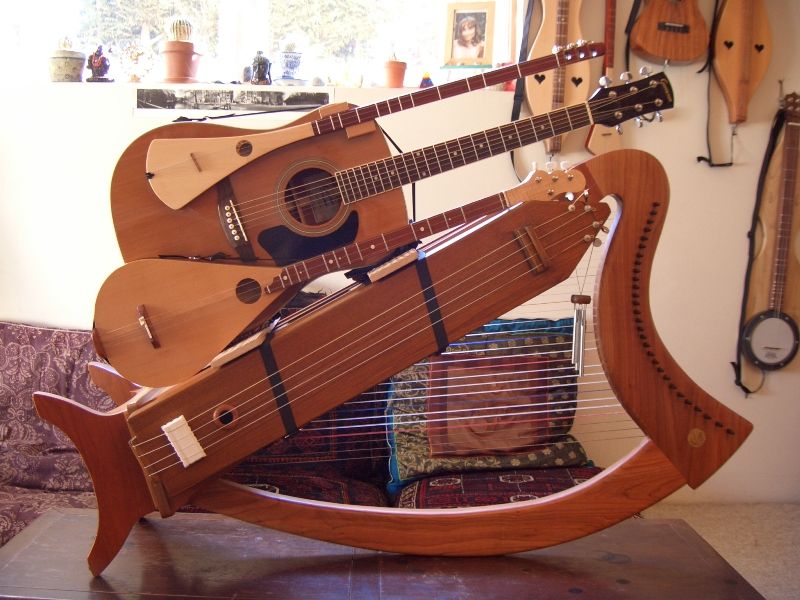
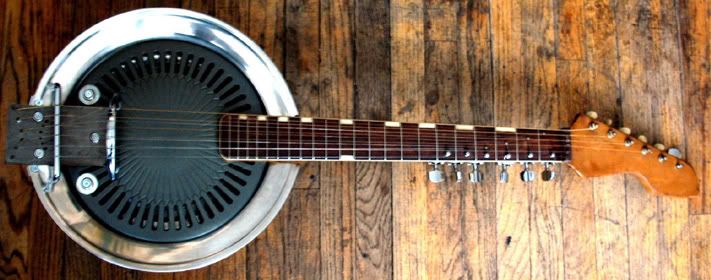
Specimen Electric 10 String Tiple
Please read our photo and content policy.
Wednesday, 4 July 2012
Performance video featuring Marko Lipovšek playing one of his electric harp guitars
Especially for Bertram, here is another of Marko Lipovšek's electric harp guitars being played by its maker during a fashion performance.
I post this here just so you can hear what these guitars sound like, although I suspect some readers (I'm not naming names) might ogle the young ladies...
G L Wilson
© 2012, Guitarz - The Original Guitar Blog - now in its 10th year!
Tuesday, 3 July 2012
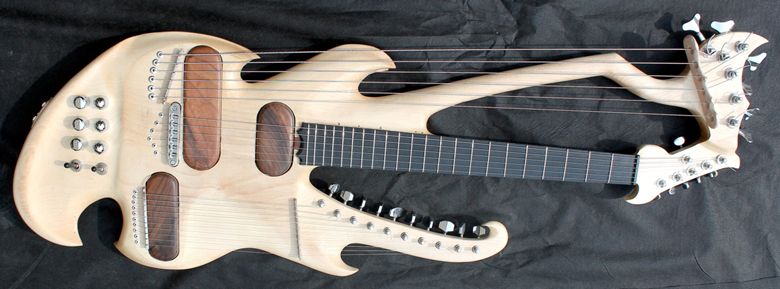
Incredible 35-string electric harp guitar by Slovenian luthier Marko Lipovšek
I don't think I'd care to be the one to hang this behemoth on a strap around my shoulders, but have to admit that it's an incredible piece of sculpture. Made by Slovenian luthier Marko Lipovšek, this one-of-a-kind 35-string harp guitar with three sets of strings has been sculpted from Slovenian White Maple, ebony, and Slovenian black walnut.
This guitar is currently being offered for sale by a Canadian seller on Etsy.com and is priced at $15,000.00 Canadian Dollars.
G L Wilson
© 2012, Guitarz - The Original Guitar Blog - now in its 10th year!
Tuesday, 6 December 2011
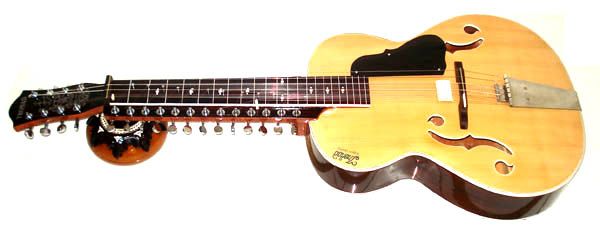
Mohan Veena Indian Slide Guitar - hybrid between jazz guitar and sitar
We first looked at Indian slide guitars here on Guitarz back in 2008. The Indian slide guitar is a hyrbid instrument, a musical chimera if you will, where quite literally East meets West and could be considered a cross between jazz guitar, slide guitar and sitar.
This Pro-grade Mohan Veena w Tumba Indian Acoustic Slide Lap Guitar claims to be the first such instrument to be offered for sale via eBay. It appears to have four main playing strings, four drones, and 13 sympathetic strings with machine heads along the length of the neck.
Hear it in the hands of Harry Manx:
Currently listed on eBay with a starting price of $799.99 (plus shipping).
G L Wilson
© 2011, Guitarz - The Original Guitar Blog - now in its 10th year!
Thursday, 22 September 2011
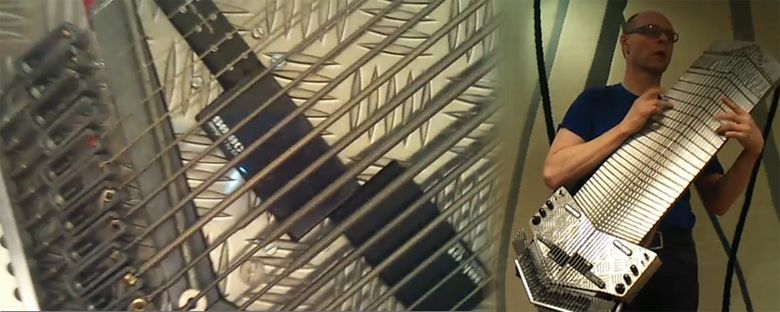
Dude taps away on 24 strings on his homemade monster metal bass
Cor blimey, guvnor! When I first saw the picture of this thing I thought it might be a Star Trek fan posing with some exotic piece of Klingon weaponry. But no, apparently it's a touch-style 24-string "bass" (not sure why it can't be called a "guitar", but that's what the fellow calls it).
I know, I've been very cynical in the past about such multi-stringed instruments and "extended range basses", and even have my own catchphrase to be used in the eventuality of sighting such a beastie: "Is that enough strings? Just buy a harp already!"
But I've been told that I shouldn't be so closed-minded, so I'll let you watch this chappie in action on his 24-string bass in the below video and allow you make up your own minds.
Actually, someone commented on YouTube, "Whats the point in having that many strings?", and 24-string bass chappie answered, "There is no 'point', I just love to play stringed instruments!" which, I guess, is fair enough. It's like the answer to the old question "Why climb that mountain?" with "Because it's there!" In this instance, it's "Why have so many strings? Because I can!"
Love it or loathe it, it doesn't matter. It's worthy of a blog post on Guitarz for weirdness factor alone.
G L Wilson
© 2011, Guitarz - The Original Guitar Blog - now in its 10th year!
Monday, 3 January 2011
10-string Santucci TrebleBass
Bertram
Guitarz - The Original Guitar Blog - now in its 10th year!
Wednesday, 7 April 2010
August Carlstedt Ideal Harp Guitar
guitarz.blogspot.com:This harp guitar by August Carlstedt is not the kind of instrument that turns up very often on eBay. The seller has listed it as a "double neck" and I suppose that is not an innaccurate description of it, but you'll notice from the closeness of the upper neck carrying the sub-bass strings to the main neck that the sub-bass strings are not meant to be fingered (I won't say "fretted" for obvious reasons). The sub-basses are intended to be plucked as open strings - the neck is there merely to support these strings. The designs of harp guitar vary wildly; many other brands employed winged extensions to the body where this guitar has the extra neck. I assume that the fretless fingerboard on this example is there for aesthetic purpose only.
I note that currently the guitar has only two of its four sub-bass strings present. Possibly, in its current condition with cracked body top it would not be wise to string it up with the full complement of strings. I am curious as to the presence of four additional bridge pins on the treble-side of the guitar's bridge, which would suggest that the guitar may have had even more extra strings. However, there are no tuners present on the treble side of the body, nor marks to indicate where they may once have been. Could the four extra bridge pins be merely an aesthetic touch so as give provide visual balance to the whole bridge design?
August Carlstedt, by the way, lived from 1861 to 1928 and was a Swedish immigrant who ran a shop in Chicago during the early 20th century, building instruments under the Ideal brand.
This beautiful antique guitar is, as already mentioned, in need of some restoration. No doubt it will appeal to a collector of harp guitars; hopefully someone who will lavish some attention on it.
For more on harp guitars, see the excellent www.harpguitars.net website.
G L Wilson
Guitarz - The Original Guitar Blog - now in its 9th year!
Tuesday, 16 March 2010
14-string "guitar"
This strange-old 14-stringed instrument is currently up for sale on eBay, although I am not sure if the seller is correct in calling it a "guitar". The body shape is like that of a cittern. When the seller claims it is 24 inches long, I guess he is referring to the total length rather than the scale length, so to my mind that would make this instrument nearer in scale to a mandolin than a guitar because you have to factor in the length of that enormous headstock!
Having fourteen strings, you would be forgiven for thinking that it had seven courses of paired strings, but in fact it has only six courses, arranged with the highest three being tripled, the middle basses being doubled and the lowest bass being just a single string.
It's not a stringing system I have seen anywhere else, but perhaps it is better known than I believe. (I'm learning things all the time writing this blog). Possibly it is a relation of the Portuguese guitar, but with fourteen strings instead of twelve and a different headstock design. As usual, if anyone has any further info, please let us all know below in the comments.
G L Wilson
Additional: It's a Philippine Bandurria - see comments.
Guitarz - The Original Guitar Blog - now in its 9th year!
Monday, 9 November 2009
Pointless triple-neck
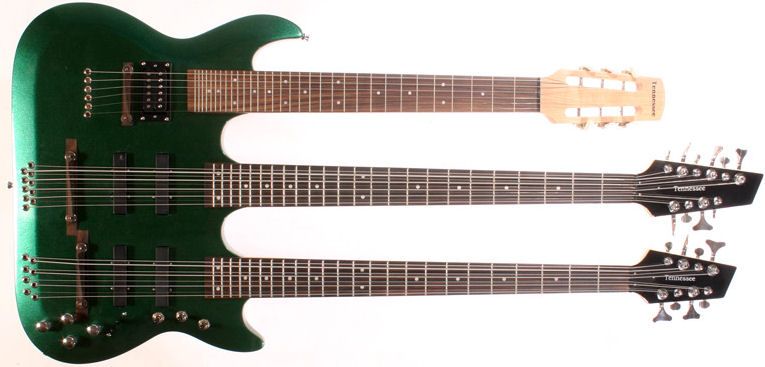
Uh-oh! You know you're in for trouble when you see a Tennessee-brand guitar. They are often very wacky instruments, but don't be fooled as the workmanship is shoddy and the instruments themselves are reported to be virtually unplayable.
But let's put aside the provenance for this discussion. Just look at this thing: it's a triple-neck comprising 8-string bass, 10-string bass, and 6-string lap steel.
Just WHY?
Why would anyone need that combination of necks on a single instrument? To start with, how many bass players double on "lap steel"? Not that this could ever be a real lap steel. Is the player supposed to un-strap it mid-song, sit down and lay the instrument on his lap for a lap steel solo?
Perhaps the "lap steel" neck was added because it was lying around at the factory at the time this ridiculous instrument was assembled.
Let's forget the lap steel neck. What about the two bass necks? Why would any bassist ever need a 8-string and a 10-string on one instrument? (That is to say, a 4-string and a 5-string with doubled courses, rather than 8 and 10 individual non-paired strings). Surely if you needed to play a song that required both 8-string and 10-string bass, all you'd need would be the 10-string neck and you could ignore the low B course in the sections that "require" the 8-string. In the same way, I can't see why anyone would ever need a 4-string and 5-string bass combination on the same instrument. I could understand a 4-string and 8-string, or a fretted and fretless, but this instrument shown above offers nothing of advantageous use.
It's utter nonsense, and as I've commented on previous occasions, Tennessee guitars seem to be put together by people who know nothing about guitars.
G L Wilson
NB: There are a lot of blogs STEALING content and bandwidth. If you read this anywhere else but on guitarz.blogspot.com then you are reading a blog that STEALS content. Please support original bloggers!
Saturday, 7 November 2009
The Omstrument
In our previous post about Uli Jon Roth's Sky Guitar, Bertram, my co-blogger here at Guitarz, made a note in the comments appealing for "Less frets, more strings!"
Is this enough strings for you, Bertram?
With a combined total of 46 strings, the Omstrument is the creation of Jack Haas and is a gestalt instrument comprising harp, guitar, longneck dulcimer, strumstick, and tanpura. And before you ask, yes, they are supposed to be played together at the same time.
Perhaps it's easier to let one of Mr Haas' videos do the talking:
G L Wilson
NB: There are a lot of blogs STEALING content and bandwidth. If you read this anywhere else but on guitarz.blogspot.com then you are reading a blog that STEALS content. Please support original bloggers!
Thursday, 22 October 2009
Steve Albini's 16-string guitar
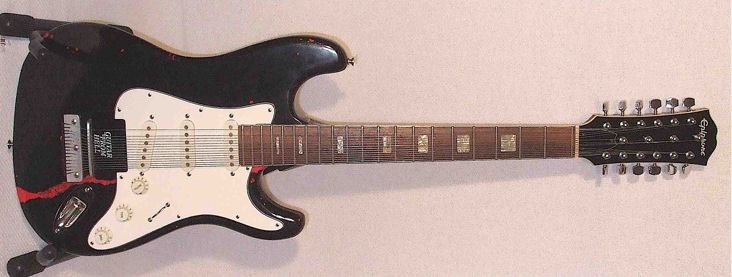
I'd like to thank Howard who forwarded this image of a 16-string guitar from Steve Albini's recording studio. It appears to be a "Frankenstein" creation with a hardtail Strat-like body (probably not a Fender) with a doctored Epiphone acoustic 12-string neck grafted onto it.
Note the four tuners in the center of the headstock (which must be bango style tuners with the buttons on the reverse) and also the simple bridge which has been moved further back than it would be on a Strat, a dictate of the neck used to allow for the correct scale and compensation.
It doesn't look like a very friendly-to-play instrument. I'm assuming that the strings are arranged in six courses as on a 12-string, but that the top four courses each have three strings. This means that the strings are all so close together that it is hard to tell where one course ends and the next begins. I'm guessing that the "Guitar from Hell" sticker near the bridge is appropriate!
G L Wilson
Additional (6 December 2009): Here's what Steve Albini himself says of the instrument:
It's a drone instrument. I saw a 12-string made like this (Epiphone neck on strat copy body) and asked the guy who made it how many strings he could fit on one guitar. His answer was 16, so I asked him to make one. The first one was a thank-you gift for Sonic Youth, who had invited Rapeman to play some shows with them in the UK. It turned out to be real fun to play, so I had another one made and that's the one we have here. It's used on a lot of records as a novelty, and on the Shellac song "Pull the Cup" in earnest.
The demo version of "Pull the Cup" is called "XVI," which is a hint.
Bob got to play one of Tom Petersson's 12-string basses at a Cheap Trick sound check, and I think he's going to see about getting one eventually. Expect everything to change once that happens.
http://www.electrical.com/phpBB3/viewtopic.php?f=4&t=46349&p=1007753
NB: There are a lot of blogs STEALING content and bandwidth. If you read this anywhere else but on guitarz.blogspot.com then you are reading a blog that STEALS content. Please support original bloggers!
Saturday, 5 September 2009
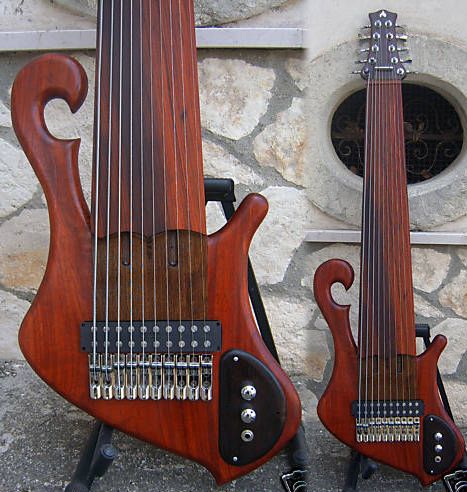
Prometeus 10-string bass
This is a Prometeus 10-string bass, currently on sale on eBay.I've said it before and I will say it again. If you want that many strings just buy a harp!
C'mon bass players... how can you justify all those extra strings? I've heard a lot of BS about these instruments opening up new avenues of sonic exploration, but I've never heard a decent piece of music played on one. Admit it - it's just a silly fad amongst some bass players to see who can have the most strings.
Just check the demo video of this particular instrument on YouTube. Now, can you honestly tell me that the highest strings on this beast are truly useable? Come to that the sub-bass is pretty ropey too, so it's only really the strings in the centre that are truly playable.
The seller, who I assume from the way he writes is also the builder, admits that he himself is really a 4-string player. He must be assuming that there is someone out there daft enough to buy this thing.
G L Wilson
NB: There are a lot of blogs STEALING content and bandwidth. If you read this anywhere else but on guitarz.blogspot.com then you are reading a blog that STEALS content. Please support original bloggers!
Monday, 20 April 2009
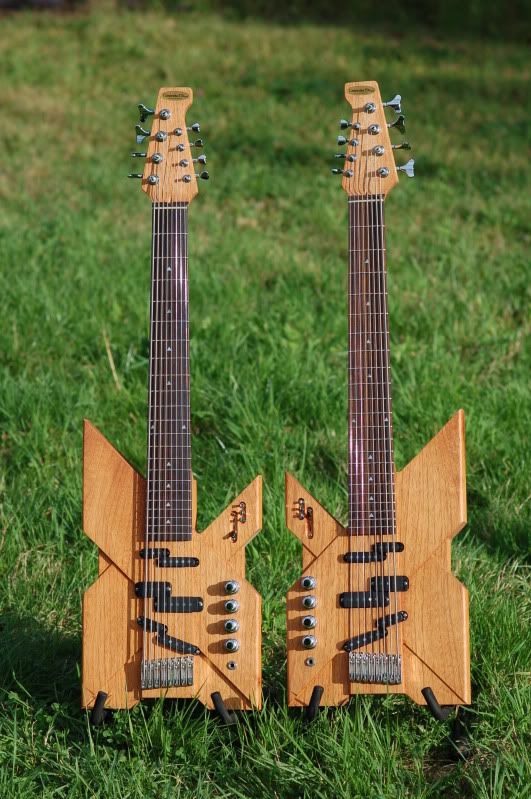
The Vootar
The 8-string Vootar - another interesting instrument from Cassandra Elk Design - is described as being guitar and bass all in one.From what I can work out from the German-language description on the eBay selling page, it looks like this instrument was designed by German record producer and musician (and record sleeve designer) Klaus Voorman.
I wonder what tuning it uses across its eight strings?
Sunday, 13 July 2008
Paolo Angeli and his big ol' strange guitar
Paolo Angeli plays a Sardinian guitar customised with extra sets of strings, levers operated by footpedals, and assorted other mechanisms and doodads, and it sounds like nothing else you've ever heard.
His recent album contains cover versions of songs by Fred Frith and - quite appropriately considering the weird factor going on here - Bjork.
Thanks to Janet who heard this guy playing on a National Public Radio All Songs Considered podcast.
Tuesday, 1 July 2008
Sympathetic Slide Chicken Cooker in Open G

Monday, 30 June 2008
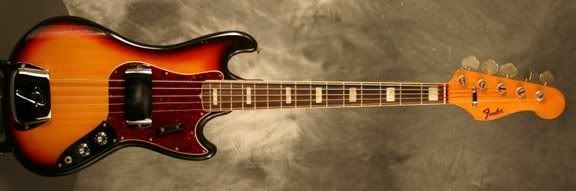
Fender Bass V - the original 5 string bass

It's a funny looking little bass with its elongated body and short neck. Unlike the later 5-strings that emerged from various manufacturers from the late 80s onwards, the extra string isn't a low B, it's a high C. The Bass VI didn't actually offer an extended range to that offered by Fender's existing Precision and Jazz Basses, it simply offered an alternative way of playing, possibly more suited to those of a smaller stature who might find those other Fender Basses more unwieldy. Instead of playing up and down the neck as much, you could play across it instead.
The auction for this one ends later tonight. It's going to go for a few thousand dollars, that's for certain. These basses weren't a resounding success sales-wise and as such this is a very rare Fender.
Edit: Sold for $3,795.
Tuesday, 6 May 2008
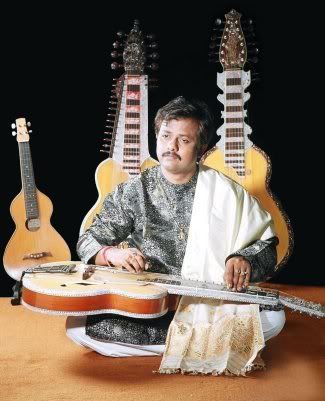
Pandit Debashish Bhattacharya, Pioneer of Indian slide guitar
Born to musician parents Pandit Debashish Bhattacharya, a child prodigy, was initiated into Indian classical singing, but was drawn to the guitar because of the ability to emulate the human voice by using the slide.He is the inventor of the Trinity of Slide Guitars:
The Chaturangui takes the guitar and gives it the tonal resonance of traditional Indian instruments, Rudra-veena, Violin, Sarode and Sitar. It has six primary sliding strings, twelve or more sympathetic strings, and two chikaris - a pair of strings located beyond the treble main strings, and tuned an octave apart from one another.
The Gandharvi is a 12-string slide guitar with an additional pair of drone strings, and which melds the tones of the Saraswathi-veena, Santoor and Sarangi with the guitar.
The Anandi is a simple 4-string instrument, and is more akin to ukulele played with a slide.
These are absolutely fascinating instruments, and I'm very curious to hear what they sound like.
Friday, 1 September 2006

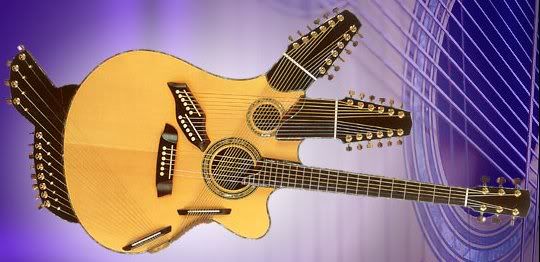
Pat Metheny's eye-boggling multi-stringed Pikasso guitar has been featured in lots of blogs recently. I originally blogged about it almost 4 years ago! (Some people take a long time to catch up, don't they?) Anyway, if you can't imagine how on earth he'd play it, see this YouTube clip of Pat Metheny playing this beast (although it appears to have lost the upper headstock):