guitarz.blogspot.com:
Though I'm not one to typically celebrate milestones I'm in the unique position of having been a fan of Guitarz for a lot longer than I've been a contributor.
So, I thought since I was going to abuse my power I'd celebrate 5000 posts by revisiting some of my favourite guitars featured on this site from when I was just a fan. Feel free to let us know if you have a favourite as well.
When
this Hayman 3030 was posted it was the first time I'd ever seen a Hayman guitar. I don't think I'd even heard of Hayman before, which is made extra odd by that fact that I've been a Burns fan/owner for a long time. Some histories are missed. I am still on the lookout for a 3030 like this one to add to my arsenal, should anyone have an extra one they would want to part with.
This
Forrest Custom Telecaster with B-Bender makes the list because it has 3 elements that I love ( aside from the fact it's a tele ). It's green , it's paisley, and it has a b-bender. A trifecta of telecaster love.
The
Burns Jet Sonic designed by Pagelli came in two different colours. A Blue and Red combination and the less understated Black and Yellow/white shown here. I admit that I like the black version much more. If you have a crazy and unique design why bother dressing it in crazy colours. Probably the second or third guitar I'll buy if I ever win the lotto.
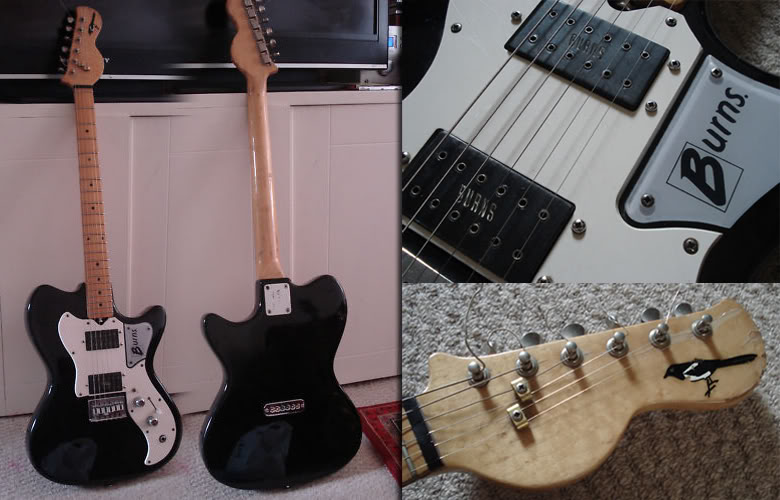
Another Burns!
This Magpie from 1980 is a great example of the design and has the added bonus of a 6 in-line tuner configuration which in my opinion makes more sense with this design. The bird on the headstock is a nice touch too.
I've never disliked a Daion, and the Savage is probably my favourite design. The only fault I see in this
Savage is that the original pickups have been replaced with dimarzios. Not that that isn't possibly an upgrade, I just think I'd prefer it to be stock.
This
Greco Brawler BR600 is a great example of 1970s made in Japan quality, only this time it's not a copy of an existing guitar. The curves on this guitar are great and I see a nod to a Tiesco Tulip.
My first guitar was a 1984 Ibanez Roadstar and looked almost exactly like this one. But mine was a very reserved black. I loved this one on first sight as it simultaneously made me feel nostalgic and go "wow". I'm not sure I would have had the courage to play a bright beauty like this in 1984, to stand out so obviously. But I'd play it with pride now.
There is a lot to like about this
John Birch guitar. The modular pickups, the simple design, the symmetry, the arm-carve on the bouts, and not least, the colour. This is one of those designs that I'm surprised didn't catch on. I guess it was ahead of its time.
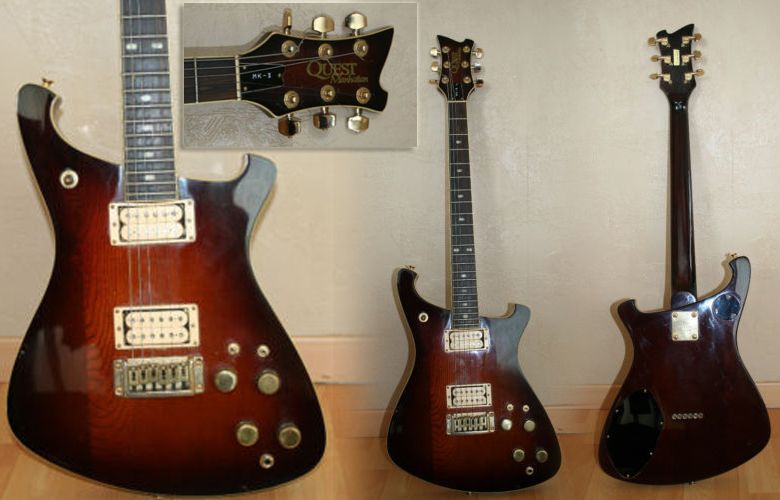
This
Quest Manhattan is another fine example of Japan getting it right in the 1970s and 1980s. When I first saw this guitar I coveted it so much that I came to within inches of buying a seafoam green version at a very inflated price. I made the right decision and passed on the purchase, yet why do I feel remorse?

This
Northern SG holds a couple of unique distinctions for me. Firstly, it's the only SG style guitar that I have loved the look of, even if it rails against all of my usual tastes. I cannot dislike this guitar.
Secondly, I'm pretty sure this is the first time Gavin posted a guitar that I sent him. It's really quite a beauty and is likely as playable as any 1970s Japanese guitar.
That's just the tip of the iceberg for my love of the guitars on this blog. Feel free to share your favourites as well.
R.W. Haller
© 2015, Guitarz - The Original Guitar Blog - the blog that goes all the way to 11!
Please read our photo and content policy.




.JPG)
.JPG)


.JPG)
.JPG)
.JPG)
.JPG)

.JPG)