Showing posts with label Personal Narrative. Show all posts

Thursday, 10 September 2015

Epsilon prototype


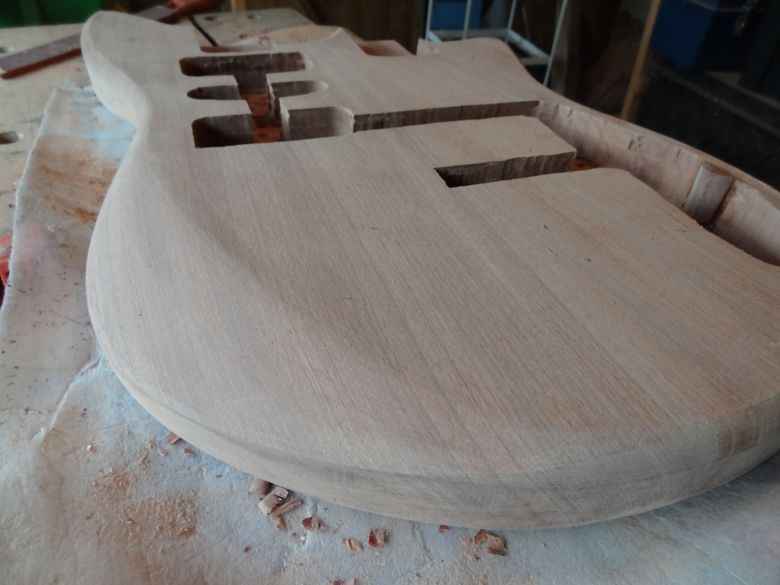
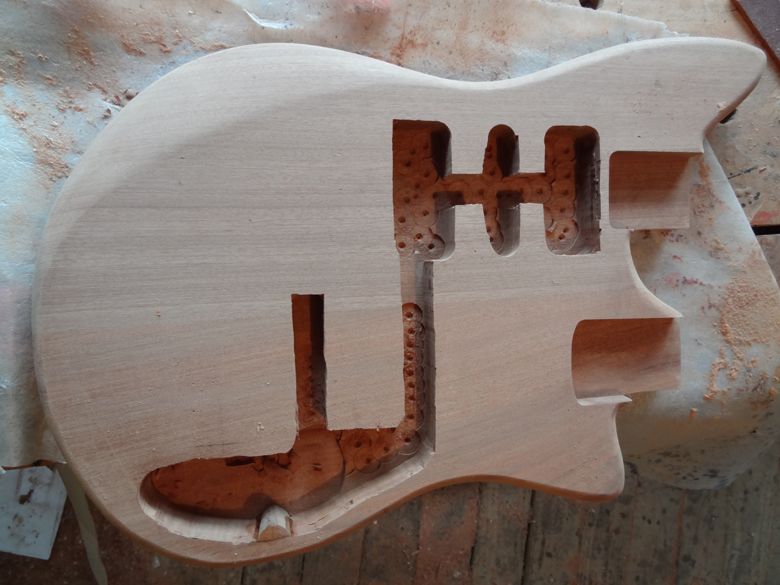
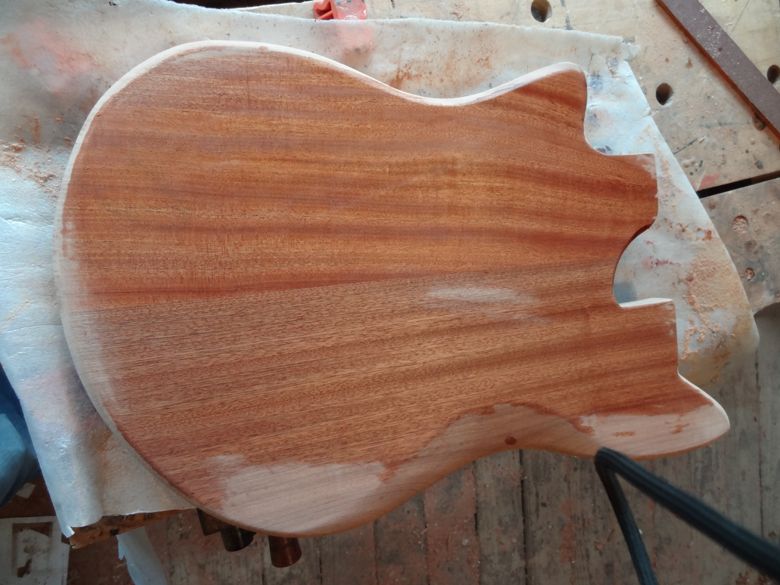
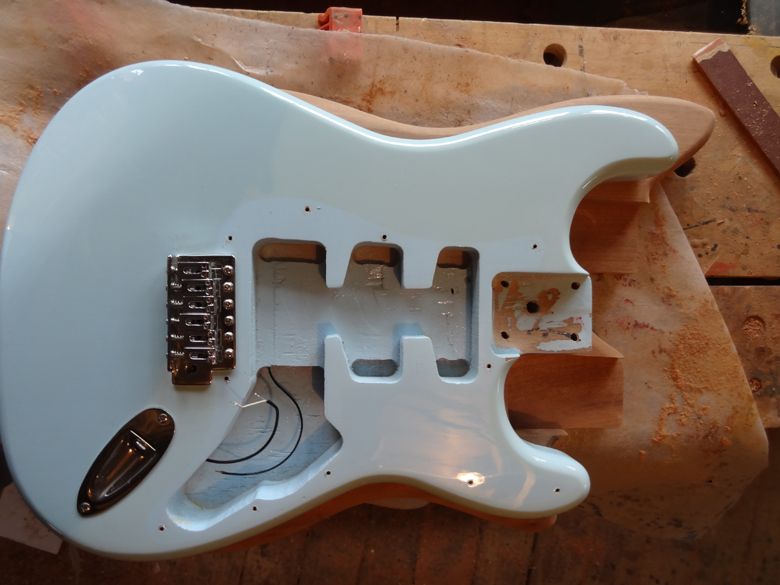
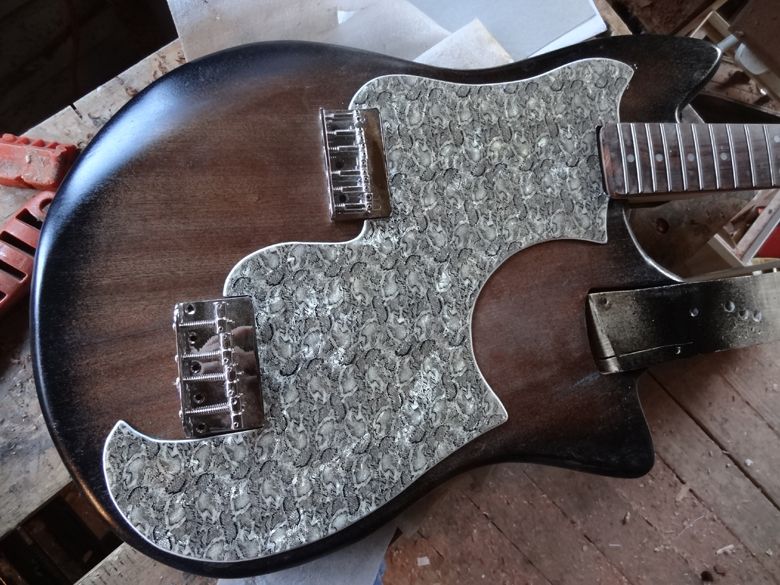
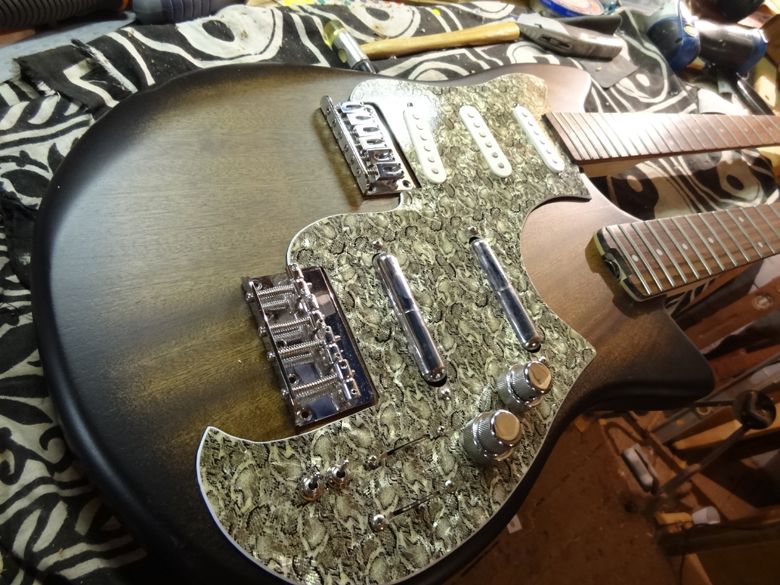
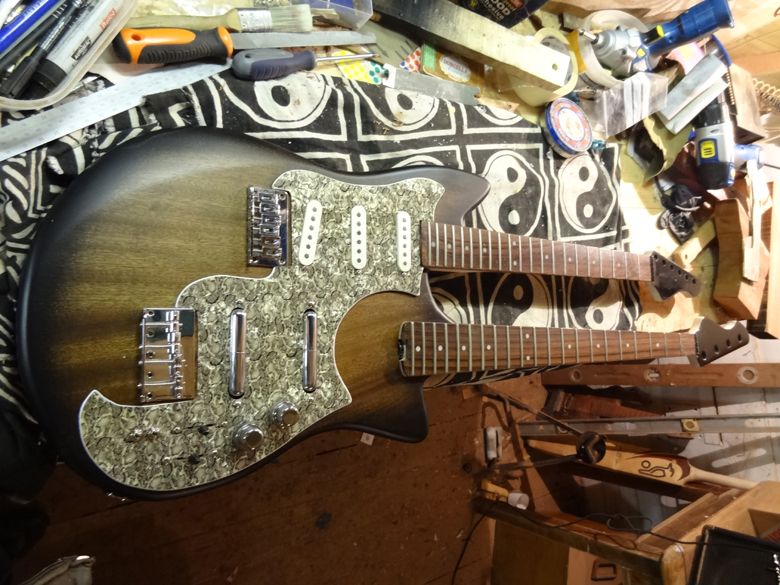
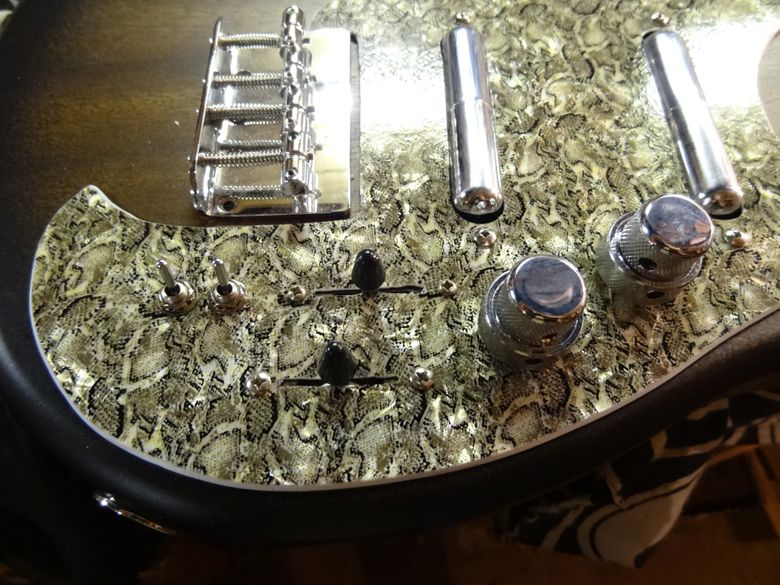
It's been a long time since I last posted on this blog (but the enthusiasm and the quality are still there!) but I didn't lose my time in the last months. You cannot only talk about guitars, you have to play them and in my case, to build them, that's why I have the pleasure and honour to present today my last baby the Epsilon, my humble attempt at combining ergonomics and coolness in a guitar...  

It does look quite cool to me, it's also very confortable seating and standing (it's meant to be played with high neck position) and it plays beautifully (thanks to its Custom Double Track Humbuckers by The Creamery). You can see a demo and have some extra info here.


Bertram

© 2015, Guitarz - The Original Guitar Blog - the blog that goes all the way to 11!
Please read our photo and content policy.

Wednesday, 14 January 2015

Doubleneck guitar and bass project - finalised!

guitarz.blogspot.com:
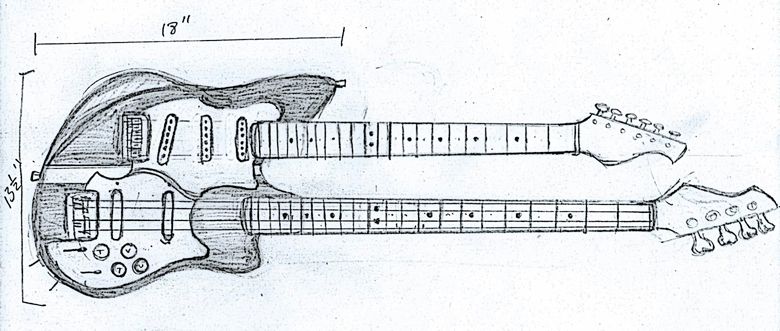
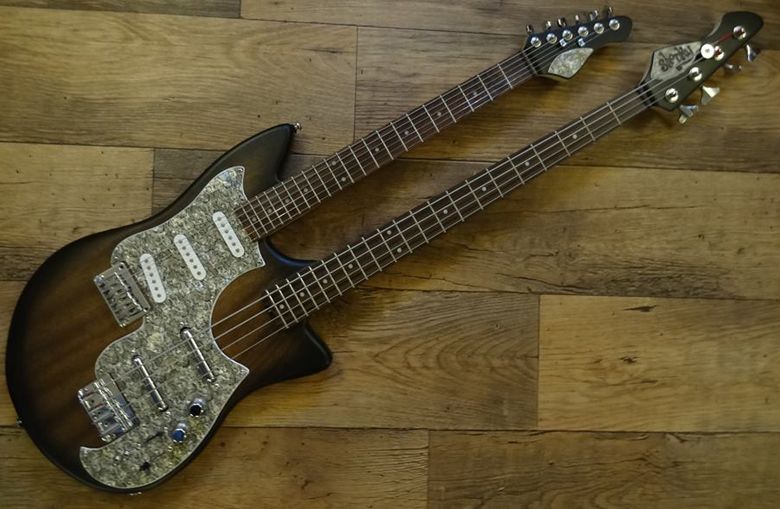
Following my October 2014 blog post asking for assistance in realising my dream of a very specific doublenecked guitar and bass, Antony Moggridge of Shonky Musical Instruments took up the challenge to build this beast for me. Above you can see his initial draft design following an exchange of emails in which I made clear exactly what I wanted.

My main specifications were for a doubleneck guitar and bass with the bass neck below the guitar neck; I wanted a compact body so as to keep the sheer bulk of instrument to a minimum; and I wanted the controls to be simple and uncluttered with NO switches on the upper bout or upper horn of the guitar, and no switches on the body in the area between necks - all switches HAD to be down the bottom at the rear of the instrument.

Together we hit upon the idea of using concentric pots for the volume and tone of each neck so as to save space and keep the control layout very simple. I also suggested that perhaps the design could be slightly Jazzmaster-like as opposed to taking its visual cues from the usual suspects (SG, Les Paul, Strat, Tele, P-Bass, etc).

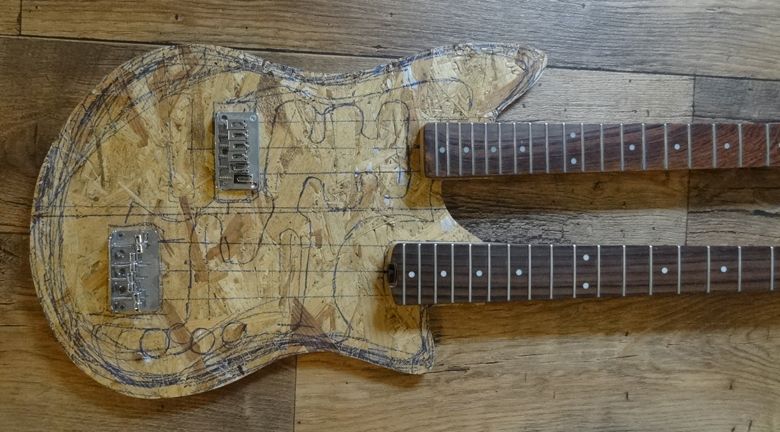
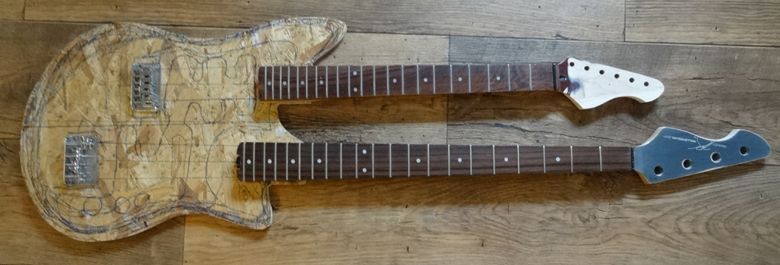
Below you see the OSB mock-up body with bridges and necks positioned to give a better idea of what the final guitar will look like.

Another constraint was that I wanted this built on a tight budget. In order to keep costs down, I sent Antony a package of components, spare parts that I already had, namely: a Strat-style neck with a trimmed headstock, a left-handed Peavey bass neck, a set of Strat-type pickups, a pair of Danelectro lipstick pickups, a hardtail Strat-style bridge, and a P-Bass style bridge.

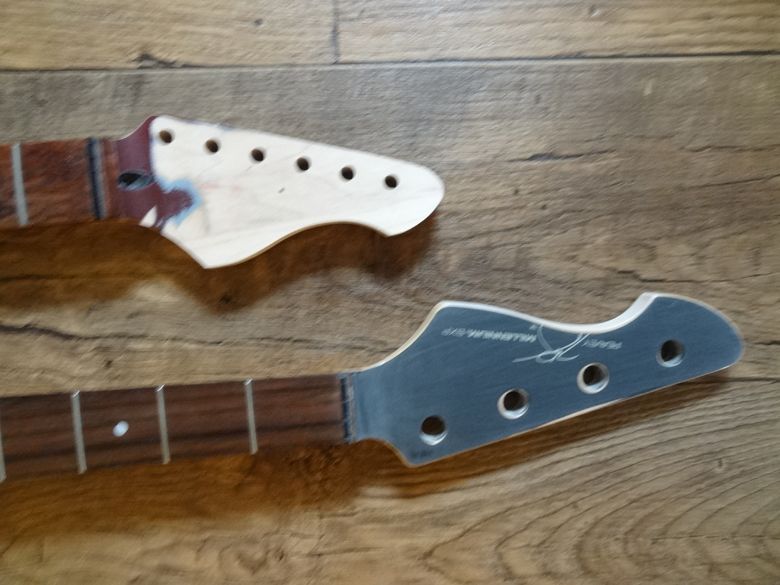
Antony re-shaped the headstocks to his own preferred Shonky style, which I agree is quite elegant. Note that in order to do so, he had to glue an extra piece of maple to the guitar headstock which had been quite brutally trimmed to vaguely resemble a 1960s-era Vox headstock.

In the next few pictures we see the shaping, contouring and routing carried out on the centre-joined two-piece reclaimed sapele body.


The next photo Antony sent to me to illustrate the size of the body. You can see that it's not a lot larger in size than the Strat body laid on top of it.

Antony initially applied a hand-rubbed stain (we wanted a natural finish as it seemed a shame to cover up the natural grain of the sapele), and then sprayed the body to accomplish a tobacco sunburst.

Here we see the perspex scratchplate (pickguard) template...

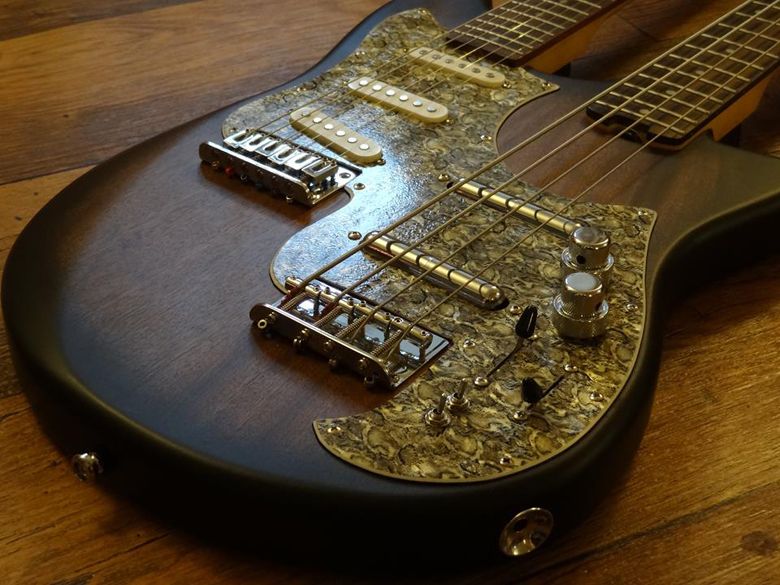
...and here is the scratchplate itself cut from some rather interesting snakeskin-effect scratchplate material that Antony had sourced. The scratchplate and bridges have been positioned on the body so as to get the general effect of how it will eventually appear.

Getting there... Hardware installed.

Necks bolted on.

The wiring was quite interesting as we have three pickups, volume, tone and 5-way selector switch on the guitar side; two pickups, volume, tone and 3-way selector switch on the bass side; and two mini-toggle on/off switches, one for each neck. Output is via a stereo jack socket to be used in conjunction with a split "Y" cable so as to send guitar and bass signals to separate effects and amps.

And all strung up and ready to go...


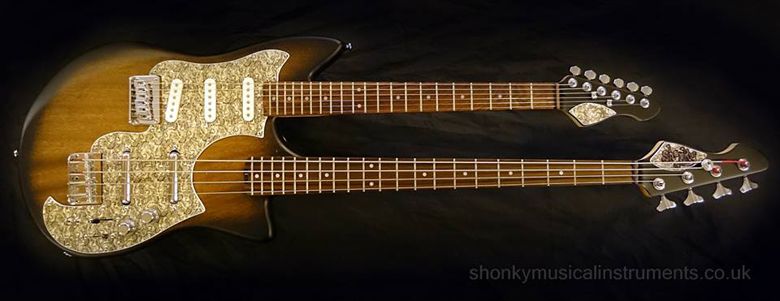
The finished item!

I've been playing this guitar/bass daily since I received it a week ago. (Antony actually finished building it in December, but we decided not to send it until after the madness of the Christmas posting period was over and done with).  I am exceedingly pleased with it and believe that between us Antony and I have come up with a fantastic design for a doubleneck.  OK, so it IS heavy at about 14lbs, but the body is nicely compact, playing the bass neck feels very natural and it is not a problem having to reach over the guitar side. The control layout is sensible and easy to use, and there are no switches in silly places where I might hit them accidentally whilst playing. Moreover, I find that it actually balances well on a strap and does not suffer from neck dive - a common complaint with doublenecks.

Antony said that in retrospect he could have made it a little lighter be removing more wood from beneath the scratchplate, and perhaps making the body shorter so that there wasn't so much wood beyond the bass bridge. But then I have to ask, would it have hung so nicely on a strap? Might that have made it neck heavy.

I played this at rehearsal with my band Spurious Transients at the weekend and it coped admirably. I've also been experimenting using the doubleneck in conjunction with the new Boss RC-1 Loop Station (the uncomplicated one!) and the results are very promising indeed.

I'm going to be playing some Spurious Transients gigs later in the year (including at this Festival of Psychedelia - hey, you can't get more prog rock than a doubleneck) and will be using this baby so I can switch between guitar and bass on the same songs.

Huge thanks to Antony (who gives his own account of the build here).

G L Wilson

© 2015, Guitarz - The Original Guitar Blog - the blog that goes all the way to 11!
Please read our photo and content policy.

Tuesday, 7 October 2014

Doubleneck guitar and bass project - your ideas and help wanted!

guitarz.blogspot.com:


I've been mulling over ideas for a guitar that I have decided I need in order to reproduce in a live situation the music I have been making in a couple of projects.

This past year I have taken to the bass guitar in a big way, so much so that it has become my main instrument. However, I still want to play guitar as well, but more than that what I'd really like to do would be to play both bass and guitar on the same songs. So, what is required is a doubleneck guitar and bass. Add in a looper pedal (or preferably two) and the possibilities are quite staggering - just check out what Kristian Dunn does in El Ten Eleven (see video clip above).

However, finding an off-the-shelf solution to a doubleneck guitar/bass combination is not so easy. Most such instruments I can find have the bass neck at the top and the guitar neck at the bottom. I can understand the logic at work here so that you have the strings across the entire instrument running from low to high, but I believe that this is not the best practical arrangement. Just think about it. For starters I'd have thought that having the longer bass neck at the bottom of the instrument would allow for better balance. But there is also the question of playability. With a bass on top you would need to rest your forearm across the longer scale bass strings in order to reach the guitar side, which could lead to unwanted damping or spurious noises from the bass if the volume for both necks was on at the same time. Also, for chordal work / strumming on the guitar I'd rather have that higher up on my body, whereas for playing bass I'm personally happier to have it slung a little lower.

So, yes, for me bass on bottom is definitely the way to go.

In which case, what options are there?
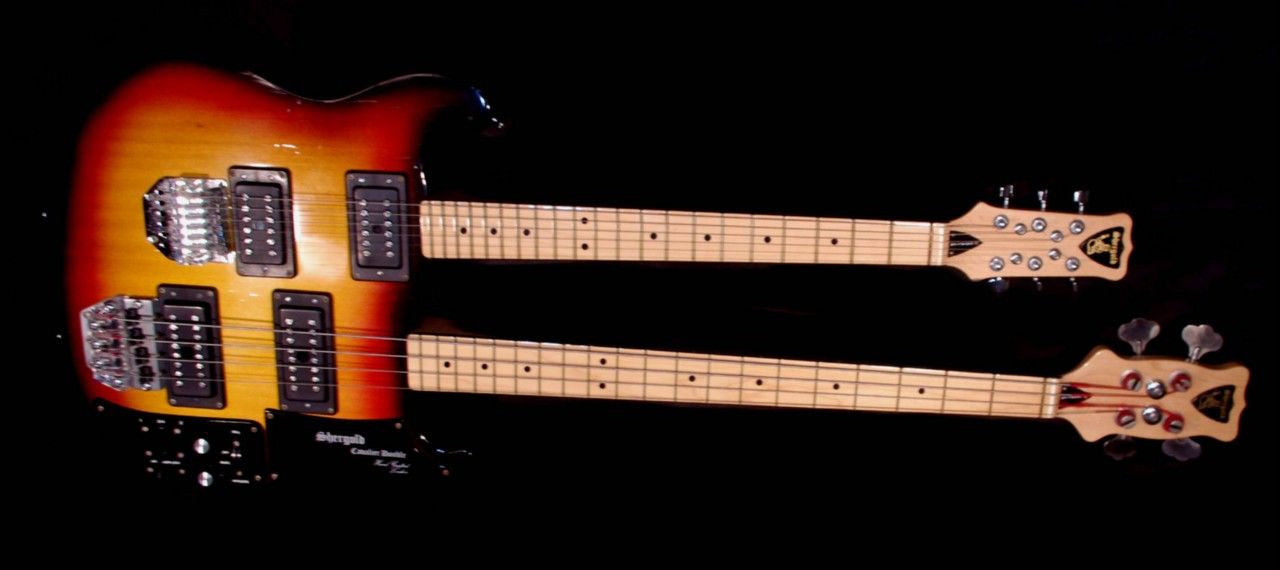

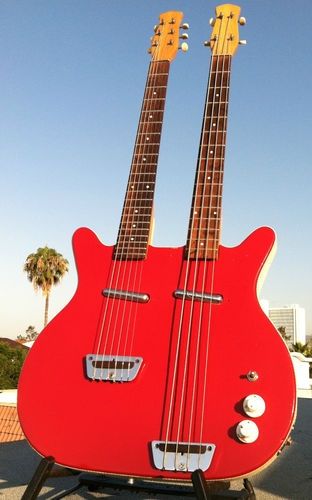
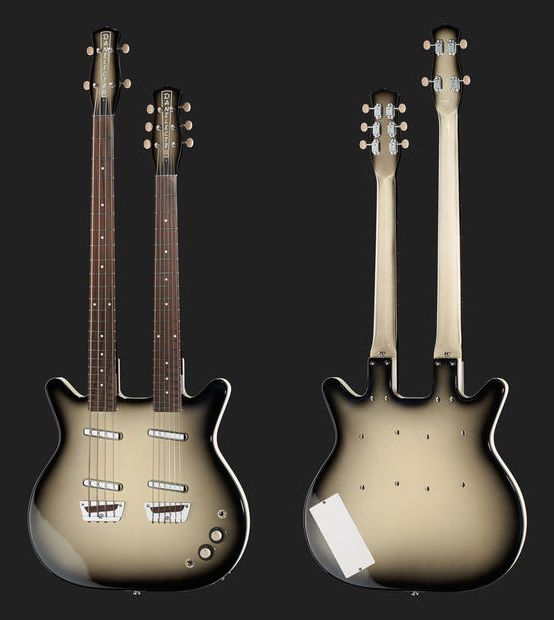
Well first off there are vintage instruments like the Shergold doubleneck and Danelectro examples pictured here.

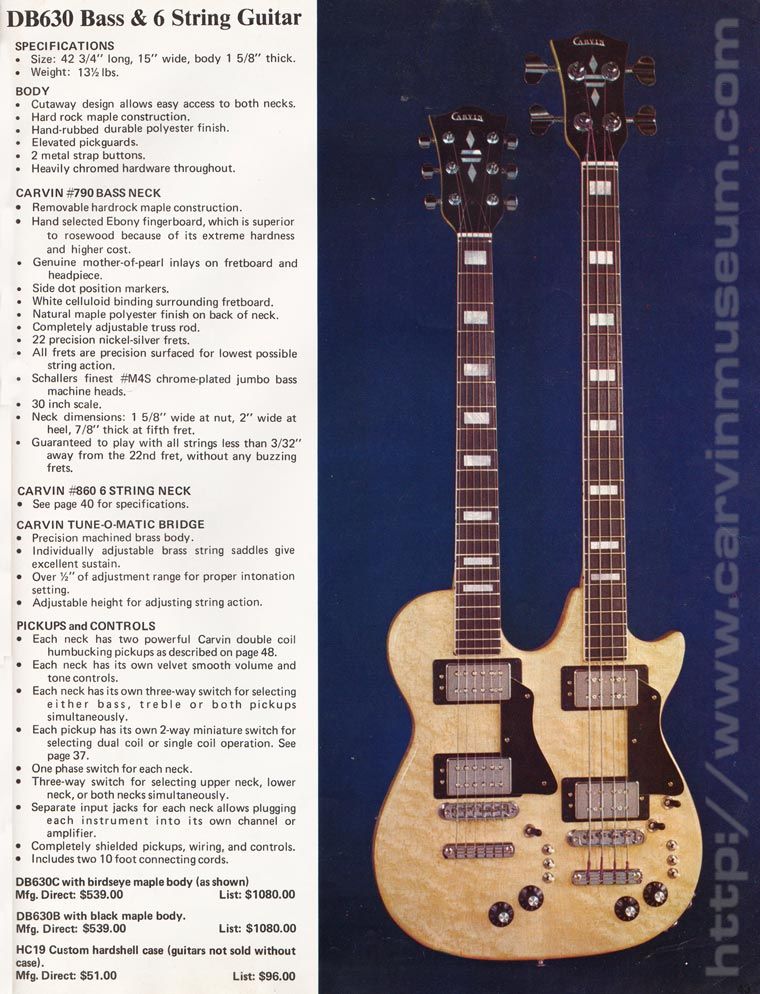
Even better would be the Carvin DB630 as used by El Ten Eleven's Kristian Dunn. It's definitely one of the better doubleneck designs I have seen; it looks a lot less cumbersome than most.

Alas, these vintage instruments are all quite rare and not very easy to track down. In the event of actually finding one for sale, it is liable to be expensive. Did I mention that my budget is limited on this project? Quite frankly, the less I can get away with spending, the better.

OK, so how about a cheaper instrument from China or Korea? There are a number of websites that feature such instruments for sale, some of which have very cheeky copies of certain big brand American guitars complete with counterfeit logos, whilst others are variations on designs from those same companies but are guitars that never existed. In this latter category are a number of doublenecks.

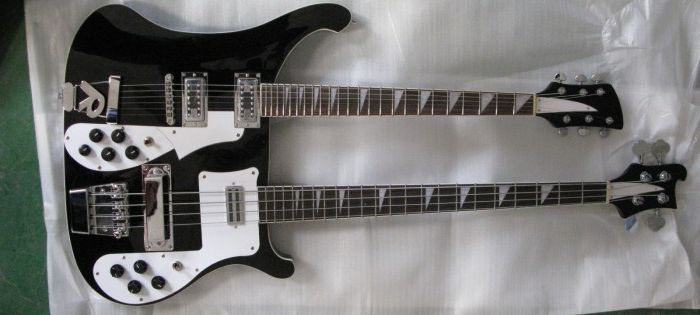
For example, this Rickenbacker 6+4. (Note that Rickenbacker's own 4080 doubleneck model had the necks the other way around with the bass on top). However, even though the Far-Eastern made Rickenbacker-influenced doubleneck has the necks in the correct formation for my requirements, just look at the size of that thing! It's much more cumbersome than I would prefer.
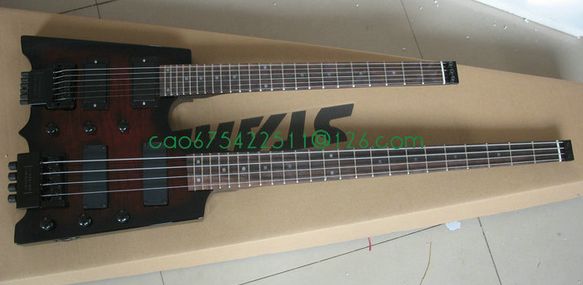
I also found this Steinberger-like headless doubleneck 6+4. With a compact body and no headstocks it shouldn't be too cumbersome. However, I could find zero information about it and looking at the photos I couldn't tell if if had one output or two (that would be ideal - an output for each neck). Looking at the control layout, I can't see any selector switches, not just for the pickups but for each side of the instrument. The use of volume controls alone would not be convenient - you'd have to raise the volume on one side of the instrument and lower it on the other. A simple switch is what is required. Furthermore, when wondering how well it would balance on a strap, I checked all the photos I could find and couldn't even see any strap buttons. It does look to be a very cheaply made instrument. Yes, I wanted cheap, but even so I would prefer to have all the basic hardware you'd expect.

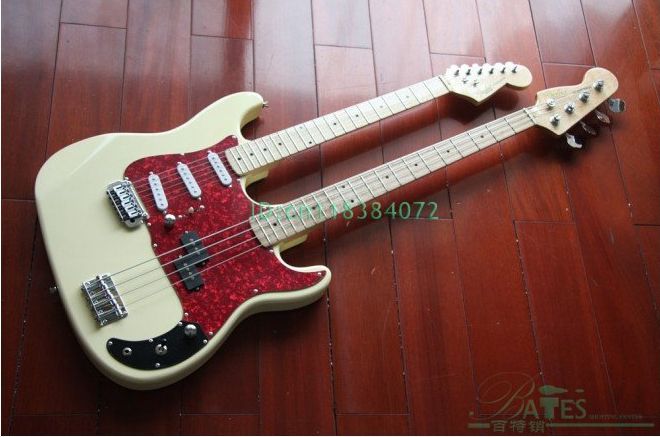
The only other doubleneck 6+4 that I could find (that is, with the guitar uppermost and the bass beneath) was this Strat/P-Bass combination. I liked this design very much and particularly liked the reverse headstock on the bass side which neatly gets around the problem of the tuners getting in the way of the opposite neck. Maybe it's a little more cumbersome than I should be aiming for, but it would indeed look very cool on stage. However, it appears to be a discontinued model and I simply couldn't find an example for sale. Quite frustrating.

OK, other options would be to commission a custom-built instrument but I've already explained that this is a budget operation, so that leaves the DIY route. Well, I've checked the doubleneck guitar kits available and can only find a 6+4 with the bass on top.

Bertram's advice to me is "try my way - cut two Squiers in halves and have them glued together by a pro." He's referring of course to his Doppelcaster, the doubleneck Telecaster that he built.

That is indeed one option, but if I wanted a doubleneck like the last one pictured above, joining a Strat body to a P-Bass body isn't quite so simple as the latter is a longer shape (remembering that I want the bass at the bottom). Then of course there is the body contouring to take into consideration. Slab-bodies would join together much more easily so maybe as Bertram suggests I should think Telecaster rather than Stratocaster.

Other guitars I considered joining together are:
  • Ibanez GAX30 guitar and Ibanez GAX150B bass. But what do you know?... The GAX150B is now discontinued and no-one seems to be selling them on eBay either.
  • Hofner Shorty guitar and Hofner Shorty bass. I thought this might allow for a nice compact design but I couldn't quite work if it was feasible to chop portions of the bodies off and join then together. There didn't seem to be quite enough material to work with. I did momentarily toy with the idea of NOT chopping down the bodies but connecting the two together with metal rods drilled into the bodies. However, I figure this would mean that the two necks would be too far apart from one another.
  • Epiphone LP Junior/Special and similar bass. As long as both were slab-bodied and of the same thickness, this could work, but I simply haven't found the necessary donor guitars for sale.
So maybe what I want to do is to take parts from a couple of donor guitars and have a new body constructed to accept the donor necks and hardware. I'm quite happy to use my cheapy no-name Chinese Telecaster for parts but haven't yet got a donor bass - I was wondering about a Squier Bronco bass maybe?

So now I'm going to be rather cheeky and ask if there are any Guitarz readers out there who would be willing to help me with this project? (Hey, I may as well take advantage of having this guitar blog!) I neither have the resources or the talent so I'm going to ask: Would someone out there be able to build me a doubleneck body? I'm more interested in function rather than it being a superb piece of first class luthiery. Obviously I'd be willing to pay but I'm not able to pay custom shop prices. It'd probably be best if it was someone in the UK or maybe Europe, so as to minimize the cost of sending parts and materials back and forth.

I am open to suggestions but at the moment, I believe what is required is a new body routed for Telecaster parts on the guitar side and probably a P-Bass on the bass side (or possibly a Squier Bronco bass - the shorter scale may make for a better balanced instrument). As to the design, that is something we could discuss further.

Please contact me by email (gavinlloydwilson@yahoo.com) or else via the comments below.
If anyone else has any ideas which might be useful please feel free to add to the discussion.

Thanks

G L Wilson

Additional: Someone has suggested that I simply buy one of these and swap the necks around. I wonder if it might be as simple as that? I can see that the bridges and pickups are in the same positions but would the neck pockets be the same size?

© 2014, Guitarz - The Original Guitar Blog - the blog that goes all the way to 11!
Please read our photo and content policy.

Wednesday, 13 August 2014

Migma 2000


In the second half of the 20th century, it was common to add '2000' to a brand or to the name of a product to sound futuristic - could be cars, radios, vacuum cleaners, toothpaste, street artists… Now in 2014, when people carry around smartphones that are more powerful that the computer that helped Apollo to fly to the moon,  it sounds very retro, like putting data on audio-cassettes, the stratocaster or Soviet Union…

So here is the Migma 2000, that must have been something very advanced at some point, the acme of socialist technopop! I still wish a guitar company would revive some east-european models from the 1960s/1970s. A few months ago Eastwood made a 'cheesy guitars' (what a stupid and insulting name) contest to have their fanbase choose a bizarre guitar to reissue, and I think they finally picked a Wandrè, but there were a Tonika and a Jolana in the lot. The choice was based on oddness, I wish they'd be genuinely interested in these guitars, and I'd love to see a brand new Migma or Orpheus or Defil, with decent wood and good electronics, like they do in China these days...

Bertram D

© 2014, Guitarz - The Original Guitar Blog - the blog that goes all the way to 11!
Please read our photo and content policy.

Monday, 28 July 2014

To all our regular readers..

...I feel I owe you guys some kind of an apology about the recent scarcity of posts. I also need to thank Bertram while I am about it, as without him we'd have had zero blog posts this last week. Not only am I getting busier and busier these days just being a musician, but I've not been able to provide you all with a regular dosage of Guitarz due to my internet connection having been either AWOL all week or otherwise so SLOW that successfully posting onto a blog would be a monumental feat of endurance. Please bear with me guys... In fact, if anyone would like to join the team and help post weird and wonderful guitars on here, then I'd like to hear from you.

G L Wilson

Saturday, 4 January 2014

"Why I Love My Acoustic Guitar"!

guitarz.blogspot.com:

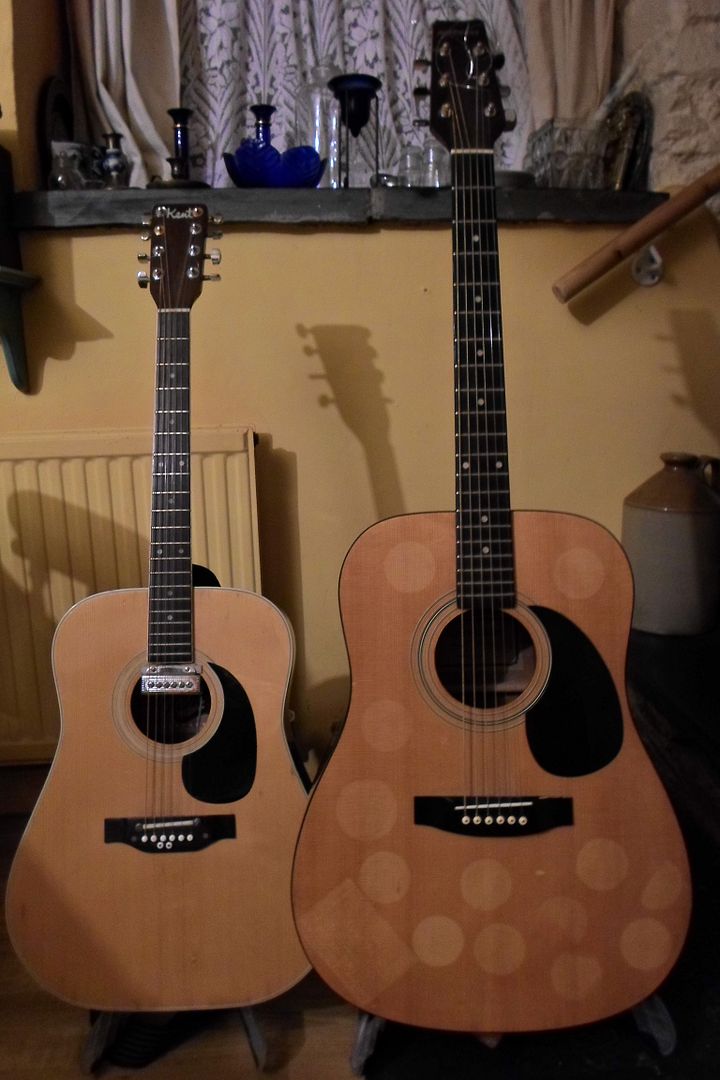
I was recently asked to contribute a few words to a Musician's Friend blog post entitled "Why I Love My Acoustic Guitar". I mentioned my Hurricane BF-402 and self-customised Kent 8-string both of which I have written about here before.

Isn't it typical that both these guitars are now out of action? The Kent needs a bit more setting up as the action (no doubt increased by the additional tension) is making it a chore to play but also there's a fault in the wiring of the Hofner pickup I added. It shouldn't be too much of a job to sort out but it's not a guitar I play very much and so it's a job that's been consigned to the backburner.

Of more concern is my hitherto trusty Hurricane which has seen me well through many guitar club meetings, practice sessions, the odd open mic night and occasional performances. Not only has the bridge started lifting but it has developed an annoying buzz on the low E string. A closer inspection shows the neck is starting to do an impression of a banana. These are things that can be fixed, but I figured, this guitar cost me £20 (plus £10 shipping) a couple of years ago and I've had loads of playing time out of it; it's time to retire it and take the plunge and get a new guitar.

After a lot of research - because I am on a limited budget - I have now ordered a new acoustic guitar which I have high hopes for and should be receiving some time next week. I'll post about it again once I've had the chance to have a play and make some kind of evaluation.

G L Wilson

© 2014, Guitarz - The Original Guitar Blog - the blog that goes all the way to 11!
Please read our photo and content policy.

Tuesday, 19 November 2013

Kay Montclair Apollo


For a guitar lover, it's not unusual to be attracted to a vintage guitar for its mere cultural, historical or collectable value. Cult of the past is a trait shared by most human cultures, and all that is left to postmodernity is to finally exhaust itself by celebrating its own short history… 

But to me this Kay Montclair Apollo is appealing for its own sake, for its beautiful outline and the way all its elements balance each other. I don't know if the people who designed this kind of guitar were just brilliant or if my taste has been shaped by such instruments, but as an art and design enthusiast, I have no problem comparing it to most refined furniture one can admire in museums. It is based on the same feeling of pure outline - though this guitars's beauty doesn't come from sophisticated delicacy but honesty, ergonomics, constructivism and an acute sense of proportions and unity. I'd be curious to know where the anonymous guy who designed this curved pickguard got his skills.

Sometimes we're so used to these vintage guitars we enjoy so much that we don't really look at them, we're just reacting to their presence, but thanks to this good old Kay, I feel like watching again carefully every guitars I've been probably overlooking lately.

Bertram D

© 2013, Guitarz - The Original Guitar Blog - the blog that goes all the way to 11!
Please read our photo and content policy.

Friday, 15 February 2013

Musima 1657B hollow body bass


This Musima 1657B may seem unimpressive - a mere approximative copy of a Gibson EB-2 bass -, but I like it a lot: not only have I a thing for hollow body basses but I myself have a Musima 1657B and I'm very happy of it. 

I bought it by chance for 150€ on a Berlin flea market - I just wanted a cheap bass to learn how to play, but it got me into vintage guitars and east-European instruments! It's dark red and is better preserved than this one, which had its pickups, knobs and tuners replaced. 

Bertram D

© 2013, Guitarz - The Original Guitar Blog - the blog that goes all the way to 11!

Sunday, 23 December 2012

Ovation Breadwinner Limited - the one and only!


Yes, I know you've seen an Ovation Breadwinner Limited on Guitarz already (here and here - there's everything you need to know on these previous posts), but come on, who can stop contemplating this marvel? 

I'm very in love with this guitar, as I am with its older sister the Breadwinner that I have the honor and pleasure to possess since 20 years - I still feel lucky to have had the opportunity to buy it as a young guitarist and use it on stage as my main guitar for many years!


And it's only after GL Wilson invited me to write for his blog that we figured out that we were both Breadwinner cultists, and we knew we would get along!

OK, enough blah-blah, kneel down and adore!

Bertram D

© 2012, Guitarz - The Original Guitar Blog - 10 years and counting!

Sunday, 16 September 2012

Guitarz Calendar for 2013... contributions wanted

guitarz.blogspot.com:

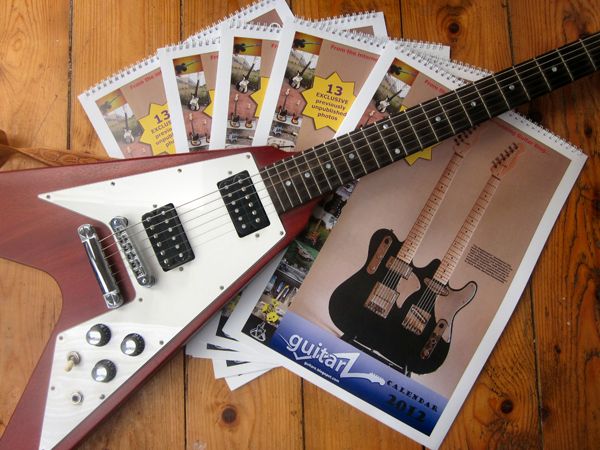
This time last year we were busily putting together the Guitarz 2012 calendar (as pictured here). Because of a distinct lack of finances, until very recently I had thought that we wouldn't be able to produce another for 2013, however we now have a plan to go ahead with a 2013 calendar after all!

So, we are now wanting photograph submissions of YOUR unusual guitars - the stranger the better! Please no ordinary Strats, Teles, Les Pauls, etc - we all know what they look like already - they'll need to be really interesting customisations or variants if we are to feature any of these!

Photos should be high resolution, and should feature the whole length of the guitar face-on (so no chopped off headstocks please). From having compiled the Guitarz 2012 Calendar, I found out the hard way that landscape-orientated photographs fit the page a lot better than portrait pictures, so landscape pictures would be preferred.

Please keep backgrounds either neutral - and uncluttered - or else photograph the guitar in an interesting setting - but the focus of the photograph MUST be the guitar itself. Please avoid clutter and any extraneous objects - photographs should be composed artfully. Please no guitars laid on a bedsheet.

Obviously as it's for a calendar, we can only use 12 photos - one for each month - plus another photo for the cover, so we will choose from the best pictures submitted. Sorry, it will not be possible to use every submission but perhaps some can make it onto the pages of the blog itself.

Email photos to gavinlloydwilson@yahoo.com

G L Wilson

© 2011, Guitarz - The Original Guitar Blog - 10 years and counting!

Sunday, 2 September 2012

1976 Mosrite Bicentennial acoustic guitar ... + speaking of anniversaries...

guitarz.blogspot.com:
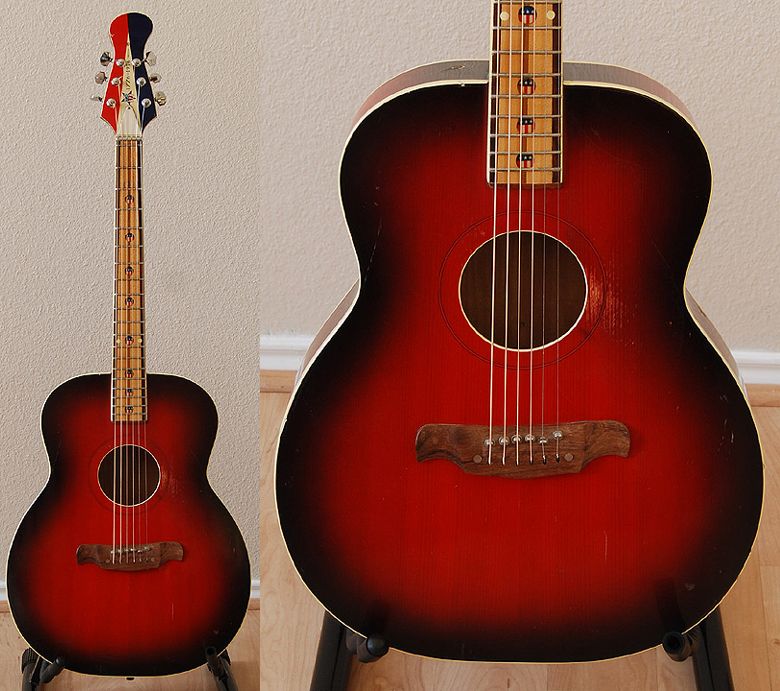
We don't normally associate Mosrite with acoustic guitars, but this Mosrite Bicentennial edition from 1976 proves that they did indeed produce such guitars. For those outside of the USA, that's America's bicentennial being celebrated, not Mosrite's own! The headstock shape on this guitar is interesting too, and is a departure from the shape with the M cutout that we expect to see on a Mosrite guitar.

Anyway, speaking of anniversaries, I've managed to miss ours again! Indeed, last Tuesday was the 10th Anniversary of the Guitarz blog - the world's first and longest running guitar blog! I had earlier in the year planned on making the announcement with quite a fanfare, giveaways, competitions, etc etc, but the brutal truth of the situation is that I am absolutely broke and simply can't afford the extravagance. I had hoped to produce a Guitarz calendar for 2013 too, but again I really can't afford to do so. Sorry for the sob story... All I can promise is that I hope and fullt intend to continue bringing you a daily dose of weird and wonderful guitars for as long as I am able.

G L Wilson

© 2012, Guitarz - The Original Guitar Blog - 10 years and counting!

Sunday, 15 July 2012

Plankaster demo


Since on the Guitar Blog we always speak in the first person - for we are not part of these self-proclaimed experts having valuable and objective point of views on everything guitar-related -, I can today shamelessly post about my very own stuff. 

You may know that once in a while I painfully build a coarse and rudimentary guitar out of a piece of junk wood I picked in the street. My friend David B. who plays guitar for his band the Dirty Primitives asked me to make him a telecaster version that would suit his rough and creative blues style... I let you judge by yourselves if it's of any relevance, but I'm proud of this baby, like any father would be!

Bertram D

© 2012, Guitarz - The Original Guitar Blog - now in its 10th year!

Sunday, 13 November 2011

2010 Kay Thin Twin Reissue and other stuff

A certain taste for vintage guitars that may transpire in my posts on Guitarz is in no way a nostalgia for a lost golden age, nor a cult of the origins (who could seriously believe that by some miracle the (almost) first three solid body electric guitar models ever conceived and produced in the 1950s by different companies are perfect and unsurpassed since?) It's just that at some point there've been a global explosion of creativity in guitar making following the invention of the instrument and of the music that fit with it, and there is a lot to learn from it.

You had the same happening in the 1910s, within a few years art and history changed radically due to creative emulation of artists all over the world, and one century later people are still trying to digest, explore and expand the potential of the historical avant-gardes: cubism, futurism, constructivism, dada, fauvism, neoplasticism, etc... Same in music with the 1960s British invasion or the late 1980s rise of electronic music.

And something happens in every domain and all the time, you have people who create things, and then you have people who bank on them - these things require different skills and spirits, so it's rarely the same people. You have also times for creativity and then you have times for making money - we're living such times when it comes to guitars... Imagine that in computers: people would buy huge slow square grey IBM PCs because they're so cool, and that's how Don Estridge invented them back in the day!

Anyway, let's go back to vintage guitars: there are roughly four things you can do with vintage guitars: you can preciously collect old instruments, hoping to get one in mint condition but a beaten one is also cool, and worship them while they gain more value year after year and end up keeping them in a safe. You can copy classic models again and again because, you know, that's the way Leo and Les did them and there's nothing more to do - and it sales -, and saturate the market until people cannot even imagine anymore that there are other guitars out there. You can re-issue vintage creative models so you can benefit from the vintage trend while diversifying and rejuvenating the offer, and as wrote 18th century French poet Antoine Houdard de la Motte: "l'ennui naquit un jour de l'uniformité (boredom was born from uniformity)" (now find other guitar blogs quoting 18th century French poets!). Or you can study the great guitars from the past, get inspired by their audacity with the distance given by time, and create the guitars of the 21st century!

The re-issue is a good starting point, and it's happening more and more since Eastwood started the trend in 2001. Now you can find Eko's lovely guitars new and functional, and reissued 1952 Kay Thin Twins.  This is not the original Kay company that provided so many budget guitars to American players between the 1930s and the 1970s (remember that Kay claimed to have produced the first electric guitars, using pickups several years before Gibson - historians must work on that!), but it's not like we're talking about high-end handmade guitars made by master luthiers in an hidden Shaolin temple. The Thin Twin got its name from its thin blade pickups sticking right out of its hollow-body. It's the kind of instrument on which blues became rock'n'roll out of the spot-lights...

Bertram

© 2011, Guitarz - The Original Guitar Blog - now in its 10th year!

Sunday, 21 August 2011

Four Nick Page Baron Interceptors made in Berlin

Baron Interceptor Tiki

Baron Interceptor Stingray

Baron Interceptor 1813

Baron Interceptor Blue Paisley

Once again I've been visiting Nick Page's website and once again I was not disappointed - if I may say, Page's guitars are getting better and better, and they'd started already quite high. 

You probably remember the Baron - whose prototype I discovered on the workbench three years ago, and it was already exciting. Well it's been now upgraded to the Baron Interceptor - just by having its body reversed. It's quite a bold move from Nick Page, since it's usually what Gibson does (when they need a new fancy model and can't come up with a new idea - in the last 50 years...), but in the case of the Baron it really works.

The non-reverse Baron was conceived as an hybrid of Fender and Rickenbacker, this simple procedure added a strong Mosrite/Ibanez Iceman feel (and I noticed since GL's post last week that it also has similarities with the Quest Manhattan series but I don't know if it's deliberate or a coincidence), but the Interceptor is unique and one of the most beautiful guitars ever - and it is my new dream guitar - I would even choose it over a Mosrite (I finally saw and tried a vintage one last week at my local guitar shop, it weighs almost 6 kilos, you can't play that on stage!).

As you can see all the Interceptors are one-off custom models and I know already how would be mine if I could order one: it would combine the Junior style metal pickguard and the wood texture of the Tiki with transparent black finish and white binding like on the Stingray, the stoptail and two Filtertrons of the Blue Paisley and the telecaster control plate of the 1813...

Thanks again to all the small luthiers who keep the spirit of innovation in the electric guitar field alive, when the big companies, once pioneering, are just busy cashing in.

Bertram

© 2011, Guitarz - The Original Guitar Blog - now in its 10th year!

Wednesday, 17 August 2011

The inevitable Hopf Saturn 63


Showing the Hopf dreadnought two days ago reminded how my interest for guitars was expanded from instruments to play music to guitars as cultural objects - combining history, design, technology - because one of the triggers was seeing the famous Hopf Saturn 63, first its Eastwood reissue, then the real thing. 

So far I already had good taste I guess since I owned a Rickenbacker 620 and an Ovation Breadwinner (quite abused by almost 20 years on stage), but they were uneducated choices, and I just got very lucky (and had a good local guitar shop, I'll never thank its owner enough). The Saturn opened my horizon, I discovered vintage guitars and the current vintage cult, alternative designs, I got into guitar making and blogging, and I improved my guitar playing by understanding much better my instruments!

The Saturn also revealed to me the unexpectedly broad field of German vintage guitars, about which I had no cue! And I can give you a little tip, if you want to buy a second hand guitar online, check eBay.de, it's the biggest market on continental Europe!

Bertram

 © 2011, Guitarz - The Original Guitar Blog - now in its 10th year!

Monday, 4 July 2011

Rickenbacker 330 in Chrome Finish


Look at this, this guy refinished his Rickenbacker 330 - a magnificent guitar - in chrome, so he can boldly play over the Jam in his basement! One of the most radical and beautiful custom paint job I've ever seen, I so love this guitar!

And I hadn't listened to a song of the Jam for 10 years! I even had forgotten that with my first band we covered Running on the Spot back in the 20th century...  

Bertram

© 2011, Guitarz - The Original Guitar Blog - now in its 10th year!

Sunday, 26 June 2011

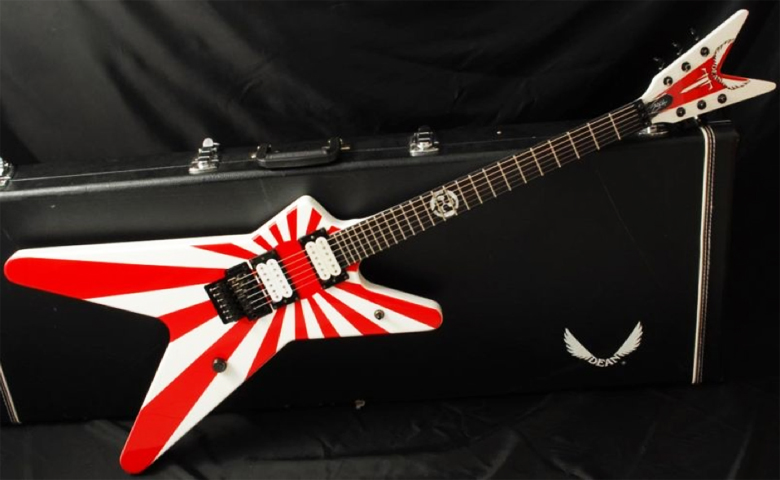
Dean ML Matt Heafy (from Trivium) Signature with Rising Sun Japanese War Flag Finish (I so love long titles)


Something I still quite don't get about electric guitars - though I've been interested in the topic for the last three decades - is that their design is supposed to determine the kind of music that should be played on them... The idea that a musical genre depends from the sound of specific gear - pickups, amp, effects - is already bizarre to me, since reproducing a sound and a style that already exist feels of limited interest if you're a spirited musician, but when it comes to looks, we are in the blur domain of utter stupidity...

Take for example this Dean ML with its Rising Sun finish: all the reviews I read about it say that its clean sound is quite good, that its neck is extremely playable and its special design makes it both well balanced and good-sounding, making it a perfect guitar for blues. Well, it's no surprise, since it's more or less a combination of Gibson's classic models, the Flying V and the Explorer, both designed in the 1950s and meant for bluesmen. And those humbucker pickups have been on jazz guitars for over half a century, so it's for sure a perfect instrument to play Hoochie Coochie Man - or Boys Don't Cry if you feel like it. 

The fact that this ML is the (short lived) signature model of the guitarist of some metal band called Trivium that I never heard about due to my general indifference to metal music (but a few bands like Suicidal Tendancies, Napalm DeathBurzum, Meshuggah or Sunn o))), but I'm not so sure of what should be called metal or not, and should Motörhead be included?) is of little importance, but this guy being half-Japanese kind of justifies the cool Rising Sun finish.

Yeah, I say again that the Rising Sun looks cool on a guitar, even if last time I said this there's been a slight controversy about it. For me, it's a beautiful design, very Japanese, sober, eloquent, and it's really part of European punk culture - I guess I love it since I saw it on a Clash cover in the late 70s, don't remember which one, not even sure BTW. I personally find it less disputable than the Confederate Battle Flag that ornates other signature models of the ML, and it is still in use in Japan for example for the fishermen union, and on the front page of some newspaper - nothing like the Svastika that is drastically forbidden in Germany (I'd probably think different if I was Chinese or Korean of course).  

Bertram

© 2011, Guitarz - The Original Guitar Blog - now in its 10th year!

Saturday, 14 May 2011

ESP Doraemon (slight return)

guitarz.blogspot.com:

Firstly, before I comment on the lovely guitar pictured here, I'd like to apologize for our brief hiatus. Blogger were having technical issues and whilst they were sorting these out, somehow, Thursday's blog posts went missing.

According to Blogger all missing posts have now been restored across their network of blogs... but not on Guitarz, so it seemed.

However, I was able to cobble together something to replace the missing post about the Argentinian Morgan guitar from what little text I had already copied over to our Facebook page.

As to Bertram's post about the Hoyer solidbody, ironically I was able to reconstruct that from one of those dreaded scraper blogs! Which doesn't stop me from wanting to eradicate said scraper blog from the face of the blogosphere. Seriously, these scraper blogs are one big headache, and now I am up against the 4th one I've had to wage war with since the beginning of April. If anyone has any good workable ideas about how to contend with this menace, then please contact me, I'm all ears. But I am going through the official channels, reporting them to Google Ads, etc - trouble is that takes time to sort out.

Anyway, long-term readers of the blog may recognize the ESP Doraemon guitar which we originally looked at in December 2008. Still, it bears repeating because it is such an oddball guitar, and we now have many more readers who may have missed it first time around.

Japan is the source of some particularly wacky guitars, but I think for me, this is my favourite. Unlike many novelty guitars - particularly those of the cartoon character with built-in speaker variety - it actually sounds pretty damned good as this video (below) will testify.


Doraemon himself, eponymous star of a Japanese manga comic series which first appeared in 1969, is a robotic cat from the 22nd century sent to aid schoolboy Nobita Nobi.

As to the ESP guitar, it certainly wouldn't win any prizes for ergonomics! Nevertheless, I would love to have one, if only for kitsch value.

Thanks to Bill Cesavice who saw this auction on eBay. ($519.99 Buy It Now price, if you're interested).

G L Wilson

© 2011, Guitarz - The Original Guitar Blog - now in its 10th year!

Tuesday, 15 February 2011

Danelectro Longhorn Baritone Reissue

This Danelectro Longhorn Baritone is a guitar about which I can honestly tell: 'I love it', because I do own one and each time I put my fingers on it I feel that it was a good move to get it!

Of course it has the characteristics of Danelectros - super light toy-like body made of masonite, non-versatile lipstick pickups, minimal gear and electronics, but what it does, it does perfectly, its sound is unique, its unusual shape happens to be quite ergonomic, and its extreme 760 mm scale (metric system, yeah) gives it a deep and twangy voice.

This one is a 2007 reissue, a limited edition in mate black finish that you won't find easily already nowadays. Sometimes I think that I should have bought 5 - it's also quite a cheap guitar - because I'm not sure I will find it ever again and I will want to play it always (for my next show I will play a Jacques Brel song in the style of Angelo Badalamenti, and it sounds wicked on the Longhorn)...

Bertram

Guitarz - The Original Guitar Blog - now in its 10th year!

Saturday, 1 January 2011

Jerry Jones Baby Sitar


A good catch to start 2011, this Jerry Jones Baby Sitar is the coolest thing ever, I dream of it since I discovered it! 

It is undoubtedly a guitar, with just a special bridge producing a buzz reminiscent of the indian sitar sound - most of the sitar heard in 60s psychedelic pop songs were actually produced with such an instrument!

Like all the Jerry Jones guitars, the Baby Sitar is originally a short lived Danelectro model, reissued by Jerry Jones during Danelectro's long gap in guitar production, with wooden bodies instead of the Dano trademark masonite though.

The Baby Sitar's body is loosely shaped like the gourd used for a real sitar, as is the headstock - a quite clumsy choice IMHO. It has the typical lipstick pickup perfectly adapted to the twangy sound of the mock sitar. I love the curved leg rest that prevents the Baby Sitar from being difficult to play while sitting - and you feel like sitting while playing sitar, don't you?

Contrarily to the original Danelectro, the Jerry Jones Baby Sitar is still available nowadays, though I find JJ instruments quite unaffordable, especially for an instrument you won't play full time...  I've been interested in guitar sitars for a while and you can find a few conversion buzzing bridges to turn regular guitars into electric sitars. But they  also quite expensive and - according to the reviews - rather unreliable and extremely difficult to set: there is a conflict between necks radius and the need for each of the six the strings to be stretched evenly flat over the 5 cm long bridge against which its vibration produces the buzzing sound. But I recently discovered a German company that issued Telecaster buzzing saddles so - for those who are interested in my humble activities - since I had planed to build a butcher block telecaster soon, I decided that it will be a sitar one... I'll keep you posted!

Bertram

Guitarz - The Original Guitar Blog - now in its 10th year!

LinkWithin

Related Posts with Thumbnails

ShareThis