guitarz.blogspot.com:
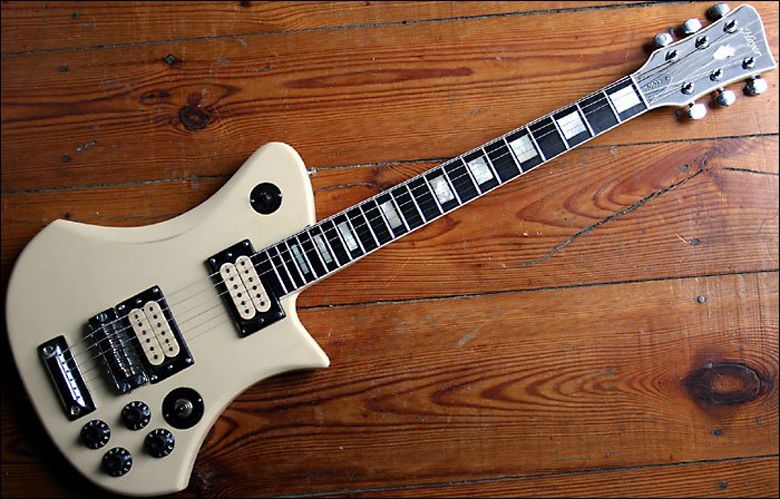
This 1970s German-made Hoyer 50603 has a body shape strangely reminiscent of certain Guild guitars (e.g. this one), and is one of those designs that I look at and say to myself, "Is it ugly? Is it attractive? I can't decide!"
The guitar features a pair of DiMarzio Super Distortion humbuckers (as was fashionable at the time) with a volume and tone control for each and a pair of switches, one of which will be the pickup selector, but as for the other... Anyone out there know? Coil top or phase inversion, maybe?
This guitar is currently located in Berlin, and is listed on eBay.de with a Buy It Now price of €799.
G L Wilson
© 2013, Guitarz - The Original Guitar Blog - the blog that goes all the way to 11!
Please read our photo and content policy.
Showing posts with label DiMarzio. Show all posts
Thursday, 25 July 2013
Thursday, 18 October 2012
Lado Guitars "The Condor" - one of only 100 built from 1981
guitarz.blogspot.com:
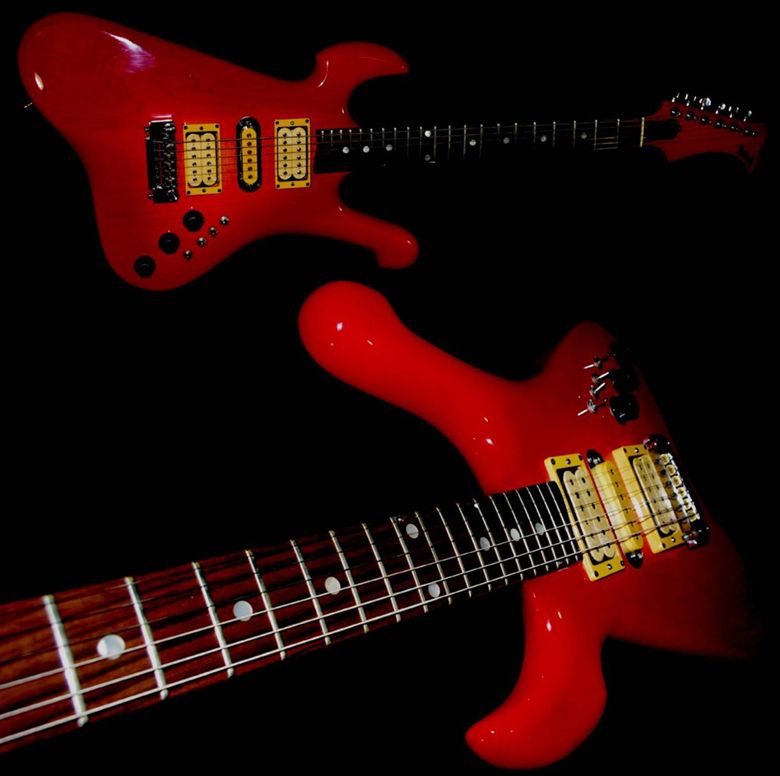
From some angles this guitar reminds me of Brian Eastwood's Bender Distortocaster.
Built by by Joe Kovacic, a.k.a. Joe Lado, in Ontario, Canada, it's a Lado Guitars Rooster 1 from 1981 (you may have guessed the age from the presence of DiMarzio pickups, which were almost omnipresent on guitars of this era), and is #57 of only 100 such examples.
Currently being offered for sale on eBay with a Buy It Now price of US $2,995.
G L Wilson
© 2012, Guitarz - The Original Guitar Blog - 10 years and counting!
From some angles this guitar reminds me of Brian Eastwood's Bender Distortocaster.
Built by by Joe Kovacic, a.k.a. Joe Lado, in Ontario, Canada, it's a Lado Guitars Rooster 1 from 1981 (you may have guessed the age from the presence of DiMarzio pickups, which were almost omnipresent on guitars of this era), and is #57 of only 100 such examples.
Currently being offered for sale on eBay with a Buy It Now price of US $2,995.
G L Wilson
© 2012, Guitarz - The Original Guitar Blog - 10 years and counting!
Friday, 10 August 2012
1978 Renaissance bass in black lucite
guitarz.blogspot.com:
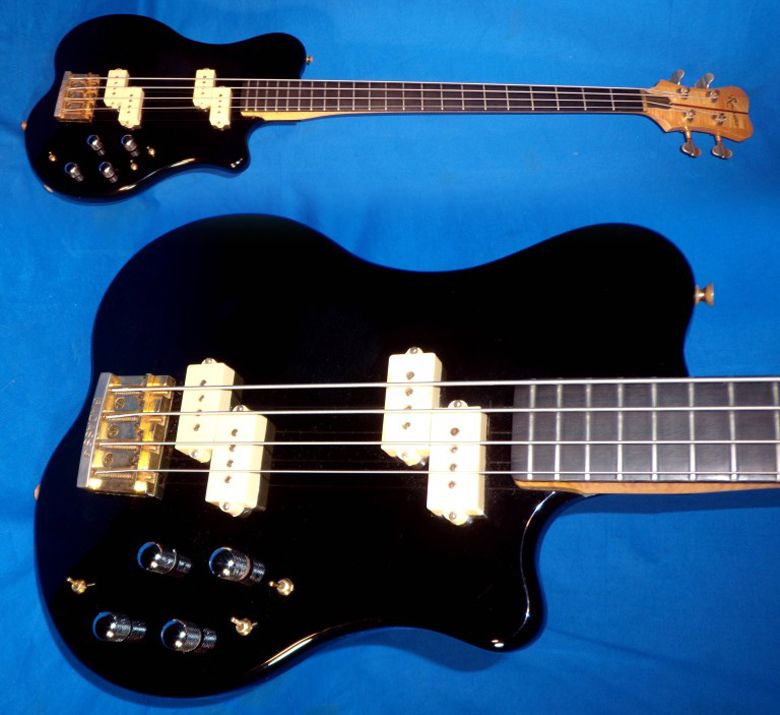
Following on from the fabulous Fender lucite prototype, here's another lucite-bodied guitar, this time it's a Renaissance Bass from 1978 with a body fashioned from opaque black lucite rather than the usual see-through variety.
Renaissance guitars also appeared with see-through lucite bodies (such as this example) and with smoked-effect lucite (see this other example).
Renaissance guitars and basses were produced between 1977 and 1980 in Pennsylvania. As well as lucite bodies, guitars and basses featured DiMarzio pickups and active electronics.
This bass is currently listed on eBay with a Buy It Now price of $2,795.
G L Wilson
© 2012, Guitarz - The Original Guitar Blog - now in its 10th year!
Following on from the fabulous Fender lucite prototype, here's another lucite-bodied guitar, this time it's a Renaissance Bass from 1978 with a body fashioned from opaque black lucite rather than the usual see-through variety.
Renaissance guitars also appeared with see-through lucite bodies (such as this example) and with smoked-effect lucite (see this other example).
Renaissance guitars and basses were produced between 1977 and 1980 in Pennsylvania. As well as lucite bodies, guitars and basses featured DiMarzio pickups and active electronics.
This bass is currently listed on eBay with a Buy It Now price of $2,795.
G L Wilson
© 2012, Guitarz - The Original Guitar Blog - now in its 10th year!
Sunday, 28 November 2010
Another DiMarzio Cellophane Strat
guitarz.blogspot.com:
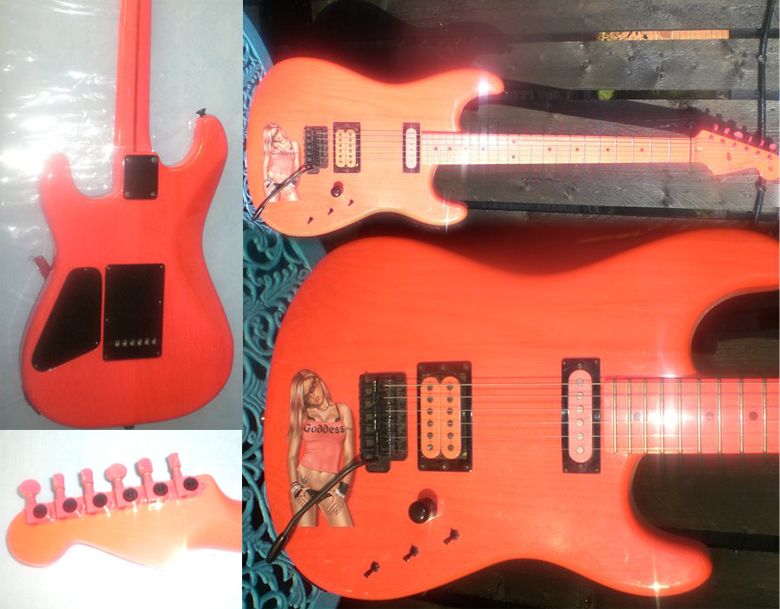
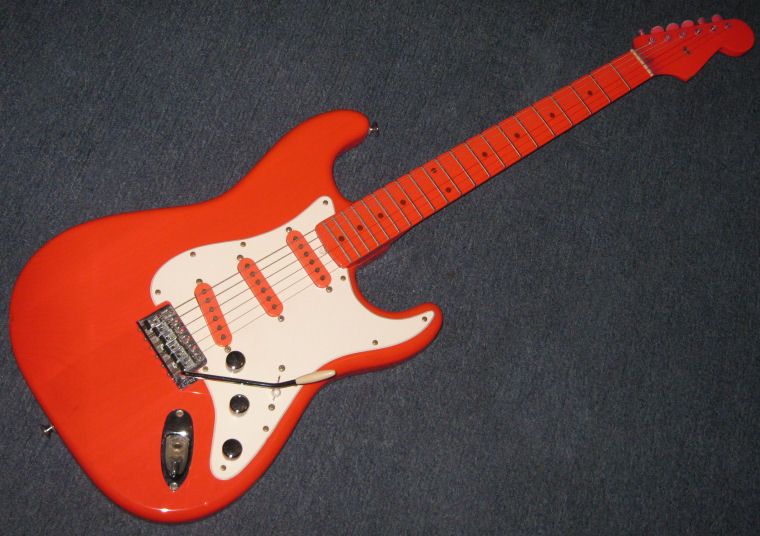
Regular readers of Guitarz will no doubt be familiar with my DiMarzio Cellophane Strat which I have posted about several times. Frank from Denmark has another one (pictured above) - indeed he's currently offering it for sale. He describes it as being pink rather than red, so I'm not sure if the finish is quite the same as mine or if we are interpreting the same colour differently. (Mine can appear red, pink or orange depending on the lighting conditions). His also differs in being routed from the rear for the controls, having a different pickup and control layout and a 22-fret neck as opposed to my guitar's 21-fret neck.
It's nice to see another one of these turn up. They are quality guitars and seem to be quite a rarity. I have owned seven Stratocasters over the years, and my Red Beauty has been my favourite one - and the one I would keep now if I had to have a Strat cull from my collection.
G L Wilson
Guitarz - The Original Guitar Blog - now in its 9th year!
Regular readers of Guitarz will no doubt be familiar with my DiMarzio Cellophane Strat which I have posted about several times. Frank from Denmark has another one (pictured above) - indeed he's currently offering it for sale. He describes it as being pink rather than red, so I'm not sure if the finish is quite the same as mine or if we are interpreting the same colour differently. (Mine can appear red, pink or orange depending on the lighting conditions). His also differs in being routed from the rear for the controls, having a different pickup and control layout and a 22-fret neck as opposed to my guitar's 21-fret neck.
It's nice to see another one of these turn up. They are quality guitars and seem to be quite a rarity. I have owned seven Stratocasters over the years, and my Red Beauty has been my favourite one - and the one I would keep now if I had to have a Strat cull from my collection.
G L Wilson
Guitarz - The Original Guitar Blog - now in its 9th year!
Thursday, 27 May 2010
DiMarzio DP408 Virtual Vintage '54 Pro
Sometimes I don't know who is more particular about the particulars; physicists, art collectors, or Blues Guitarists. I can't even begin to count how many times I've had to referee a near bare-knuckle brawl over which was better; "Ceramic" Capacitors or "Paper in Oil". Holy Moley, the level of detail that is debated about guitars.... so, am I completely out of my mind to even bring up the topic of "Best Blues Guitar Pickup" ?Totally.
But first, we must take a moment for my disclaimer: Discussions of guitar pickups are more subjective than that of lovers and football teams. Everything that follows here is merely my opinion. I do not claim to be right, smarter than the average bear or more experienced than the next civilian. I am not a doctor, nor do I play one on T.V.
Ok, disclaiming done.
That all said, I am much more of a 25 1/2" scale kinda guy; hence my Les Paul with hardly a scratch on it, and my pile of Tele & Strat bodies that look like they go back to the Johnson administration. So, my taste in pickups tends to meander more into single coil territory. Although, a pair of early to mid '70s T-Tops are also very very nice to sprinkle on your Cocoa Puffs in the morning. But I digress.
Today I ask permission to rave about the DiMarzio DP408 Virtual Vintage '54 Pro. I have gone 'round and 'round on the subject of Dimarzio pickups ever since I bought my first X2n in 1979...or 1980... it's all getting a bit fuzzy... and what the heck was I thinking buying an X2n? (answer: I was young and stupid), but I digress again. After all the back and forth with Dimarzio pickups, never hating, just flip-flopping on how much I liked 'em, I came across the Virtual Vintage series. I stopped, stomped out my cigarette, got down on one knee, and proposed on the spot.
I just can't find anything to not love about these puppies. Loud, Snappy, Crisp and no hum.... my kinda girl. And when I say no hum, I mean 4-trackin' late at night, plugged into your overdrive, pro-tools fired-up, your guitar a mere one inch from the monitor... no hum. Now that's a bit extreme.... but y'know, there you are on stage, playin' louder than you know you are supposed to, you stomp on your favorite OD, kick into your big solo, and no screech, no hum, just really great tone. Sold, I'll take two... no wait, I'll take three.
I think these are particularly outstanding because while they do nail the vintage thing, they also handle serious drive with no problem. They are excellent in a set and play well with other kids too. Some say that all the members of the Virtual Vintage series are too bright. Well, I have always felt that it is a bit easier to darken up a bright pickup than it is to accomplish the opposite. Personally, I don't think it's an issue at all. These darken up very nicely and I believe that most amplifiers built in the last 70 years have at least one or two knobs that allow you to adjust your tone.... unless I'm missing something.
I know... someone is gonna chime in here that "XYZ Bonker Rails" or the "Acme Jilbo 5000" is a better pickup for Blues. See my rambling disclaimer at the top of this post please, and then come back. Of course I love a bunch of other single coil pickups for Blues. I've only written about a gazillion articles about how great Fender Texas Specials are, as well as the very cool Seymour Duncan SSL-5, Maybe "Best" is to much, who knows. I will admit that I get a little over enthusiastic about pickups sometimes (yet if you ask me when is my Sister's birthday is I will will draw a blank). That is my cross to bear, I just love pickups.
In summary, I do hate to sound like a paid endorser of this Staten Island marvel, but what a great pickup. Bell like chime? you got it. Thick / Leathery / Creamy molasses? You got it. Serious Grindage when you pull the tap off the keg? You got it. Not every pickup is gonna be everyone's cup of tea, but if you are still in search of one damn fine vintage & noiseless Strat pickup for Blues, this one is definitely worth a try. If you don't love it, fine, just throw it up on eBay and you'll get most if not all of your bucks back. You gotta really try pickups before you know if they are right for you. If you are looking for a new one (or set of three) to try, these are highly recommended. And if you want a low-maintenance way of dippin' your toe in the water, check out pre-wired assemblies, they really make your life a lot easier when experimenting with Strat or Tele pickups.
Kevin Chisholm
Wednesday, 20 January 2010
Follow-up stories: The DiMarzio "Cellophane" Strat
guitarz.blogspot.com:
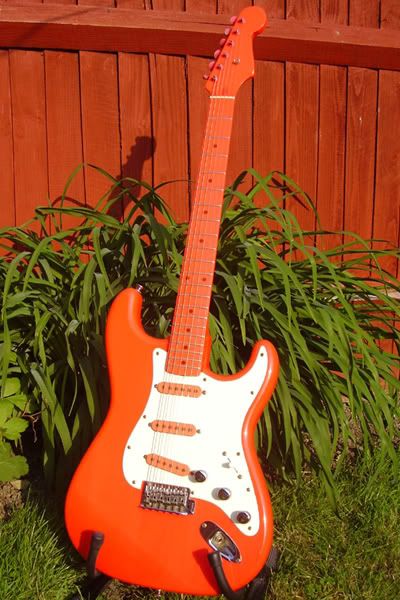
Whilst at risk of alienating the anti-Strat contingent out there, today I want to talk about the background to this particular little-known instrument, the DiMarzio Cellophane Strat. It's just a little footnote at the bottom of the history of the Strat, the DiMarzio corporation, and Japanese guitars in general, but it's footnotes like these that I find particularly fascinating.
I originally saw this guitar for sale on eBay in March 2008 and instantly fell in love with it. In the late 1970s/early 1980s, DiMarzio - known for their pickups - branched out into a whole range of guitar parts - not just pickups and hardware but bodies and necks too. You could build a whole guitar exclusively from DiMarzio-branded parts. I remember this well as I used to have one of their catalogues from the period and in my mind's eye I was putting together various combinations of parts to create my dream axe.
The seller of this particular guitar claimed that it was put together from DiMarzio parts as a showpiece for the 1984 NAMM trade show. Unfortunately I have nothing but his word to either confirm or refute this, but it does at least sound plausible.
He also mentioned that the body and neck were made for DiMarzio by Charvel during their now legendary San Dimas era, so as far as I was aware this red Strat was, despite not being a Fender, an American guitar.
The auction finished without anyone bidding on the guitar, and I was so annoyed at myself for not bidding as I could have bought it for the starting price. However, soon after it was re-listed, and this time I made sure to put a bid or two in. However, I was up against a competing bidder this time around, but they didn't put up a fight and I won the auction at a little over the starting price.
When the guitar arrived in May 2008 I was surprised that the deep red colour looked a lot more salmon-pink in real life, although it seemed to change depending on the lighting conditions. It turns out that there are no identifying names or marks on the guitar anywhere, other than the bridge saddles being stamped "DiMarzio".
The body and neck - as you can see - are coated in a see-through red plastic-like finish, this being known as the "cellophane" finish. The grain of the wood beneath is quite clearly visible, despite the vivid colour. I have seen one or two other examples, but these have been "super-Strat" types rather than the traditional Strat-layout. Some guitars just featured the cellophane red neck on non-cellophane bodies, such as played by guitarist Earl Slick (who of course is known for his work with David Bowie). This is understandable, as DiMarzio parts would have beed used in various mix and match combinations. As far as I am aware, they were never sold as completed guitars. (But if you know differently...)
Recently, a guy named Steven Beall contacted me via the comments of this blog. He had this to say:
Whilst at risk of alienating the anti-Strat contingent out there, today I want to talk about the background to this particular little-known instrument, the DiMarzio Cellophane Strat. It's just a little footnote at the bottom of the history of the Strat, the DiMarzio corporation, and Japanese guitars in general, but it's footnotes like these that I find particularly fascinating.I originally saw this guitar for sale on eBay in March 2008 and instantly fell in love with it. In the late 1970s/early 1980s, DiMarzio - known for their pickups - branched out into a whole range of guitar parts - not just pickups and hardware but bodies and necks too. You could build a whole guitar exclusively from DiMarzio-branded parts. I remember this well as I used to have one of their catalogues from the period and in my mind's eye I was putting together various combinations of parts to create my dream axe.
The seller of this particular guitar claimed that it was put together from DiMarzio parts as a showpiece for the 1984 NAMM trade show. Unfortunately I have nothing but his word to either confirm or refute this, but it does at least sound plausible.
He also mentioned that the body and neck were made for DiMarzio by Charvel during their now legendary San Dimas era, so as far as I was aware this red Strat was, despite not being a Fender, an American guitar.
The auction finished without anyone bidding on the guitar, and I was so annoyed at myself for not bidding as I could have bought it for the starting price. However, soon after it was re-listed, and this time I made sure to put a bid or two in. However, I was up against a competing bidder this time around, but they didn't put up a fight and I won the auction at a little over the starting price.
When the guitar arrived in May 2008 I was surprised that the deep red colour looked a lot more salmon-pink in real life, although it seemed to change depending on the lighting conditions. It turns out that there are no identifying names or marks on the guitar anywhere, other than the bridge saddles being stamped "DiMarzio".
The body and neck - as you can see - are coated in a see-through red plastic-like finish, this being known as the "cellophane" finish. The grain of the wood beneath is quite clearly visible, despite the vivid colour. I have seen one or two other examples, but these have been "super-Strat" types rather than the traditional Strat-layout. Some guitars just featured the cellophane red neck on non-cellophane bodies, such as played by guitarist Earl Slick (who of course is known for his work with David Bowie). This is understandable, as DiMarzio parts would have beed used in various mix and match combinations. As far as I am aware, they were never sold as completed guitars. (But if you know differently...)
Recently, a guy named Steven Beall contacted me via the comments of this blog. He had this to say:
I have one of these red necks I bought in 1985 and love it. A few years back I heard rumors they were made for Dimarzio by Charvel and did some investigating. I contacted Steve Blutcher at DiMarzio and he said these cellophane necks were made in Japan by a small company called Harayama (now defunct) not Charvel. I would assume that the matching bodies were also made by that company because of the finish.
Charvel did indeed start making bodies for DiMarzio in the late 70s - early 80s to fill a gap in cash flow until Grover Jackson could get his own line of guitars under production but that agreement ended prior to 1984 when the first of these cellophane necks and bodies were made because Charvel was well into the production of its own Charvel brand and had no need or available resources to sub-contract parts manufacturing out to other companies.
Sadly, as I found out too, not only is this guitar not USA made, it's not a Charvel either. I hope this helps clear up any questions.
Far from being disappointed, I think this makes the story even more interesting. I have no problem with this being a Japanese guitar - I'm a big fan of Japanese-made guitars. They are often finely-crafted instruments with top-notch attention to detail. However, I'm not aware of the name Harayama - very possibly this was another factory that built guitars for other brands.
If anyone reading this has any DiMarzio or Harayama-built guitars, with cellophane-finish or otherwise, please get in touch!
G L Wilson
NB: There are a lot of blogs STEALING content and bandwidth. If you read this anywhere else but on guitarz.blogspot.com then you are reading a blog that STEALS content. Please support original bloggers!
Wednesday, 14 May 2008
It's that red Strat again... or is it?
Just to show that I put my money where my mouth is, after enthusing about this American-made Strat type guitar allegedly made from DiMarzio parts for the 1984 NAMM show, I did actually go ahead and buy it.However, the colour was a surprise. In my previous post about this guitar back in March, I dubbed it the "red beauty", and indeed in the photos it did look very red.
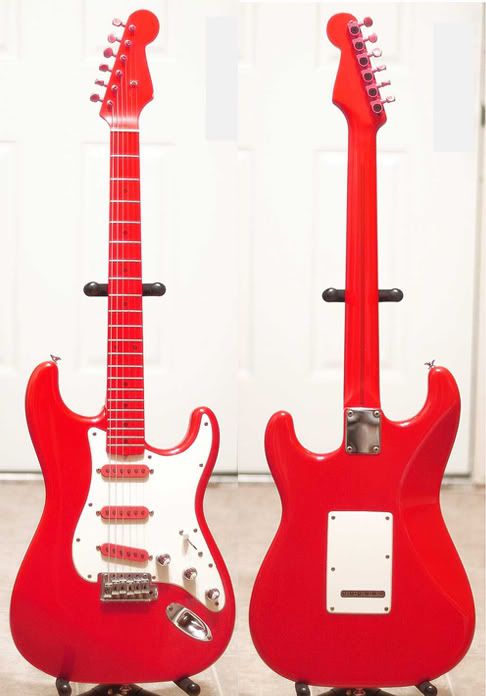
I feel the picture I have included here to the left here gives a better representation of the colour, although I still can't decide what colour it actually is as it seems to change in different lighting conditions. Sometimes it looks orange, sometimes salmon pink, other times - usually in dim or artificial light - it does look red. Actually, it looks almost fluorescent. I wonder if this was the only brightly coloured guitar on the DiMarzio stand at the 1984 NAMM show? Perhaps there were fluorescent green and fluorescent yellow sisters to this guitar. I'd love to know.
Despite the all-pervading colour on this guitar - not just the body but the whole of the neck and the fingerboard - the finish is actually see-through and you can see the wood grain beneath quite nicely. The body appears to be a 3-piece affair.
The seller had mentioned "Charvel San Dimas era", so I'd like to do a little research and find out if Charvel ever built guitar bodies and necks for the DiMarzio brand.
Given its age, the guitar is in very good nick. With only a quick glance, you'd be forgiven for thinking it was built recently, although a closer inspection reveals one or two minor knocks and dints. This guitar doesn't appear to have been played very much at all, which is unusual seeing that it's 24 years old. You may be able to make out in the photo an area where the finish has worn away on the headstock, and also the pink has worn away on the pink-coloured machine heads.
What is the sound like? Well, very authentic Fender Strat, I'd say, although I've not yet been able to test her at volume.
Did I really need another Strat? (This is my 5th). Well, no I didn't, but something about this guitar really appealed to me and I just had to add it to the collection.
UPDATE: I think I'm on the right track. According to the USA Charvels website, "...in 1978 Grover Jackson put a deal together with DiMarzio which allowed Charvel Manufacturing to make guitar and bass bodies for DiMarzio."
Futhermore, sandimascharvel.com tells us that Charvel's "Strat necks are most commonly oiled...", but goes on to add that "Some are 100% lacquered or painted to match the body."
Friday, 21 March 2008
DiMarzio "Red Beauty" Strat from 1984
I'm not JP Stratoblogster but if I was I'd choose this as my Strat for Friday.OK, so it's yet another Strat-type guitar - nothing unusual about that, but WOW! isn't it so very very red? I've certainly not seen the neck and fingerboard coloured in this fashion before. Not on a Strat anyway. I have to say, I really like it.
DiMarzio, of course, are known mainly for their pickups, but back in the 1980s they put their name to a full range of spare parts from hardware to bodies and necks. These days, I believe, they tend to focus mainly on pickups. This red beauty is apparently one that they built for display at the 1984 NAMM trade show. I bet it turned a few heads.
So, it's from 1984, it's built from quality DiMarzio parts, it's
Unless you don't like red, of course. My nephew, being a Manchester United supporter, would LOVE it (anything red is good in his book), but he's going to have to make do with the Jaxville "relic" guitar I already bought.
Subscribe to:
Posts (Atom)