guitarz.blogspot.com:
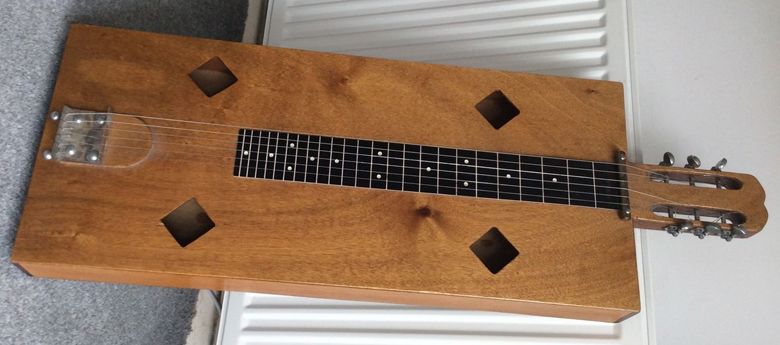
This acoustic lap steel or Hawaiian guitar has been hand-built using a large plywood box. Whether the box was made specifically for the guitar or whether it was an existing box that has been repurposed, I could not tell you. Whatever, with a soundbox that big it ought to have plenty of acoustic volume. I think if it was mine I'd be tempted to put legs on it.
Currently listed on eBay UK with a starting price of £10.
G L Wilson
© 2014, Guitarz - The Original Guitar Blog - the blog that goes all the way to 11!
Please read our photo and content policy.
Showing posts with label lap steel. Show all posts
Wednesday, 16 July 2014
Tuesday, 26 February 2013
Crazy Australian Pioneer tripleneck mandolin / guitar / slide guitar
guitarz.blogspot.com:
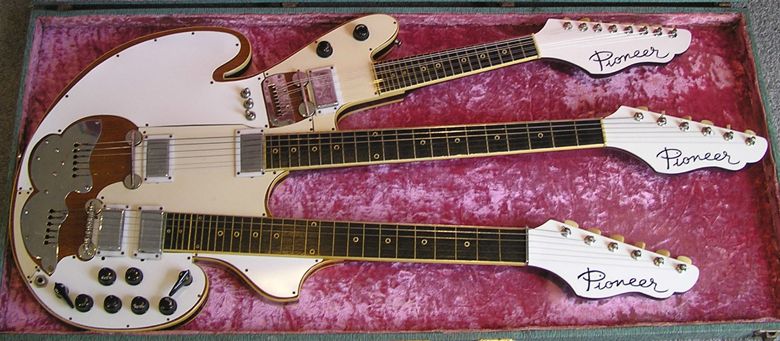
We've shown a few Matons on Guitarz before now, but perhaps we don't feature enough Australian guitars. However, I don't think they come much wilder than this Pioneer tripleneck which has necks for mandolin, 6-string guitar, and slide guitar. I'm not sure how the slide neck is supposed to function, whether the player needs to sit down and play this beastie lap-style whilst on that neck. I love the matching headstocks, especially the mandolin headstock with all eight tuners in-line.
Apparently, it was built by Arthur Bianchi of Pioneer Guitars, Rockhampton in the early 1960s.
Currently listed on eBay with a Buy It Now price of AUS $3,950 (Australian dollars).
G L Wilson
© 2013, Guitarz - The Original Guitar Blog - the blog that goes all the way to 11!
We've shown a few Matons on Guitarz before now, but perhaps we don't feature enough Australian guitars. However, I don't think they come much wilder than this Pioneer tripleneck which has necks for mandolin, 6-string guitar, and slide guitar. I'm not sure how the slide neck is supposed to function, whether the player needs to sit down and play this beastie lap-style whilst on that neck. I love the matching headstocks, especially the mandolin headstock with all eight tuners in-line.
Apparently, it was built by Arthur Bianchi of Pioneer Guitars, Rockhampton in the early 1960s.
Currently listed on eBay with a Buy It Now price of AUS $3,950 (Australian dollars).
G L Wilson
© 2013, Guitarz - The Original Guitar Blog - the blog that goes all the way to 11!
Thursday, 14 February 2013
King Kameamea Lap Steel Guitar
This King Kameamea lap steel guitar is a one-off copy by German luthier Ralph Falk of a vintage National instrument (I think the New Yorker model but i don't know much about lap steel guitars). Definitely a looker, isn't it?
By the way, Kamehameha was a 19th century king of Hawai, who unified the island.
Bertram D
Edit: it seems to be based on the National Dynamic model - with its own color scheme...
© 2013, Guitarz - The Original Guitar Blog - the blog that goes all the way to 11!
Thursday, 3 May 2012
Vintage & Rare Guitar Of The Week: 1965 Teisco Model Z Lap Steel
guitarz.blogspot.com:
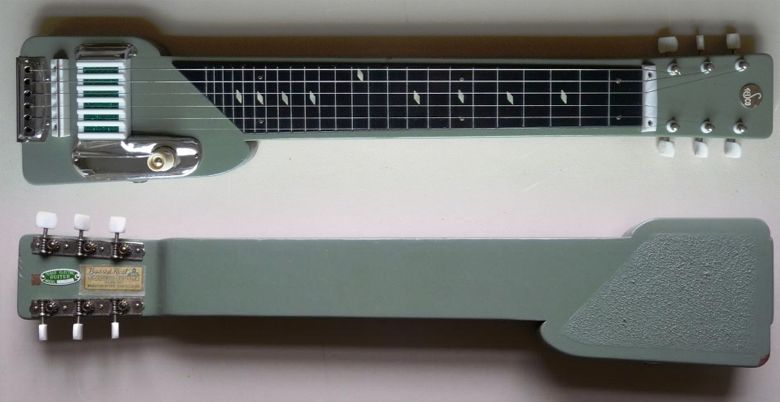
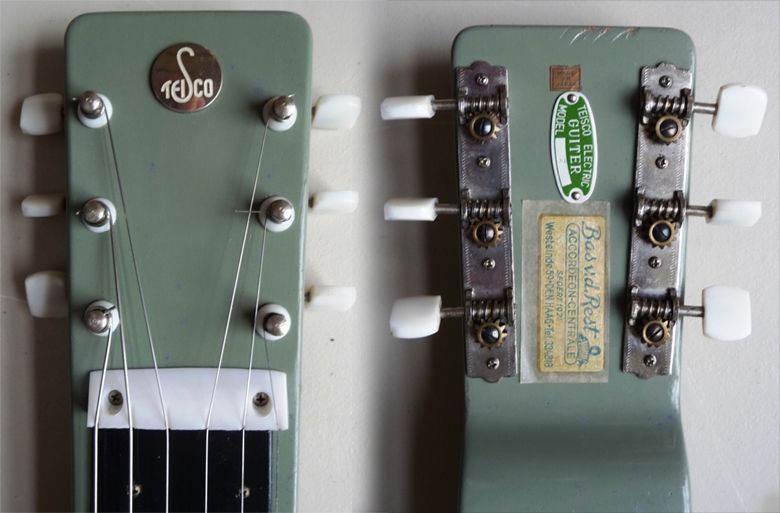
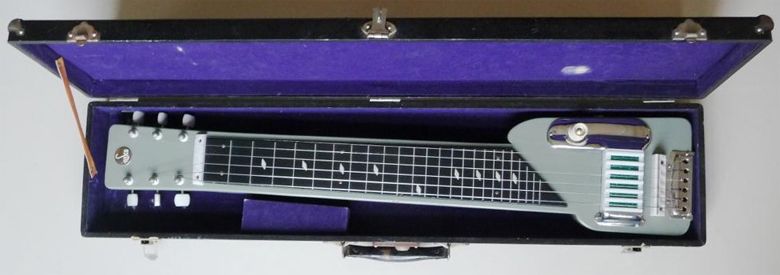
This guitar - a Teisco Model Z lap steel from 1965 - is about as simple as they come: slab-bodied, single pickup, single volume control, but I find it absolutely fascinating. I've not seen one quite like this before but that grey-green colour is a typical Teisco finish.
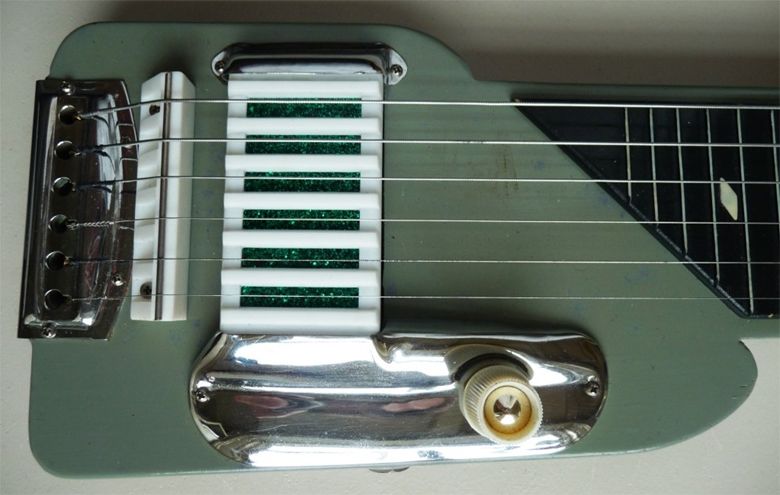
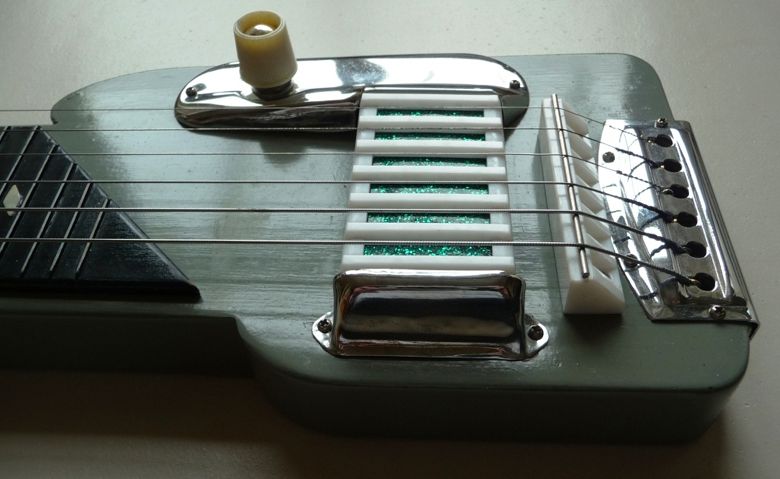
Note how the plastic-bodied pickup is not only inlaid with green pearloid but also appears to be "scalloped" with channels for each of the strings. I also like the contours of the metal components: the tailpiece, panel carrying the volume control, and the little pickup bracket. Compare this with modern lap steels with use generic bridges and Strat-like single coil pickups.
Note also that the fingerboard appears to be inlaid with real frets which is unusual on a lap steel where the only function for frets (or fret-lines as on most examples of this type of instrument) is as visual markers.
I love the Teisco label on the reverse on the head complete with a mis-spelling on the word "guitar", and also the label from an accordion retailer where this lap steel was originally purchased.
The guitar even comes in its original hard case, and is available for sale via Vintage & Rare for a very reasonable €250.
G L Wilson
© 2012, Guitarz - The Original Guitar Blog - now in its 10th year!
This guitar - a Teisco Model Z lap steel from 1965 - is about as simple as they come: slab-bodied, single pickup, single volume control, but I find it absolutely fascinating. I've not seen one quite like this before but that grey-green colour is a typical Teisco finish.
Note how the plastic-bodied pickup is not only inlaid with green pearloid but also appears to be "scalloped" with channels for each of the strings. I also like the contours of the metal components: the tailpiece, panel carrying the volume control, and the little pickup bracket. Compare this with modern lap steels with use generic bridges and Strat-like single coil pickups.
Note also that the fingerboard appears to be inlaid with real frets which is unusual on a lap steel where the only function for frets (or fret-lines as on most examples of this type of instrument) is as visual markers.
I love the Teisco label on the reverse on the head complete with a mis-spelling on the word "guitar", and also the label from an accordion retailer where this lap steel was originally purchased.
The guitar even comes in its original hard case, and is available for sale via Vintage & Rare for a very reasonable €250.
G L Wilson
© 2012, Guitarz - The Original Guitar Blog - now in its 10th year!
Monday, 6 February 2012
1955 Magnatone G-65 lap steel, designed by Paul Bigsby
Simplicity of material and sophistication of the design: you cannot do much better than this 1955 Magnatone G-65 lap steel with an art-deco design by master Paul Bigsby!
I love its shining chrome hardware on wood in natural finish, and the design has the same evidence as the one of the Telecaster - and thus is still used half a century later by models by Gretsch or Duesenberg...
Bertram
© 2012, Guitarz - The Original Guitar Blog - now in its 10th year!
Tuesday, 27 December 2011
Telecaster hybridized with Rickenbacker lapsteel pickup - a real ugly duckling for sure
guitarz.blogspot.com:
I'm going to be really lazy today (hey, it IS the holidays) and copy extensively from the eBay listing for this Tele/Rickenbacker hybrid:
Currently listed on eBay with a Buy It Now price of $1,000.
Thanks to Andrew who saw this listed on eBay.
G L Wilson
© 2011, Guitarz - The Original Guitar Blog - now in its 10th year!
I'm going to be really lazy today (hey, it IS the holidays) and copy extensively from the eBay listing for this Tele/Rickenbacker hybrid:
This is a guitar which was constructed using:Likely this guitar is as amazing as the seller claims, but it's sure not going to win any beauty contests. Personally I think the placement of the volume and tone controls is a mistake - and I appreciate this was dicatated by the plate used from the Rickenbacker lapsteel. Nevertheless, I think he should have put the controls in the usual position for a Tele, and maybe plugged the holes in the lapsteel plate - else not used the plate at all if it is detachable from the pickup. I'm not just talking aesthetics here, those controls would get in the way where they are.
Fender MIM neck Serial Number MZ4013361 (hard rock maple)
Non-Fender Tele style Mahogany body
Rickenbacker horseshoe pickup from a Rickenbacker (old spelling is Rickenbacher) Model 100 lap steel
Lipstick pickup (4.9K) GFS from Guitar Fetish
Brass nut
Other misc parts from Guitar Fetish, staggered tuners and string tree, 3 way switch, tele jack cup, Tele dome knobs, cloth wiring.
This guitar was born in a Hamtramck second hand store where I found the Rickenbacker lap steel. At the time I could not even tell what brand it was because there were no tags, markings, or serial numbers on it. Also the body had been crudely modified, some wood cut away, strap buttons put on so it could be played slung around your neck more like a regular guitar. The store owner told me it had been owned by a friend of hers that had passed away. who was from the coal mining fields of Tennessee. He had also painted numbers on the metal fretboard. That genesis gave me the idea of putting this pickup on a telecaster style body.
Since the Rickenbacker is an old pickup with usage marks, I bought a Fender neck which showed a little natural wear. I then yellowed the face of the neck over the logo to make the neck looka little further aged. It is a very subtle effect. (I used gunstock oil infused with a little walnut dye.)
I picked up a mahogany body and modified it so the Rickenbacker pickup fit on it. At first I used a Gibson style wraparound bridge behind the rickbacker pickup. But it seems like some of that lap steel singing quality was missing. So I filled those holes, cut a little more wood and used the bridge integrated into the pickup. I also more tightly attached the neck to the body by using threaded steel neck inserts instead of the standard wood screws. You can search on ebay to see what inserts are are like.
The end result is that this thing sings like a woman! I took the guitar to my sister's house in Michigan's UP and played with her old-timey, bluegrass band. With the bluegrass band, I had to use the lipstick pickup because the Rickenbacker was too powerful, too bluesy. We were just playing an instrumental, but after the end of one song, someone asked "Who is singing?" No one was singing. It was the TeleRick. I was playing on the next song, and I thought I heard a woman singing vowels, I looked up from the fretboard and no, my sister (the only female musician present) was not singing. It WAS the guitar.
I had configured the guitar with a brass nut at first. It sounded great. I then switched to a solid plastic nut, and the open notes sounded more muffled than the notes held with the slide did. So, I put the brass nut back on. Also, when you play I think the brass affects the tone even more than just the open notes. I mean, the string does vibrate from the slide back to the nut unless you dampen it. The lipstick pickup loves the brass nut. I think the singing woman tone is a combination of the brass nut, lipstick pickup, mahogany body, threaded steel inserts, and the very solid Rickenbacker bridge. As I mentioned, the bluegrass people were not into the powerful Rickenbacker sound.
I put a 3 way switch on the guitar so you get the raw lipstick pickup, lipstick and Rickenbacker combined, and Rickbenbacker by itself. The tone and volume knobs only affect the Rickenbacker pickup. I did it this way for a couple reasons. If you wanted you could physically move the Rickenbacker pickup from the tele body to the Rickenbacker body, by only by snipping two wires. If I had integrated the tone and volume with the lipstick pickup, then more wires would have to be cut. Tonewise, the guitar rocks this way. The lipstick is a kind of a hollowed out singing acoustic sort of sound, you can play 4 strings together and they blend like a gospel choir. The Rickenbacker pickup has twice the output of the lipstick and is more raucous so you would only want to play 2 notes together (unless you are going for the heavy distortion). So you can do this multiple string sliding with the lipstick, and then flip the switch and go into a real heavier tone on the Rickenbacker pickup. You can tone down the Rickenbacker pickup with its controls to more closely match the lipstick if you want. The one pickup sounds like a logical extension of the other.
This guitar sounds so good, it could be the basis for a whole new unique style of playing. You can get lost flipping back and forth between them for hours..
The string height (action) is such that you can play the classic boogie woogie on the low strings from open to the 7th fret, and if you are sliding at the 5th fret, you can press down the strings behind the slide to get the missing notes in the scale, but when you are at the 12th fret you will be all slide all the time. Now, the action could be lowered a little. The bottom of the brass nut could be filed, maybe the neck truss rod could be used, but the Rickenbacker bridge is a little higher than the tele bridge, so the action will always favor the slide player. But that is not a loss on this guitar, because this is a slide players guitar.
In my heart of hearts, I believe that is a guitar born for slide and it will need a slide guitarist to properly appreciate it. That is why I am putting it on a month long listing. This special guitar requires a special person...
Currently listed on eBay with a Buy It Now price of $1,000.
Thanks to Andrew who saw this listed on eBay.
G L Wilson
© 2011, Guitarz - The Original Guitar Blog - now in its 10th year!
Thursday, 22 December 2011
1947 National New Yorker lap steel guitar, Art Deco design in Tuxedo finish
guitarz.blogspot.com:
Here is a National New Yorker lap steel guitar from 1947. Apparently there were 15 variations of the New Yorker produced between 1935 and 1968; the Art Deco stylings of this particular example were supposedly inspired by the Empire State building.
I always think that lap steel guitars were ahead of their time in some ways. Whilst they didn't altogether abandon the traditional hourglass guitar shape, makers did experiment with a whole variety of different shapes and designs whilst contemporary "Spanish" style guitars (i.e. played in the regular way and not lap steel style) had ultra conservative designs for the most part. And then there's the hotly debated question of who developed the first solidbody electric guitar. Was it Leo Fender with the Broadcaster/Esquire? Was it Les Paul? Or was it even some obscure Norwegian guitar manufacturer? I have to wonder why so much noise made about this when it seems that lap steels had abandoned the acoustic resonating sound box ages before Les Paul or Leo Fender had their brainwave ideas.
This particular lap steel is currently listed on eBay Australia with a Buy It Now price of AU $1,300 (Australian dollars).
G L Wilson
© 2011, Guitarz - The Original Guitar Blog - now in its 10th year!
Here is a National New Yorker lap steel guitar from 1947. Apparently there were 15 variations of the New Yorker produced between 1935 and 1968; the Art Deco stylings of this particular example were supposedly inspired by the Empire State building.
I always think that lap steel guitars were ahead of their time in some ways. Whilst they didn't altogether abandon the traditional hourglass guitar shape, makers did experiment with a whole variety of different shapes and designs whilst contemporary "Spanish" style guitars (i.e. played in the regular way and not lap steel style) had ultra conservative designs for the most part. And then there's the hotly debated question of who developed the first solidbody electric guitar. Was it Leo Fender with the Broadcaster/Esquire? Was it Les Paul? Or was it even some obscure Norwegian guitar manufacturer? I have to wonder why so much noise made about this when it seems that lap steels had abandoned the acoustic resonating sound box ages before Les Paul or Leo Fender had their brainwave ideas.
This particular lap steel is currently listed on eBay Australia with a Buy It Now price of AU $1,300 (Australian dollars).
G L Wilson
© 2011, Guitarz - The Original Guitar Blog - now in its 10th year!
Saturday, 5 November 2011
Selmer vintage lap steel with integral case
guitarz.blogspot.com:
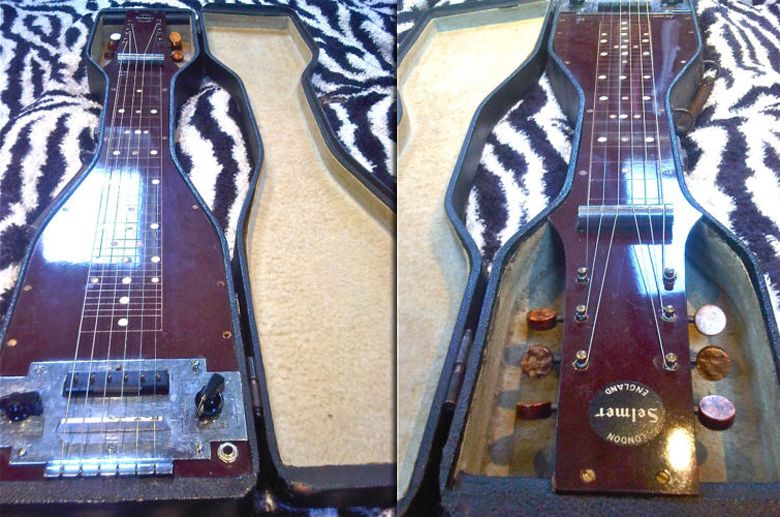
I've not seen another guitar like this before, and I suppose a lap steel (or console guitar) would be the only kind of guitar that would suit this format. It's a Selmer-branded lap steel which is actually built into its own case. That is to say, the case forms part of the guitar body. All you need to do is open and detach the lid, plug the guitar in and you're ready to go.
Selmer were a musical instrument manufacturer established in the early 1900s and based in Paris (surely their best known guitars were the gypsy jazz guitars as played by Django Reinhardt). By 1928 they had aquired a semi-independent UK branch. From the 1950s and through to the 1970s some of Selmer UK's own-brand guitars were produced by Germany's Höfner especially for the UK market. With the logo on this particular example proudly proclaiming "London, England", it's possible that this is a Höfner-made instrument. Unless you know differently...
Unfortunately the eBay auction for this guitar has already ended, although it did not sell despite a starting price of £175 (which I'd say was cheap for a vintage lap steel, and a possible Höfner-made one to boot). If you are interested, keep checking those auctions as maybe it will be re-listed at some point.
G L Wilson
© 2011, Guitarz - The Original Guitar Blog - now in its 10th year!
I've not seen another guitar like this before, and I suppose a lap steel (or console guitar) would be the only kind of guitar that would suit this format. It's a Selmer-branded lap steel which is actually built into its own case. That is to say, the case forms part of the guitar body. All you need to do is open and detach the lid, plug the guitar in and you're ready to go.
Selmer were a musical instrument manufacturer established in the early 1900s and based in Paris (surely their best known guitars were the gypsy jazz guitars as played by Django Reinhardt). By 1928 they had aquired a semi-independent UK branch. From the 1950s and through to the 1970s some of Selmer UK's own-brand guitars were produced by Germany's Höfner especially for the UK market. With the logo on this particular example proudly proclaiming "London, England", it's possible that this is a Höfner-made instrument. Unless you know differently...
Unfortunately the eBay auction for this guitar has already ended, although it did not sell despite a starting price of £175 (which I'd say was cheap for a vintage lap steel, and a possible Höfner-made one to boot). If you are interested, keep checking those auctions as maybe it will be re-listed at some point.
G L Wilson
© 2011, Guitarz - The Original Guitar Blog - now in its 10th year!
Friday, 15 July 2011
1990s Melobar doubleneck with Telecaster neck and angled Melobar neck for slide playing
guitarz.blogspot.com:
We've looked at Melobar guitars here before several times. For those new to the concept they allow the steel guitar player to stand up and move around the stage by having a 45-degree angled neck mounted onto a slab body.
However, here we see a doubleneck with regular 6-string Tele-style neck at the top and a 6-string Melobar steel at the bottom. Note the way in which the necks are angled to allow the player unhindered access to the slide neck.
This particular pearloid-covered example has been listed on eBay UK (although the item for sale is actually located in The Netherlands) and has a But It Now price of £2,500.
Why do I feel that someone is about to mention Junior Brown and his Guit-Steel in the comments?
G L Wilson
© 2011, Guitarz - The Original Guitar Blog - now in its 10th year!
We've looked at Melobar guitars here before several times. For those new to the concept they allow the steel guitar player to stand up and move around the stage by having a 45-degree angled neck mounted onto a slab body.
However, here we see a doubleneck with regular 6-string Tele-style neck at the top and a 6-string Melobar steel at the bottom. Note the way in which the necks are angled to allow the player unhindered access to the slide neck.
This particular pearloid-covered example has been listed on eBay UK (although the item for sale is actually located in The Netherlands) and has a But It Now price of £2,500.
Why do I feel that someone is about to mention Junior Brown and his Guit-Steel in the comments?
G L Wilson
© 2011, Guitarz - The Original Guitar Blog - now in its 10th year!
Monday, 11 July 2011
1930s Epiphone Electar 7-string lap steel featuring stunning Art Deco design
guitarz.blogspot.com:

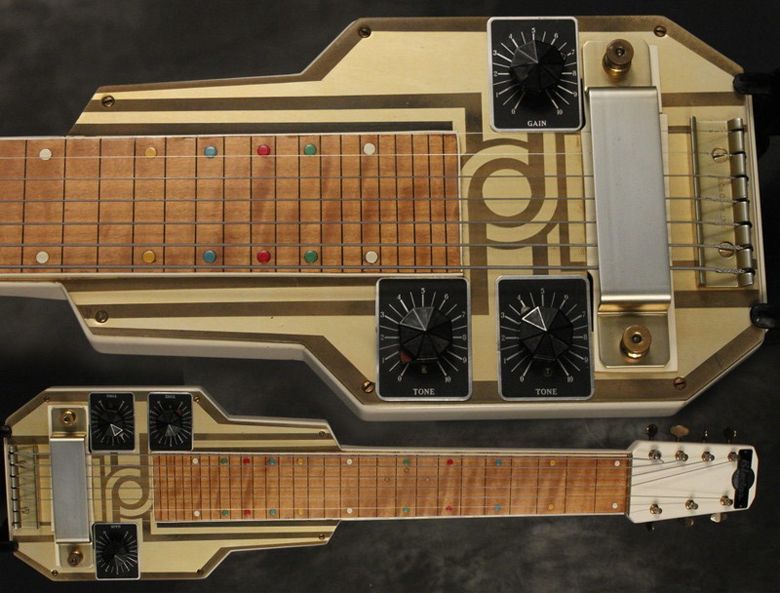
Here's an early Epiphone from way before the company had any links with Gibson. We've seen guitars before with an Art Deco design to them; none seem to pull it off more successfully than lap steel guitars such as this Epiphone Electar 7-string lap steel, which the seller claims is from the late 1930s. This would partly be because being a lap steel instrument it's not subject to the same ergonomic constraints as a guitar played "Spanish" style, if I may borrow that antiquated term. Also, if it's from the 1930s then it's the correct period for this style of design so it's the real thing and not just a latter-day homage. I particularly like the ocatagonal control knobs which look as if they might be made from bakelite, although I can't imagine why there would be two tone controls for just a single pickup.
G L Wilson
© 2011, Guitarz - The Original Guitar Blog - now in its 10th year!

Here's an early Epiphone from way before the company had any links with Gibson. We've seen guitars before with an Art Deco design to them; none seem to pull it off more successfully than lap steel guitars such as this Epiphone Electar 7-string lap steel, which the seller claims is from the late 1930s. This would partly be because being a lap steel instrument it's not subject to the same ergonomic constraints as a guitar played "Spanish" style, if I may borrow that antiquated term. Also, if it's from the 1930s then it's the correct period for this style of design so it's the real thing and not just a latter-day homage. I particularly like the ocatagonal control knobs which look as if they might be made from bakelite, although I can't imagine why there would be two tone controls for just a single pickup.
G L Wilson
© 2011, Guitarz - The Original Guitar Blog - now in its 10th year!
Sunday, 6 March 2011
Vega console guitar from the 1930s
guitarz.blogspot.com:
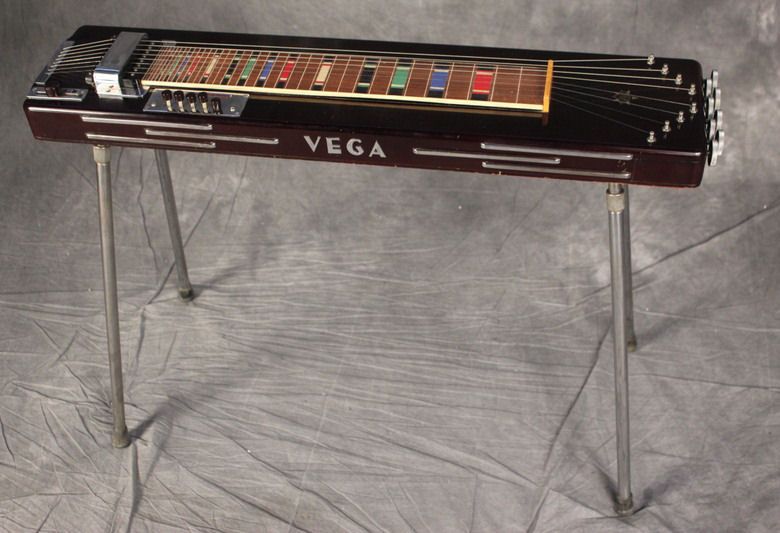
This 8-string Vega console guitar (basically a lap steel with legs!) has more than a touch of the Art Deco about it, with decorative chrome accents and bakelite knobs. The feature that I find most intriguing, though, is the tuning apparatus. I've not seen anything quite like that on a guitar before. Compact, it isn't!
The five bakelite-topped tone controls are labelled "Contra", "Bass", "Normal", "Treble" and "High".
A fascinating instrument; I'm sure you could make a whole blog on the subject of slide guitars alone. Unfortunately I know precious little about them.
G L Wilson
Guitarz - The Original Guitar Blog - now in its 10th year!
This 8-string Vega console guitar (basically a lap steel with legs!) has more than a touch of the Art Deco about it, with decorative chrome accents and bakelite knobs. The feature that I find most intriguing, though, is the tuning apparatus. I've not seen anything quite like that on a guitar before. Compact, it isn't!
The five bakelite-topped tone controls are labelled "Contra", "Bass", "Normal", "Treble" and "High".
A fascinating instrument; I'm sure you could make a whole blog on the subject of slide guitars alone. Unfortunately I know precious little about them.
G L Wilson
Guitarz - The Original Guitar Blog - now in its 10th year!
Monday, 27 December 2010
Dobro Model 66 from the 1930s
guitarz.blogspot.com:
This highly decorated 1930-era Dobro Model 66 seems to be a very appropriate guitar to show during this festive season. It's a wooden-bodied resonator guitar with a square neck for lap steel playing. The decorative design has been applied through the process of sandblasting. The body would have been made from mahogany plywood with a neck of mahogany and an ebonized (i.e. artificially blackened) rosewood fingerboard. In its day this would have been Dobro's top of the line instrument, and was also available as a roundneck guitar for what we nowadays consider to be the more conventional "Spanish" style of playing.
G L Wilson
Guitarz - The Original Guitar Blog - now in its 9th year!
This highly decorated 1930-era Dobro Model 66 seems to be a very appropriate guitar to show during this festive season. It's a wooden-bodied resonator guitar with a square neck for lap steel playing. The decorative design has been applied through the process of sandblasting. The body would have been made from mahogany plywood with a neck of mahogany and an ebonized (i.e. artificially blackened) rosewood fingerboard. In its day this would have been Dobro's top of the line instrument, and was also available as a roundneck guitar for what we nowadays consider to be the more conventional "Spanish" style of playing.
G L Wilson
Guitarz - The Original Guitar Blog - now in its 9th year!
Tuesday, 21 December 2010
Alvino Rey (and not to mention Stringy the talking steel guitar!)
guitarz.blogspot.com:
Here's an email from Alan:
Hello from Washington DC USA.Guitarz - The Original Guitar Blog - now in its 9th year!
Two slick videos I wanted to tell you about featuring Alvino Rey - a steel guitarist popular from the '40s thru the '60s. One (see above) features "Stringy", a singing puppet fronting for a vocalist going through a Sonovox. Bands of the 1940s routinely did these early "music videos" that ran in movie theaters.
The fun starts around the 0:42 sec mark.
The second shows Alvino on the "King Family" TV show of the 1960s - a very safe, family-friendly music variety show of that era. What makes it cool is seeing Alvino slinging a state of the art Fender solid-body instead of a nice, dignified archtop jazzbox; almost a blasphemy on a "family" TV show such as this.
In black and white it's hard to tell what the actual color of this guitar is. Since TV of that era couldn't handle *pure* white (it would blow the picture out), I want to pretend it's a Lake Placid Blue, an Ivory, or some kinda yellow.
Enjoy.
-AP
Wednesday, 29 September 2010
Home made aluminium lap steel
guitarz.blogspot.com:
David in Barcelona
This very simple instrument, made out of a piece of aluminium double glazing extrusion, is especially interesting to me as I just bought a Peavey Powerslide and I'm in the process of getting the hang of it. Not a piece of cake by any means.
The builder of this guitar (Airbrake 1 or Marscape 1, depending whether you find him on Flickr or Youtube) has further simplified the construction - and complicated the learning process - by leaving out the fret markers! Which makes his rather modest claim to not be able to play steel guitar even more remarkable. On his Flickr page, he says "I decided to fit 3 strips of tape to show the 5th fret position, the 12th and the 24th. I could have fitted more, but I wanted to try to develop my ear, so I would be able to automatically find the right notes. It takes some practice to do this!" Yeah, you don't say. Check out his not too shabby video. If I could coax something like this from my Powerslide, I'd be pretty pleased with myself.
David in Barcelona
Guitarz - The Original Guitar Blog - now in its 9th year!
Labels:
aluminium body,
fretless,
handmade,
lap steel,
video
Friday, 24 September 2010
This Rickenbacker's got legs!
guitarz.blogspot.com:
This 1960 vintage Rickenbacker 100 Consolette steel guitar is one of a species that could be described as a "missing link". Console guitars - essentially lap steels with legs - evolved from the more usual kind of lap steels that you actually play with the guitar on your lap, and would later evolve further with the addition of pitch bending levers and pedals into the pedal steel guitar.
G L Wilson
Guitarz - The Original Guitar Blog - now in its 9th year!
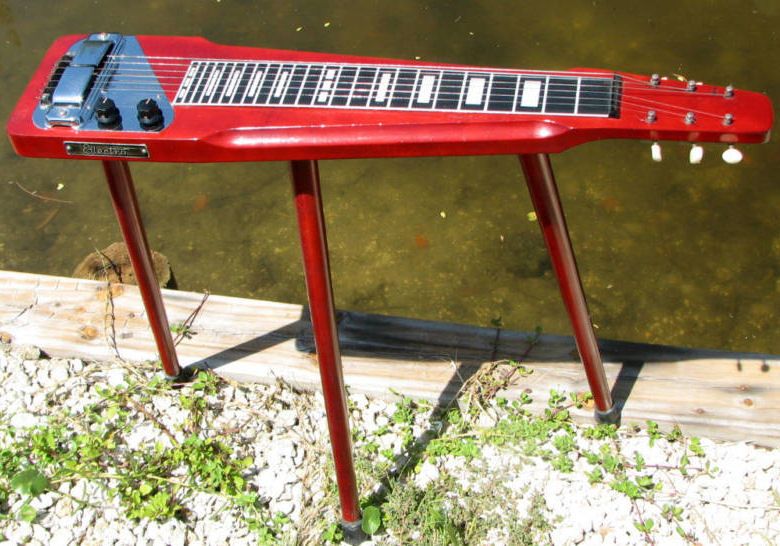
This 1960 vintage Rickenbacker 100 Consolette steel guitar is one of a species that could be described as a "missing link". Console guitars - essentially lap steels with legs - evolved from the more usual kind of lap steels that you actually play with the guitar on your lap, and would later evolve further with the addition of pitch bending levers and pedals into the pedal steel guitar.
G L Wilson
Guitarz - The Original Guitar Blog - now in its 9th year!
Thursday, 26 August 2010
1939 Recording King Model D lap steel
guitarz.blogspot.com:
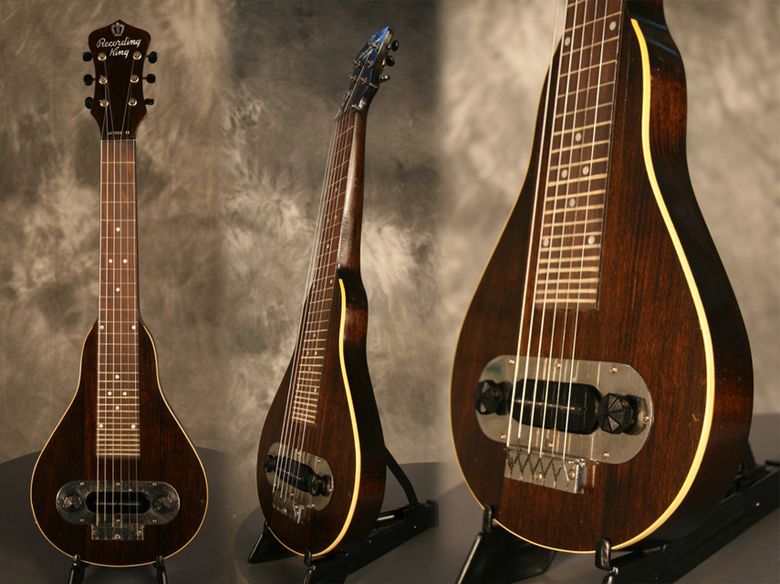
Whilst we're on a lap steel kick at the moment, I can't help showing you this utterly gorgeous Recording King Model D from 1939 currently being offered for sale on eBay. I particularly like the pear-shaped body, which has a mandolin-quality to the design.
Recording King was a brand name used by American department store Montgomery Ward's in the 1930s, with instruments being made by Gibson.
The brand name has since been revived by San Francisco-based AXL.
G L Wilson
Guitarz - The Original Guitar Blog - now in its 9th year!
Whilst we're on a lap steel kick at the moment, I can't help showing you this utterly gorgeous Recording King Model D from 1939 currently being offered for sale on eBay. I particularly like the pear-shaped body, which has a mandolin-quality to the design.Recording King was a brand name used by American department store Montgomery Ward's in the 1930s, with instruments being made by Gibson.
The brand name has since been revived by San Francisco-based AXL.
G L Wilson
Guitarz - The Original Guitar Blog - now in its 9th year!
Wednesday, 25 August 2010
One-off "Juju" lap steel
guitarz.blogspot.com:
I don't know why we don't feature more lap steels on this blog, because some of the designs are really out there! This very distinctive one-off lap steel bearing the "Juju" name has been built around a huge slab of lacewood. As you can see the lacewood slab, although polished up, has been left in a rustic state showing the beauty of the wood.
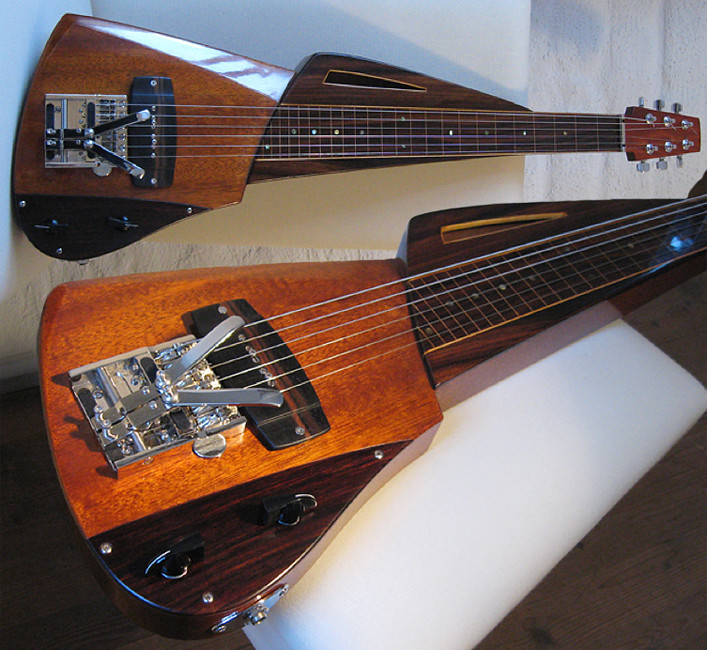

Very strangely for a lap steel, the fingerboard seems to have actual frets rather than simple visual markers.
G L Wilson
Guitarz - The Original Guitar Blog - now in its 9th year!
I don't know why we don't feature more lap steels on this blog, because some of the designs are really out there! This very distinctive one-off lap steel bearing the "Juju" name has been built around a huge slab of lacewood. As you can see the lacewood slab, although polished up, has been left in a rustic state showing the beauty of the wood.Very strangely for a lap steel, the fingerboard seems to have actual frets rather than simple visual markers.
G L Wilson
Guitarz - The Original Guitar Blog - now in its 9th year!
handmade lap steel guitar with multibender bridge
Check this astonishing handmade lap steel guitar - a creative and nice piece of craftsmanship, isn't it?
Though it pioneered the electrification of musical instruments in the early 1930s, lap steel guitar seems a conservative instrument because of the musical genres it's associated with - country, blue grass and old school blues (though it was created firstly to play hawaiian music if I'm not wrong) - so it might be surprising to see one with a elaborated design where usually you find rough simplicity.
This one has a Duesenberg multibender, a wooden P90 pickup, and a chambered body providing a richer sound than lap steel guitars often reduced to a neck. Usually I like chicken head knobs, but here they don't match - some art deco Duesenberg ones would fit better!
Sunday, 18 July 2010
John Paul Jones's Manson Custom Bass Lapsteel
Addendum to my previous Melobar post:
the first time I noticed a Melobar style lapsteel guitar was in a video of Them Crooked Vultures showing John Paul Jones playing a custom made (by Manson, hence the trademark embedded Kaoss pad) strap-on bass lapsteel (photo) - I actually wrote a post about them, but at the time I was more interested in Homme's Maton guitar and Jones's Manson bass mandolin!
I'm not a fan of Them Crooked Vultures' music but I must admit that they have a very good taste in instruments. Besides Jones's Manson lapsteel, we can see in this video Homme playing his MotorAve BelAir and Johannes who took over bass duty with a violin bass that looks like an original Höfner (couldn't see the brand but the headstock shape fits)(can't tell about Grohl's drums, this is out of my domain!).
Guitarz - The Original Guitar Blog - now in its 9th year!
Sunday, 23 May 2010
1930s Rickenbacker A-22 Frying Pan
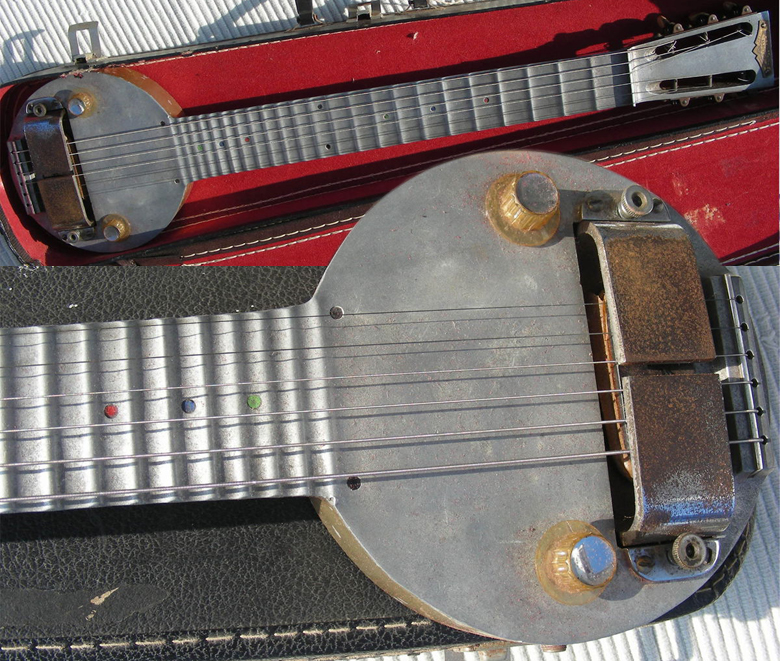
No, not all the Rickenbacker Frying Pans - the vintagest amongst the vintage guitars - are safe in museums or bankers' collections, you can still find one on eBay!
For those you don't know it, this cast aluminium lap steel guitar with its characteristic horse shoe magnet pickup was created in 1931 - and is the first electric guitar in history.
Get down on your knees and adore, guitar lovers!
Guitarz - The Original Guitar Blog - now in its 9th year!
Subscribe to:
Posts (Atom)