This is Ronnie from Botswama who has a really interesting playing technique! I'll let the video do the talking, just click "play" already!
Thanks to Marty Jensen for recommending this clip.
Thanks also to Paul Bob for pointing me in the direction of a better quality version of the video than the one I posted pre-edit.
G L Wilson
Guitarz - The Original Guitar Blog - now in its 10th year!

Showing posts with label Guitar Technique. Show all posts
Showing posts with label Guitar Technique. Show all posts
Friday, 11 February 2011


Thursday, 27 August 2009
Of reverse headstocks and string tension
Earlier this month, the post on the Ampeg Scroll Bass legacy provoked an interesting discussion about the so-called "reverse headstock" and its influence on string tension, sound and playability. On this post, I imprudently stated - a common misconception - that the reverse headstock provides better tension to the respective gauges of the strings.
One of our readers, who goes under the moniker dre, provided precious and detailed information to reestablish the one and only truth about this essential topic, and so I've slightly edited his comments for this post.
"The effective string length (ie nut-to-bridge) determines the tension, in concert with string gauge and tuned pitch. If you have two guitars identical scale length, string gauge, and tuning, but different total string lengths, you will still have identical string tension.
Imagine one of those early Les Pauls with the combo bridge/tailpiece: minimal total string length. Then imagine a Firebird with a Bigsby. Longer headstock, more string behind the bridge, maximal total length. Both guitars have the same scale length.
If both have the same strings and are tuned to standard pitch, the strings will still be at the same tension, despite the differences in total string length, because the effective string length is the same, and those 24.75 inches of string between the nut and bridge have to be at the same tension to be at the same pitch.
The real difference created by different total lengths is in the feel of the guitar. All that extra string below the bridge and above the nut on the Firebird's low E string means that the string can be stretched more. If you reach way up and pull that E string across the fretboard (Why? I don't know, you're the one doing it!), that string will be easier to bend than the E string on the Les Paul, because there's less total string to stretch on the Les. Bending a string utilizes the entire length of the string since it can slide through the nut as it stretches. Playing an open note only utilizes the effective length, unless you really hammer it and it stretches a little.
Length, mass, tension. Those are the three determinants of pitch in a string. A guitar's nut and bridge functionally isolate the string between them from the remaining string above the nut and below the bridge, with regard to vibration. The length of string between the nut and the bridge is what vibrates to produce a pitch, and that length has to be at a particular tension in order to do so, depending on the mass of the string. The entire string must be at that same tension, every inch of it, including what's above the nut and below the bridge.
If (I'm estimating here) the .052 low E string on your Les Paul needs 23 pounds of tension to be tuned correctly, then your Firebird's .052 low E string needs 23 pounds to be tuned correctly. You may have more string at 23 pounds of tension, but that 24.75 inch piece of string between the nut and bridge has to be at 23 pounds, and therefore the entire string must be at 23 pounds.
Extra strings at either end of a guitar can be attractive and even musically useful (I am a certified Sonic Youth fan), but it does not change the string tension required to tune to pitch.
Here's a thought experiment that helps visualize the irrelevance of the nut-to-tuner (or saddle-to-anchor) length of string in terms of string tension at pitch. I have forgotten who came up with the basic premise of this visualization, and it was found on some bass forum, so please don't credit it to me.
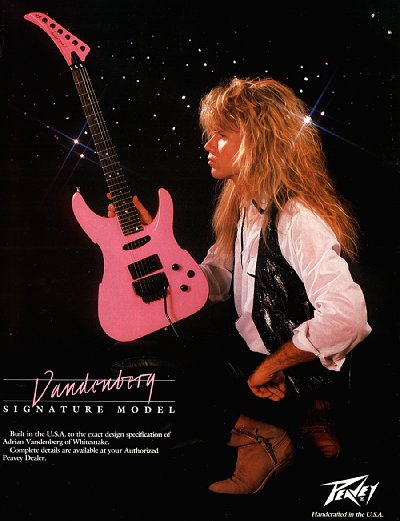
Okay: Imagine you've got Adrian Vandenberg's secret pearlescent black prototype Peavey 24.5" scale guitar from 1987. It was made with a three-foot-long reversed headstock, which makes the total length of the E string (from tuner to Floyd Rose) 61", assuming half an inch of string from the saddle to the anchor on the Floyd. Don't ask why. Vandenberg was crazy. The custom-made superlong strings cost $500 a set.
You block the Floyd Rose to immobilize it (just to take it out of the equation), loosen the locking nut, and tune up to E. Now you have 61" total string length at a tension at which the 24.5" of speaking length between the saddle and nut play an E. The whole 61" of string is at the same tension from anchor to tuner, yes?
Okay. Now, crank down that locking nut. We don't want to get out of tune while playing the chorus riff from "In the Heat of the Night". When the nut is locked, the entire string is still at the same tension, right? All we did was fix one point on the string so that it can't move. Check to make sure you still have that string tuned to E. What happens when you take your string snips and cut out the string between the nut and the tuner? The speaking string between the saddle and the nut is still 24.5", still tuned to E, and still at the exact same tension.
At the same time, you've removed three feet of string. Now the total length, including the bit between the anchor and the saddle, is 25", less than half what it was, but the tension is still the same. If the tension was lowered when the string was shortened, the string would no longer be tuned to an E. This is fundamental physics. If string of the same speaking length with the same mass is tuned to the same fundamental frequency (and it is the same in every possible parameter in this example, because it is in fact the very same string), it absolutely must be at the same tension. Whether it was 61" or 25" total length, the string had to be at the same tension when tuned to E. When using string mass, length, and tension to determine fundamental frequency, only the vibrating length is relevant.
Please note that I am referring to actual tension, the pulling force of the string. I am not talking about "perceived tension" or "feel" or "slinkiness" or "springiness" or "bendability", all of which seemed to surface in my interweb research, all of which being mistaken for tension. Since every element of a guitar affects feel and sound, surely extra string length beyond the speaking portion somehow subtly affects the feel and sound of a guitar. I'll wager it's a barely perceptible change."
So thank you dre for this extensive contribution (the picture of Adje Vanderberg's signature Peavey guitar is supposed somehow to make all this even more convincing).
Bertram
NB: There are a lot of blogs STEALING content and bandwidth. If you read this anywhere else but on guitarz.blogspot.com then you are reading a blog that STEALS content. Please support original bloggers!
NB: There are a lot of blogs STEALING content and bandwidth. If you read this anywhere else but on guitarz.blogspot.com then you are reading a blog that STEALS content. Please support original bloggers!
Monday, 29 September 2008
Guitar Weekends - Rock Weekend in Cumbria
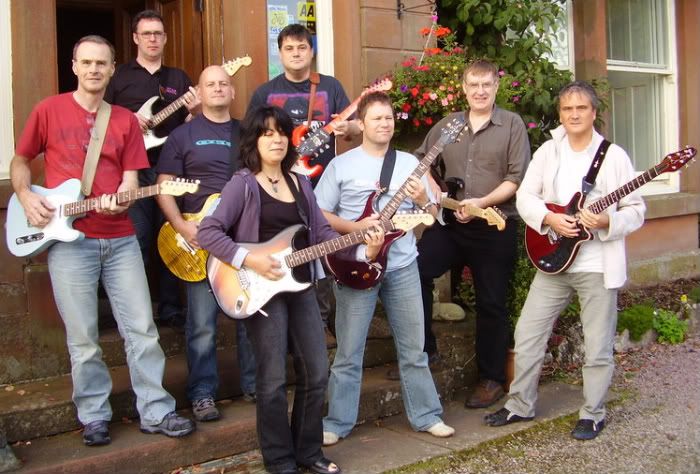
Guitar Weekends - Rock Weekend group 26-28 September 2008. L-R: Iain, Gary Dunn, Tony, Yours Truly, Rachel, Mark, Gordon and Graham
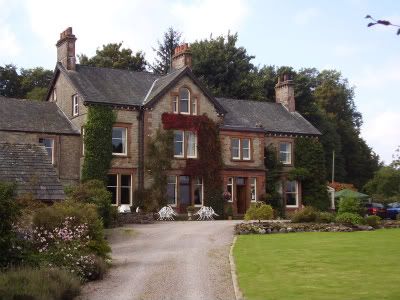
On Friday morning, I took the train up north and by mid-afternoon found myself at Beckfoot House near Penrith in Cumbria. I was there for one of the Guitar Weekends that Malcolm and Lesley White at Beckfoot House run throughout the year. Now I'd been on one of these before back in early 2007. That time it was an "Improvers" weekend, albeit with a rock flavour. I had a great time on that occasion but wanted to return so as to brush up on some of the theory. The weekend I chose this time also had a "rock" theme, but it turned out that it was actually a much more advanced course.
By mid to late afternoon a group of seven of us had assembled with our guitars and other paraphenalia and after introductions, Malcolm led us through a few exercises where we looked at scales and some alternative chord shapes. As a group we played through a few songs several times with Malcolm explaining how we could improve things by sharpening up our timing and by paying attention to the rhythm patterns.
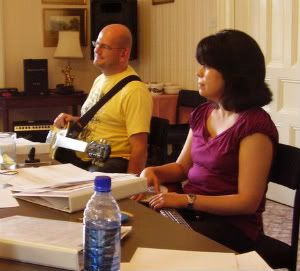 After an excellent dinner, we took it turns to play solos using the various scales relevant to the key the song was in. Everyone was put on the spot for a few moments when we were each asked to play something for the rest of the group. That was quite nerve-wracking but a good way to break the ice - a few of us fudged our playing, but no matter, we were all in the same boat. We went on playing until 1AM. Despite not starting until late afternoon, it had been a very busy day.
But Malcolm was only the warm-up man. From Saturday morning Gary Dunn took over as our teacher. A softly-spoken Geordie with a great sense of humour and a helluva lot of patience, Gary is an excellent musician and a fantastic teacher, explaining and demonstrating everything clearly. We studied some theory, such as how chords are constructed, what notes appear in different keys and why. As on the previous day, we played through a number of songs and took turns to play solos. We spent some time looking at AC/DC's "Back In Black", breaking it down into its component riffs, and then combining them into a whole. I have to confess that I was finding some of this very tricky. The theory I could follow, but the putting it into practice was something else! However, I made plenty of notes for practicing later at home.
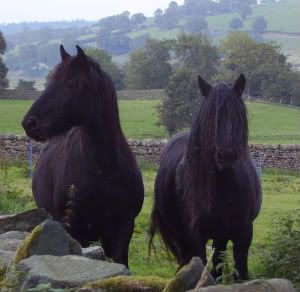 Late Saturday afternoon we had a break before dinner, so a group of us took a walk out into the beautiful surrounding countryside (and nearly getting ourselves lost, which is what happens when you start climbing walls and fences and marching over fields). This was a great opportunity to socialise and get to know each other better.
After another one of Lesley's excellent dinners, we began our project for the night. We split into two groups, each being given a song to work on, arrange, practice and finally perform. My group had "Riders on the Storm" which we had to arrange for four guitars. Luckily it's a song with several intertwining guitar parts, so there was something for each of us to do. My main job was the rhythm guitar, but they weren't letting me off that easily and it was decided that each of us would take a solo, so whilst I soloed someone else had to take over the rhythm. One of our group, Iain, was persuaded to sing, which was a nice touch.
After about three hours of arranging and practicing our parts, both groups came back together and performed our respective songs for one another and these were recorded so we could listen back to our triumphs and mistakes! We were quite pleased with our "Riders" although unfortunately Tony's Les Paul chose to develop a jack-socket fault just as he was about to start his solo so that we had a crackle-crackle-crackle solo for a few moments before he was to get stuck in properly.
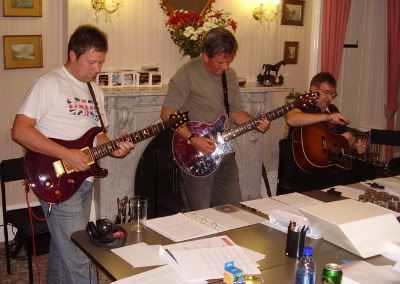 Rachel came out with a fantastic lead sound on her solo which caused a few heads to turn. I'm afraid I fluffed mine a little bit (although it wasn't that bad) but my main problem was that I hadn't set my relative rhythm versus lead volumes quite right and I was just too damn quiet. Iain having finished the vocals brought the song to a close with a nice solo on his Tele.
Then it was Mark, Graham and Gordon's turn, and they got up and performed Santana's "Samba Pa Ti" ("This isn't just any food. This is Marks and Spencers' food"), which allowed Mark on his PRS and Graham with his Brian May Red Special to indulge in a little lead guitar duelling whilst Gordon played the rhythm on his Gibson Hummingbird acoustic. Very nice it sounded too!
It had been another very busy - and long - day, so at 11:30 I decided to go hit the sack.
Sunday morning began with each of us independently working through the TAB for "Star Spangled Banner" whilst we waited to begin and trying to resist the tempation to add divebombing, explosions and rockets a la Hendrix.
 Gary then came in and taught us about 9th chords and arpeggios - all of which we worked through, and together we played "Hotel California" which has an E9 chord and a solo which you can play using the B harmonic minor scale. He also used "House of the Rising Sun" as an example of how to arpeggiate. I'm glad to report that none of us had to refer to the chord sheet for that one! (As if!)
After lunch it was time to bid our farewells and make our respective ways back home. All in all, it was an intense course. It was very enjoyable but it was certainly no picnic. (If you go on one of these courses you must be prepared to work!) As I said earlier, the course was much harder than I was expecting and if I'm honest I was slightly outside of my own comfort zone, but then surely it's better to be challenged rather than to cruise through things that come easily.
Guitar Weekends offer a whole host of these intensive weekends for guitarists of all abilities - Strugglers, Improvers, Rock, Blues, Country, Django and Maintenance. Next year they are possibly going to introduce a Recording weekend. I've been on two weekends now (which is nothing compared to some people who keep on coming back for more), and can wholeheartedly comment on their excellence: venue, staff, food, accommodation, material covered - all are top notch. My thanks to Lesley and Malcolm at Beckfoot House and also to our tutor Gary Dunn.
Thursday, 2 August 2007
Zack Zim performs The Simpsons theme on two guitars simultaneously: I was going to see The Simpsons Movie tonight but the folks I was going with weren't able to make it. Oh well, in the meantime I have to console myself with this neat YouTube video.
Tuesday, 5 June 2007
Guitar Weekends
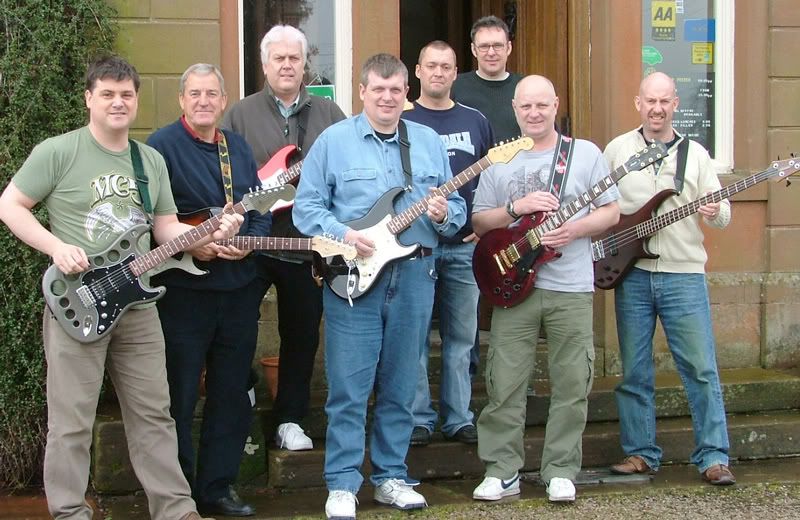
Back in March I spent a weekend in the Lake District playing guitar as part of one of these Guitar Weekends. Now despite being a total guitar nut, I'm not exactly the world's greatest player. I'm largely self-taught and have not learnt any theory over the years, so the idea of attending one of these courses seemed perfect. The course I attended was an "Improvers" courses. Other courses offered include a more basic one for "strugglers", or more advanced courses such as those for Blues and Django-style playing.
It was an intense course. We played all weekend up until midnight on Friday and Saturday nights, with breaks for meals. The accommodation and food was absolutely top-notch. It was great to play in a group situation with others and to learn some of the techniques of rhythm and lead playing (we each had spots at taking a solo), and to learn some of the music theory behind it all: how to ascertain which key a song is in, how to apply the understanding of scales and how to solo in that key.
It was so good that I'm considering going again!
BTW, guess which one of the chaps above is me? (Older readers of this blog will probably recognise my guitar).
Friday, 4 April 2003
Subscribe to:
Posts (Atom)
LinkWithin
