Wednesday, 31 July 2013

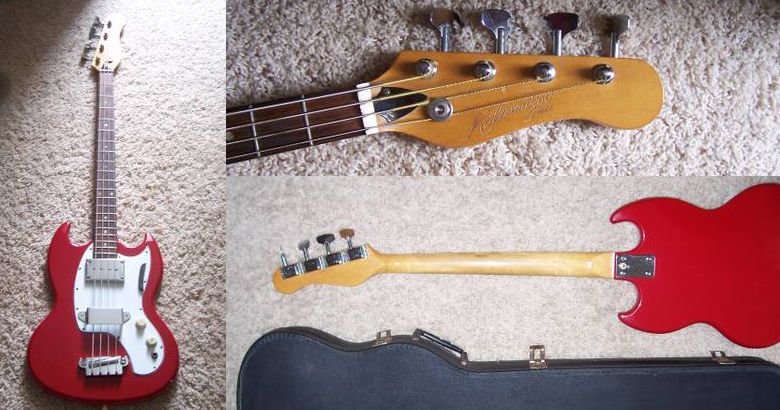
1966/67 Kalamazoo KB1 entry-level bass guitar made by Gibson

guitarz.blogspot.com:
Blake writes:
I came across this on a local craig's list post in Michigan. I thought you might be interested. Keep up the good work!

http://grandrapids.craigslist.org/msg/3964178634.html
Thanks for that, Blake. I'll just borrow some text from the listing that is quite informative about these instruments:
The Kalamazoo bass, or KB (sometimes referred to as KB1), arrived in 1966, as a companion model to two Kalamazoo KG guitars that had been launched a year earlier.

Modern styling in solid-body 4-string bass that offers full, true bass tones in a sleek, rugged economically priced instrument. With one pickup of extremely powerful design and full volume and tone control, the Kalamazoo Bass creates the full driving bass sound that sells a combo.

The vintage Kalamazoo-brand bass guitars are perhaps not that well known outside the United States, due to their short production time (just a few years in the mid 1960s) and the lack of endorsement by well known musicians; however being made by Gibson, in the USA, out of genuine Gibson parts meant that they were better instruments than many in the same price range. Good condition examples can change hands for reasonable sums amongst vintage guitar enthusiasts, and players alike.

There were two body shapes - later models are SG shaped (have a closer look at a 1967 KB bass), but the majority are more like a Fender Mustang (see a 1966 KB bass). They have a bolt-on maple neck; something that Gibson (up until this point) didn't do, rosewood fingerboard, and were short scale. There were two subtley different headstock shapes, the first again suggests Fender, though a bit rounded off - the second has the characteristic 'beak' and is almost identical to that of the non-reverse Thunderbird (see images below). The Kalamazoo logo is engraved on the headstock. This bass used some standard Gibson components; a typical EB series humbucker right up at the neck, as used in the EB0, EB2, EB3, Melody Maker bass and Epiphone Newport This pickup in this position, has more affect on the sound than anything else. This bass does sound quite a lot like an EB0. Tuning keys are the Japanese-made closed keys that were also used on the Melody Maker bass and a few EB0s. The bar bridge had been in use on all bass models, but around 1966/67 this was replaced by the two-point intonatable bridge. From this point, the KB bass was the only one using these bridges - likewise the only one using the old-style (and position) chrome handrest. The scratchplate is almost identical (except some minor screw hole differences) to the Melody Maker bass, but the fingerrest is not rosewood as on all Gibsons, but actually plastic. The body material is not specified in Kalamazoo literature, but is supposedly a wood-laminate of one or more unspecified species, produced by a toilet-seat manufacturer in Wisconsin. There were three colours: Flame Red, Glacier White, and Las Vegas Blue. These were not the expensive nitrocellulose finishes applied to Gibsons, but again catalogue descriptions are not specific, perhaps some form of polyurethane?

Kalamazoo, rather than Epiphone was Gibsons Budget brand. A common misconception about Epiphone is that its 1960s guitars and basses were cheaper imitations of the Gibson lines. This is simply not true. From the late 1950s until 1969 Gibson and Epiphone instruments were made side by side at the Kalamazoo factory in Michigan, using the same woods, techniques and components. The purpose of the Epiphone range was to continue to provide Epiphones high-end instruments; those that had been Gibsons competition, and to circumvent certain supply agreements (Gibsons protective territorial policy). There was actually a waiting list to become a Gibson dealer, and to avoid upsetting existing dealers, Gibson was able to offer its (almost identical) Epiphone models to newcomers.
Currently being offered for sale on Craigslist in Michigan for $650.

G L Wilson

© 2013, Guitarz - The Original Guitar Blog - the blog that goes all the way to 11!
Please read our photo and content policy.

Tuesday, 30 July 2013

Westone Corsair Classic - a Sid Poole-designed beauty

guitarz.blogspot.com:

I really like the design of this Westone Corsair Classic, it looks almost as if a Fender Stratocaster has been given the Gibson Junior treatment. Or perhaps a slightly offset version of Fender's Lead series guitars.

Of course this is one of the Sid Poole designed Prestige-series Westones built in the UK by the makers of the Status Graphite bass. It's virtually identical to the Westone Cutlass which differs only in pickup configuration.

This guitar is currently listed on eBay UK with a wholly reasonable Buy It Now price of £400. Alas, the seller specifies collection in person, which is quite a bummer if the prospective buyer is not within easy travelling distance of Swindon in Wiltshire, and is also peculiar given that the guitar comes in a hard case which looks like it'd easily provide adequate protection against the rigours of being sent by courier.

G L Wilson

© 2013, Guitarz - The Original Guitar Blog - the blog that goes all the way to 11!
Please read our photo and content policy.
Sunday, 28 July 2013

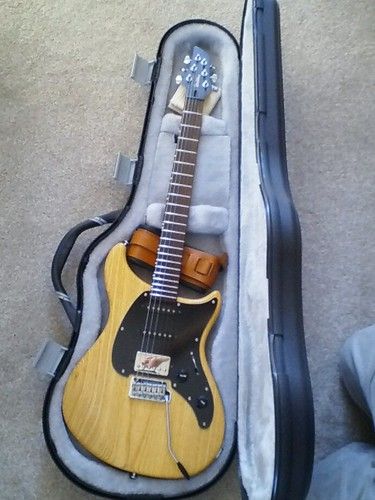
Can you identify the mysterious Outlook guitar?

guitarz.blogspot.com:
Guitarz reader Julian writes:
Ok, so curiosity has gotten the better of me here. For a few days I saw the guitar on the Hotmail login page and wondered what it was but didn't attempt to find out, but now I can no longer hold in that desire. So I was wondering whether you or any of the viewers of the blog might be able identify the guitar (photo attached)?

Many thanks, and keep up the great work on the ever interesting blog!
Thanks for that, Julian. That guitar does look strangely familiar; I have the sneaking suspicion that we may even have featured it on the blog at some point, but short of trawling our entire archives nothing is jogging the old memory, I'm afraid.

Do any of our other readers have any clues as to what this mystery guitar might be?

G L Wilson

© 2013, Guitarz - The Original Guitar Blog - the blog that goes all the way to 11!
Please read our photo and content policy.

Morbidoni Diamond Wildcat


Diamond was an US export brand of Italian guitar company Morbidoni, one of many companies based in Castelfidardo in central Italia near the Adriatic sea, once the world capital of accordion making, that turned to guitar making in the 1960s (we heard this story already, it happened also in Germany, Sweden, the Netherlands...) 

The Wildcat model is less known and less well designed than the Ranger, but it still has big square plastic switches, and that's what we love in Italian vintage guitars!

Bertram D

© 2013, Guitarz - The Original Guitar Blog - the blog that goes all the way to 11!
Please read our photo and content policy.

Friday, 26 July 2013

Born Custom Guitars OG-Drop solidbody electric guitar with Pistachio top

guitarz.blogspot.com:
Of course, here at Guitarz we don't just focus on weird and wonderful guitar finds on the auction sites. We're guitar aficionados and besides all the weird and wonderful guitars, vintage instruments, beautiful - or even occasionally horrendous - guitars, we are very keen to celebrate contemporary guitar design, and we have a particular fondness for the "little guy", i.e. the small guitar companies out there who are keeping the spirit of experimentation and guitar design alive. The guitar pictured here is a case in point, an experimentation in the use of an alternative and rather unusual tonewood. I'll allow Campbell Davis of Born Custom Guitars to explain:
We (Born Custom Guitars) are a new and small company located in Colorado. We're all big fans (all three of us!) of your blog, and we wanted to share a guitar that we recently completed that we feel is pretty unique. As a company, we love traditional tone woods, but we also really like experimenting with and promoting alternative tone woods. In either case, we use only salvaged, reclaimed, or sustainably sourced woods.

The guitar seen in the attached photos and video is our "OG-Drop" model. This particular guitar sports a Port Orford Cedar body and neck, Granadillo fretboard, and a Pistachio top…that's right, Pistachio! Pistachio trees are grown commercially for their nuts, but are only commercially productive for 50-80 years. After that point, they are usually chipped/scrapped, despite the fact that they can often live up to 200 years. The Pistachio top on this guitar was salvaged from a farm in California before it was scrapped. Pistachio is very heavy, hard, and dense and pairs very well with the lightweight and airy Port Orford Cedar (POC). The POC neck and body originate from a southern Oregon forest that was almost completely destroyed by a 500,000 acre fire a little more than a decade ago. The fire left many dead but harvestable trees. POC is really lightweight but incredibly straight grained and stable and we've found it to be an excellent alternative for Maple necks.
Thanks to the guys at Born Custom Guitars for showing us this beauty. I personally think it looks quite stunning, and as the video demonstrates it sounds sweet too!

G L Wilson

© 2013, Guitarz - The Original Guitar Blog - the blog that goes all the way to 11!
Please read our photo and content policy.

Thursday, 25 July 2013

From Germany of the 1970s - the Hoyer 50603

guitarz.blogspot.com:
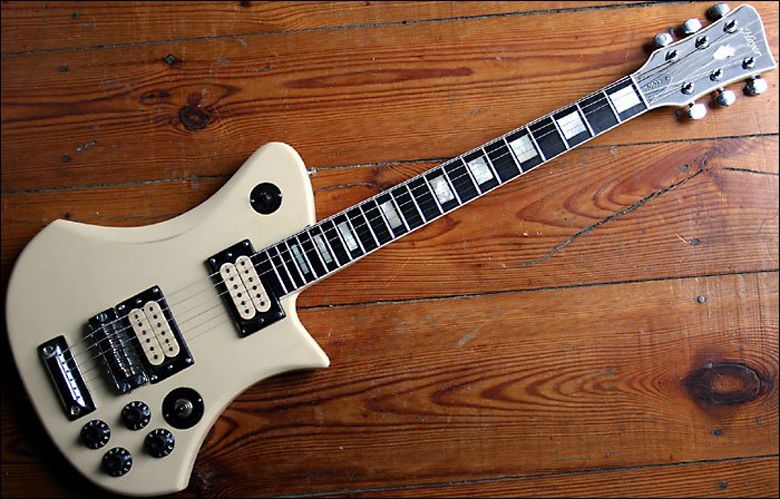
This 1970s German-made Hoyer 50603 has a body shape strangely reminiscent of certain Guild guitars (e.g. this one), and is one of those designs that I look at and say to myself, "Is it ugly? Is it attractive? I can't decide!"

The guitar features a pair of DiMarzio Super Distortion humbuckers (as was fashionable at the time) with a volume and tone control for each and a pair of switches, one of which will be the pickup selector, but as for the other... Anyone out there know? Coil top or phase inversion, maybe?

This guitar is currently located in Berlin, and is listed on eBay.de with a Buy It Now price of €799.

G L Wilson

© 2013, Guitarz - The Original Guitar Blog - the blog that goes all the way to 11!
Please read our photo and content policy.
Wednesday, 24 July 2013

One-off handmade guitar with a Love and Rockets theme

guitarz.blogspot.com:
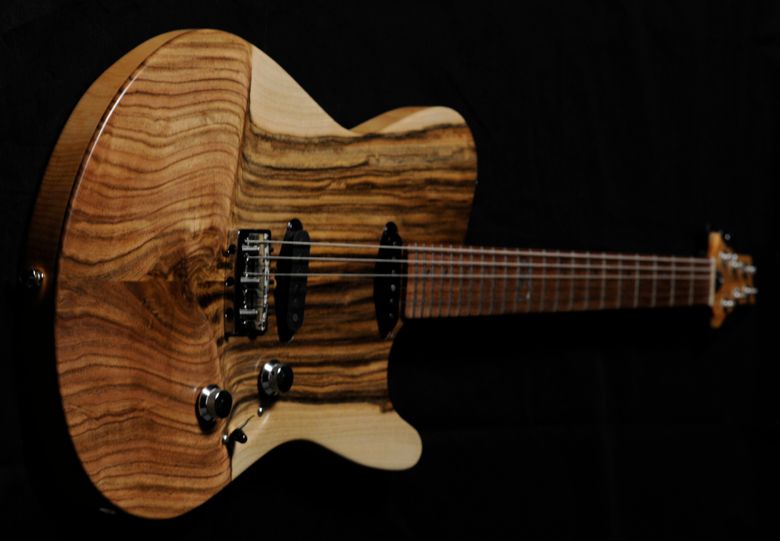
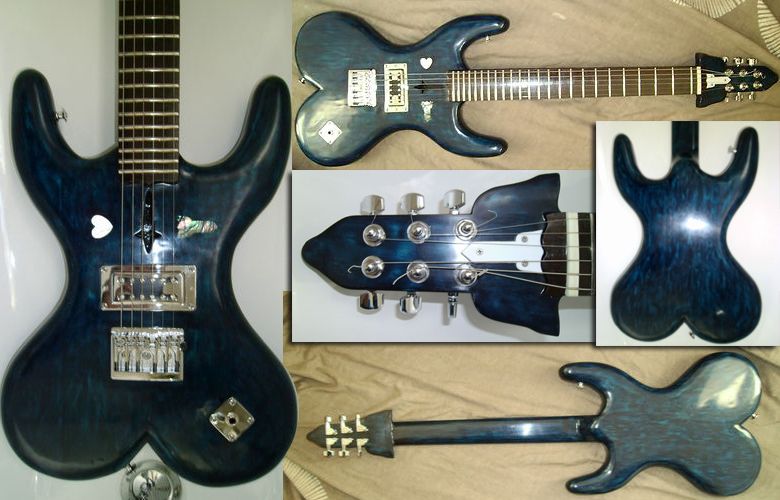
Far be it for me to decry the handiwork of those who are talented enough to build their own guitars from scratch - I'm quite sure I couldn't do it - but even having said that, I have to comment that this strangely-shaped hand-built Love and Rockets-themed guitar is quite an oddity. The set neck construction, inlay work, and high quality of the finish are all evidence that this guitar was built by someone comfortable with working with wood (apparently one Stephen Sidney Johnson, brother of the eBay seller). However, the design of the guitar is quite curious in places, particularly the almost buttock-like rear-end and one of the very weirdest headstock shapes I have ever seen - rocket-shaped, I presume. The neck is also bizarre in that it appears to be parallel along its length in these photos. It also has no volume and tone controls - just a jack output from the lone humbucker. Whether this guitar is homage to Love and Rockets the comic or the band (or even some other reference that I am unaware of), I do not know.

Currently listed on eBay with a Buy It Now price of £4,000, which, sadly, I think may be optimistic. I am sure that this may have been a real labour of love for its creator, but I cannot imagine it selling for anything remotely approaching this sum.

G L Wilson

© 2013, Guitarz - The Original Guitar Blog - the blog that goes all the way to 11!
Please read our photo and content policy.
Tuesday, 23 July 2013

"The Handle" (rough) copy guitar on a Dutch auction site

guitarz.blogspot.com:
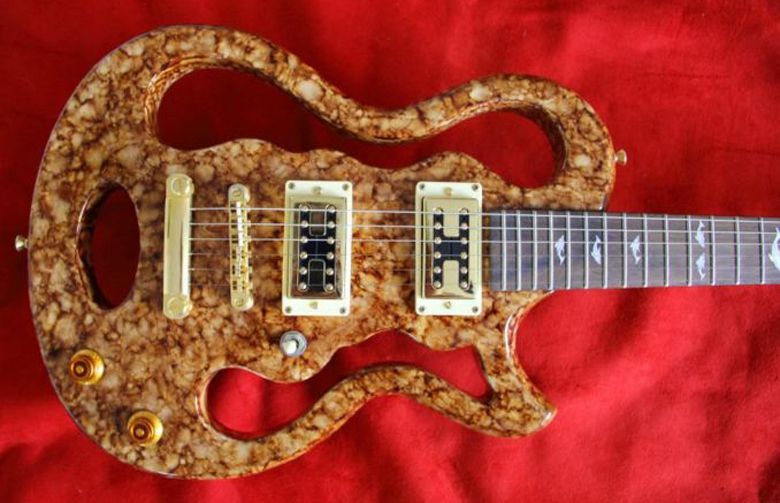
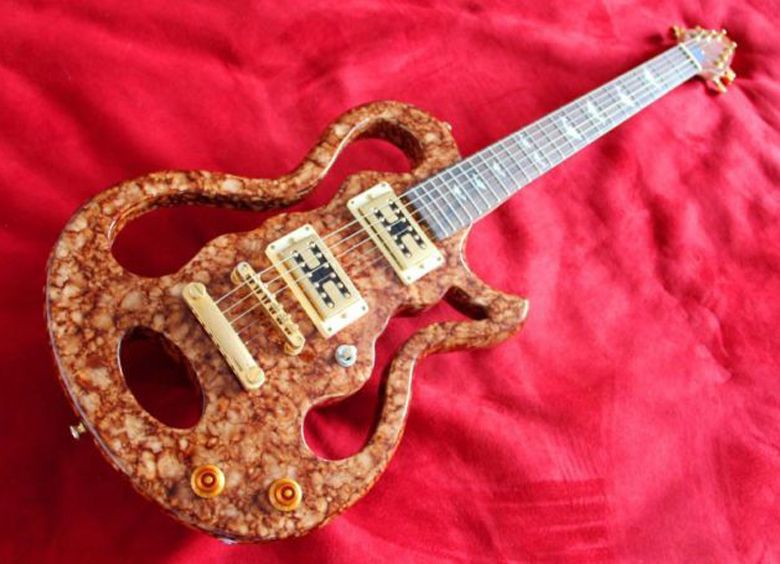
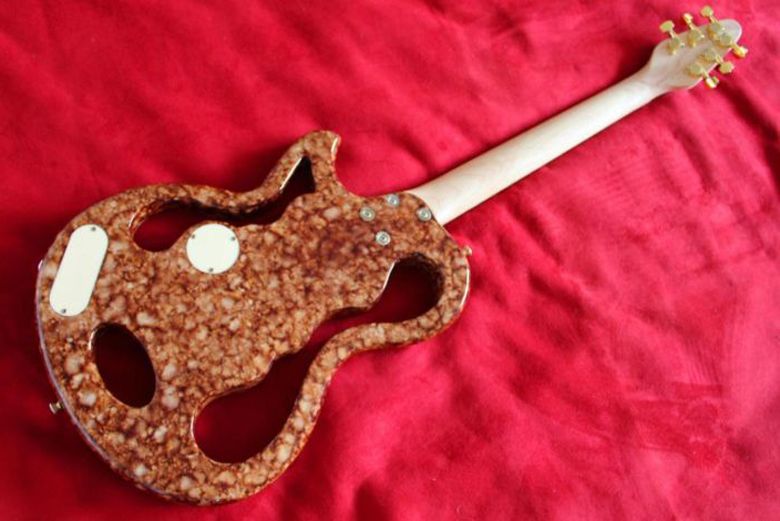
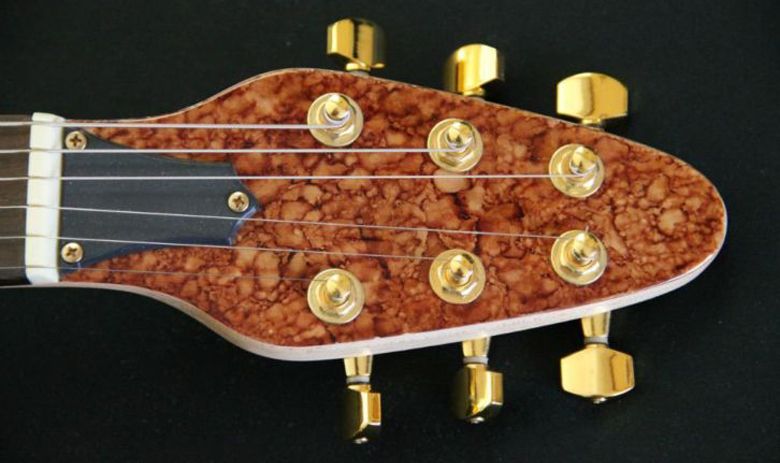
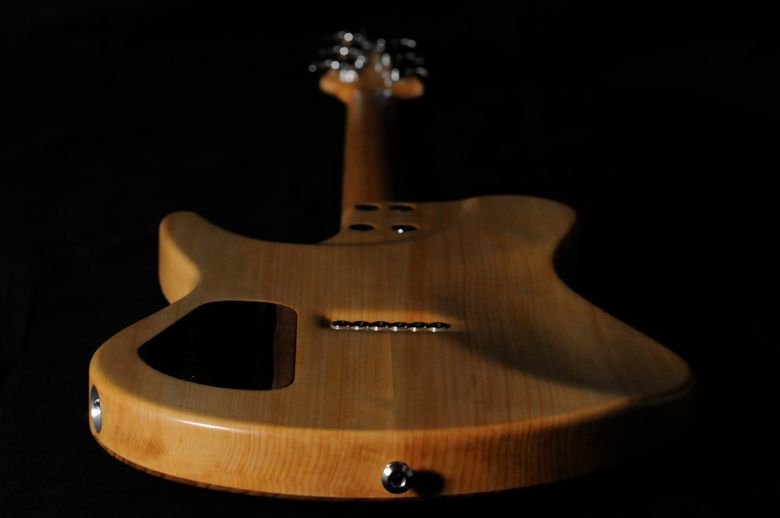
Now here's quite a curious guitar currently listed on a Dutch auction site priced at €250,00. Of course, the holey shape makes much more sense when you realise that the entire design has been copied from the fantastic XOX Audio Tools "The Handle" which is a guitar I have been coveting now for several years. Bear in mind, of course, that the XOX Handle is a cutting edge technologically advanced guitar made from carbon fibre with a hollow tube body, whereas this guitar on the Dutch site is merely a cheap approximation of the same shape made in Taiwan. Oh, and it has Wilkinson pickups too and dolphin inlays on the fingerboard (quite what the relevance is, I do not know). The body finish is unusual, I'm guessing it's supposed to suggest that the body is made from marble but even without seeing this guitar in the flesh I can 99.9% guarantee that it's made entirely from wood. If the body were made from stone, you think the seller might mention it. And can you imagine how heavy such a guitar would be, even with the holes in the body?

Thanks to Eric for bringing this guitar to my attention.

G L Wilson

© 2013, Guitarz - The Original Guitar Blog - the blog that goes all the way to 11!
Please read our photo and content policy.
Monday, 22 July 2013

A gumby-shaped DIY furry guitar currently listed on eBay UK

guitarz.blogspot.com:
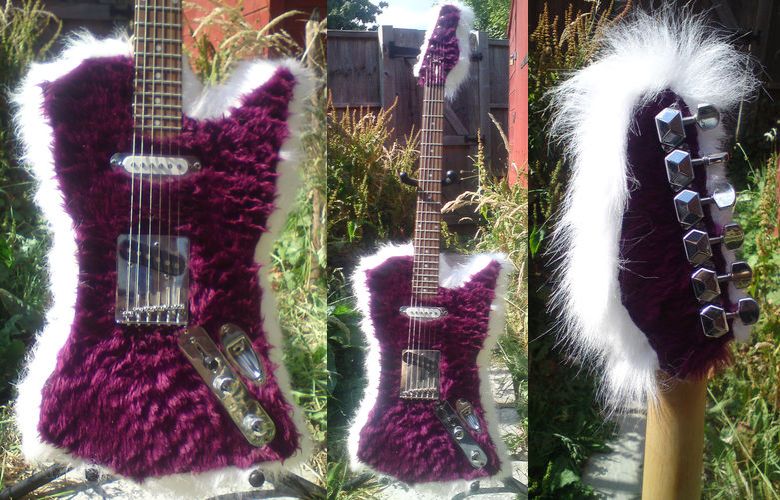
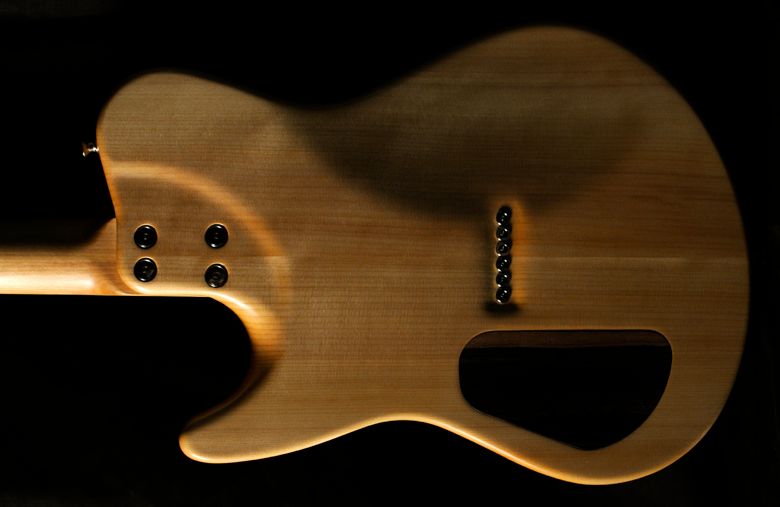
I'm trying to work out quite what the original body shape is beneath all that fur fabric on this self-made fluffy guitar currently listed on eBay UK. Despite the Telecaster hardware, the shape now appears to be "gumby"-like.

I'm not really sure who it's supposed to appeal to. Perhaps a glam-rock covers party band? Or a Wombles or Banana Splits tribute band maybe?

Currently listed on eBay UK with a Buy It Now price of £220.

G L Wilson

© 2013, Guitarz - The Original Guitar Blog - the blog that goes all the way to 11!
Please read our photo and content policy.
Sunday, 21 July 2013

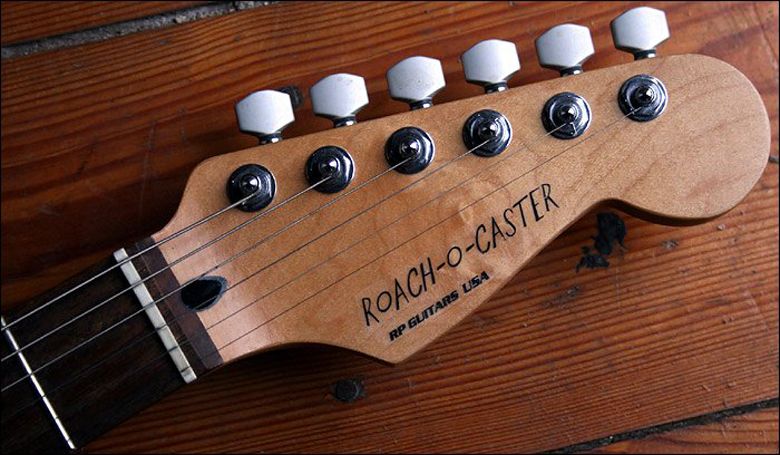
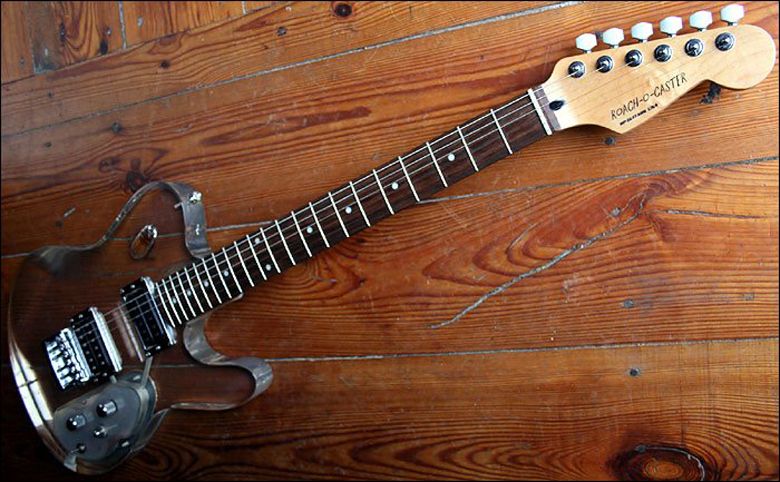
RP Custom Guitars Roach-o-caster acrylic-bodied guitar complete with entombed cockroach

guitarz.blogspot.com:
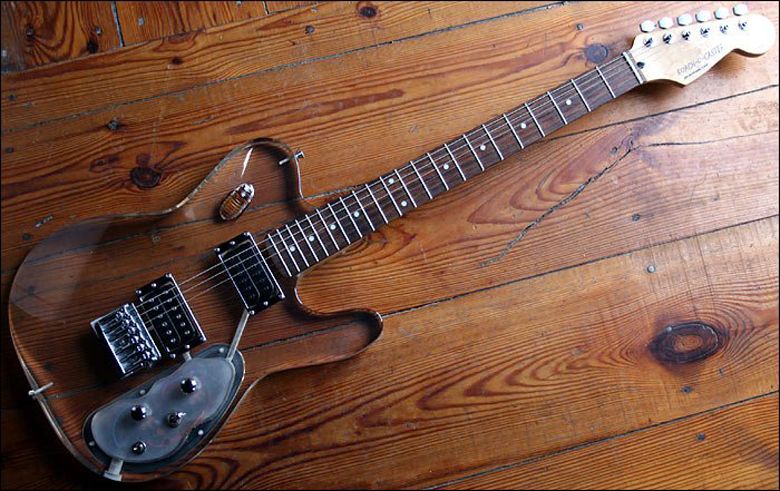
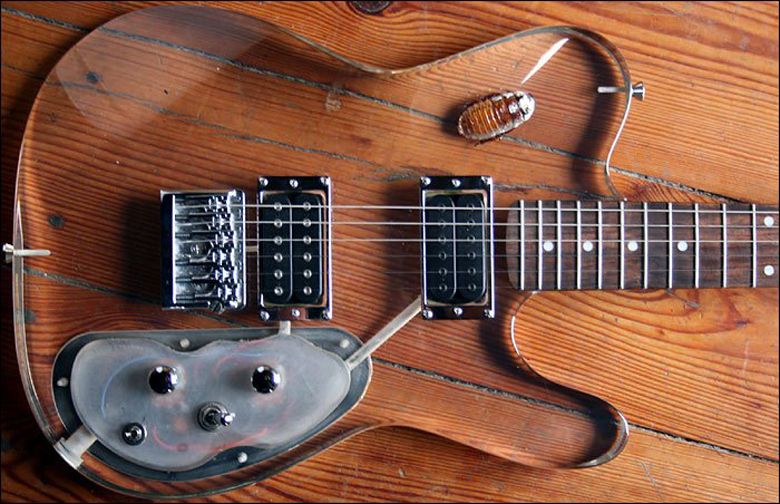
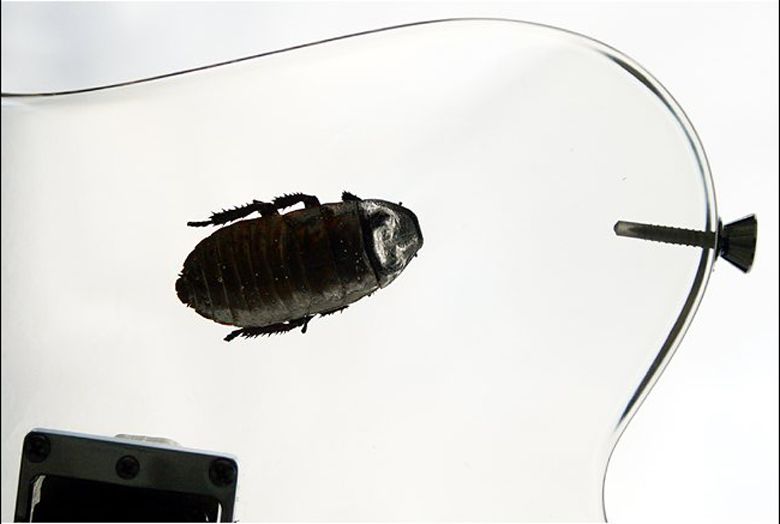
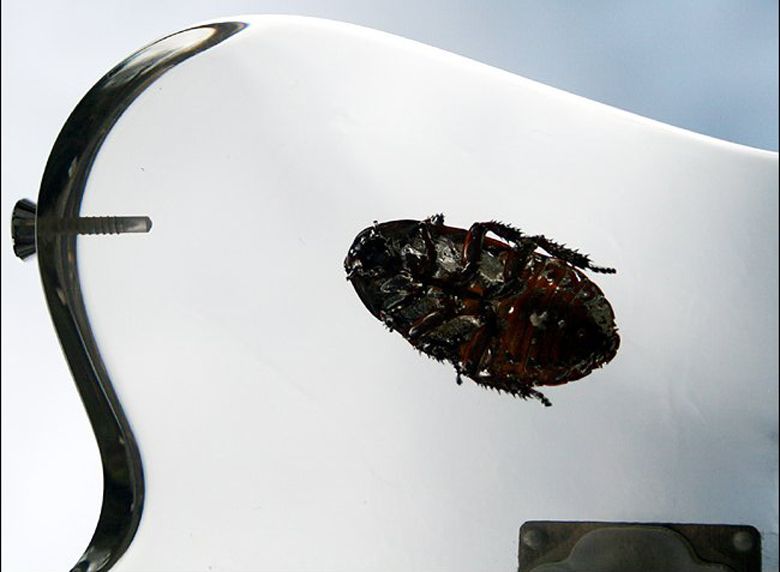
I think the photos of this acrylic-bodied "Roach-o-caster" electric guitar from RP Custom Guitars of Los Angeles say it all. We've looked at a number of see-thru acrylic-bodied guitars before, but the big difference with the Roach-o-caster is that it comes with its own entombed insect cast inside the acrylic body. I don't know about you, but I can't say that I'm too comfortable with the morality or ethics of putting dead bodies of living creatures into a musical instrument, even if it is something as frequently reviled as a cockroach (although I am told that they make very nice pets). The question is, was it already dead when it was put in? I certainly hope so. Even then, there's something quite ghoulish about it.

This guitar, currently located in Berlin, is now listed on eBay.de with a But It Now price of €899.

G L Wilson

© 2013, Guitarz - The Original Guitar Blog - the blog that goes all the way to 11!
Please read our photo and content policy.
LinkWithin

Related Posts with Thumbnails

ShareThis