I have previously posted on this blog about these suspicious looking instruments, but this time I decided to do a little homework and it didn't take very long to dig out the dirt. Checking through the seller's feedback reveals numerous stories of unplayable instruments, instruments damaged in transit, instruments not set up, etc etc. Feedback such as this would have put me off, so it amazes me that people still bid.
Over at Harmony Central there are three user reviews for the Tennessee brand of instuments, none of which are favourable.
- Tennessee 10 String Bass
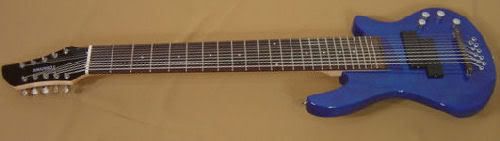 "The electronics though are horrible. Described as having two volumes and three tone controls, it actually has one volume and four tone controls. After removing the control cover plate and studying the wiring, both pickups are wired in parallel to the main volume control and the other four controls are wired as tone controls with the exact same spec capacitor. As you turn up each tone control you roll off more and more highs, until you are left with mud. [...]
When I received this bass it was unplayable. [...] The nut looked liked it was slotted by an 8 year old Chinese sweatshop employee...which it probably was. The "fully" adjustable rosewood bridge only has height adjustments at each end and when adjusted all the way down the action is still a mile high, and of course the intonation is way off with no way to adjust it. Had 4 low frets and several sharp fret edges. [...] If it couldn't get any worse...to ground the strings/bridge, a wire soldered to one of the tone pots is fed through the ball ends of all the strings!" - Tennessee 6 string electric/8 string lap steel double neck
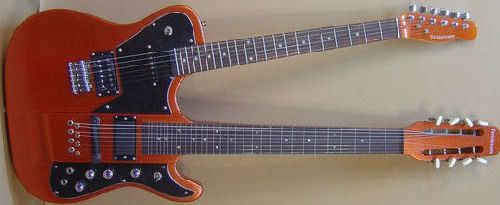 "...it was delivered with a broken nut on the lap steel, and in severe need of a proper set-up on the 6 string. [...] This guitar ... is in desperate need of a luthier. [...] It arrived un-playable on either neck.
The 6 string neck seems "ok", but I've not been able to play it at all, due to such a horrible "initial set-up". The action, as delivered, is on par with a properly set-up lap steel guitar. The intonation isn't as well set as my first service merchandise "toy" guitar. The humbucker's trim ring was clearly designed to fit an arch-top guitar in the neck position, but is mounted on a flat top in the bridge position.
The bridge for the lap steel is wooden and NOT mounted to the guitar; it was held down by string pressure, alone. It is not wide enough for the standard 3/8" string spacing and will be replaced with a good hunk of metal. The strings run through the body via PLASTIC ferrels, and were secured by nothing but the wood of the body, and a grounding wire from the electronics run through the ball ends of the strings. The nut was broken between the two lowest tuned bass strings at delivery, and will also need to be replaced. That's just fine, as this will give me time to properly finish the "fretboard", which appeard as if it came straight off of a belt sander wrapped in 80 grit.
Currently, I wouldn't rely on this guitar to hold a door open. [...]
This could not be considered an instrument; merely a representation of one. It is advertised as a "pro" guitar; I wouldn't even consider it a beginner or student level guitar. I wouldn't foist it upon anyone for anything other than shooting practice..." - Tennessee Mandolin/Guitar Doubleneck
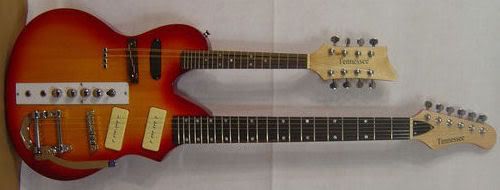 "Believe it or not, the guitar has no bridge* - the strings come straight off the bigsby, so there is no way to adjust height or intonation. I found that if I threaded the guitar strings under the retainer bar on the Bigsby (which is proper) the strings hit the fretboard. If I allowed the string to be above the retainer, then the 12th fret is no longer halfway between the nut and bridge, and intonation is off by a mile. This is a serious design flaw - the bigsby should have been placed further back towards the endpin so that there would be room for an adjustable bridge, which is the proper set up for a bigsby. (I'm not kidding - if you look at a photograph of one of these, you will plainly see that the guitar has no bridge).
On the mandolin side, putting 2 strings in each of 4 string ferrules is not a good system because the strings do not stay separate as they cross the bridge, and the bridge itself was not grooved to hold the strings in place. The bridge on the particular instrument I received was much too large to function as a mandolin bridge - it was over 3" wide (closer in size to a bass bridge!). [...]
It also smelled like paint. [...]
The instrument I received was not a playable or professional quality instrument."
* - note that the guitar pictured by way of illustration, DOES have a bridge.
Remember the old saying: "If it looks too good to be true - it probably is!"


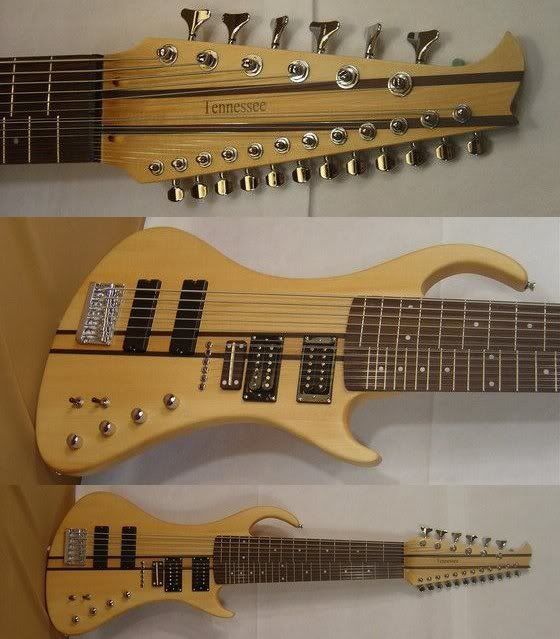 More and more often on eBay these days I'm seeing guitars bearing the Tennessee brand. These guys don't play it safe with tried and trusted popular models. They seem to make up the most outlandish designs possible such as crazy multi-necked instruments (I've featured some of these before) and they always seem to be very cheap so as to appeal to the buyer who thinks "That guitar might well look crazy, but at that price I'll give it a whirl." It's an interesting marketing strategy.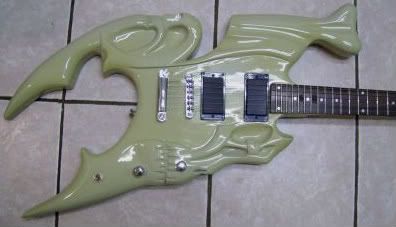
 I'd like to say a big Thank You to Joe Coffey and
  This is the first in an occasional series of blog items, basically for when I'm experiencing a slow news day in the guitar world and for when I haven't found anything particularly alarming on eBay to show you.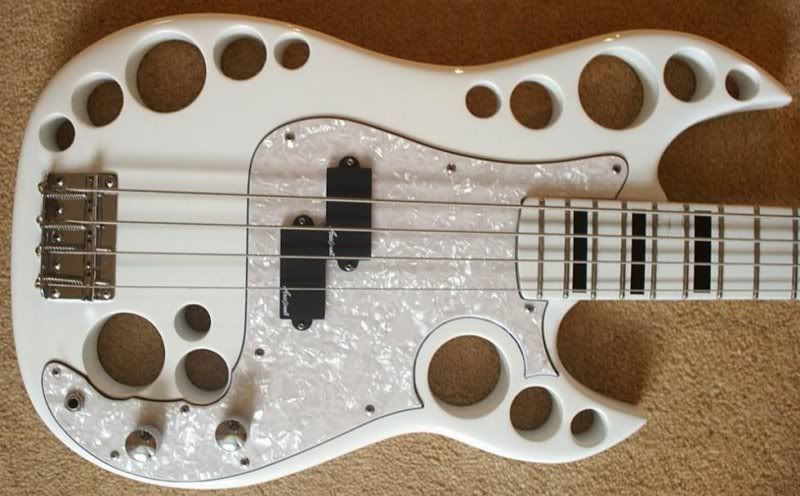
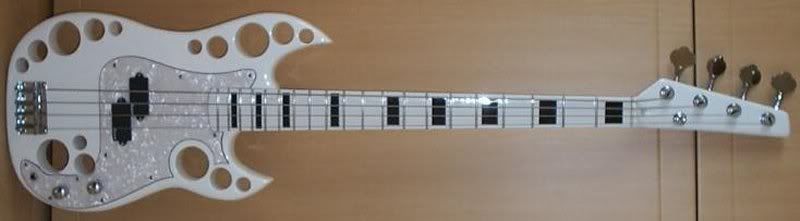
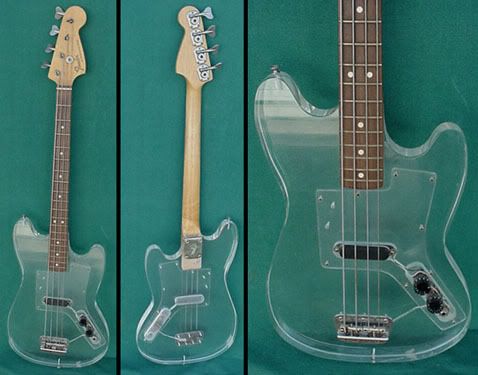 Here's a rare Fender - in fact it's so rare that it's one of those models that doesn't officially exist!
 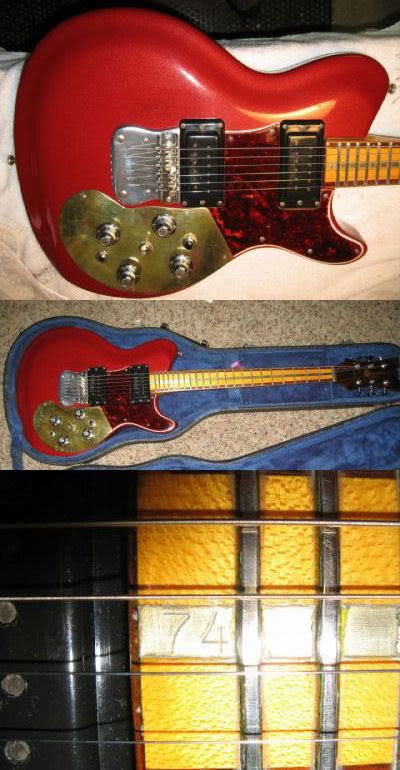 There's a listing on eBay right now for a