Sunday, 12 February 2012

1960s Hoyer semi-hollow Telecaster


I knew that Hoyer has been producing their own version of the Telecaster since the 1960s (as you can see here, it's never been a mere copy) up to nowadays, but so far I didn't know the semi-hollow version of it. And I say semi-hollow, not thinline like the Fender Thinline Telecaster we all know - a chambered guitar with a single F-hole on the upper side. This is a real archtop semi-hollow guitar in the German style, probably out of laminated wood, that just keeps from the Tele the general outline! And I must say that it works quite well!

Bertram

© 2012, Guitarz - The Original Guitar Blog - now in its 10th year!

Saturday, 11 February 2012

1959 Teisco J-5


Another day when I browse the Web looking for a new guitar to show here, thinking that I've seen it all and that I've squinted at enough Les Paul and strat copies for the next ten years... 

Then here it is, the little wonder from across time and space, a Teisco J-5 from 1959, that makes it one of the earliest Japanese solid body guitars ever distributed in the USA. 

Its outline is quite unique, so bizarre that it's almost east-German, then there is a lot of chrome - that can never be bad - including the covers of the typically Teisco gold foil pickups.

Thank you Teisco, you saved the day again!

Bertram

© 2012, Guitarz - The Original Guitar Blog - now in its 10th year!

Friday, 10 February 2012

1963 Fender Jaguar refinished in silver sparkle


In this times of vintage worship, it's good to see a disrespectful refinish in a joyously vulgar (if used by KISS or Abba) or flashily glam (if David Bowie or Marc Bolan are around) silver sparkle of a good old 1963 Fender Jaguar! 

Usually I think that the look of a guitar should not influence what you play on it, but this one seems to invite you to play 'Get it on'! Don't you hear the riff when you look at it?

Bertram


Edit: a live video of 'Get it on'!


© 2012, Guitarz - The Original Guitar Blog - now in its 10th year!

Thursday, 9 February 2012

Erlewine Lazer headless travel guitar and a ghost mystery

guitarz.blogspot.com:
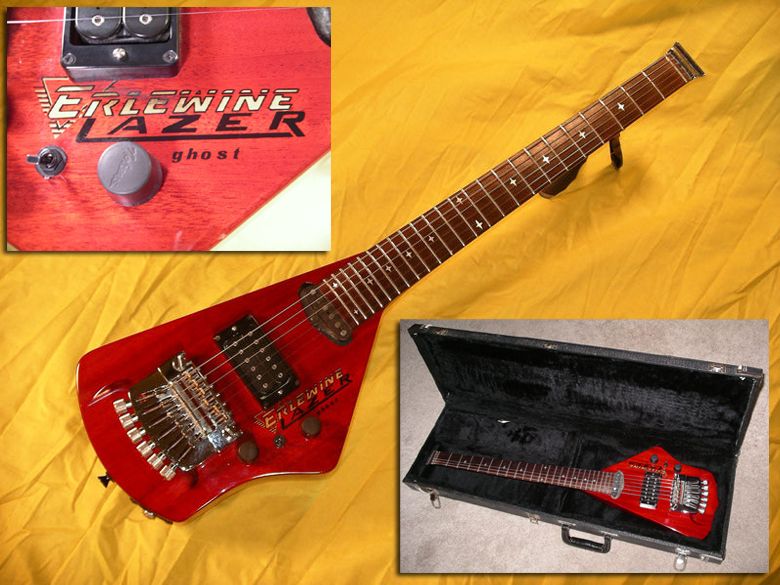
We previously looked at an Erlewine Lazer last year here on Guitarz but that was a heavily modified example. The Erlewine Lazer we are looking at today is a much finer example, being in superb condition; it also has two pickups, a singlecoil in the neck position and DiMarzio humbucker at the bridge.

These guitars, as favoured by Johnny Winter, are - despite their diminutive size - full-scale length guitars, and are built by luthier Mark Erlewine, the man responsible for bringing us the original Chiquita guitar as used by Michael J Fox in the now legendary Back To The Future opening sequence.

What is unusual about this particular Lazer, however, is the "Ghost" legend applied beneath the "Erlewine Lazer" decal on the body. To quote from the eBay listing:
An interested eBayer asked. "(W)hy does it say "ghost" under the Lazer label? I have never seen that on a Lazer." Indeed, none of the photographs of Lazers I have found have this moniker. A close examination indicates the "ghost" in lower case black lettering is below the clear nitrocellulose lacquer as if it was original to the guitar, so I telephoned Mark Erlewine at his Austin Texas office to inquire. Mr. Erlewine does not recall having ever made a special Lazer with the word "ghost” added, and he does not have records that would indicate a special order to add the word “ghost” to one of his custom made guitars.

A conversation with the widow of the original owner revealed that the owner was fascinated with ghost iconography; especially flaming skulls. This was a theme he carried into many of his artistic endeavors. She does not have information about specifics, but it seems reasonable that the original owner would have named his guitar the ghost and added the name. If so, the addition was professionally done by someone who understands how to work nitrocellulose lacquer.

If the new buyer wanted to remove the name, nitrocellulose lacquer is malleable enough that a craftsman would be able to remove the “ghost” within the multiple layers of clear lacquer, which brings up another point.

Erlewine stated that he would perform a full setup of the Lazer for less than $200, including strings of choice. I personally cannot think of anyone better to set the Lazer for the new owner’s playing preference than the skillful luthier who designed and built it in the first place. The new owner may want to ask Mr. Erlewine what he would charge to remove the “ghost” and re-lacquer the guitar, however I personally believe that this historical evidence of the guitar’s journey should remain. In other words, one should probably not mess too much with the “ghost”.
I agree with the eBay seller that the "ghost" should be allowed to stay. It's part of the guitar's history, and it isn't as if it's an unsightly blemish.

This guitar is currently listed on eBay with a Buy It Now price of $2,500 - the auction ends later today.

G L Wilson

© 2012, Guitarz - The Original Guitar Blog - now in its 10th year!

Wednesday, 8 February 2012

Vintage & Rare guitar of the week: 1962 Gretsch Bikini Bass

guitarz.blogspot.com:
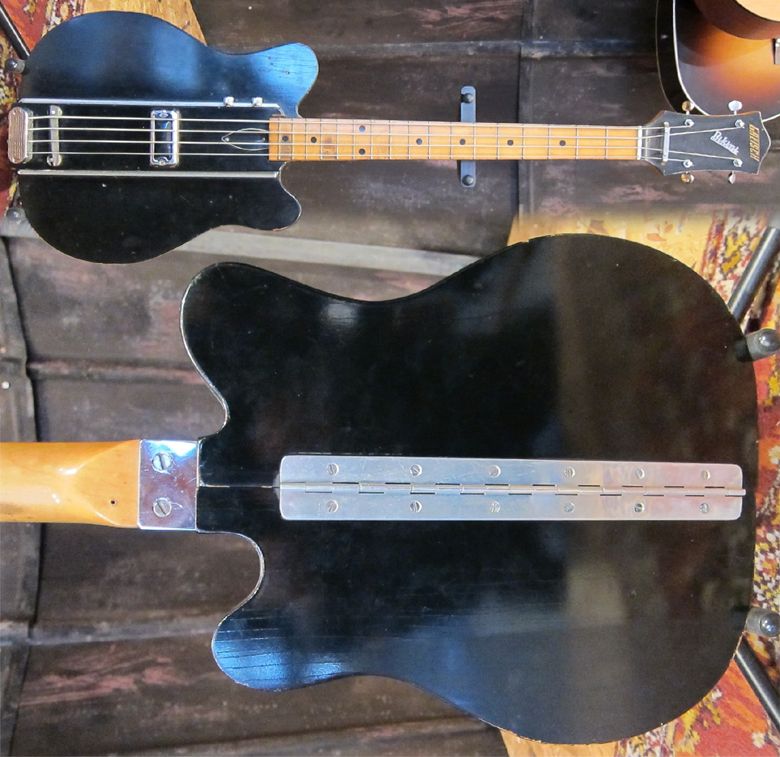
I guess that without the foldaway hinged "wings" making up the body this 1962 Gretsch Bikini Bass would resemble a LaBaye 2x4. Note how the volume and tone controls are mounted on the top edge of the central section. It makes me wonder if this was an early take on the travel guitar, one that folds down into a small package. I'm pretty sure that Gretsch also made a 6-string guitar neck too which would also fit into the same hinged body. The Who's John Entwistle had a doubleneck Gretsch Bikini in his collection; the foldaway nature of the instrument would be a definite advantage on a cumbersome doubleneck and you would also be able to choose which way around to arrange the necks (bass on top and guitar on bottom, or guitar on top and bass on bottom).

This bass is currently being offered for sale via Vintage & Rare priced at €1344.

G L Wilson

© 2012, Guitarz - The Original Guitar Blog - now in its 10th year!

Tuesday, 7 February 2012

1960s vintage Vox Student Prince

guitarz.blogspot.com:
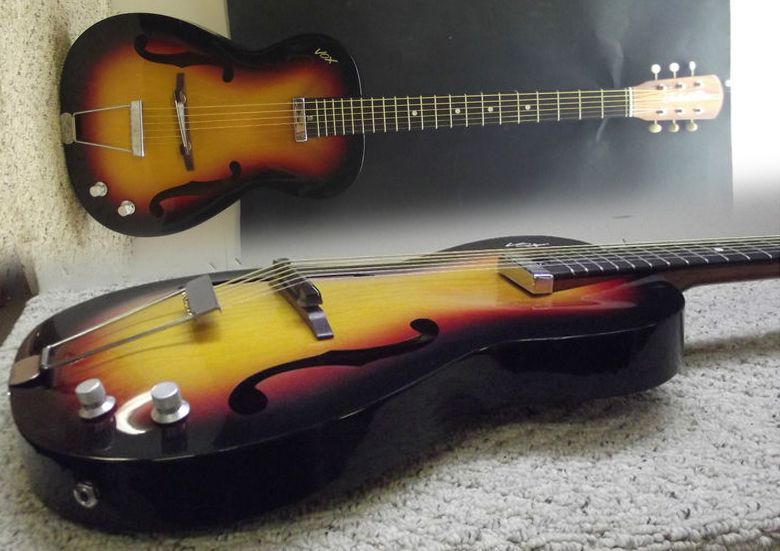
A 1960s student-model guitar from Vox might sound like a bad idea to some, for early Vox guitars were not exactly known for their high quality in the first place; so, an even inferior model would not, on the face of it, present a very good prospect. However, the back of the headstock of this Vox Student Prince tells us that this is one of the later 1960s Voxs from the period when guitar production was no longer from Dartford, Kent in England, but was outsourced to Italy - most famously with the Eko factory. That would make this unassuming little - almost 1950s-style - guitar a contemporary of the more famous Vox Mark Series, Teardrop and Phantom models.
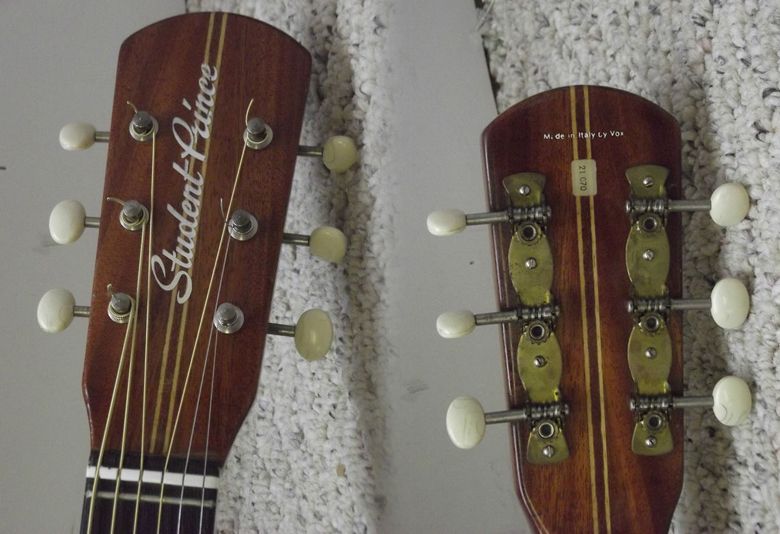
At first glance it would appear to be an archtop acoustic guitar with a pickup mounted at the end of the fretboard. However, turn the guitar sideways on and you'll see that this guitar does not have a full-depth acoustic body and is more of a thinline. It also has a bolt-on neck which is much more in keeping with the construction of electric guitars, although Eko were known for their bolt-on acoustic guitars such as the Ranger series. Note also there is access for the adjustable trussrod at the end of the fingerboard. The earlier Vox guitars from Dartford did not have adjustable trussrods, just am immobile steel rod embedded beneath the fingerboard for strength (I know this from having changed the fingerboard on an old Vox Clubman II guitar in order to convert it to fretless).
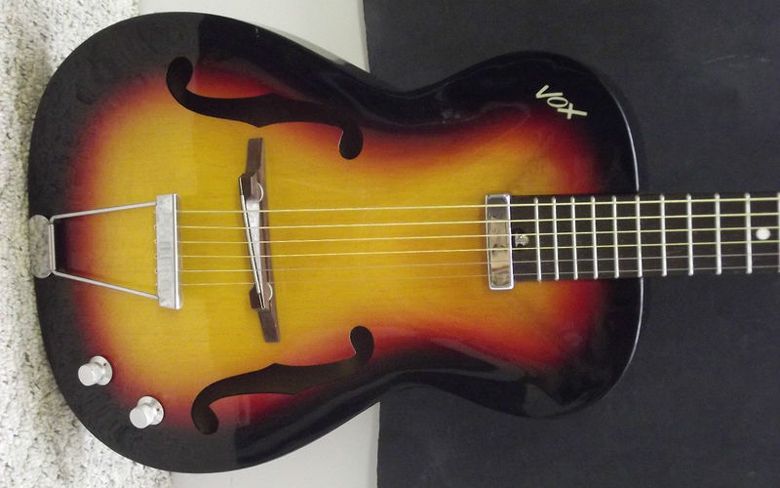
It looks to be in excellent condition for a guitar approximately 45 years old. The sunburst finish looks as good as new, although perhaps with a guitar this shape you'd expect to see some binding but I guess that was left off as befitting the guitar's student status.

This Vox Student Prince in currently listed on eBay (with just over a day left to run on the auction) with a not unreasonable sounding starting price of $395 and no bids at the time of writing.

G L Wilson

EDIT: It didn't sell and has been re-listed.

© 2012, Guitarz - The Original Guitar Blog - now in its 10th year!

Monday, 6 February 2012

Just what is that strange Red Dead Redemption guitar?

guitarz.blogspot.com:
Dear Guitarz,

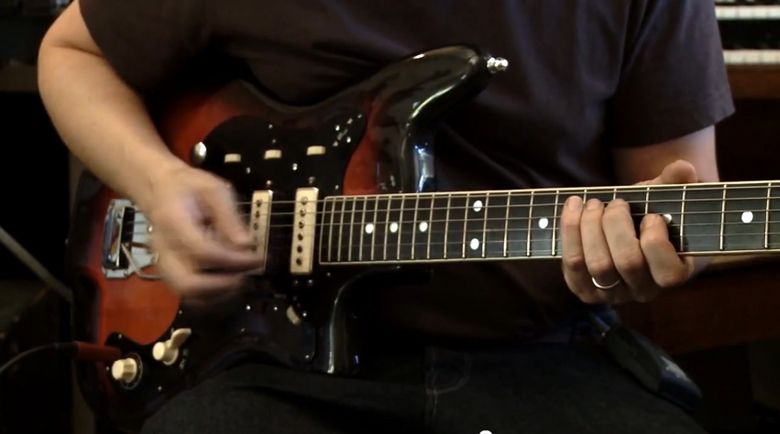
I have become slightly obsessed with finding out what I can about this guitar (images attached) that was used for the soundtrack to [the videogame] Red Dead Redemption. These screen caps comes from a cool video on the making of the soundtrack [see below].

Any ideas?
Thanks,
Steve


© 2012, Guitarz - The Original Guitar Blog - now in its 10th year!

1955 Magnatone G-65 lap steel, designed by Paul Bigsby


Simplicity of material and sophistication of the design: you cannot do much better than this 1955 Magnatone G-65 lap steel with an art-deco design by master Paul Bigsby!

I love its shining chrome hardware on wood in natural finish, and the design has the same evidence as the one of the Telecaster - and thus is still used half a century later by models by Gretsch or Duesenberg...

Bertram 


© 2012, Guitarz - The Original Guitar Blog - now in its 10th year!

Sunday, 5 February 2012

Another Daion Headhunter 555


This (magnificent) Daion Headhunter 555 is nothing new for Guitarz' regular readers, we've seen one here - but it was already back in 2010, and this picture is much better than the one I showed last time ! Even the sunburst finish - that I usually quite dislike - looks cool!

And one picture reveals something I didn't know, that though it is a semi-hollow body, the Headhunter has a string-through-body bridge - it is quite unusual if I'm not wrong! [It has a solid centre block in the body, like on a Gibson 335. See: http://daionguitar.com/electric.php - GLW]

You will also find extra information about Daion guitars on this other previous post.

Bertram

© 2012, Guitarz - The Original Guitar Blog - now in its 10th year!

Saturday, 4 February 2012

Squier M-80


At first sight, this M80 doesn't look much like a Squier - isn't Squier supposed to just released budget versions of Fender guitars? -, but more like these Matsumoku guitars from the early 1980s that prepared the guitar world to the metal era: unspectacular outline and wood, transparent finish, Gibsonesque gear and pickups - even an Ibanez-style headstock! But the M80 is a real - though short-lived - Squier guitar from the mid-2000s, about which there is little online information, but several very positive reviews. 

This one has seen its Duncan Designed HB replaced by Seymour Duncan open ones - like many Squiers, it seems that the M80 has been a good base for upgrades and modifications! It's easy to overlook this guitar - though it has a refreshing feel of honesty that made me want to know more about it -, but when you read what Tod Krause, its designer, says, you may reconsider:
“I’ve been working on the M-80 for a long time. I designed it for somebody who was playing at a club, working with a label, about to be signed, or had been signed. I wanted to build a “workingman’s” guitar for a new generation of players. That guitar evolved from many years of seeing things in guitars that I like or dislike. A lot of designs on that guitar are my gut-level reaction to what I see people playing, my playing, and what players tell me they like and dislike – or find comfortable and uncomfortable.
 “There’s a lot of design in the M-80 that doesn’t meet the eye. For example, the body comes from a shortened Mustang guitar. If you put a longer-scale Neck on a Mustang, you have to shorten the body so it feels right. I placed the strap buttons, so that when the guitar is hanging, it feels familiar. Let me put it this way … I’ve got 25 years in the business, and the M-80 is the accumulation of 25 years of designing and building guitars for the world’s most discriminating players.” – Todd Krause
Strange that the guitar was discontinued so quickly...

Bertram

© 2012, Guitarz - The Original Guitar Blog - now in its 10th year!


LinkWithin

Related Posts with Thumbnails

ShareThis