Saturday, 29 August 2009

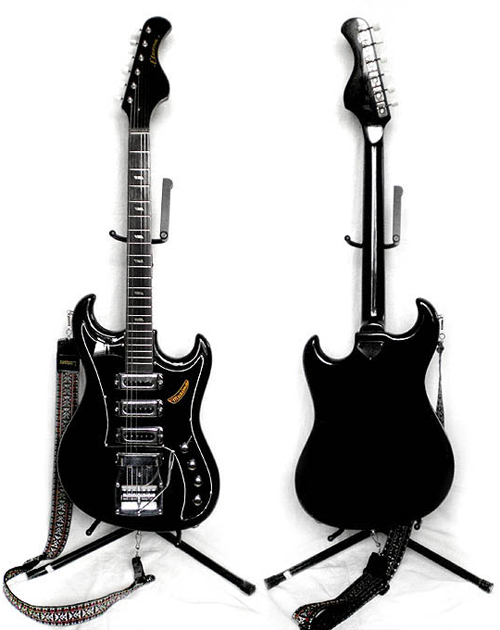
Rare Heartfield EX-2 electric guitar

guitarz.blogspot.com:

Hey folks, Its Ben from All About Guitars

Built in 1989 in Japan (Fuji-Gen Gakki), possibly a prototype because it differs from print advertising of the time as well as the catalog photo in terms of switch placement, scaled down strat-style body with 22 fret set-in maple neck with rosewood fingerboard.

Alder body with spectacular two piece bookmatched gray flamed maple top.

Original electronics included three single coil pickups with 3 way strat-like switching and two mini-switches with volume, tone, and midrange boost knobs.
Bridge is a Gotoh licensed Floyd Rose clone.

Tuners were also non-locking Gotohs (guitar has a locking nut).

The neck has large jumbo frets and is a pleasure to play.

Hardshell case with crushed velvet that matches the color of the guitar.

This guitar is for sell on ebay Heartfield EX-2


NB: There are a lot of blogs STEALING content and bandwidth. If you read this anywhere else but on guitarz.blogspot.com then you are reading a blog that STEALS content. Please support original bloggers!

Friday, 28 August 2009

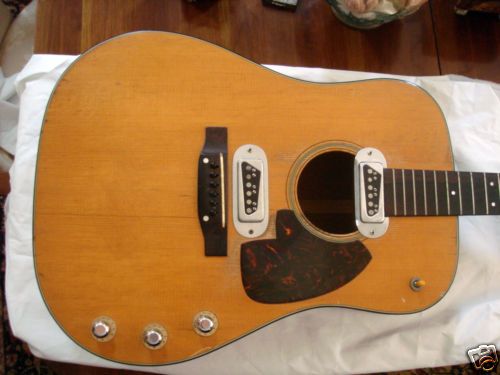
Martin D18-E

guitarz.blogspot.com:

Built in 1959, the D18-E was Martin's first attempt at producing an electric guitar.

They didn't really think it through as an electric guitar from the ground up, did they? They just took an existing model from their catalogue, added two DeArmond pickups and volume, tone controls and pickup selector switch. I can't imagine all that additional hardware would allow the guitar's spruce top to resonate as it was originally designed to, but nevertheless this is one cool guitar! (A pity this example on eBay isn't strung in the photos).

And of course, Kurt Cobain thought so too when he used one for Nirvana's Unplugged sessions. (I've often wondered about that. It wasn't really "unplugged", was it?)

EDIT: I've just noticed - this post was made on the 7th Anniversary of this blog - the world's longest running guitar blog! Happy birthday to us!

G L Wilson

NB: There are a lot of blogs STEALING content and bandwidth. If you read this anywhere else but on guitarz.blogspot.com then you are reading a blog that STEALS content. Please support original bloggers!

Thursday, 27 August 2009

Of reverse headstocks and string tension

Earlier this month, the post on the Ampeg Scroll Bass legacy provoked an interesting discussion about the so-called "reverse headstock" and its influence on string tension, sound and playability. On this post, I imprudently stated - a common misconception - that the reverse headstock provides better tension to the respective gauges of the strings.

One of our readers, who goes under the moniker dre, provided precious and detailed information to reestablish the one and only truth about this essential topic, and so I've slightly edited his comments for this post.

Adje Vandenberg Peavey
"The effective string length (ie nut-to-bridge) determines the tension, in concert with string gauge and tuned pitch. If you have two guitars identical scale length, string gauge, and tuning, but different total string lengths, you will still have identical string tension.

Imagine one of those early Les Pauls with the combo bridge/tailpiece: minimal total string length. Then imagine a Firebird with a Bigsby. Longer headstock, more string behind the bridge, maximal total length. Both guitars have the same scale length.

If both have the same strings and are tuned to standard pitch, the strings will still be at the same tension, despite the differences in total string length, because the effective string length is the same, and those 24.75 inches of string between the nut and bridge have to be at the same tension to be at the same pitch.

The real difference created by different total lengths is in the feel of the guitar. All that extra string below the bridge and above the nut on the Firebird's low E string means that the string can be stretched more. If you reach way up and pull that E string across the fretboard (Why? I don't know, you're the one doing it!), that string will be easier to bend than the E string on the Les Paul, because there's less total string to stretch on the Les. Bending a string utilizes the entire length of the string since it can slide through the nut as it stretches. Playing an open note only utilizes the effective length, unless you really hammer it and it stretches a little.

Length, mass, tension. Those are the three determinants of pitch in a string. A guitar's nut and bridge functionally isolate the string between them from the remaining string above the nut and below the bridge, with regard to vibration. The length of string between the nut and the bridge is what vibrates to produce a pitch, and that length has to be at a particular tension in order to do so, depending on the mass of the string. The entire string must be at that same tension, every inch of it, including what's above the nut and below the bridge.

If (I'm estimating here) the .052 low E string on your Les Paul needs 23 pounds of tension to be tuned correctly, then your Firebird's .052 low E string needs 23 pounds to be tuned correctly. You may have more string at 23 pounds of tension, but that 24.75 inch piece of string between the nut and bridge has to be at 23 pounds, and therefore the entire string must be at 23 pounds.

Extra strings at either end of a guitar can be attractive and even musically useful (I am a certified Sonic Youth fan), but it does not change the string tension required to tune to pitch.

Here's a thought experiment that helps visualize the irrelevance of the nut-to-tuner (or saddle-to-anchor) length of string in terms of string tension at pitch. I have forgotten who came up with the basic premise of this visualization, and it was found on some bass forum, so please don't credit it to me.

Okay: Imagine you've got Adrian Vandenberg's secret pearlescent black prototype Peavey 24.5" scale guitar from 1987. It was made with a three-foot-long reversed headstock, which makes the total length of the E string (from tuner to Floyd Rose) 61", assuming half an inch of string from the saddle to the anchor on the Floyd. Don't ask why. Vandenberg was crazy. The custom-made superlong strings cost $500 a set.

You block the Floyd Rose to immobilize it (just to take it out of the equation), loosen the locking nut, and tune up to E. Now you have 61" total string length at a tension at which the 24.5" of speaking length between the saddle and nut play an E. The whole 61" of string is at the same tension from anchor to tuner, yes?

Okay. Now, crank down that locking nut. We don't want to get out of tune while playing the chorus riff from "In the Heat of the Night". When the nut is locked, the entire string is still at the same tension, right? All we did was fix one point on the string so that it can't move. Check to make sure you still have that string tuned to E. What happens when you take your string snips and cut out the string between the nut and the tuner? The speaking string between the saddle and the nut is still 24.5", still tuned to E, and still at the exact same tension.

At the same time, you've removed three feet of string. Now the total length, including the bit between the anchor and the saddle, is 25", less than half what it was, but the tension is still the same. If the tension was lowered when the string was shortened, the string would no longer be tuned to an E. This is fundamental physics. If string of the same speaking length with the same mass is tuned to the same fundamental frequency (and it is the same in every possible parameter in this example, because it is in fact the very same string), it absolutely must be at the same tension. Whether it was 61" or 25" total length, the string had to be at the same tension when tuned to E. When using string mass, length, and tension to determine fundamental frequency, only the vibrating length is relevant.

Please note that I am referring to actual tension, the pulling force of the string. I am not talking about "perceived tension" or "feel" or "slinkiness" or "springiness" or "bendability", all of which seemed to surface in my interweb research, all of which being mistaken for tension. Since every element of a guitar affects feel and sound, surely extra string length beyond the speaking portion somehow subtly affects the feel and sound of a guitar. I'll wager it's a barely perceptible change."

So thank you dre for this extensive contribution (the picture of Adje Vanderberg's signature Peavey guitar is supposed somehow to make all this even more convincing).

Bertram

NB: There are a lot of blogs STEALING content and bandwidth. If you read this anywhere else but on guitarz.blogspot.com then you are reading a blog that STEALS content. Please support original bloggers!

Tuesday, 25 August 2009

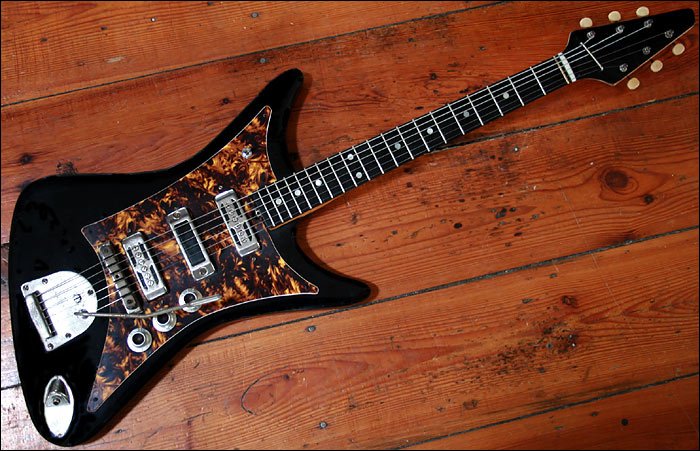
70s Jolana Star X

guitarz.blogspot.com:
jolana star x

Another Czechoslovakian guitar (I didn't write "Czechoslovakian" for ever, did you?), this stunning Jolana Star X looks like these guitars that are never supposed to leave the drawing board, a designer's fantasy made true.

The headstock is beautifully simple, even the flashy pickguard works and contributes to balance a otherwise twisted body, though its pure lines...

That's the kind of guitar that has 95% chances to be ugly and it is just brilliant.

Bertram

NB: There are a lot of blogs STEALING content and bandwidth. If you read this anywhere else but on guitarz.blogspot.com then you are reading a blog that STEALS content. Please support original bloggers!

Monday, 24 August 2009

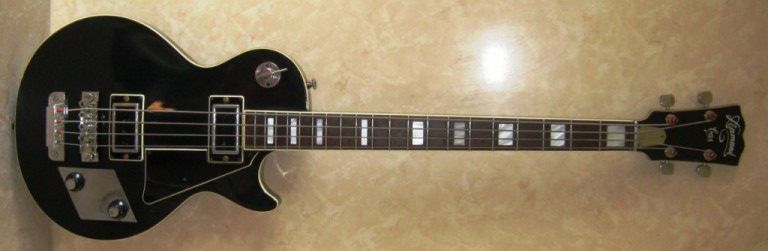
Jolana Diamant Bass

guitarz.blogspot.com:

I don't know what it sounds like (the listing claims that it is in playable condition) but the Les Paul styling of this vintage Czech-built Jolana Diamant bass really appeals to me. Gibson themselves have made the occasional attempt over the years of producing a Les Paul bass but they always looked very awkward to my eyes, whereas this retro-looking instrument seems to have got it right, visually at least. It has, I believe, a certain mojo emanating from it. (Undoubtedly the Gibson basses sound better and are of better build quality).

G L Wilson

NB: There are a lot of blogs STEALING content and bandwidth. If you read this anywhere else but on guitarz.blogspot.com then you are reading a blog that STEALS content. Please support original bloggers!

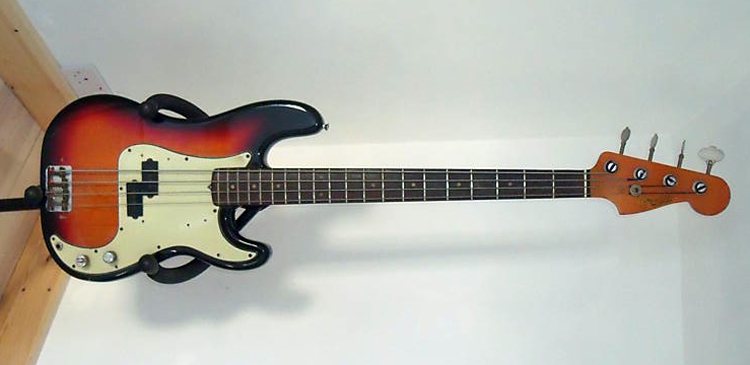
Fender Precision Bass

guitarz.blogspot.com:

fender precision bass

I'm happy to share today something I just learned yesterday (maybe I'm just dumb and was the only one who didn't know but still it's worth telling) about electric guitar genesis.

Probably even more important that his contribution to solid body guitars, Leo Fender developed the electric bass (invented by Paul Tutmarc in the 30s). But the chronology of it is interesting. The Esquire/Broadcaster/Telecaster guitar came first (1951), then the Precision Bass, for which Leo Fender invented the double-horn design to reduce and balance a bigger body. And this lead to the design of the iconic Stratocaster.

But the P-Bass came first.

Bertram

NB: There are a lot of blogs STEALING content and bandwidth. If you read this anywhere else but on guitarz.blogspot.com then you are reading a blog that STEALS content. Please support original bloggers!

Sunday, 23 August 2009

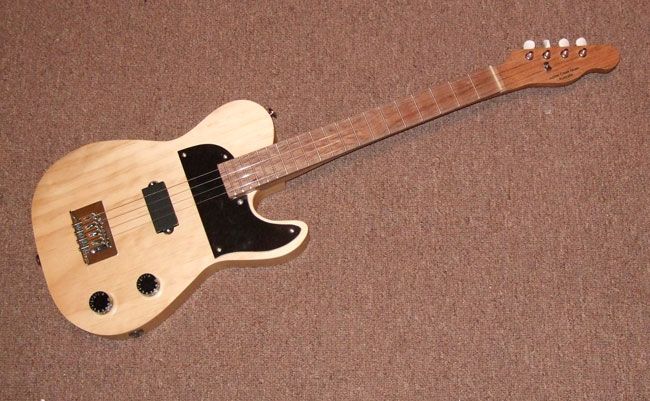
Jupiter Creek electric baritone ukulele

guitarz.blogspot.com:

This solid electric baritone uke is entirely handmade from Australian timbers by Rob Dick of Jupiter Creek Music near Adelaide in Australia. Rob's baritone ukes are each designed as from the ground up as a baritone ukulele and aren't merely re-modelled children's guitars. He also makes a range of other ukuleles, slide guitars and ukes, tenor guitars, dulcimers, stomp boxes, etc. He offers instruments in original designs as well as those derived from the Telecaster, Les Paul - and unusually - the Ovation Breadwinner.

His website says that he is struggling to catch up with backorders and won't be taking any new orders for the time being, so it's nice to know that someone out there is doing well in this time of recession.

G L Wilson

NB: There are a lot of blogs STEALING content and bandwidth. If you read this anywhere else but on guitarz.blogspot.com then you are reading a blog that STEALS content. Please support original bloggers!

Saturday, 22 August 2009

Apologies...

guitarz.blogspot.com:

...for the sparsity of recent updates. I've been having some major computer problems over the last couple of weeks but hopefully will at last be getting my laptop sorted out this weekend. The problem after that will be to get the wireless router to function properly - that's also been a major headache.

On top of all this I've been looking for work. Note to any publishers or magazine editors out there: Yes, I am available for any writing commissions. I have recently completed work on a book about guitars which will be published in December and am available to do further work like this, be it books, magazine articles, or whatever.

G L Wilson

NB: There are a lot of blogs STEALING content and bandwidth. If you read this anywhere else but on guitarz.blogspot.com then you are reading a blog that STEALS content. Please support original bloggers!

Musima Eterna on Soviet Guitars

Another guitar that is just a picture and no sound (until I finally manage to get one and post a track). But I can't imagine that someone would build such a beautiful and sophisticated machine if not to provide a good music instrument!

But this post is not only about the guitar itself, but about the website where I found it - sovietguitars.com on which you can see a superb series of pictures of it. It was hard not to hack their whole Musima Eterna page and show most of these pictures, so you must go there and check particularly the trem and the bridge.

DDR is often associated with rough and depressive design, but Musima guitars prove how untrue this is!
BTW, the Soviet Guitars website is in Russian so most of readers will have to navigate blind, but that's worth, and you will see some nice Jolana, Ural and this kind of stuff, all beautifully photographed.

Bertram

NB: There are a lot of blogs STEALING content and bandwidth. If you read this anywhere else but on guitarz.blogspot.com then you are reading a blog that STEALS content. Please support original bloggers!

Tuesday, 18 August 2009

Oud player Kamilya Jubran

guitarz.blogspot.com:


A few months ago I discovered oud player and singer Kamilya Jubran. Though this is not the kind of music I usually listen to (and I listen to a lot of different styles), it just took one song on the radio to instantly order the CD, and it's one of my favorite since.

Oud has a lot of shared DNA with guitar, and I wish I could find a singer / guitar player who would be so interesting, simple, sincere and still ambitious, mixing tradition and modernity (Jubran's lyrics are taken from Arabic and African contemporary poets, she often works with real time computer treatment).

Anyway, I'm sure that the comments will offer some counter-examples! Actually that's on this blog that I first read about Kaki King and she's also some guitarist!

Bertram

NB: There are a lot of blogs STEALING content and bandwidth. If you read this anywhere else but on guitarz.blogspot.com then you are reading a blog that STEALS content. Please support original bloggers!

LinkWithin

Related Posts with Thumbnails

ShareThis