Wednesday, 20 June 2012

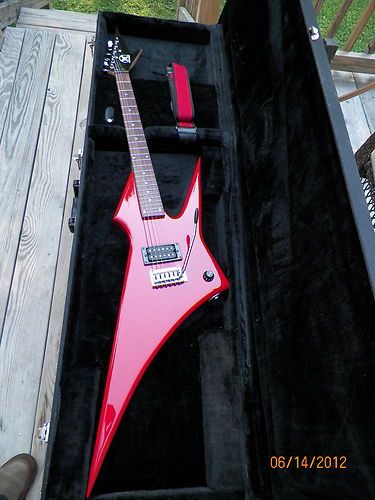
Just look at the size of the case for this guitar: pointy 1980s Hondo H-1

guitarz.blogspot.com:

Here's another 1980s offering from Hondo guitars - reviled in some quarters and loved in others. It's a Hondo II H-1 from the 1980s with body styling obviously based on the now legendary Gibson Explorer but with the pointiness factor taken to the extreme.

Hondo guitars offered a budget range of instruments made in Japan and Korea. The company was originally formed in 1969 by Jerry Freed and Tommy Moore of the International Music Corporation (IMC) of Fort Worth, Texas, working in conjunction with the Samick Company.

It's interesting to note that Hondo was one of the first overseas companies to offer American-made DiMarzio pickups on their guitars - that surely would have made the purchase of a Hondo guitar all the more attractive to the prospective buyer with a strict budget in mind.

The H-1, looking perfect for hair metal bands, is almost certainly a Korean-made Hondo coming from the latter part of the 1980s (Hondo moved guitar production to Korea in 1983). I think if I had a bandmate who played one of these, I'd keep my distance through fear of being impaled.

G L Wilson

© 2012, Guitarz - The Original Guitar Blog - now in its 10th year!

Tuesday, 19 June 2012

One-off Fender Weirdcaster - is it a bouzouki? a tenor guitar?

guitarz.blogspot.com:
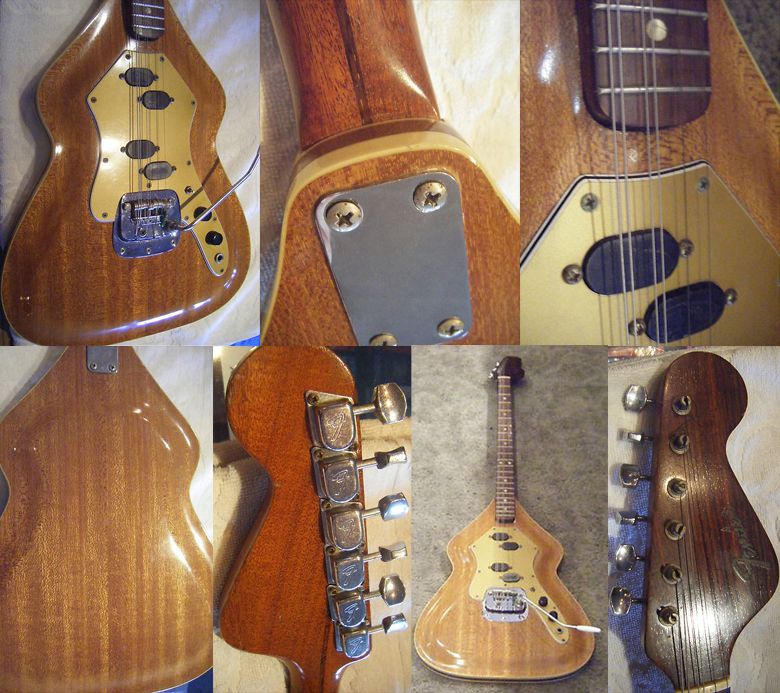
I'm not sure what to make of this weird guitar (electric bouzouki? long-scale tenor guitar?). All I know about it is what the eBay seller tells us:
Up for sale is a Hobby shop Instrument that an Employee at Fender had made in the 70's. We are selling for orig owner family member. I dont particularly know much about it. (Electric Boozuki?) ( plectrem?) I've never seen anything quite like it. Has a Mahogany Body, Bolt-On Mahogany Neck,Rosewood Fingerboard, two pairs of octive strings and a pair of single strings. Comes With Hard Case.
(Sic throughout - weird spellings, capitalisation, punctuation all courtesy of the seller).

If it IS a genuine Fender (and the hardware used would seem to suggest that it is), then the real surprise is that it doesn't resemble a Strat, Tele or Jazzmaster/Jaguar. The one thing the seller doesn't suggest is that it might be a prototype or instrument from Fender's research and development department.

G L Wilson

© 2012, Guitarz - The Original Guitar Blog - now in its 10th year!

Monday, 18 June 2012

1999 Gibson ES-335 in bronze finish


Couldn't find any information about the unusual bronze finish of this 1999 Gibson ES-335, is it a custom shop product, a variation on a goldtop? I just find it beautiful, and it's good to look at nice photos of ultra-classic models!

Bertram D

© 2012, Guitarz - The Original Guitar Blog - now in its 10th year!
Sunday, 17 June 2012

Orpheum hollow body


I have very little to tell about this Orpheum hollow body guitar, but that since it's labelled 'made in USA', it might have been made by Kay or Harmony - these two companies have made Orpheum branded guitars before their construction switched to Europe in the 1960s (Wandré then Egmond).

Later on it went to Japan but it was used for Guyatone, FujiGen or Teisco made solid bodies. 

Bertram D

© 2012, Guitarz - The Original Guitar Blog - now in its 10th year!

Saturday, 16 June 2012

Another one from Matsumoku: the Westbury Deluxe

guitarz.blogspot.com:
Gideon writes:
I've been following the blog for a while and its hands down one of my favourite places on the web.

Thought you might be interested in one of mine, which I don't believe has graced the pages of Guitarz yet.

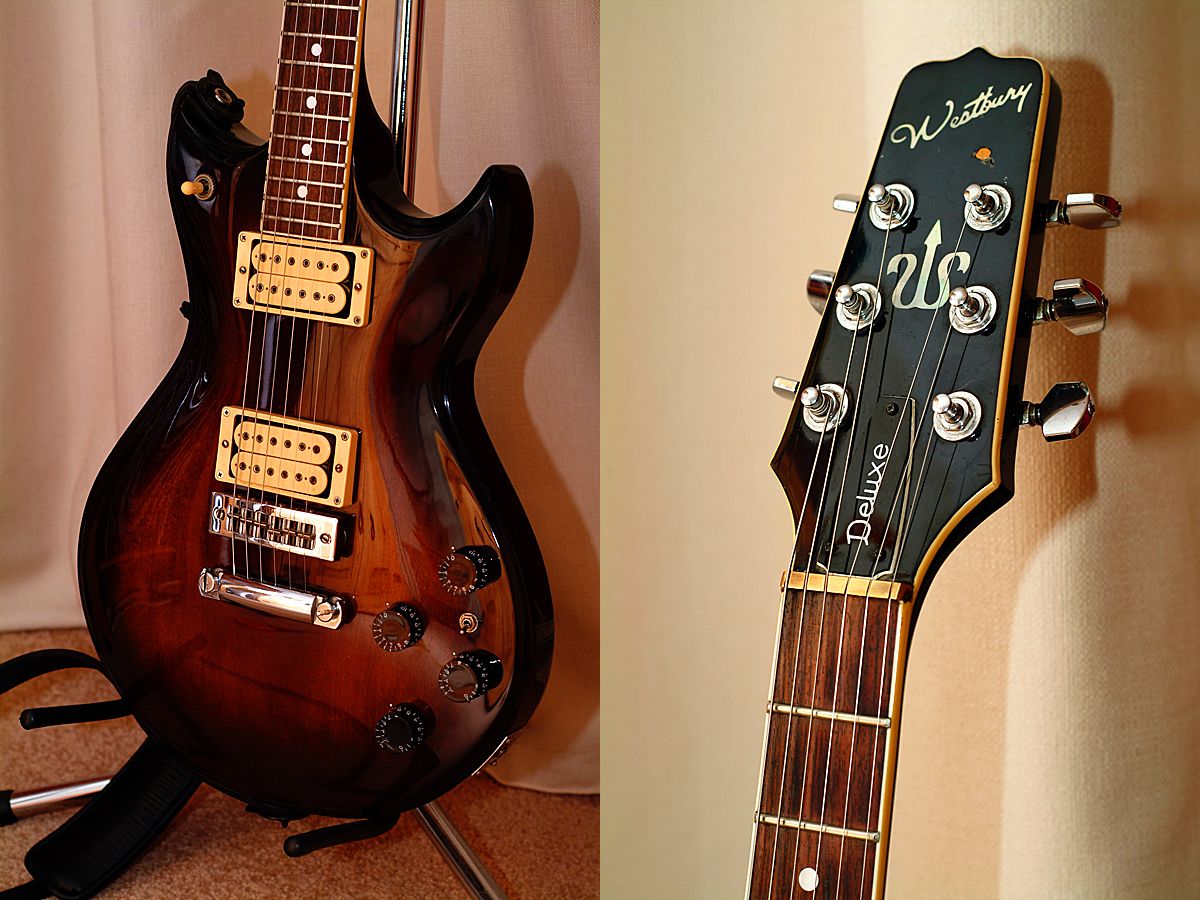
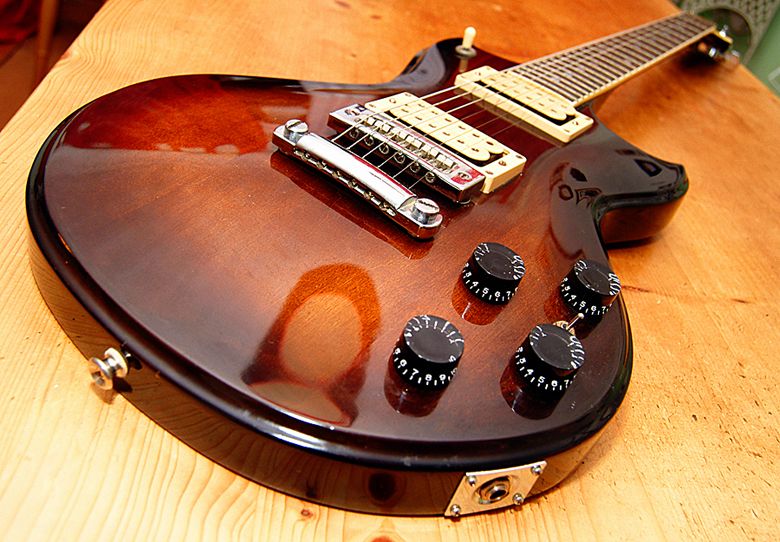
It's a 1980 Westbury Deluxe in aged walnut given to me by a friend a number of years ago. It was in a bit of state, covered in stickers, etc. A bit of TLC and she's looking a lot better and plays wonderfully.

The small amount I have been able to dig up on these is that they have a hard maple body with a carved top, rosewood fretboard and DiMarzio pickups. The bridge is a Dual Sound DiMarzio (selectable via the microswitch near the pots) and the neck is a DiMarzio Super Distortion.

The Westbury brand was one used by Unicord and these were built by Matsumoku.

That's about all I know, but anymore that you guys or readers are able to provide would be a bonus.

Regards
Gideon
Hi Gideon, thanks for sharing the photos of your guitar with us. For a guitar that had seen better days and was covered in stickers, you've done a good job at cleaning it up. My understanding of the Westbury brand was that it was a pre-cursor to the Westone brand, or you could say that Westbury was re-named Westone. All the Westone trademarks are there (the shape, the chunky metal hardware, use of DiMarzio pickups), and you can't deny that there is a similarity to the Westone Thunder series guitars - although the arched top and German carve on the Westbury Deluxe make it look a lot more upmarket than the slab-bodied Westone Thunder. The dates of operation of these two brands would seem to confirm this theory. The Westbury brand was in operation from 1978 to 1981, and then Westone guitars were produced from 1981 to 1987 when Matsumoku ceased production and the Westone name was transferred to Korean-made instruments with a few upmarket instruments being produced in Japan circa 1990.

G L Wilson

© 2012, Guitarz - The Original Guitar Blog - now in its 10th year!

Friday, 15 June 2012

Strangely shaped guitar with Rellog Gitona pickups


This strangely shaped vintage German guitar set with Rellog Gitona pickups is much probably a Herrnsdorf - considering  its characteristic headstock and prolongated fretboard -, though it doesn't sport any brand...

I cannot tell if this design is great or horrible - probably both!

Rellog Gitona (Gitona stands for Gitarre Tonabnehmer - guitar pickup) was a Markneukirchen-based East-German brand, as was Herrnsdorf.

Bertram D

© 2012, Guitarz - The Original Guitar Blog - now in its 10th year!
Thursday, 14 June 2012

Vintage & Rare Guitar of the Week: Leo Losspennato RadioStar headless doubleneck guitar and bass

guitarz.blogspot.com:
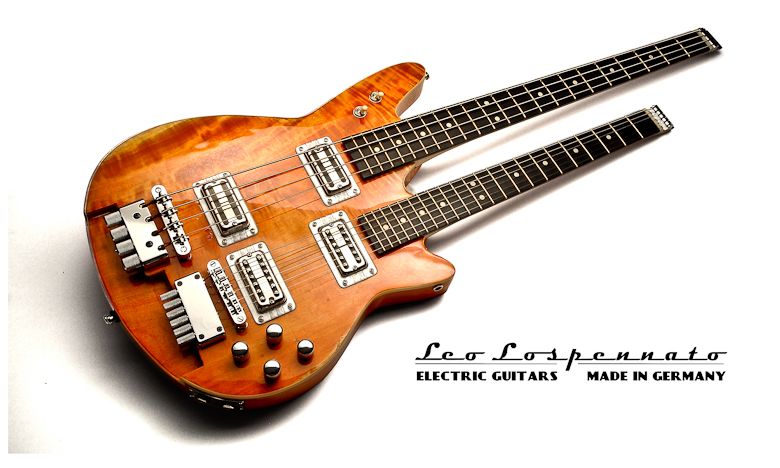
This doubleneck from German luthier Leo Lospennato aims to combine vintage styling (the Filtertron pickups and worn orange finish are a definite nod to Gretsch) with a more modern twist in the shape of headless necks and fine tuners behind the bridges.

The headless design would no no doubt eliminate any neck heaviness that doublenecks guitars all too often suffer from, and the body does look to be relatively compact. Personally I find the straight lines of the cut-out area at the base of the body for the fine tuners to be stylistically too harsh; I think curves with rounded over edges would have been more much more elegant and in keeping with the styling of the instrument, but that's just my opinion.

This guitar/bass doubleneck is being offered for sale via Vintage & Rare priced at €2950.

G L Wilson

© 2012, Guitarz - The Original Guitar Blog - now in its 10th year!
Wednesday, 13 June 2012

Aria Pro II SH-800 through-neck thinline semi

guitarz.blogspot.com:
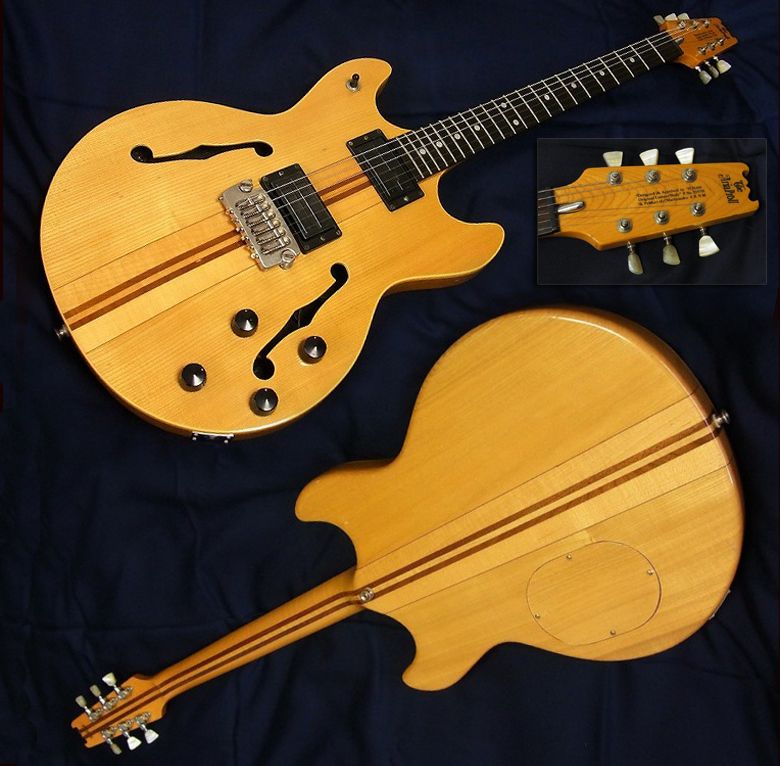
I realise that we're at risk of becoming the Matsumoku Fan Blog with a third post in a row about a Japanese Matsumoku-made guitar, but I make absolutely no apology for this. These guitars are still out there, are fabulous players, brilliantly engineered, and should be snapped whenever possible by discerning guitarists rather than buying the latest Chinese-made Fender Reissueocaster.

This Aria Pro II SH-800 is not a model that I remember, but is from circa 1979/1980 back when the logo on the headstock gave the name as "THE Aria Pro II". Although it appears to be a semi-hollowbody it's not part of the Titan Artist series; in fact it's of a completely different construction and is more of a Thinline - effectively a hollowed-out solidbody! The SH-800 and the more upmarket SH-1000 model can be seen here in this Japanese-language Aria catalogue from 1979.

G L Wilson

© 2012, Guitarz - The Original Guitar Blog - now in its 10th year!

Tuesday, 12 June 2012

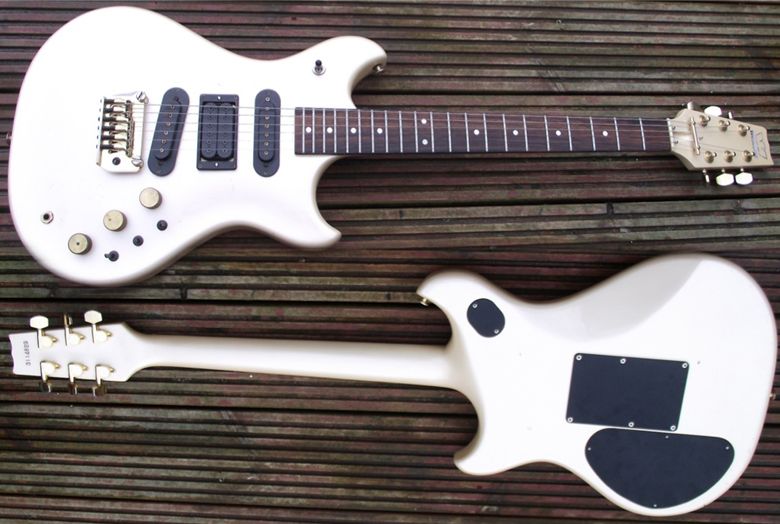
Matsumoku-made Westone Thunder III guitar from 1983

guitarz.blogspot.com:
It's funny how your perception changes over time. I remember thinking, back in the day when they were being produced, that Westone guitars were all rather ugly - although I would have been first to admit that they were "ugly ducklings" by which I mean that the quality of the build and the playability meant they were really quite elegant swans beneath the ugly duckling appearance. (Errmmm... perhaps, I've carried that metaphor a little too far).

Anyway, back in 1983, this Westone Thunder III was the top of the Thunder range and features all maple construction, a very modern and comfortable heel-less set neck, and coil taps/phase reversal switches for the humbucker pickup, which is - unusually by present day standards - the middle pickup in a three-pickup S-H-S layout. It's the kind of pickup layout that makes you question why so many modern guitar manufacturers stick rigidly to the same few tried and trusted ways of doing things and don't try anything different from the norm anymore.

This guitar is currently listed on eBay UK with bidding currently just over £30 at the time of writing. Japanese-made Westone guitars have more than kept their value over the last thirty years and examples often change hands these days for sums in excess of their original retail price in the 1980s.

G L Wilson

© 2012, Guitarz - The Original Guitar Blog - now in its 10th year!
Monday, 11 June 2012

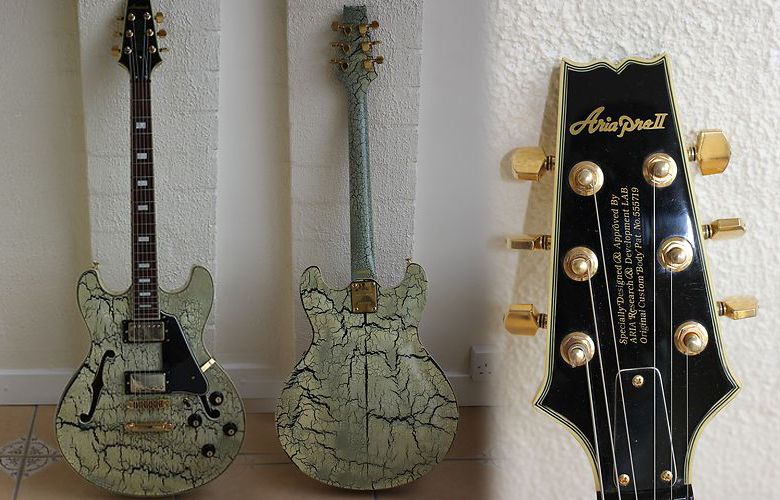
Aria Pro II Titan Artist semi-hollowbody in crackleburst finish

guitarz.blogspot.com:
As far as I am concerned, one of the best kept secrets in the guitar world is the Aria Pro II Titan Artist series from the 1980s and 1990s. They are absolutely superb guitars, and are my own guitar of choice. I have two, a 1990s Korean-made TA-40 with Welsh Dragon graphic, and an earlier 1980s Japanese Matsumoko-made TA-30 which is actually my main electric guitar. The Korean-made examples are very good guitars, but the Japanese Matsumoku-made Titan Artists definitely have the edge over them; the differences are subtle, but I feel, important to the overall quality of the guitar. Anyway, this is the subject for a future blog post, one that I will return to later.

This particular Aria Pro II TA guitar (I'm not quite sure of the exact designation - the binding and gold hardware would imply that it isn't the basic bolt-on neck TA-40 model; it's possibly a TA-60) is finished in a very dated 1980s "crackleburst". I'd quite forgotten about finishes like this. Didn't Washburn produce a similar "magma" finish? Whatever, it really is quite awful and doesn't do the guitar any favours.

This guitar is currently listed on eBay UK with bidding currently at £51. I'd expect a guitar like this to sell for up to £200. I personally wouldn't want to spend more for a Korean-made TA, but a Japanese example would be worth forking out more for.

G L Wilson

EDIT: Sold for £186.89 which seems fair enough but is in the region of the upper limits of what you'd want to spend on a Korean-made Aria TA.

© 2012, Guitarz - The Original Guitar Blog - now in its 10th year!
LinkWithin

Related Posts with Thumbnails

ShareThis