Wednesday, 12 December 2012

Squier Vintage Modified Telecaster Bass and Telecaster Bass Special

guitarz.blogspot.com:
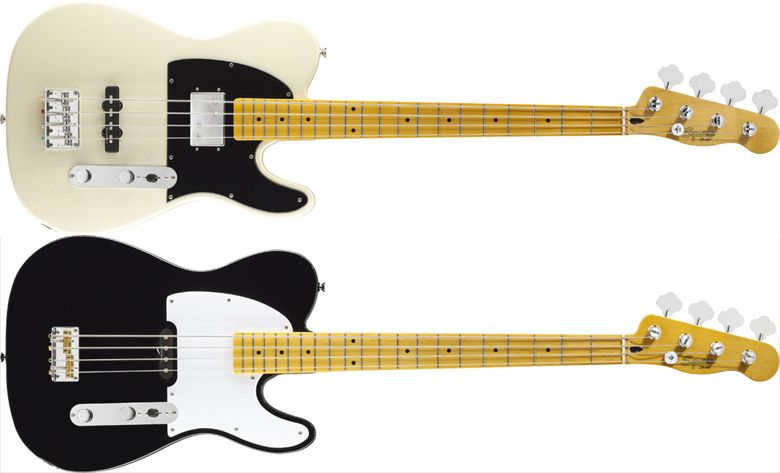
Here are a pair of new basses from Squier's Vintage Modified Series, the new Telecaster Bass and Telecaster Bass Special (pictured top). These are not to be confused with the original Fender Telecaster Bass which in itself was based upon the original slab-bodied Precision design before it was redesigned to have a more contoured Strat-like body. 1970s examples of the Telecaster Bass (of which the Squier Vintage Modified Precision Bass is quite an accurate representation) featured a huge humbucker pickup in the neck position instead of the centre-position singlecoil pickup. It also had a twin-cutaway body, rather than the same basic shape as the Telecaster guitar as we see here on these new Squier offerings (although it seems to me that the body has been lengthened). I guess that Fender/Squier must have decided that bassists wanted the same shape as the Tele guitar but I can't imagine it'd balance anywhere near as well balanced as the double-cutaway P-bass shape.

It all seems a bit silly to me. What's next, the Stratocaster Bass? And no, the Precision is not already the bass equivalent of the Strat. It was originally the bass partner to the Telecaster, and if anything, the Jazz Bass was the Strat's opposite number in the bass camp, although some would argue that with its offset body shape the Jazz Bass's natural sibling would be the Jazzmaster/Jaguar. But of course these days there's a Jaguar Bass too. I wonder how long it is before Fender/Squier issue a Jazz Bass-bodied 6-string guitar? Hey, I reckon I could work for Fender marketing too with ideas like that.

With the Squier Telecaster Bass having a singlecoil pickup similar to that in the original P-Bass, and the Deluxe version having a 70s Telecaster Bass humbucker in the neck position and a J-Bass unit nearer the bridge, no doubt these new Telecaster Basses will appeal to players out there, although for me the designs are far too Frankenstein-like; for example that pickguard design is quite patently created for a guitar and not a bass. But never mind my nitpicking, if you're interested get yourself over to the Squier website and check out the specs for yourself.

G L Wilson

© 2012, Guitarz - The Original Guitar Blog - 10 years and counting!

Tuesday, 11 December 2012

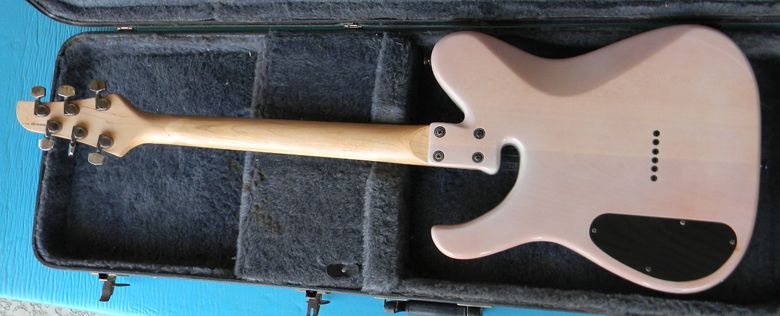
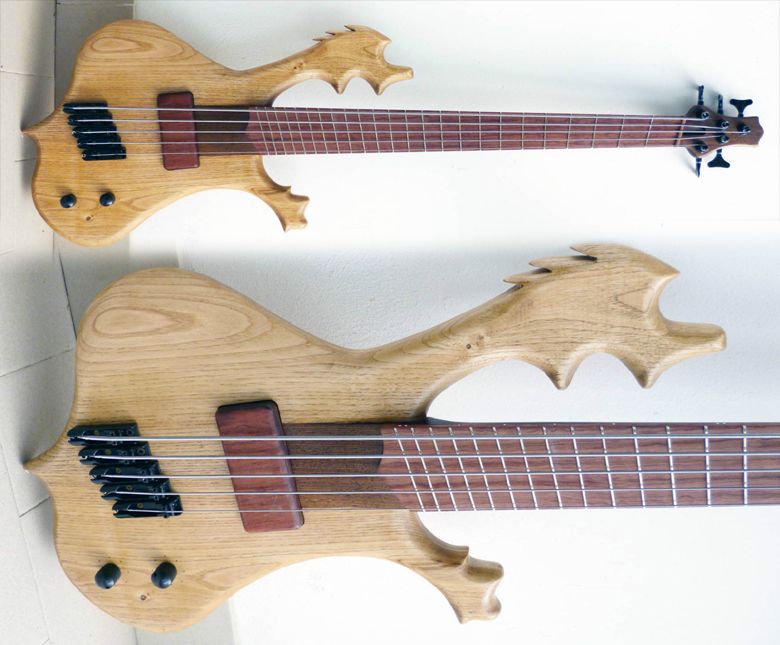
Prometeus Mothra multi-scale/fan-fretted 5-string bass with moose antlers!

guitarz.blogspot.com:
I don't know if the horns on this handmade Prometeus multi-scale 5-string bass are deliberately supposed to resemble moose antlers, but that's my interpretation. I think it would suit a band from Scandinavia, or Canada or Alaska. Perhaps.

In actual fact, Prometeus is from Italy and this particular model is named "Mothra" which may mean Japanese Godzilla movies were the inspiration.

Confused? OK, never mind all the above speculation, let's look at the specs: 34"-32.5" scale over 5-strings, 24 frets, quarter-sawn Wengé neck with deep set-in construction without neck heel, quarter-sawn Bubinga fingerboard, French Chestnut body, 1 ceramic humbucker (shielded and wax-potted) with vol/tone controls, black hardware, dual action truss rod, Shellac-based finish, total weight of 3.7kg).

And if you'd like to know how it sounds:


Currently being offered for sale on eBay with a Buy It Now price of $1,399.

G L Wilson

© 2012, Guitarz - The Original Guitar Blog - 10 years and counting!

Monday, 10 December 2012

Alvarez Dana Scoop Nashville, Telecaster-inspired guitar with extreme cutaway

guitarz.blogspot.com:
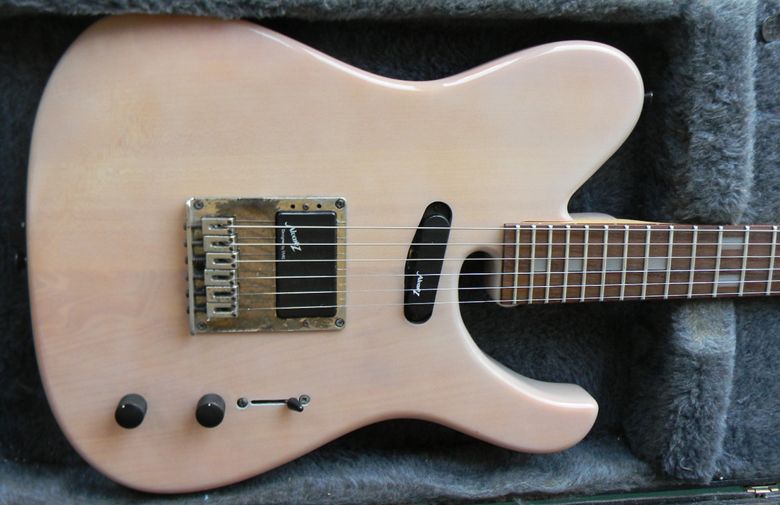
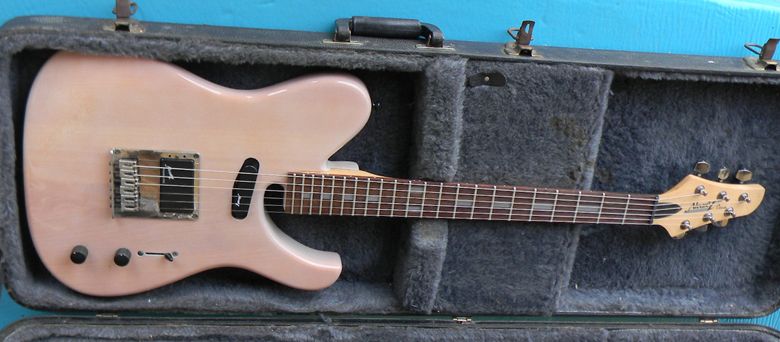
We've looked at these mid-1990s Alvarez Dana Scoop guitars before (here and here) but the guitar featured in this eBay auction is the first that I have seen of the less common Telecaster-inspired Nashville model.

Made in Korea, the guitar features Alvarez's own "designed by EMG" passive pickups and is finished in a very fetching translucent blonde that to my eyes is reminiscent of a Fender Mary Kaye finish. Note that the scoop cutaway is not quite as radical as on the other guitars in the Scoop range and only extends beneath four strings as opposed to all six.

This guitar is curently listed on eBay with a start bid of $499.99 and a Buy It Now price of $599.99, but note that the auction finishes later on today (in 14 hours time at the time of writing).

G L Wilson

© 2012, Guitarz - The Original Guitar Blog - 10 years and counting!

Sunday, 9 December 2012

Vintage & Rare Guitar of the Week: Mosrite 350 Mono Bass from 1973

guitarz.blogspot.com:  
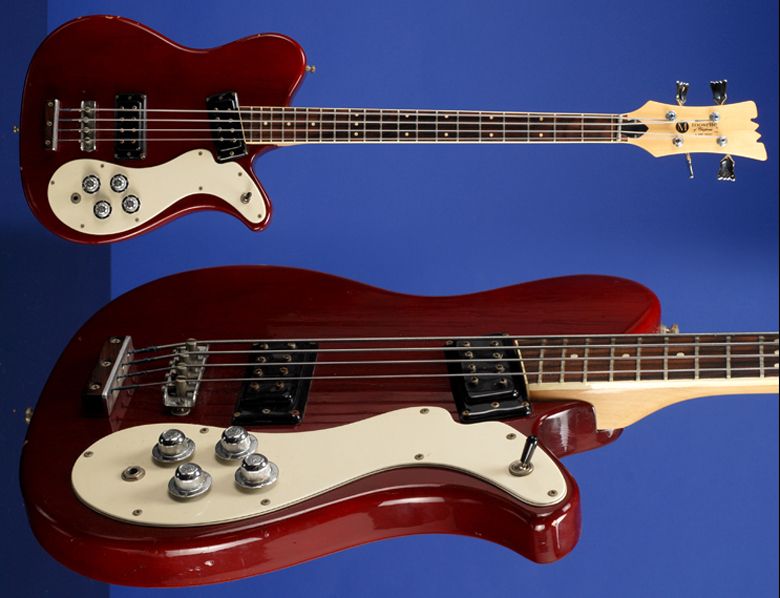
I figured it was high time we looked at another bass, and so present the above-pictured for you. Although it's not a bass that you see every day I'm sure that most everyone reading this blog knows who it was made by just by looking at it even if they are unsure of the model designation. From 1973, it's a Mosrite 350 Mono Bass, and as I have limited time today I shall copy and paste from the listing on Vintage & Rare:
This exceptionally rare, custom-color 'semi-transparent Wine Red' "350 Mono" bass weighs 8.60 lbs. Solid alder body and two-piece medium-profile rock-maple neck with a nut width of 1 5/8 inches and a scale length of 30 1/4 inches. Single-bound rosewood fretboard with metal nut, zero fret and 20 original jumbo frets frets with clay dot position markers. Specially shaped headstock with "Mosrite of California, USA", "By Semie Moseley" and the Mosrite "M" logo decal in black. Black plastic bell-shaped truss rod cover with two screws. Individual Mosrite of California closed back tuners with crown shaped metal buttons. The serial number is stamped in blind into the twentieth fret of the guitar. Four-bolt neck plate. Two Mosrite 'Humbucking' pickups with black plastic covers with "Mosrite of California" embossed on the lower edge and outputs of 5.45k and 4.95k. Three-layer (white/black/white) plastic pickguard with eight screws. Four controls (two volume, two tone) plus three-way pickup selector switch, all on the pickguard. Mosrite metal 'hat type' knobs with "M" stamped on top, numbered from 1 to 5 (one with a "V" and the other with a "T". Jack socket on pickguard on treble horn. Mosrite bridge with four individually adjustable saddles and Mosrite aluminum and rosewood tailpiece secured by three screws. The 'Translucent Wine Red finish is bright and vivid and shows no fade. There is some very light finish checking on the back and a few small and fairly insignificant edge chips. Overall this super rare and all original, early seventies Mosrite Bass is in exceptionally fine (9.00) condition. Housed in its original three-latch black hardshell case with black leather ends and burgundy plush lining (9.00). We have never seen another Mosrite "Brut' Bass.
I think that probably says it all. I love those "Bart Simpson" tuners, by the way. Currently being offered for sale by Fretted Americana via Vintage & Rare priced at €2185 / $2800.

G L Wilson

© 2012, Guitarz - The Original Guitar Blog - 10 years and counting!

Saturday, 8 December 2012

Guitar Review: The Musicvox Space-inator - small-bodied, spear-like and with a really useful pickup layout

guitarz.blogspot.com:
Here at Guitarz we really admire people like Matt Eichen, a vintage guitar enthusiast who loves retro instruments so much that back in 1997 he decided to start his own line of retro-inspired guitars. He wasn't content to merely create another range of Fender or Gibson knock-offs, he wanted to create something quirkily different as a homage to the past but with modern playability and production quality.

And so Musicvox was born, and their first model - the Space Ranger - was quite a head turner - classic singlecut guitar and bass models but with an unfeasibly large lower horn and a very eccentrically-shaped headstock. These weren't guitars for just anybody, certainly not for the hordes of conservative-minded guitarists who can only think in terms of Strat, Tele, Les Paul, SG. With a Musicvox guitar you needed to be in the Matt Eichen mindset; you either "got it" or you didn't.

Finding it difficult to find a distributor for these "wackily"-designed guitars, Musicvox began selling their guitars directly to the public via the internet, and indeed were one of the first guitar brands to do so. Of course this is common practice nowadays.

Musicvox followed the Space Ranger with the Space Cadet - a similar design but with the eccentricities toned down - and models included the Space Cadet 12-string bass which was not only one of the more competitively priced 12-string basses on the market but also highlighted Musicvox's agenda to create instruments that challenged the norm.

In 2002 a pair of Musicvox Space Ranger guitars were featured in Goldmember, the 3rd instalment of the Austin Powers movie series, which exposure should have proved beneficial to Musicvox sales, but soon after for personal family reasons Eichen was forced to wind down the company.

Fast forward best part of a decade, and Eichen - buoyed up by the fact that he noticed that there were still a lot of people out there talking about Musicvox guitars and a continued interest on the internet - decided to re-launch the brand.

Of course the models that got everyone talking in the first place - the Space Ranger and the Space Cadet - were back and were accompanied by some new designs - the MI5 guitar, bass and 12-string guitar, and the spear-like Space-inator guitar and bass (the prototype was named the Strataspear but a certain other company took umbrage and issued a court injunction against the use of the name).

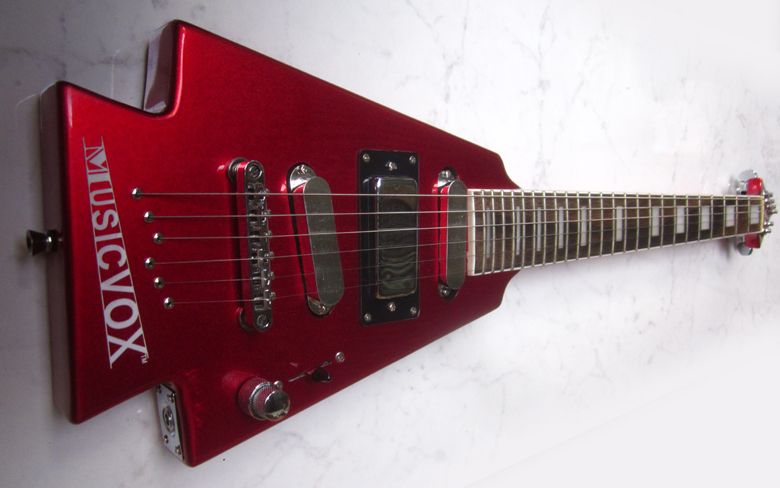
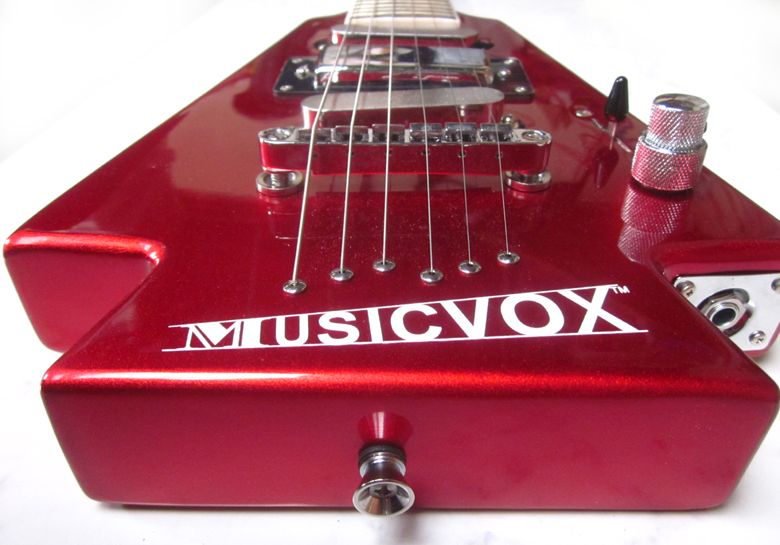
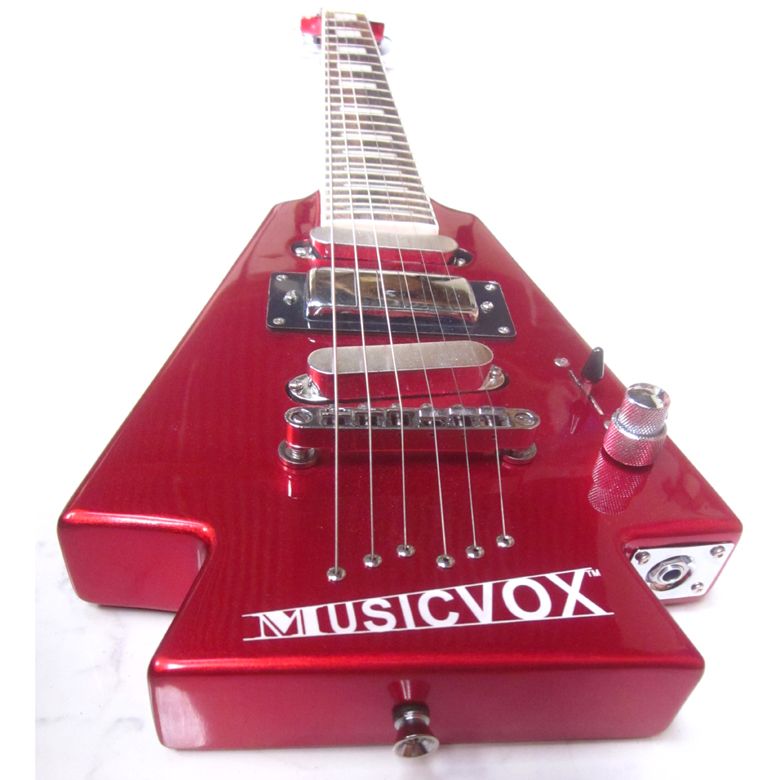
Matt very kindly sent a Space-inator all the way to deepest darkest Pembrokeshire in Wales, UK for Guitarz to review. This particular example is finished in a flawless candy apple red. Other colours I have seen pictured are gold flake, silver flake, and taxi cab yellow - all are extremely eye-catching. Upon taking the guitar out of the box I was immediately struck by the sheer quality of the finish. With the metallic candy apple red I could almost have believed that the Space-inator was made completely of metal. I was also very impressed that it emerged from the box more or less in tune after its Atlantic Ocean crossing; just two strings were slightly flat and needed tweaking.

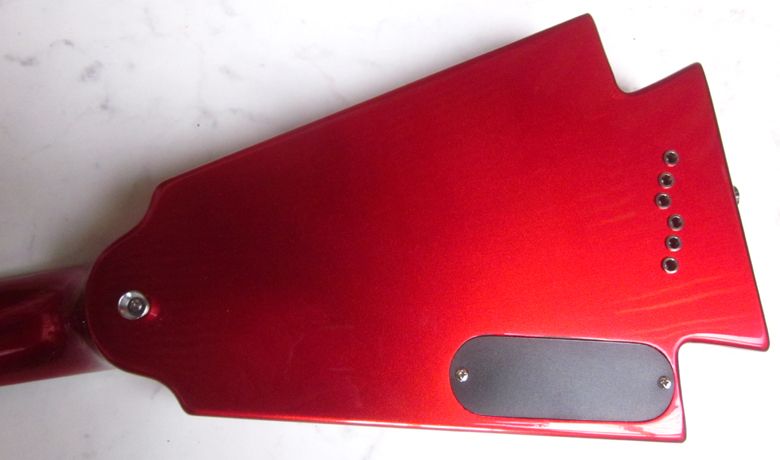
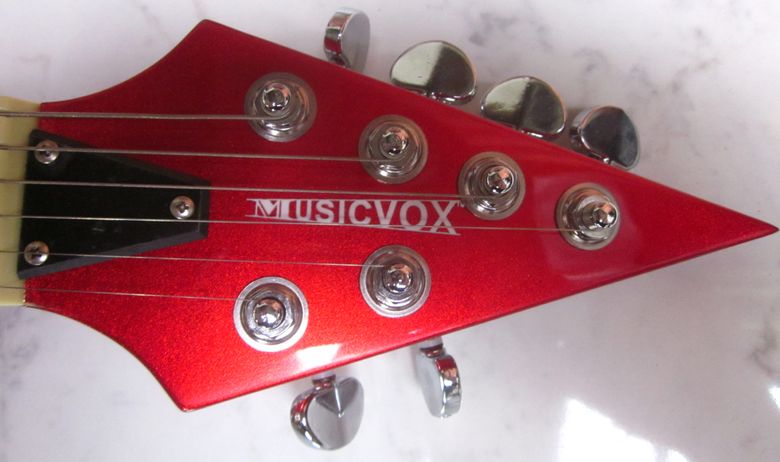
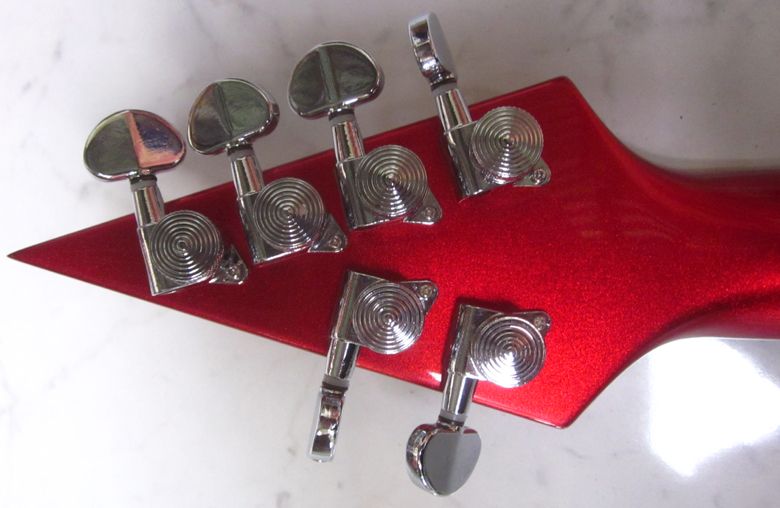
So, let's take a closer look at what we've got here. The Space-inator is a small-bodied guitar weighing in at just over 4 pounds. It has an angular, arrow-shaped body not unlike a more flared-Steinberger shape, and also perhaps vaguely reminiscent of the Burns Flyte, whilst a friend who I showed it to commented that it looked like a "sawn-off Flying V". The headstock is a compact very pointy spear-shaped affair with locking tuners arranged in a 4+2 formation a la Musicman and certain vintage Teisco guitars. This isn't merely a whim of aesthetics; if you look at the back of this very compact headstock you'll see that there would have been no room to facilitate having the G and D string tuners opposite one another in a 3+3 layout.
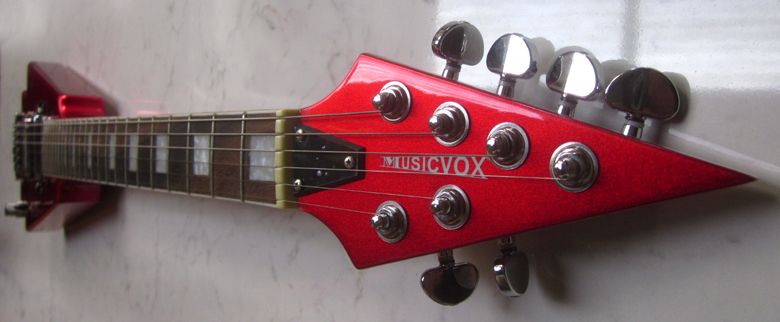
The neck of the Space-inator has a bound rosewood fingerboard and carries 24 jumbo frets and block pearloid position markers. Of course, because of the minimal body shape, there is no difficulty whatsoever in reaching the highest frets at the body end of the fingerboard. The scale length is 25.5", and the heel of the neck blends smoothly into the underside of the guitar body. The Space-inator is in fact of neck-through construction. That and the through-body stringing behind the Tune-o-matic style bridge ensure that the Space-inator gives plenty of sustain, something which may have so easily have been compromised on such a small bodied guitar.

It would have been so easy for Musicvox to unimaginatively equip this guitar with a pair of humbuckers or else three Strat-style single coil pickups, but instead they have chosen to do something much more interestingly versatile. What we have here are three pickups controlled via a 5-way switch, with two low-noise single coils in the neck and bridge positions and a mini-humbucker in the middle position. I have previously commented on this blog about the usefulness of such a rarely-seen layout after having played a friend's Aria "Dragon Strat" which had a stacked humbucker in the middle position. What it means is that you can get the classic single coil sounds in the neck and bridge positions, but you can beef up both of these in the inbetween positions, and of course get a full-throttle humbucker in the middle position. I find that it's a lot more useful say than a SSH pickup layout where you can only use the humbucker in conjunction with one of the other single coils (unless it has individual pickup switching). Note also that the bridge pickup on the Space-inator is angled in the opposite direction to that on a Strat. I found it wasn't as bright sounding as the bridge pickup on a (typical) Strat, but then this guitar is its own animal - if you want Strat tones that badly then use a Strat! I must confess that my favourite pickup selections were the middle three, i.e. all of those utilising the humbucker, but then that's just me.
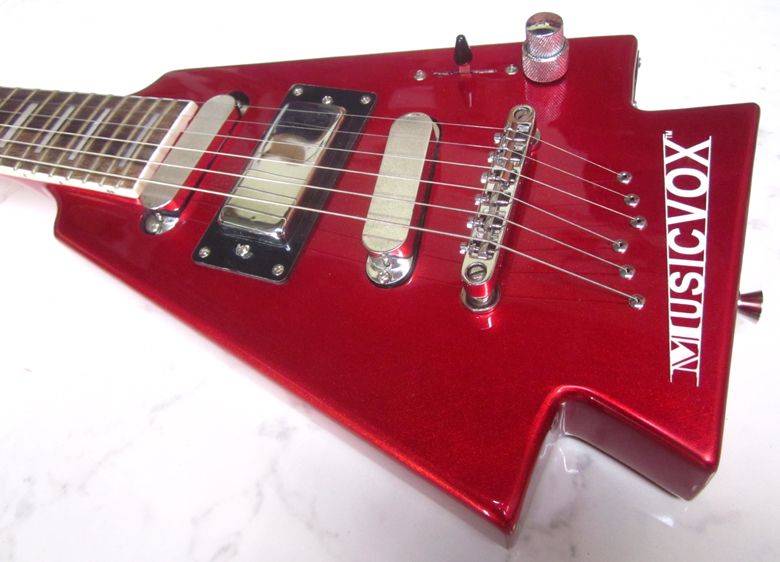
As for controls, we have the aforementioned 5-way pickup selector switch and a volume and tone on a single concentric stacked pot - very nice and simple to use, maybe too simple for some who like separate controls for each pickup; for myself I'd be happy to sacrifice the tone control altogether and just have a single volume.

In use, the Space-inator does take a little bit of getting used to at first, mainly because of the way it hangs on a strap and because of that and its shape the 24-fret neck does seem to be extremely long - it feels a little like suddenly having a bass neck to contend with. Playing some solos I'd previously been playing on my trusty Aria TA-30 semi I did find I was going to the wrong frets quite often. But of course none of this is the guitar's fault; it's just the learning experience that goes along with anything that is new to you.

I had worried that the minimalistic body would not provide any forearm support for my right arm when playing, but in fact it's very easy to rest your right wrist against the "notch" formed by the shape at the rear of the body and I experienced no arm fatigue whatsoever, unlike that I have experienced playing other small-bodied guitars.

One thing I should mention is that the Space-inator is neck heavy (or "body light", as Bertram put it). Unfortunately this is just about unavoidable on a small bodied guitar such as this, and Musicvox have done all they could to design a compact headstock. Sure, they could have made it headless, but that would likely have limited its appeal to many, and I don't think design-wise it'd have done the Space-inator any favours. But it's not necessarily a problem; it's just something that you need to know about and compensate for when playing. I mentioned resting the right wrist against the rear of the body when playing; this also helps keep the instrument balanced, and 99% of the time your left-hand is holding the neck anyway so that ought to keep it pointing the right way. But I do think it is essential that the Space-inator owner uses some form of strap locking device, just in case the guitar takes a neck-wise tumble. I use the cheap plastic variety that only cost 50 pence each or thereabouts - they are cheap but they do the job well; you don't necessarily have to go to the expense of getting specialist strap locks installed.
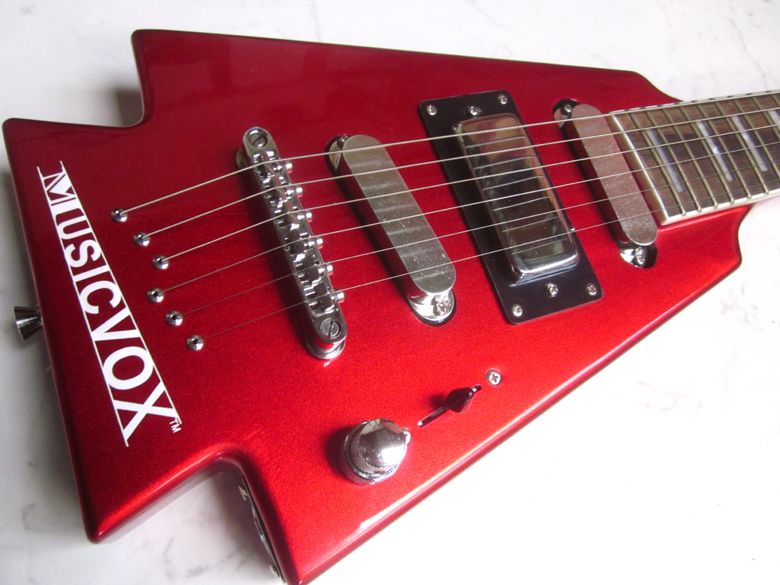
Whilst the Space Ranger and Space Cadets will appeal to psychedelic rockers, retro-themed bands, possibly a few krautrockers, rock'n'rollers and rockabillies, the Space-inator is probably the one Musicvox guitar that might appeal to those from the shredding fraternity as it excels at fast lead playing, playing right up at the top of the 24-fret neck, and thanks to that mini-humbucker it has the necessary tones required.

I can also see a use for it in the studio, as not only is it a professional quality instrument with a wide tonal palette, but also the compact body size make it perfect for those times when you have a guitar strapped on at the ready whilst behind a recording console or computer. You could also use it as a travel guitar, although its full scale length and the presence of a headstock mean that it's a lot longer than some.

The Space-inator is available directly from the Musicvox website, but also keep following Musicvox on Facebook where special offers are occasionally announced.

More photos follow:

Note: photos are by G L Wilson, but please feel free to copy and reproduce - although a credit to Guitarz would be appreciated - thanks!

G L Wilson

© 2012, Guitarz - The Original Guitar Blog - 10 years and counting!

Friday, 7 December 2012

Ibanez Strat-ish 1970s electric guitar, but is it a "lawsuit" guitar?

guitarz.blogspot.com:
Another term that gets bandied about in the guitars section on eBay is "lawsuit", used when describing early Japanese "copy" guitars.

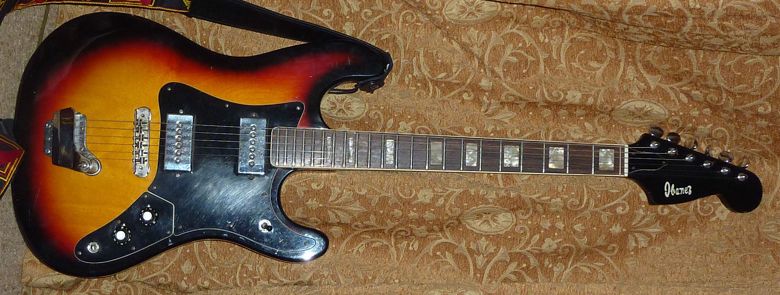
Despite the seller labelling this 70s-era Ibanez as a "lawsuit" guitar, I'd have thought it would have been extremely churlish for Fender to have filed a lawsuit because of this particular model; I appreciate that it is very Fender Stratocaster-like in silhouette but the similarities end there. Surely no-one with any knowledge of guitars would confuse this Ibanez for a Fender?

The guitar features two P90-style pickups, controls and output jack on a separate Mustang-like plate, a vaguely tune-o-matic styled bridge and a top mounted vibrato (arm sadly missing on this example) - a kind of el cheapo Bigsby if you will - behind the bridge. The neck, although it has a Fender-like 70s large headstock, is bound and features block inlay position markers. Looking at the photos I wonder too if the scale length might be nearer to 24" than a Fender-esque 25.5".

This is potentially a great guitar, depending on its current condition, set-up and playability but I can't help thinking that the eBay seller's starting bid of £750 and Buy It Now price of £1250 are optimistic. Perhaps this is the Holy Grail to some Ibanez/vintage guitar collectors, but I doubt it's going to sell with those prices. As to whether it could be considered a "lawsuit" model or not, I personally don't think that it qualifies but if you know differently please explain how and why in the comments below.

G L Wilson

© 2012, Guitarz - The Original Guitar Blog - 10 years and counting!
Thursday, 6 December 2012

Dynacord Cora


No more link to the selling site of this stunning Dynacord Cora - it was unsurprisingly sold very fast - there've been no more than 100 of these ever produced and it's a guitar collector's dream, when vintage surpasses once for all anything that followed in the next half century!

Dynacord is a major German audio company started in the 1950s, shortly teamed in the 1960s with Italian GEM (also using Schaller hardware and pickups) to produce a series of guitars including this quite unique Cora: a reduced wooden body in a double cutaway-shaped tubular frame.

It was short-lived - not sure if for technical flaws or excess of avant-gardism,  but it's a mystery to me that such a perfect design was not explored further and made a standard!

And you know what? There was a black body model and it looked even better!

Bertram D

© 2012, Guitarz - The Original Guitar Blog - 10 years and counting!

Tuesday, 4 December 2012

Hagstrom Deluxe doublecutaway guitar from 1962

guitarz.blogspot.com:
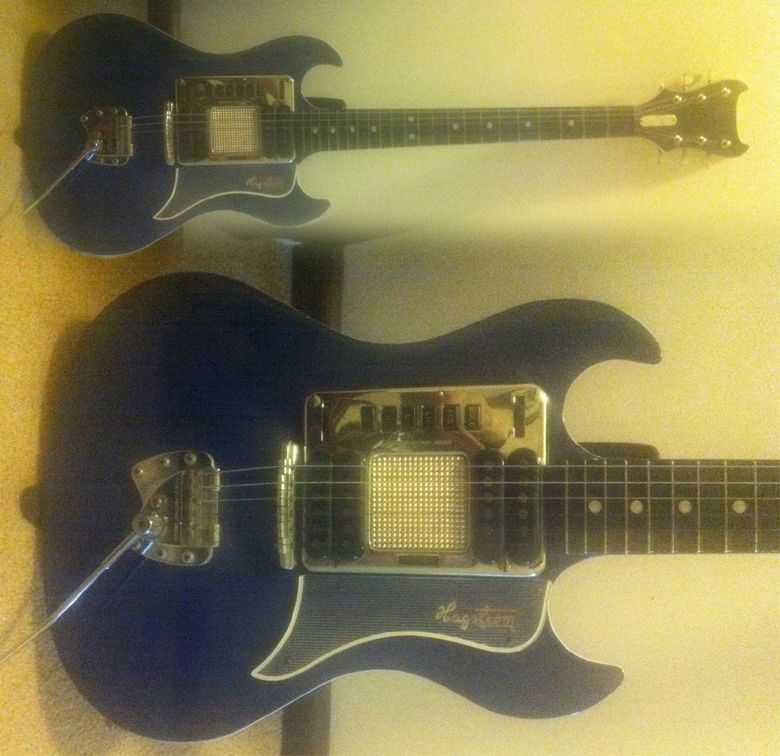
An obvious relation to the glitter-topped singlecut Hagstrom guitars, this doublecut Hagstrom Deluxe is a much rarer beast with only 225 examples having been produced between the years 1962-63. The chrome pickup housing with "grille" and pushbutton switches is shared with the better-known singlecut models, although the top of the guitar is a solid blue rather than glittered, and the fingerboard is timber (rosewood?) as opposed to perspex. [Edit: I'm told it IS perspex, but solid black perspex rather than clear].

Note also the distinctive headstock shape which earnt this model the nicknames of "Batman" and "Duck's foot".

Despite the distinct lack of bling on this model, it's of much more value to collectors as evidenced by the starting bid on this example currently listed on eBay which stands at $6,000 Australian dollars. Alternatively, if you don't want to get into a bidding war, the seller will accept $10,000 Australian dollars as a Buy It Now price.

G L Wilson

© 2012, Guitarz - The Original Guitar Blog - 10 years and counting!

Monday, 3 December 2012

Vintage & Rare Guitar of the Week: Bellwood acrylic-bodied "Super Swinger" Strat circa 1979

guitarz.blogspot.com:
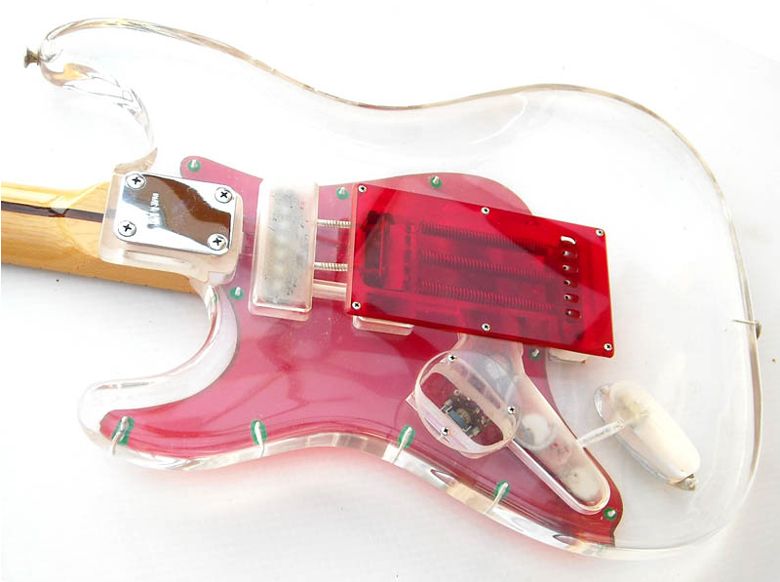
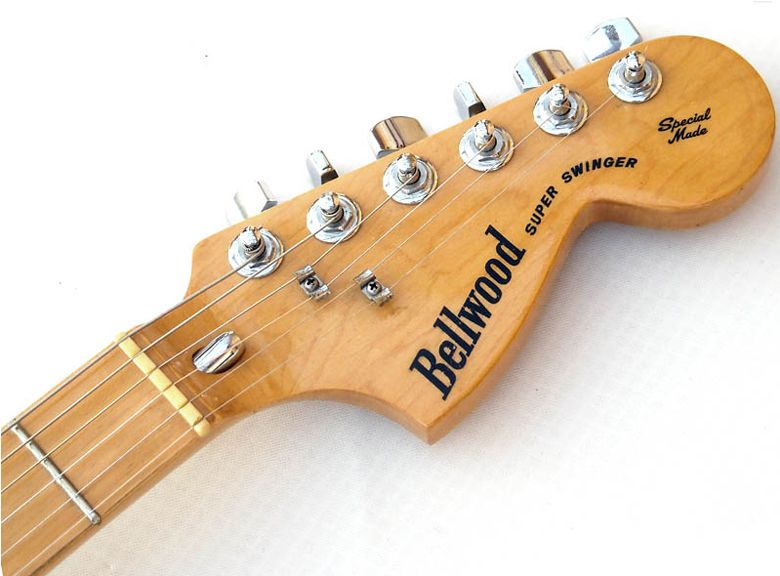
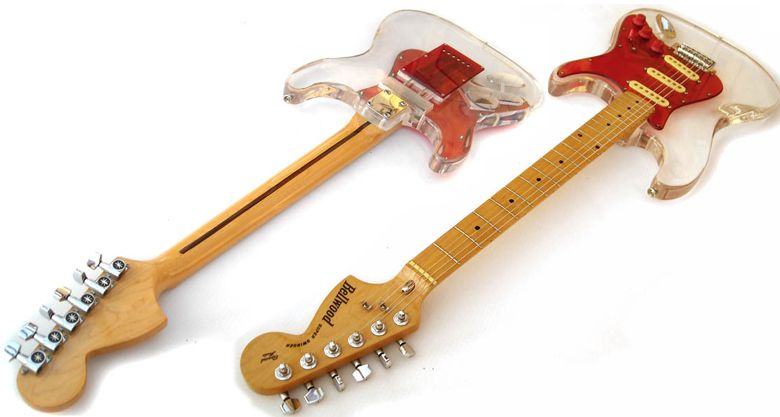
This 1979 acrylic-bodied Bellwood "Super Swinger" Strat-type guitar caught my eye on Vintage & Rare this week. This is a Japanese-made plexiglass bodied guitar from the late 1970s and other than the colour details is identical to my own Sanox Sound Creator-branded guitar. There are a couple of clues that betray the fact that these are the same guitars, most noticeably the rectangular pickup cavities, the plate behind the pickup selector switch (the narrow body of the guitar, necessitated by the desire to keep the weight down meant that the cavity for the 5-way switch goes right through the body - hence the back cover), and also the back of the machine heads which have a star design on them - dead giveaways.

These guitars seem to have been sold under various different brandnames including Bellwood, Sanox Sound Creator, and Coloursound ("guitar guru" Paul Day has one with a blue pickguard in his collection and which is pictured on page 109 of The Ultimate Guitar Book by Tony Bacon).

This Bellwood version appears to be in supreme condition, although I would hazard a guess that the coloured control knobs and selector switch tip are replacements (also, why not go for coloured pickup covers?). It's certainly in better condition than my own Sanox Sound Creator which has a nasty-looking internal crack beneath the bridge.

Currently being sold by Germany's Wutzdog-Guitars (coincidentally, I bought my Sanox from Germany) via Vintage & Rare and priced at €990.

G L Wilson

© 2012, Guitarz - The Original Guitar Blog - 10 years and counting!
Saturday, 1 December 2012

refinished Musima Eterna


This is not the first time we see a Musima Eterna on Guitarz since I even presented my own here a few years ago, but this version roughly refinished in blue (usually Musima models are black and Migmas are perloid red) with a replacement wooden pickguard allows to see how well designed this guitar is - it's not just some eccentric East-German guitar interesting for its mere oddity... 

OK, the sound is a little bit raw and the neck is very thick so don't expect to shred on it but it's the perfect garage guitar - it makes me think that I don't play enough on mine (but I never play enough on none of my guitars!)

Bertram D

© 2012, Guitarz - The Original Guitar Blog - 10 years and counting!
LinkWithin

Related Posts with Thumbnails

ShareThis