guitarz.blogspot.com:
The most iconic of all doubleneck guitars is surely the Gibson EDS-1275 as notoriously played by Led Zeppelin's Jimmy Page. However, Gibson have produced many other doublenecked instruments over the years, some of which we have already looked at during the 12 year history of Guitarz (which is a round-about way of letting me slip into the text the fact that today is the 12th Anniversary of this blog, the world's first and longest running guitar blog!).
However the above picture doubleneck acoustic is a one-off creation, the Gibson Master Museum Doubleneck Orville and is from the estate of the Late Dr.Michael Brown. It was hand-built in 2003 by Ren Ferguson, who ran the Gibson Master shop for many years. Note how the 12-string neck is the lower of the two - I've often wondered why most other doubleneck 12+6 guitars have the 12-string at the top.
Currently listed on eBay with a quite staggering Buy It Now price of US $34,999. You'd think for that kind of money the guitar would be fitted with more elegant volume and tone controls.
Incidentally, I've got a bit of a thing for doubleneck guitars at the moment. If anyone would like to buy us a 12th Anniversary present, a doubleneck 6+4 (guitar and bass combo) would be received most gratefully!
G L Wilson
© 2014, Guitarz - The Original Guitar Blog - the blog that goes all the way to 11!
Please read our photo and content policy.
Thursday, 28 August 2014
Wednesday, 27 August 2014
Stradi Symphony Five-string Fretless Bass
guitarz.blogspot.com:
The design of this Stradi Symphony Five-string Fretless Bass incorporates visual elements from both the electric bass and stand-up acoustic double bass, but at the same time it is quite a minimalistic design with no visible pickups, control knobs or switches being allowed to sully the face of the instrument. In fact, the sole control on the bass is a volume slider and that is to be found located on the backplate on the reverse of the instrument (seems a weird place for it, I'd imagine it could get knocked there). Note how the fingerboard (wenge, apparently) continues all the way to the base of the body beyond the bridge, giving the whole bass a very sleek and elegant appearance.
The specs are as follows:
Body: Walnut and oak with curly maple top
Neck: Hornbeam sides with maple center and walnut lines, two 8mm carbon fibre pipes from headstock to bridge working as resonant chambers and stiffening rods
Fingerboard: One, thick piece of quartersawn wenge. Side dots made of brass with acrylic centre eye.
Tuners: Gotoh
Bridge: Black oak with Stradi cutom piezo pickup underneath
Electronics: Stradi Sweet Transistor Preamp for piezo, Volume slide pot on backplate, 9v battery operation
Strings: Rotosound Tru-Bass
I can't say I'd personally want to keep those horrible black plastic-coated flatwounds on there. One thing that polarises fretless bass players is the whole thorny question of flatwounds versus roundwounds. I am very definitely in the roundwound camp. So, OK, they are going to mark your lovely black minimalist fingerboard - but the lovely sustain they will produced will more than make up for it. But then if you really ARE looking for an upright bass sound which is often more percussive and has a lot less sustain than an electric bass, maybe the RotoSound Tru Bass strings are worth a try?
Item is located in Poland and the starting bid is set at US $2,470.
G L Wilson
© 2014, Guitarz - The Original Guitar Blog - the blog that goes all the way to 11!
Please read our photo and content policy.
Tuesday, 26 August 2014
Highly ingenious Telecaster guitar and mandolin doubleneck
guitarz.blogspot.com:
For the Telecaster player who doubles on mandolin (why do I think this person might be a country player?) here's a very ingenious solution to the age-old problem of cumbersome and back-breakingly heavy doubleneck guitars. This particular Tele guitar and mandolin doubleneck custom-built by Stuart Palmer, cleverly utilises the existing Telecaster body and neatly accommodates the mandolin neck into the upper bout so that the actual guitar body is no bigger than that of a regular Telecaster.
Currently listed on eBay UK with a Buy It Now price of £850.
G L Wilson
© 2014, Guitarz - The Original Guitar Blog - the blog that goes all the way to 11!
Please read our photo and content policy.
Monday, 25 August 2014
Gamble Guitars Rocketfire Junior handmade in Germany
guitarz.blogspot.com:
Aesthetically-speaking I am not the biggest fan of singlecut guitar designs such as th almost Univerally loved Les Paul, but occasionally a singlecut design will do it for me. For example I've always had a soft spot for the Dano U2-style singlecuts, and here is another I spied on eBay that appeals to me, namely the Gamble Rocketfire Junior.
Gamble Guitars are lovingly handcrafted in Germany by the two-man team of Sascha Proske and Robby Rybol. Their Rockfire Junior model features a Mahogany body with either cream binding or fake binding; choice of finish (Nitro satin or matt, black, vintage white, shell pink, surf green, sonic blue and open pore nitro satin or gold), oil-finished back, Mahognay neck with ebony or rosewood fingerboard with dot inlays and 12" radius, 25"(635 mm) scale length, bone nut, ABM Wraparound bridge, choice of Harry Häussel P90, humbucker or Filtertron pickups, Gotoh SD 510 tuners, and controls consisting of volume, tone with push-pull for coil tap, and 3-way pickup selector.
The guitar new is priced at €2,100.00 (which includes a SCC Canada case), but this example on eBay is listed with a Buy It Now price of €1,250. Condition is said to be almost as new but with one minor ding on the back.
I do like the almost offset design which can be seen a lot clearer on this photo taken from the Gamble Guitars website.
G L Wilson
© 2014, Guitarz - The Original Guitar Blog - the blog that goes all the way to 11!
Please read our photo and content policy.
Friday, 22 August 2014
1966 Fender Jazzmaster prototype
guitarz.blogspot.com:
From the eBay listing:
G L Wilson
© 2014, Guitarz - The Original Guitar Blog - the blog that goes all the way to 11!
Please read our photo and content policy.
From the eBay listing:
For sale is this vintage 1966 Fender Jazzmaster prototype electric guitar. The prototypical headstock on this unbelievably unique Jazzmaster was hand-carved and finished by Roger Rossmeisl under the supervision of Freddie Tavares, but was never implemented during subsequent production making it the only Fender Jazzmaster of it's kind. Interestingly, Mr. Tavares took a liking to the guitar, and kept it in his office in the Fullerton factory for years to come, even playing it at many holiday parites and other Fender-related events. The guitar wasn't officially finished until 1983 when Steve Grom (Fender and Gibson employee) chose to purchase it as part of Fender's "Employee Sale" program of 1983. At which point the original Lake Placid Blue nitrocellulose finish was replaced with an absolutely exotic Purple polyurethane, and the guitar was finally mated with an appropriate case. The instrument is 100% all original in incredibly pristine like new condition, and includes the singed documentation from Mr. Grom on (ironically) Gibson letterhead.Currently listed with a Buy It Now price of US $18,999.99.
G L Wilson
© 2014, Guitarz - The Original Guitar Blog - the blog that goes all the way to 11!
Please read our photo and content policy.
Tuesday, 19 August 2014
Strat copy given the hollow / relic treatment on eBay in Germany
guitarz.blogspot.com:
Currently listed on eBay with an optimistic Buy It Now price of €685.
When it comes to "Holey" Strats, I much prefer my own Feline Holy Panther. (Which, incidentally has now been immortalised on vinyl record and CD on the track "(Return Of The) Maggot Brain" on the new Sendelica "Live At Crabstock" album).
But if you prefer your Strats even more minimalistic, then there are these!
G L Wilson
© 2014, Guitarz - The Original Guitar Blog - the blog that goes all the way to 11!
Please read our photo and content policy.
Sunday, 17 August 2014
Bluesouth Clarksdale guitar in TV yellow: the sound of the American South
guitarz.blogspot.com:
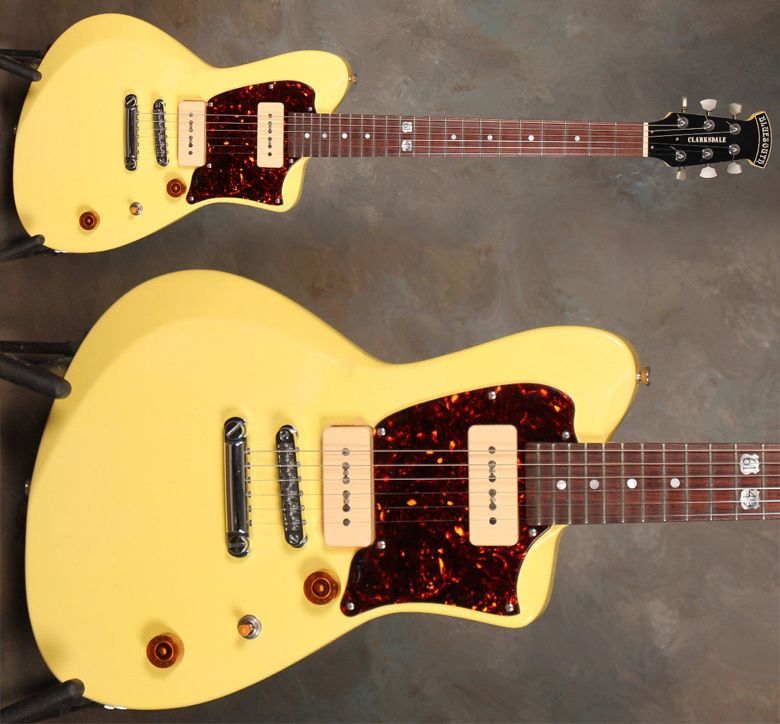
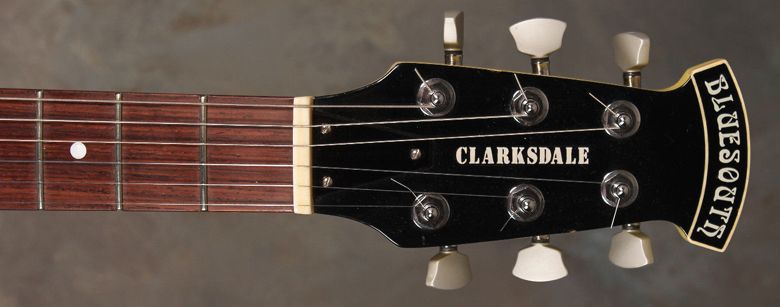
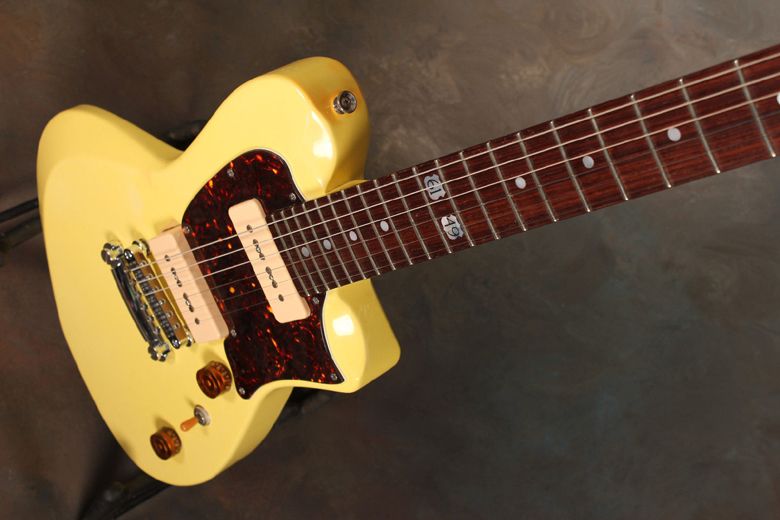
I love the timeless vintage but all original good looks of this Bluesouth Clarksdale guitar. It's built like a Gibson with a glued-in neck joint, but the off-centred waist is surely a nod to the Fender camp.
To borrow from the eBay listing:
G L Wilson
© 2014, Guitarz - The Original Guitar Blog - the blog that goes all the way to 11!
Please read our photo and content policy.
I love the timeless vintage but all original good looks of this Bluesouth Clarksdale guitar. It's built like a Gibson with a glued-in neck joint, but the off-centred waist is surely a nod to the Fender camp.
To borrow from the eBay listing:
Ronnie Knight began Bluesouth Guitars in 1991 with the idea of building stringed musical instruments which celebrate the musical heritage of the American South. Blues, jazz, country, rock, and spiritual music were all created in the southern American states. This small area from Texas to the Carolinas, from Kentucky to Florida, has been the hotbed of the worlds musical culture in the twentieth century. Several small towns within the southeast have had a huge impact on today's popular music: Muscle Shoals, Alabama; Macon, Georgia; and Clarksdale, Mississippi.Currently listed on eBay with a starting bid of US $800 (over half of the original list price).
The results of this project have been unique, light-bodied guitars with large, comfortable necks. Bluesouth contends that "fierce individualism" is the key ingredient in their guitar making operation. Starting in a small shop over a record store in early 1992, Bluesouth moved to a much larger industrial facility in the spring of 1995. The company offered seven models, including two electric basses. Bluesouth also built its own cases and pickups in house (company history courtesy Ronnie Knight, April 17, 1996).
G L Wilson
© 2014, Guitarz - The Original Guitar Blog - the blog that goes all the way to 11!
Please read our photo and content policy.
Friday, 15 August 2014
Taras Guitars VP-1 - Could this be the next big guitar innovation?
guitarz.blogspot.com:
The first time I saw a photo of a VP-1 prototype from Taras Guitars I was quite perplexed. Surely the guitar was missing a bunch of strings seeing as it had such a wide fingerboard but just the six strings running down the centre. However, that first photo I saw was a close-up, and I didn't appreciate how the curvature of the fingerboard towards the nut.
A quick view of the Taras Guitars website explained the concept. The wide, surfboard-shaped fretboard means that "'New' notes and sounds can be found when the frets are extended and strings are bent AWAY". Indeed it's all to facilitate extreme string bending. For more information, check out the video.
G L Wilson
© 2014, Guitarz - The Original Guitar Blog - the blog that goes all the way to 11!
Please read our photo and content policy.
Wednesday, 13 August 2014
Migma 2000
In the second half of the 20th century, it was common to add '2000' to a brand or to the name of a product to sound futuristic - could be cars, radios, vacuum cleaners, toothpaste, street artists… Now in 2014, when people carry around smartphones that are more powerful that the computer that helped Apollo to fly to the moon, it sounds very retro, like putting data on audio-cassettes, the stratocaster or Soviet Union…
So here is the Migma 2000, that must have been something very advanced at some point, the acme of socialist technopop! I still wish a guitar company would revive some east-european models from the 1960s/1970s. A few months ago Eastwood made a 'cheesy guitars' (what a stupid and insulting name) contest to have their fanbase choose a bizarre guitar to reissue, and I think they finally picked a Wandrè, but there were a Tonika and a Jolana in the lot. The choice was based on oddness, I wish they'd be genuinely interested in these guitars, and I'd love to see a brand new Migma or Orpheus or Defil, with decent wood and good electronics, like they do in China these days...
Bertram D
© 2014, Guitarz - The Original Guitar Blog - the blog that goes all the way to 11!
Please read our photo and content policy.
Sunday, 10 August 2014
Jim is looking for info on his "Triumph" archtop guitar
guitarz.blogspot.com:
Jim writes:
To give some background, Selmer were a musical instrument manufacturer established in the early 1900s and based in Paris (surely their best known guitars were the gypsy jazz guitars as played by Django Reinhardt). By 1928 they had aquired a semi-independent UK branch. From the 1950s and through to the 1970s some of Selmer UK's own-brand guitars were produced by Germany's Höfner especially for the UK market.
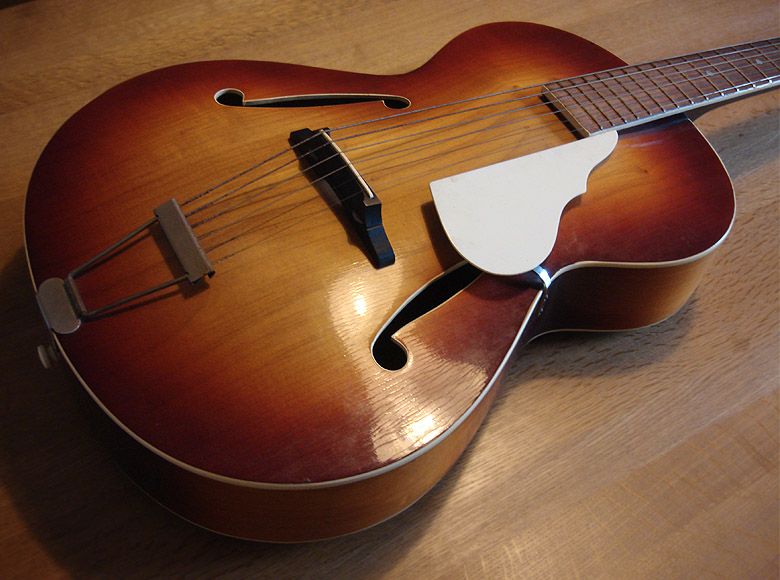
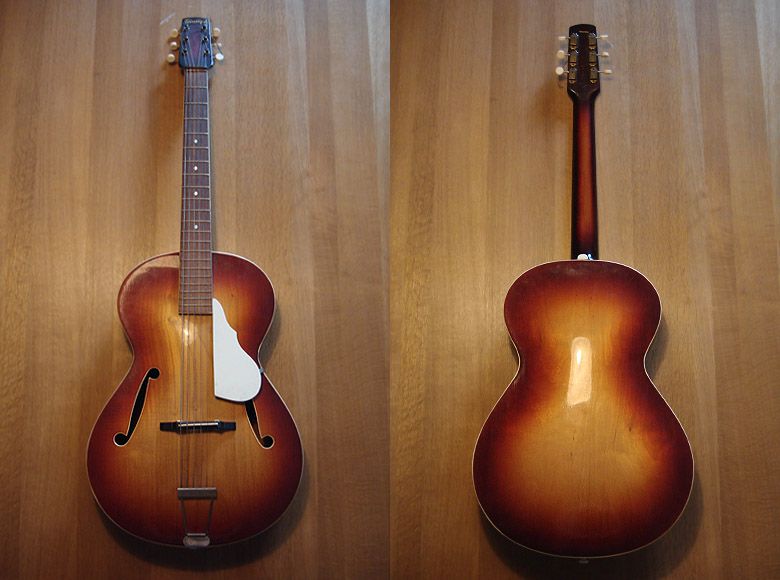
However, rather than being a Höfner this particular guitar looks to be very similar to the Framus Studio 5/51. We've looked at one of these before here on Guitarz, although that example was unusual in having just a single f-fole.
Speaking of the f-holes, you'll notice that these Framus guitars have very distinctive shaped f-holes which omit the crossbar of the "f".
So, in brief, Jim, your guitar would be made in Germany, most likely in the 1960s. For further information you might want to check out this exchange I found on an internet forum, which concerns another very similar guitar.
By a strange coincidence, it also looks very similar to a guitar owned by my friend Frank, which has recently been restored by luthier Jeff Beer.
G L Wilson
© 2014, Guitarz - The Original Guitar Blog - the blog that goes all the way to 11!
Please read our photo and content policy.
Jim writes:
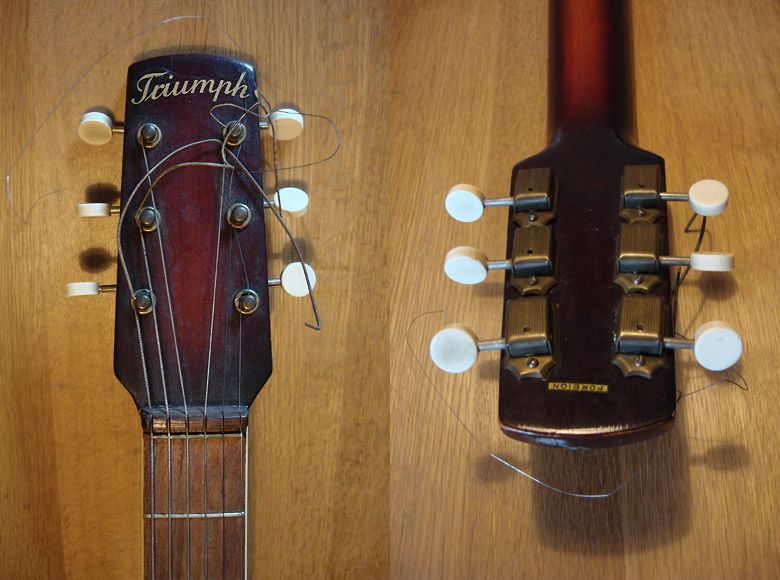
Hi Gavin,Hi Jim, I believe what you have got there is a Selmer Triumph guitar. It's hard to pinpoint it to an exact model because the Selmer Triumph name encompassed several different guitar designs and a few amplifiers too.
I'm a fan of the Guitarz blog, it's been a great read. I started to learn how to play last year, and I'm finding the instruments and their history very interesting.
I bought this guitar in a junkstore yesterday (pictures attached), I was hoping someone at Guitarz might be able to tell me where it's from, how old it is? It's got a 'Triumph' sticker label on the headstock with a 'Foreign' label on the back, also stamped with number '13547'.
I think it's a cheap copy, but I've kinda fallen in love with it and I'm going to get it cleaned up and looking a bit healthier. It's currently smells of old books! Hope someone might be able to fill in some it's history, as I can't find anything about it.
Thanks for the great blog - it's been a really great resource.
All the best, Jim
To give some background, Selmer were a musical instrument manufacturer established in the early 1900s and based in Paris (surely their best known guitars were the gypsy jazz guitars as played by Django Reinhardt). By 1928 they had aquired a semi-independent UK branch. From the 1950s and through to the 1970s some of Selmer UK's own-brand guitars were produced by Germany's Höfner especially for the UK market.
However, rather than being a Höfner this particular guitar looks to be very similar to the Framus Studio 5/51. We've looked at one of these before here on Guitarz, although that example was unusual in having just a single f-fole.
Speaking of the f-holes, you'll notice that these Framus guitars have very distinctive shaped f-holes which omit the crossbar of the "f".
So, in brief, Jim, your guitar would be made in Germany, most likely in the 1960s. For further information you might want to check out this exchange I found on an internet forum, which concerns another very similar guitar.
By a strange coincidence, it also looks very similar to a guitar owned by my friend Frank, which has recently been restored by luthier Jeff Beer.
G L Wilson
© 2014, Guitarz - The Original Guitar Blog - the blog that goes all the way to 11!
Please read our photo and content policy.
Subscribe to:
Posts (Atom)