Showing posts with label Ampeg. Show all posts

Wednesday, 30 July 2014

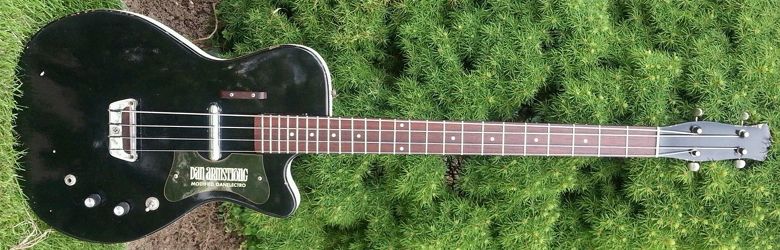
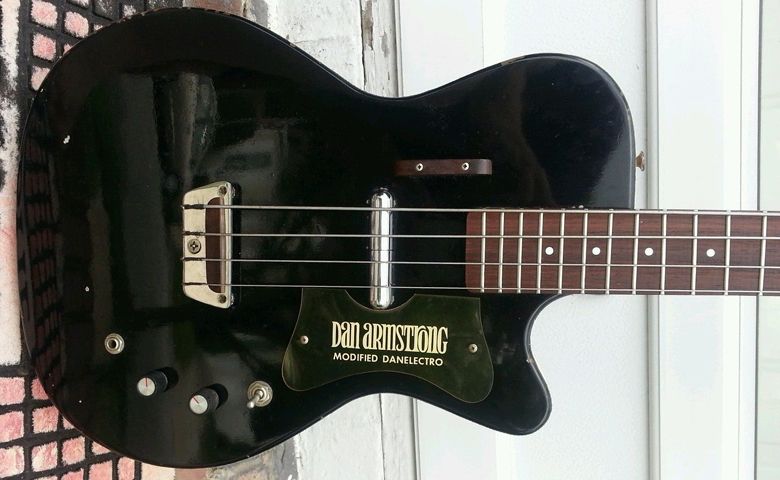
Ampeg Dan Armstrong-modified Danelectro bass, circa 1969-70

guitarz.blogspot.com:

Dan Armstrong, the man who created the line of clear lucite-bodied guitars and basses bearing his name for Ampeg, freely admits that he was influenced by Danelectro:
Danelectro® instruments served as far more than merely inspiration for the clear guitars and basses, as Dan virtually built his business on these guitars practically from day one. When Dan opened up his shop on 48th Street he almost immediately began taking Danelectro instruments and stabilizing them to make them play better. 

According to the book Electric Rock© by Richard Robinson - Jesse Colin Young used a Danelectro bass in the Youngbloods® that Dan had modified. 

In the same book Dan went on to say "I was in the repair business in '65. I had a repair shop and wanted something to sell and due to all the stiff competition on 48th Street I couldn't sell Fenders® and Gibsons®, there was no way to do it. I could improve the ones that people brought to me but there was no way to buy them new." The problem here was the fact that the large musical stores already held the franchise on these instruments. 

Still Dan wanted something to sell, and later said "Danelectros were so doggone cheap. I could buy them new and they were basically pretty doggone good. Most of the good parts on those things were engineered in the design which I always appreciated, and with some finishing up they could have been really done well, even out of the factory. But they just didn't have time, it was an economy instrument. I've always been an improver anyway. I enjoy that kind of thing, to find something that's made almost well and try to fix it up. It was all basically right so I just took them apart and cleaned them up a little bit."

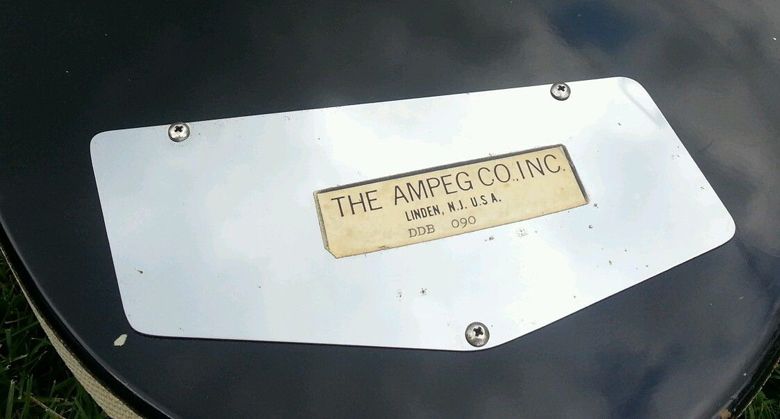
Here we see a Dan Armstrong modified Danelectro bass currently being offered for sale on eBay. This is the AMPEG tagged version with serial # DDB 90, which means it's the 90th one made. DDB=Dan Armstrong Danelectro Bass. 

Modifications made by Armstrong to the original Danelectro design include Kluson tuners, rewound pickups,upgraded electronics, reshaped headstock, re-shaped  smoother cutaway, branded pickguard, micro tilt neck, and double strap buttons on bottom so the guitar can be stood upright more safely.

Currently listed on eBay with a Buy It Now price of S $1,499.99.

G L Wilson

© 2014, Guitarz - The Original Guitar Blog - the blog that goes all the way to 11!
Please read our photo and content policy.

Saturday, 12 April 2014

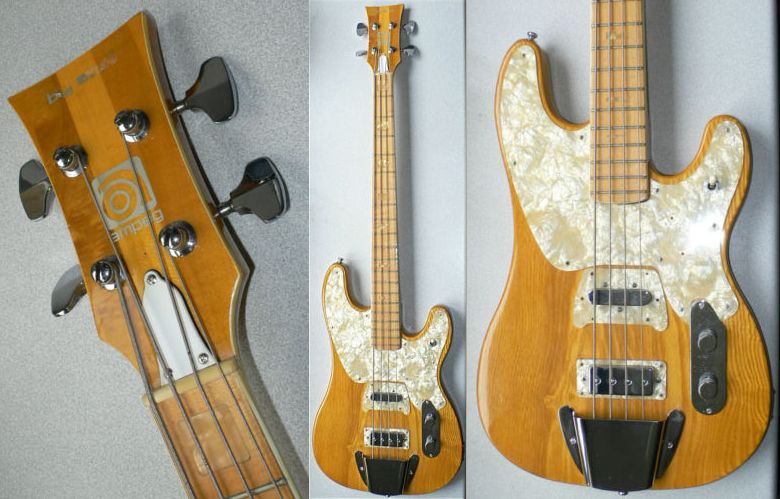
Ampeg Big Stud - a 1970s Japanese take on the Precision/Telecaster Bass

guitarz.blogspot.com:
We recently looked at an early 1970s Fender Telecaster Bass which itself was a reissue, or rather, a reinterpretation of the original pre-redesign Fender Precision Bass. Here we see another 1970s interpretation of the same design by the Japanese, marketed under the Ampeg brandname. This particular model was named the Ampeg Big Stud; there was also a Little Stud model fashioned more in keeping with the traditional Precision bass.

When I first saw this bass I did wonder momentarily if it was a short or medium-scale bass, but it does indeed have the full 34" long scale length. I think it must be an optical illusion created by Ampeg's choice of a smaller 2+2 headstock.

Notable users include bassist Senon Williams of Cambodian pop/psychedelic band Dengue Fever.

Currently listed on eBay UK with a Buy It Now price of £375.00.

G L Wilson

© 2014, Guitarz - The Original Guitar Blog - the blog that goes all the way to 11!
Please read our photo and content policy.

Friday, 22 June 2012

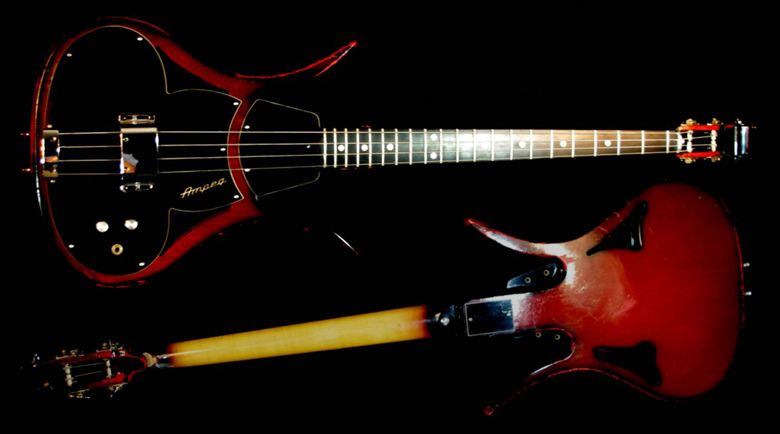
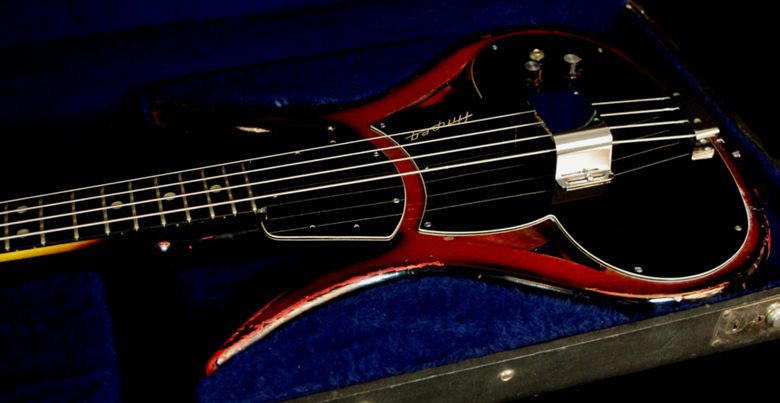
Rarer sibling of the Ampeg AEB-1 "Scroll" Bass, 1966-vintage Ampeg ASB-1 "Devil Bass" on eBay now

guitarz.blogspot.com:
Original Ampeg AEB-1 and (fretless) AUB-1 Scroll basses themselves so rarely turn up for sale on eBay, so to see this example of the even rarer Ampeg ASB-1 Devil Bass listed... well, I'd be failing in my Guitarz hosting duties if I didn't blog about it.

Features are more or less the same as the AEB-1, although with a different body shape. In common with the AEB-1, the Devil Bass - so called because of the pointy horns - has through-body sound holes, the same scroll-headed neck, and the same "mystery" hidden pickup (essentially a steel diaphragm over two magnetic coils set into epoxy) which allows use of nylon or gut strings if so desired.

I believe that Scroll Bass "expert" Bruce Johnson currently makes an updated version of the Devil Bass (or at least he has been planning to do so), and you can read more about the original Ampeg ASB-1 and AUSB-1 (fretless) Devil Basses on his website.

The Ampeg ASB-1 pictured here is currently listed on eBay with a Buy It Now price of $19,500.

G L Wilson

© 2012, Guitarz - The Original Guitar Blog - now in its 10th year!

Tuesday, 15 May 2012

Ampeg (by Burns of London) Jazz Splitsound

guitarz.blogspot.com:

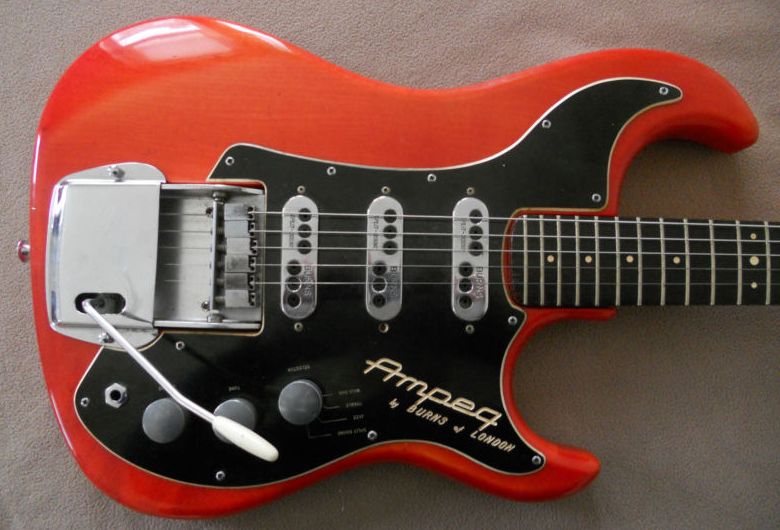
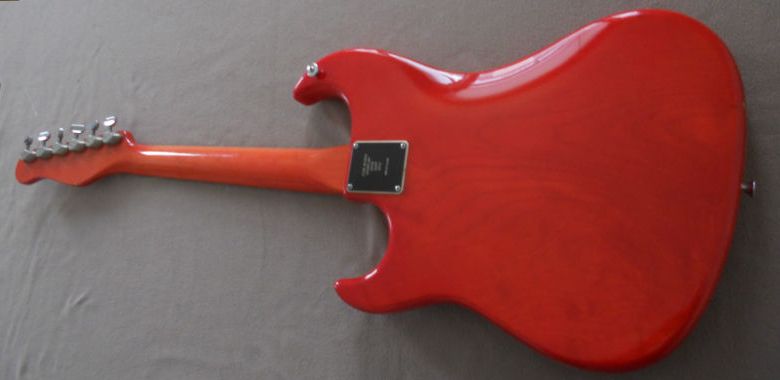
Here's another familiar-looking guitar with an unfamiliar logo on it. This 1963 Ampeg guitar is a re-branded Burns of London Jazz Splitsound (although to be perfectly fair, the logo does say "Ampeg by Burns of London").

Ampeg, known mainly for their amplification, have made various attempts over the years to market their own brand guitars and basses; this guitar is from their first attempt in 1963 when they imported British-made Burns Splitsound, Nu-Sonic, Split Sonic and TR_2 guitars complete with their own branding. We don't have records of how many such instruments were involved, but the Ampeg/Burns union only lasted a year in which time the guitars didn't sell particularly well. The eBay seller tells us that the transparent red finish on this example makes this guitar even rarer as most Ampeg/Burns guitars were finished in tobacco burst.

Currently listed on eBay UK with a starting price of £1,050.

G L Wilson

© 2012, Guitarz - The Original Guitar Blog - now in its 10th year!

Sunday, 25 December 2011

Early PiL excellent video, featuring a Travis Bean Wedge and an Ampeg Scroll Bass


Er, the title says it all but I can give some extra details: this is Public Image Ltd's first TV, on BBC2's show The Old Grey Whistle Test in 1980, performing Poptones from the Metal Box album. You can see Keith Levene playing a Travis Bean Wedge TB3000 - its quite unique triangle shape is easy to spot! Levene gets his razor-edged tone by using aluminium neck guitar - he's been playing also a TB1000 and an all-alu Veleno guitar. Jah Wobble plays an Ampeg AMB1 bass - aka the Scroll Bass - with its characteristic scroll headstock and body-through f-holes. One could tell than on top of being the brilliant creators of their own hybrid of pop and avant-garde music, these gentlemen had very good taste when it came to music instruments!

Actually while browsing through YouTube this morning I didn't only watched old PiL videos, but also saw a Michael Jackson/Eddie Van Halen one, and I understand that some people still loathe the 1980s for having been shallow and flashy, but that's just because they only look at the mainstream crap. To me it was a time of great and radical music, that I highly enjoyed then and since, and PiL was the herald of it!

Bertram

© 2011, Guitarz - The Original Guitar Blog - now in its 10th year!

Sunday, 13 March 2011

AEB-2 scroll bass - Ampeg tribute by Bruce Johnson

guitarz.blogspot.com:
Here's an email from Jeremiah:
I finally saw something on eBay that breaks my heart not to have, and thought might be shared with the blog. eBay has a Bruce Johnston AEB-2 - new and direct from Bruce, himself. The serial is 073, and build date is this last Feb, 2011.

Johnston's scroll bass is a direct continuation of the classic Ampeg scroll bass, and was initially produced under a license. Bruce has steadily improved and modernised his builds, while remaining true to the original appeal and characteristics of the vintage Ampeg models.
Fantastic stuff. Thanks for sharing!

G L Wilson

Guitarz - The Original Guitar Blog - now in its 10th year!

Thursday, 11 February 2010

1970 Ampeg Dan Armstrong


Dan Amstrong Ampeg

This plexiglass body Ampeg Dan Amstrong guitar from 1970 is a classic that most guitar lovers already know, but I  thought that these unglamourized pictures from eBay can allow a more accurate look at it - and it's always a pleasure... 
And if you want to know more, have a look at danarmstrong.org.


NB: Please make sure you are reading this Guitarz post at guitarz.blogspot.com and not on a Scraper blog that copies posts without permission (and steals bandwidth) so as to profit from advertising. Please support original bloggers!

Thursday, 27 August 2009

Of reverse headstocks and string tension

Earlier this month, the post on the Ampeg Scroll Bass legacy provoked an interesting discussion about the so-called "reverse headstock" and its influence on string tension, sound and playability. On this post, I imprudently stated - a common misconception - that the reverse headstock provides better tension to the respective gauges of the strings.

One of our readers, who goes under the moniker dre, provided precious and detailed information to reestablish the one and only truth about this essential topic, and so I've slightly edited his comments for this post.

Adje Vandenberg Peavey
"The effective string length (ie nut-to-bridge) determines the tension, in concert with string gauge and tuned pitch. If you have two guitars identical scale length, string gauge, and tuning, but different total string lengths, you will still have identical string tension.

Imagine one of those early Les Pauls with the combo bridge/tailpiece: minimal total string length. Then imagine a Firebird with a Bigsby. Longer headstock, more string behind the bridge, maximal total length. Both guitars have the same scale length.

If both have the same strings and are tuned to standard pitch, the strings will still be at the same tension, despite the differences in total string length, because the effective string length is the same, and those 24.75 inches of string between the nut and bridge have to be at the same tension to be at the same pitch.

The real difference created by different total lengths is in the feel of the guitar. All that extra string below the bridge and above the nut on the Firebird's low E string means that the string can be stretched more. If you reach way up and pull that E string across the fretboard (Why? I don't know, you're the one doing it!), that string will be easier to bend than the E string on the Les Paul, because there's less total string to stretch on the Les. Bending a string utilizes the entire length of the string since it can slide through the nut as it stretches. Playing an open note only utilizes the effective length, unless you really hammer it and it stretches a little.

Length, mass, tension. Those are the three determinants of pitch in a string. A guitar's nut and bridge functionally isolate the string between them from the remaining string above the nut and below the bridge, with regard to vibration. The length of string between the nut and the bridge is what vibrates to produce a pitch, and that length has to be at a particular tension in order to do so, depending on the mass of the string. The entire string must be at that same tension, every inch of it, including what's above the nut and below the bridge.

If (I'm estimating here) the .052 low E string on your Les Paul needs 23 pounds of tension to be tuned correctly, then your Firebird's .052 low E string needs 23 pounds to be tuned correctly. You may have more string at 23 pounds of tension, but that 24.75 inch piece of string between the nut and bridge has to be at 23 pounds, and therefore the entire string must be at 23 pounds.

Extra strings at either end of a guitar can be attractive and even musically useful (I am a certified Sonic Youth fan), but it does not change the string tension required to tune to pitch.

Here's a thought experiment that helps visualize the irrelevance of the nut-to-tuner (or saddle-to-anchor) length of string in terms of string tension at pitch. I have forgotten who came up with the basic premise of this visualization, and it was found on some bass forum, so please don't credit it to me.

Okay: Imagine you've got Adrian Vandenberg's secret pearlescent black prototype Peavey 24.5" scale guitar from 1987. It was made with a three-foot-long reversed headstock, which makes the total length of the E string (from tuner to Floyd Rose) 61", assuming half an inch of string from the saddle to the anchor on the Floyd. Don't ask why. Vandenberg was crazy. The custom-made superlong strings cost $500 a set.

You block the Floyd Rose to immobilize it (just to take it out of the equation), loosen the locking nut, and tune up to E. Now you have 61" total string length at a tension at which the 24.5" of speaking length between the saddle and nut play an E. The whole 61" of string is at the same tension from anchor to tuner, yes?

Okay. Now, crank down that locking nut. We don't want to get out of tune while playing the chorus riff from "In the Heat of the Night". When the nut is locked, the entire string is still at the same tension, right? All we did was fix one point on the string so that it can't move. Check to make sure you still have that string tuned to E. What happens when you take your string snips and cut out the string between the nut and the tuner? The speaking string between the saddle and the nut is still 24.5", still tuned to E, and still at the exact same tension.

At the same time, you've removed three feet of string. Now the total length, including the bit between the anchor and the saddle, is 25", less than half what it was, but the tension is still the same. If the tension was lowered when the string was shortened, the string would no longer be tuned to an E. This is fundamental physics. If string of the same speaking length with the same mass is tuned to the same fundamental frequency (and it is the same in every possible parameter in this example, because it is in fact the very same string), it absolutely must be at the same tension. Whether it was 61" or 25" total length, the string had to be at the same tension when tuned to E. When using string mass, length, and tension to determine fundamental frequency, only the vibrating length is relevant.

Please note that I am referring to actual tension, the pulling force of the string. I am not talking about "perceived tension" or "feel" or "slinkiness" or "springiness" or "bendability", all of which seemed to surface in my interweb research, all of which being mistaken for tension. Since every element of a guitar affects feel and sound, surely extra string length beyond the speaking portion somehow subtly affects the feel and sound of a guitar. I'll wager it's a barely perceptible change."

So thank you dre for this extensive contribution (the picture of Adje Vanderberg's signature Peavey guitar is supposed somehow to make all this even more convincing).

Bertram

NB: There are a lot of blogs STEALING content and bandwidth. If you read this anywhere else but on guitarz.blogspot.com then you are reading a blog that STEALS content. Please support original bloggers!

Saturday, 1 August 2009

Ampeg Scroll Bass and Legacy


guitarz.blogspot.com
Ampeg basses

This post will be a little bit fatter than usually, because I wanted to share a little inquiries I made about the Italia Imola 6 guitar, that lead me to rediscover the fabulous Ampeg AEB-1 aka the Horizontal Bass aka the Scroll Bass aka the F-hole Bass, and a couple of its descendants.

There was already a post about this bass last year on Guitarz, with a picture that gives a good idea of what wearing it must feel, with its huge double bass headstock. You can also find a very complete database about it on Johnson's Extremely Strange Musical Instrument Company 's website. Bruce Johnson builds nowadays quite acurate copies of the Scroll Bass that you can see on the small picture on the right.

scroll bassThe first big pic shows bass amps builder Ampeg's first series of 'horizontal' basses, starting in 1966 - their previous and first instrument was the 1962 Baby Bass, a small body fiber glass/plastic double bass. There are 3 Scroll Bass models, let's keep the Devil Bass (center) for a future post ; the f-hole models are the 1966 AEB-1 (AUB-1 for the fretless version - the very first fretless electric bass), and its 1968 upgraded version the AMB-1/AMUB-1.

Of course their most remarkable features are the 2 f-holes cut through the solid body, and the headstocks directly inspired by violon family instruments. It's quite of our time that a retro inspiration would result in such an inovative design!

The AEB-1/AUB-1 was designed to be appeal to upright bass players and featured a weird hidden pickup which was essentially a steel diaphragm over two magnetic coils set into epoxy. This meant that the bass could use gut strings. Notice also the way that the tailpiece extends beyond the body - this was so as to achieve the correct string angle over the hidden pickup.

The later AMB-1/AMUB-1 is a logic adaptation to modern rock sound, with more classical humbucker single pickup for metal strings, smaller head and Fender style tailpiece. You will find a very complete description of all these instruments on Bruce Johnson's website linked above.
Bruce Johnson's contemporary versions AEB-2/AUB-2 intend to be humble improvements of the original model, with the benefit of 40 years on electric lutherie. The few changes are meant to - as Johnson puts it - "bring the Scroll Bass design up to its full potential". That is definitely an instrument I'd love to play!


EEB eastwood


This is what Eastwood Guitars made based on the second model of the Scroll Bass - the AMB-1.

Eastwood
's EEB-1 is also a quite faithful reproduction, a noticeable change is the slightly shorter lower f-hole and the pickguard curling around it, and of course you can see that the scroll headstock is gone. I can understand that a modern guitar needs to get rid of vintage oddities - and the replacement headstock has a good design - but you probably loose the feeling of playing a horizontal double bass...

Like Ampeg, Eastwood proposes also a fretless version, the EUB-1.

italia imola 4


Now this is the Italia Imola 4 Deluxe in Cherry Sunburst. As you can see, the shape is the same but the two cut-through-body f-holes have been replaced by a more classical one (I actually read contradictory information about this f-hole, here it's called a "faux f-hole", there a "solid body f-hole", also this bass is said to have a "chambered solid body" but without "glued top", so something like vintage Rickenbackers... if someone knows more, it's welcome).

The big contoured pickguard is also there - without the lower f-hole - and the headstock is more classic (and very 60s - it looks like the one of my Musima ES-335 style bass). The pickups are completely different and are closer to a J-bass than to an Ampeg. This bass exists also fretless and/or 5-string.

No matter how much it betrays its Ampeg model, it's a beautiful instrument.

imola 6 italia


And finally this is the Italia Imola 6 Standard with which the all thing started. For this model Italia didn't try to reproduce a vintage model but extrapolated from their own interpretation of the Ampeg Scroll Bass. The result is a rounded Jaguar shape with a characteristic f-hole partially covered by a large pickguard. The 6 tuners in line headstock is inverted, that seems always to me the logical thing to do - the tuners have easier access and the tension suits better the different string gauges (and it's not only true for metal guitars).

Imola 6 doesn't only stand for 6 strings (as in Imola 4 or 5 for the 4- and 5-string basses) but mostly for the quite original 6 pickups - 3 vintage Teisco style split singlecoils. These pickups and the two 5-way levers allow many combinations - 25 -, some of which are probably quite original and must give this guitar a quite unique sound.

You can find a detailled review on musicradar.com and nothing on italiaguitars.com where the guitar is not even mentioned, though you can find it on their newer (I suppose) JHS website - where the bass models are completely missing... Italia people, please make some maintenance, it's confusing!

Italia
is a brand created by Trevor Wilkinson - THE Wilkinson - and intends to combine vintage creativity (isn't it contradictory to look in the past for creativity?) and contemporary technical qualities.

thanks to blogmaster GL Wilson for his expertise about the Scroll Bass.

EDIT. This is a close-up of the scroll headstock of the 1966 Ampeg model - none of the previous pictures give a clear look of it.

EDIT 2. Just found a blog about the original scroll Bass, it's here.

Wednesday, 1 October 2008

Ampeg AEB-1 Bass

Ampeg AEB-1 BassHere's another Ampeg, this is one I consider to be quite tasty and desireable. It's an original Ampeg AEB-1 Bass and appears to be in all original condition, other than having been converted to fretless (which is no bad thing in my book).

I love the through-body f-holes, the double-bass styled headstock, and also the fact that this bass comes with a spike that can be screwed into the bottom so that it can be played as an upright.

You'll notice it doesn't has any obvious pickups. Some of the earlier Ampeg basses featured a rather unusual pickup that was supposedly a bit like a speaker in reverse mounted beneath the scratchplate. I'm not 100% on how exactly these functioned, so if anyone has any more info, please don't be shy in offering it up for us.

Eastwood Guitars make some nice copies of these basses in both fretted and fretless versions but with the more usual magnetic pickups.

Tuesday, 30 September 2008

Ampeg T-style guitar

Ampeg T-style guitar
Ampeg, mainly known for their amps (and especially bass amps), have occasionally put their name on guitars and basses. This Tele-styled guitar is one I've not seen previously. Doesn't that headstock look really out of place on that shape body? It's an interesting one, nonetheless.

Thursday, 28 November 2002

Ever since I posted that entry here about the Aria Legend plexiglass guitar that I was selling, this website has been getting lots of hits from people searching for plexiglass guitars.

Here are some more perspex-bodied guitars:Of course the original perspex guitars were the now legendary Ampeg Dan Armstrong instruments from the 1960s. These had been re-issued in relatively recent years, although I can't find a link to any official webpage for them. However, there are some nice pics of the Dan Armstrong see-thru bass over at bunnybass.com.

Friday, 13 September 2002

Rod Clements from Lindisfarne is auctioning off some of his guitars on eBay, and I have been drooling over the pictures of this Ampeg-style Fretless Bass.

Warning: Some of these links may expire soon.

LinkWithin

Related Posts with Thumbnails

ShareThis