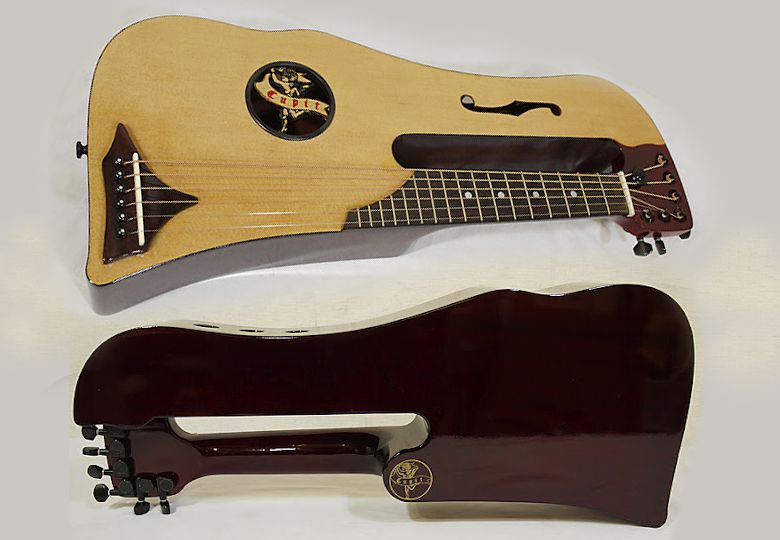
Travel guitars, particularly the acoustic variety, are all too often a compromise with sound being sacrificed for portability. The Cupit travel guitar has a length of 22.5" (which makes what? A scale length of 18 or 19 inches? That's positively ukulele territory!) but manages to produce a full rich sound. As the website explains:
This guitar's patented revolutionary unique design joins the end of the neck to the body creating an all around brace removing the need for a truss rod. The three sound holes in the top side create a better listening perspective for the player. The round hole and F hole help to distribute the tones equally along the front of the instrument.
I guess that volume-wise (I'm talking litres rather than decibels) the body is of similar size - although a very different shape - to that of a regular classical guitar. The video below gives a good indication of how good it sounds/.
The Cupit travel guitar has a list price of $499.99, but according to the website it appears to currently have a sale price of $349.99. Just one last comment: that name "Cupit"... judging by the logo it looks as if someone couldn't spell "Cupid".
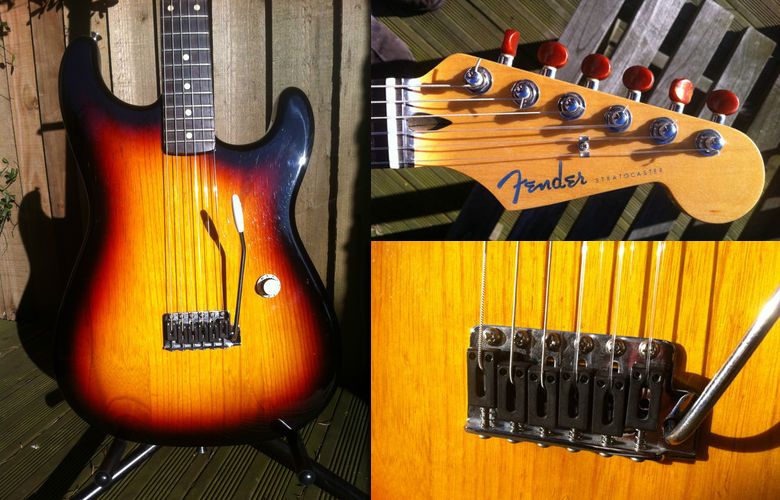
Here's another apparently "pickup-less" solidbody, this time it's a Fender Stratocaster Classical from Fender Japan. It's equipped with piezo pickups in the bridge saddles and is strung with nylon strings. I'm really curious to know what those nylon strings sound like with the Strat tremolo. It's not something that classical guitar usually calls for, although I doubt this would be used for playing classical guitar upon anyway. It's more an instrument for the rock guitarist who's after the nylon strung sound for certain particular songs.
The seller thinks this may be a one-off or a prototype, although I think this is doubtful. It's most likely a Fender Japan model that was not made for export outside of Japan.
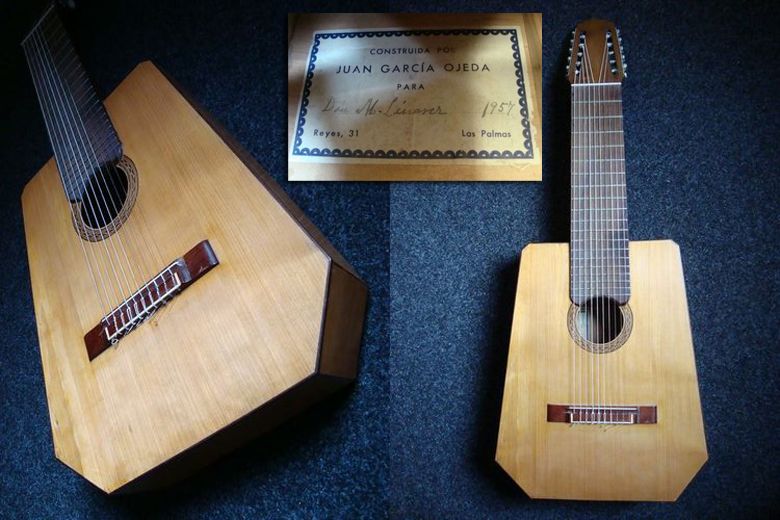
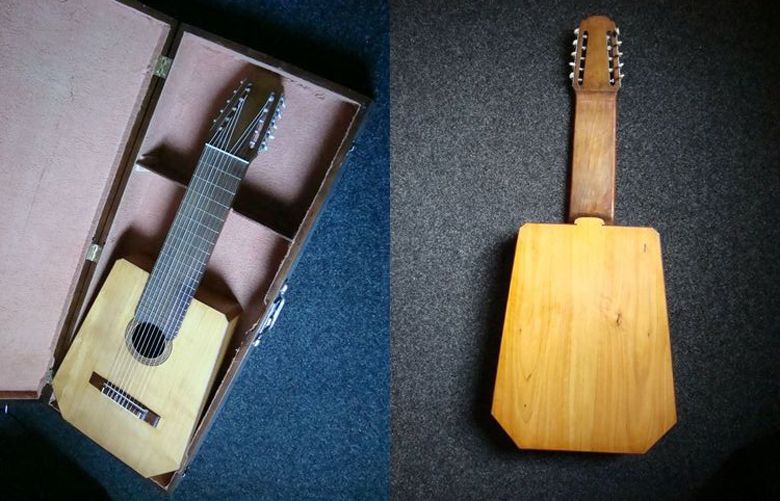
I do hope that this 10-string classical guitar does not sound as boxy as it looks. According to the information on the label inside the soundhole it was built by Juan Garcia Ojeda in Las Palmas Spain in 1957. I have to wonder if perhaps he was an apprentice luthier at the time because the construction methods with the straight-edged sides and the flat neck profile make for a much simpler design than the classically-shaped classical guitar. It looks like something inspired by the Cubism art movement of the early 20th Century. I wonder also how well this shape would work for a seated classical guitarist.
10-string classical guitars can be considered as a form of harp guitar, in that despite all 10-strings being on the same fully-fretted neck, the additional four strings are sub basses and intended to be played as open strings rather and are not fretted with the left hand. I'm not saying that this isn't possible with the correct tuning and piece of music, but that music written for 10-string classical guitar has always dictated that the sub-basses are played open.
This guitar is currently being offered for sale on eBay UK with a Buy It Now price of £550.
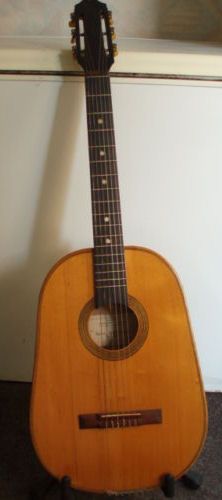
I'm afraid I have virtually zero information to give you about this French pineapple guitar other than it looks to be a nylon strng instrument (although it originally had a trapeze tailpiece which would imply folk guitar rather than classical guitar) and is supposedly pre-war French (2nd World War, I believe).
Its shape echoes that of the pineapple ukulele. I've not seen a pineapple-shaped guitar before, although we have previously looked at an egg-shaped acoustic guitar.
This guitar does require some attention and as such is being auctioned on eBay UK as a project with a starting price of £50.
G L Wilson
Additional: We believe it is a Hawaiian guitar - see the comments below this post.
Being from the 1930s, this Wappennylon string guitar is more than vintage, it's antique! So antique that it was not strung at first with nylon but with gut (ox or cat) like all classical guitars did until the late 1940s - actually when all the gut was used as surgical thread for the wounded of the WWII, urging guitarists to discover nylon that was invented in 1935 and used so far to make fishing thread - a.o.
It's a German guitar, with a quite different design than the more regular models from southern Europe (France, Italy and Spain) that fixed the shape in the 19th century and made it universal. Germany's contribution to guitar design didn't start with electrification!
Our instrument has a long history. Dating all the way back to 1400s when an instrument called the Vihuela flourished in Spain. Vihuela featured six courses of strings - a course being a pair of strings tuned to the same pitch in this case. Much like today's guitars, the tuning was fourths and one third. In today's terms, Vihuela tuning would be E A D F# B E.
Interestingly, vihuela was really a family of instruments: they came in all sizes. There are only three original Vihuelas in existence today, and each is slightly different in scale length and pitch. Some would even be considered bass-like. There was also a four course guitar that flourished in France during the Renaissance.
The Baroque guitar (around 1600-1800) flourished in many European countries. These guitars are as much works of art as they are instruments. They featured extensive ornamentation and inlays.
And elaborate rosettes that filled the sound hole.
Around 1800 guitar builders gradually added a sixth course, and went to single strings. Check out this instrument, a six course guitar built around 1800.
And this one built just a few years later.
Like guitarists today, guitarists in the later 1800s explored guitars with more than six strings. Composer/Guitarist Johann Kaspar Mertz played on a ten-string instrument similar to the modern harp guitar.
Napoleon Coste also added more strings and wrote music for this seven string guitar.
The ten-string guitar is still alive today thanks to the work of Narciso Yepes.
Classical, nylon-strung guitars today, however, are mostly pretty tame. And they're all descendents of the grand-daddy of the modern guitar, Antonio Torres. Torres built guitars in Spain during the late 19th century, and his instruments are the first that we consider modern. The bodies on his instruments were slightly bigger, and the braces on the underside of the top were arranged in a fan.
While electric guitars may feature gorgeous wood on the top, the back and sides of a classical guitar are often the most beautiful. Below is my guitar, built in 2009 by Michael Thames.
Most professional level classical guitars - called "concert guitars" - are custom shop jobs. They are built specifically for one person, and you choose a guitar builder based on the features you want. Some builders specialize is construction methods that are a bit unorthodox or strange. Check out the inside of this "lattice braced" guitar.
The tops on these guitars are extremely thin (you could puncture it with your finger), and that black stuff inside is carbon fiber. Another popular construction method today is a "double top". These guitars have a thin top, then a layer of honey-comb style material called Nomex, then another thin top is glued on the other side. Here builder John H. Dick shows off the inside of his guitar tops (towards the end).
There's a lot out there in the world of classical and nylon-strung guitars, and it's well worth exploring.
Christopher Davis
Guitarz - The Original Guitar Blog - now in its 9th year!
This nylon stringed Aria pro II is serious stuff. Its slim wide telecaster shape has its sound hole on the upper horn, something that Ovation and its followers made quite common now, but the hole is big as required to properly amplify the nylon strings and has a quite elegant shape.
I like how Japanese instrument makers have no complex about innovation also in classical music instruments, where tradition absolutely rules in the West!