Showing posts with label guitar review. Show all posts

Thursday, 20 March 2014

Bass guitar review: The ProBass Retrovibe EVO bass

guitarz.blogspot.com:
ProBass Retrovibe basses are the brainchild of David Konig who gets the basses built in China to his exacting specifications and then sells them to UK and European customers via his website. With no middlemen involved and no distributors or stockists other than Konig himself, he is able to keep these basses extremely competitively priced. In fact, the whole current range consists of basses costing between £249 and £319 plus post and packaging fees.

Retrovibe's debut model was the RV4 (and RV5 five-string model) strongly influenced by Rickenbacker's 4000 series bass guitars and equipped with two MusicMan style humbuckers. At the request of RIC, that particular model has now been discontinued. Its replacement was the Retrovibe Vantage which I can best describe as looking as if it's the offspring of an intimate liasion between a Rickenbacker 4003 and a Fender Jazz Bass. More recently Retrovibe have followed this up with the Zygote which appears to be a more evolved version of the Vantage, and the EVO, which is the bass we are looking at here.

But before I go on, let me backtrack and set the scene a little. I was recently offered some bass playing gigs with a local psychedelically-inclined band called Sendelica, to stand-in for their usual bassist on certain gigs that he's not able to play. Some of you may well have heard of them, being very well known on the psyche, "space rock" and progressive scene and having had recorded with specialist vinyl-only record label Fruits De Mer (which itself has something of a cult following). I didn't hesitate too long before accepting this offer, even though I didn't really have a bass suitable for the gig. I started practising using my Fender Pawn Shop Bass VI but pretty soon decided that for Sendelica's songs I wanted to use a Drop D tuning, and on a short-scale instrument like the Bass VI where the low E string can often be a bit flabby, tuning down to D wasn't going to be an option.

I decided I needed a regular long-scale, 4-string bass, and so spent days scouring the internet for suitable candidates that I thought would be within my budget. I didn't want to go the P-Bass or J-Bass route, not being a particular fan of either of those. I toyed with the idea of a Thunderbird style design, maybe an Epiphone or an ESP, but then I found many reviews criticising such basses as being extremely neck heavy.

Sendelica live at the Zephyr Lounge, Leamington Spa, 7 March 2014. Me on the right on the Retrovibe EVO bass. Photo: Matty Dread
Then something clicked in the back of my mind and I remembered Retrovibe basses, having previously seen the website a year or two ago. I checked the website and liked what I saw of the EVO model. I shot off a quick email to David Konig to enquire about how well the bass handled Drop-D tuning, and he very quickly replied, having tried it out on his own EVO, that it indeed handled the tuning very nicely. I then ordered a bass straight away and it was delivered just two days later.

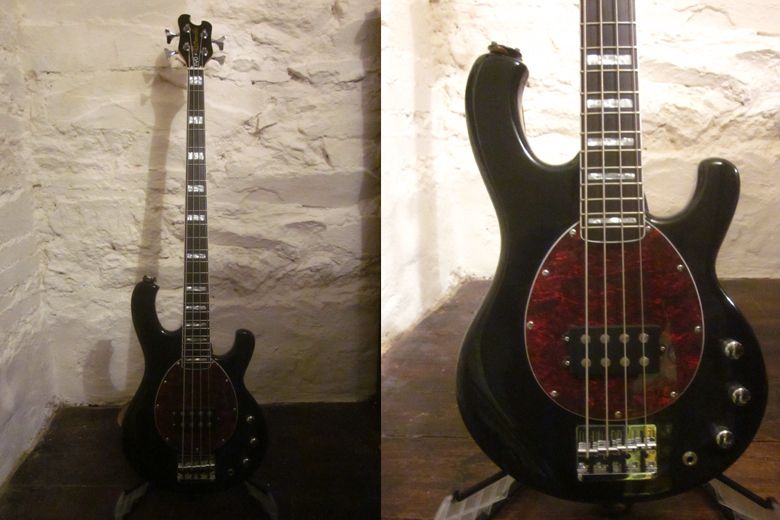
So, enough of my life story for the time being... What's the EVO like? The website tells us that it "draws on many different styles, old and new, to deliver a robust and eye-catching design which sounds as good as it looks", and in the case of the EVO those different styles include Musicman Stingray, Rickenbacker, Fender Jazz Bass, and Warwick. To clarify, it does look a bit like a Musicman Stingray (especially with that ovoid pickguard) but has a more compact body, the horns of which have a touch of Rickenbacker about them; the 24-fret neck is beautifully bound, has pearloid block markers, and  tapers to a narrow Jazz Bass-like 38mm at the nut; the headstock reminds me of those of Warwick basses, but with a little cut-out which makes it almost Rickenbacker-like. It does look to be a really classy instrument.

The body is basswood (as you'd probably expect), the neck is maple and beautifully finished (none of this "satin feel" crap, i.e. unfinished necks you find on so many cheaper guitars) and it has a rosewood fingerboard (plus white binding and block markers as already mentioned). It's a bolt-on neck, attached to the body by no less that six bolts - that neck ain't going to move!

The hardware - bridge, tuners, control knobs - are all very substantial and on this example are finished in chrome. Pickup-wise we have one MM-style humbucker although you may have noticed in the photos there are three controls. This set-up is more versatile than you may think, with two volume controls - one for each coil of the MM-style pickup - and a single tone control. It essentially functions as a two pickup instrument and despite the proximity of the two coils there are a wide range of tones to be dialled in.

I was practising with this bass every day for a month solid (I had a lot of material to learn!), and have since gigged with it and recorded with it. I found that the EVO hangs well upon a strap so that the neck is positioned just where I want it. The neck is a joy to play. As someone more familiar with guitar string spacing, the narrow spacing up at the nut suits me fine, and the large block markers are invaluable for helping me navigate around the fingerboard. The EVO certainly delivers sound-wise; I found it sat very nicely in the live mix along with lead guitar, saxophone, drums, and various samples all doing their thing. The tuning is stable and the bass happily handles my Drop D tuning with no sign of flabbiness on the lower string.

The build quality and finish are excellent. I actually showed my EVO to a luthier whilst I was picking up another guitar he'd been working on. He seemed quite impressed with the quality; he did comment that the action could be even lower but I personally wouldn't want it any lower, it suits me fine as it currently is. If I did have to nitpick, I'd mention that there are a few sharp-ish fret ends that could benefit from a fret dress, however thankfully these are on the bass side rather than the treble side of the fingerboard and so my fingers rarely encounter them. That, and the "EVO" text on the trussrod cover is slightly askew... but THAT really is splitting hairs!
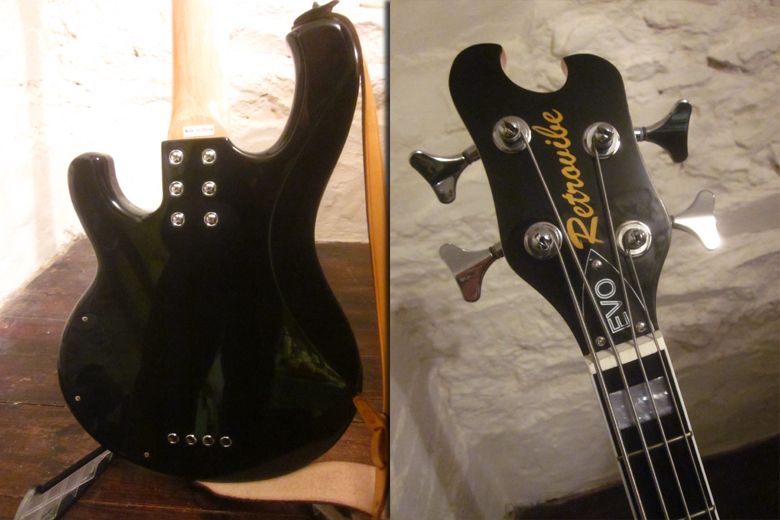
Those minor points aside if there was one slight niggle that I personally have about the EVO it would be that, as someone who is - shall we say - well-built, I sometimes wonder if the compact body shape might make the bass too small for me. But then I remind myself that it DOES hang very nicely on a strap, presenting itself in the perfect playing position. (And remember of course there are much smaller-bodied instruments played by bassists of all shapes and sizes, for instance minimalist Steinbergers and that whole kind of thing.) Another positive is that the EVO would suit players of a smaller stature, younger players, female players, etc. Weight, by the way, is approximately 3.5kg / 7.4lbs.

As you may have gathered I am quite a fan of this bass. I really think I made the right choice. In fact, I am seriously considering buying a second example to keep in regular tuning and as a back-up bass at gigs. (Actually I'd love a fretless EVO if that was ever to become an option).

Retrovibe basses are produced in a number of different finishes, with each being strictly a limited edition. Of the five finishes available on the EVO, there were only eight examples of each produced. Maybe, if the range is successful, there might be further production.

Priced at £249 / £279 / £289 depending on finish options.

Available online only from probass.co.uk
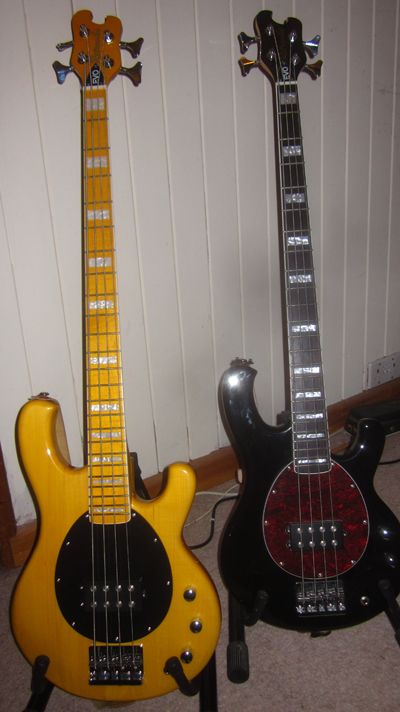
ADDITIONAL (3 April 2014): Just to show that I put my money where my mouth is, I did indeed buy a second Retrovibe EVO (see photo opposite). That's a Transparent Amber finish. Very nice indeed!

G L Wilson

© 2014, Guitarz - The Original Guitar Blog - the blog that goes all the way to 11!
Please read our photo and content policy.

Friday, 26 April 2013

Guitar review: cheap Chinese-made "no-name" unbranded Tele from eBay

guitarz.blogspot.com:
We've all seen these cheap guitars on eBay, often with prices that seem too good to be true. If you're like me you'll have said to yourself that one day you'll buy one and give it a whirl, see if it really is as good as the eBay seller claims (and don't they always claim they are wonderful?).

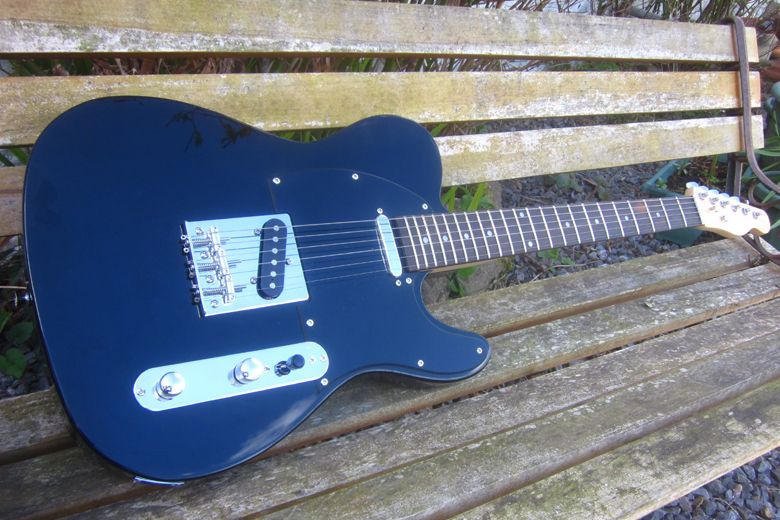
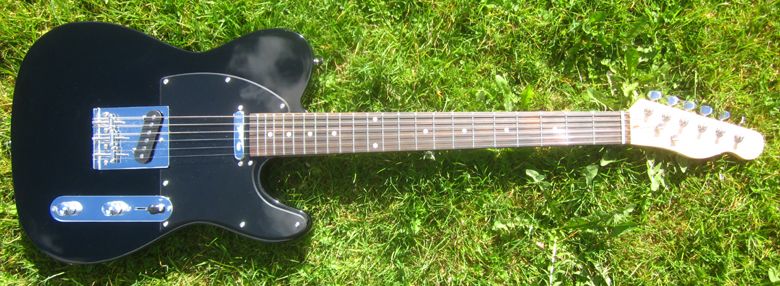
Leo Fender's famous Telecaster design is still as popular as ever after more than 60 years, and is a design that is ripe for copyists. Recently I've noticed several eBay sellers here in the UK who have been importing cheap Telecaster copies in from China and who seemed to be making quite a killing selling them on at sub-£100 prices. Checking the feedback on the sellers' accounts would seem to confirm that these guitars are worth having a look at, so when I saw this black no-name Tele offered at a special knock-down price (i.e. even cheaper than usual from this particular seller), I hit the Buy It Now button straight away.

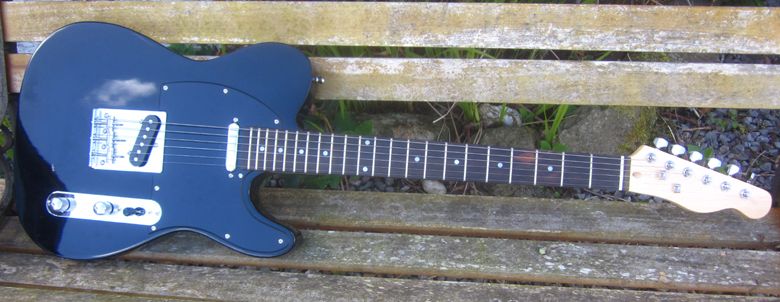
The guitar arrived two days later, which was quite impressive, and removing if from the box, it looked to be a fairly faithful replica of the Fender original. The seller had made claims about the impressive weight of the guitar (apparently with a body made of basswood) and that it could "demolish a house". I must say I didn't quite see eye to eye with him on this particular claim, I think there's a certain amount of advertising BS that we as buyers need to spot and ignore, but the guitar did seem solid enough, nicely put together and finished. It even came complete with a (cheap) guitar cable and a pair of Allen keys, one each for the adjustment of the truss rod and bridge saddles.

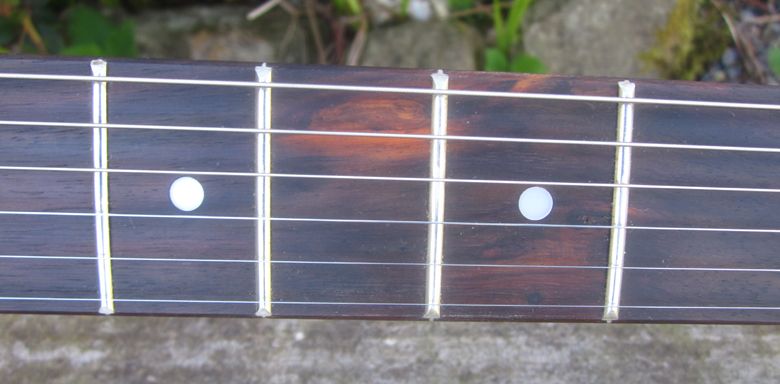
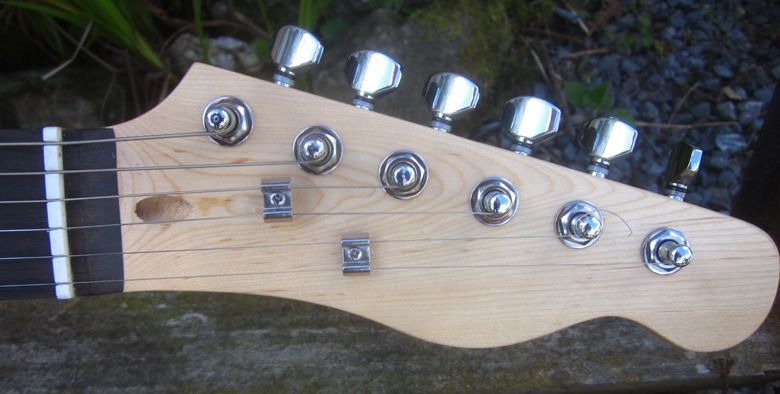
The eBay listing already mentioned that "guitars may have minor assembly marks or imperfections as are a custom made item" and whilst I didn't really follow the logic behind that statement, at least it prepared me for a few minor imperfections, most notably a couple of dents in the top edge of the headstock and also the slightly erratic placement of the dots along the top of the fretboard - they were all at the correct positions, but several were not centred very well and the 12th fret double-dot was decidedly askew. But really, these are very minor quibbles and hardly noticeable. Slightly more noticeable was the discolouration of the rosewood(?) fingerboard at the 4th fret beneath the bass strings. A guitar with a fretboard like this would be consigned as a "second" with many quality guitar manufacturers, but it's only a visual imperfection and not something I could care less about. In fact I think it gives the guitar a little bit of character.

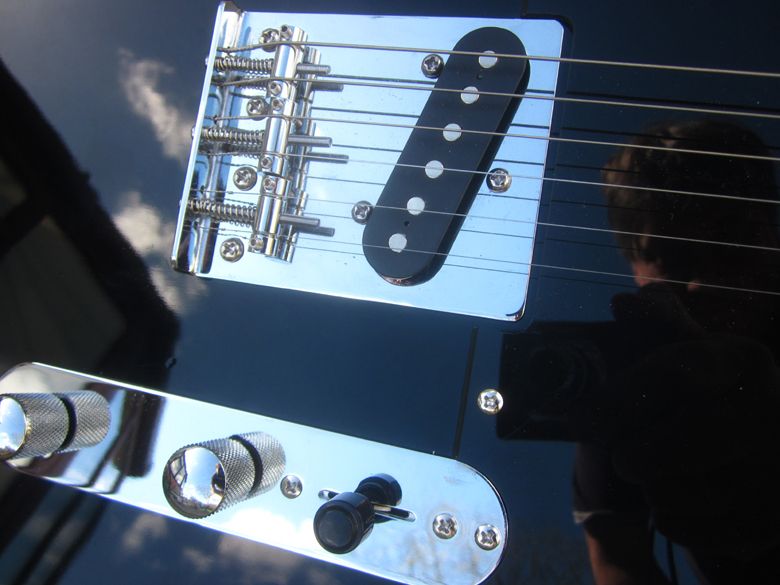
While the bridge is of the three saddle Telecaster variety, it does feature the more modern flat bridge plate rather than the "ashtray" type with an upturned lip on three sides. I must say that I would have preferred the latter as I automatically wanted to rest my right hand against the top side of the bridge but kept ending up gouging my thumb on the threaded inserts protruding from the bridge saddles. It's not really much to worry about and I'm sure I can train myself not to put my hand there.

So far, so good. I'm thinking at this point that the guitar is easily comparable to a Squier-branded Tele, and at a fraction of the price. Even the action and the intonation seem OK; I'm not saying they couldn't be improved upon, but essentially the guitar was ready to go right out of the box. Perhaps it could do with a light fret-dress, a few of the fret ends were slightly rough, but I've known other guitars costing considerably more that far more urgently needed attention in this area.

So, how does it sound plugged in?

Well, it sounds Tele-like, no surprises there. Of course these pickups are not going to be the world's best, but having said that they don't sound bad. If anything they are a little too harsh. I used this guitar at band practice this week and I found I was having to roll off the tone all the time, especially on the bridge pickup (hey, good thing this wasn't a Strat-type guitar!). But yeah, it gives a good Tele twang, and I guess the pickups could always be upgraded if so desired, although a new set of pickups could easily cost more than the guitar itself!

On a less positive note, I noticed considerable hum from the guitar, especially when I removed my hands from the strings. Uh-oh! It's that old problem of a guitar not being properly shielded and/or grounded.

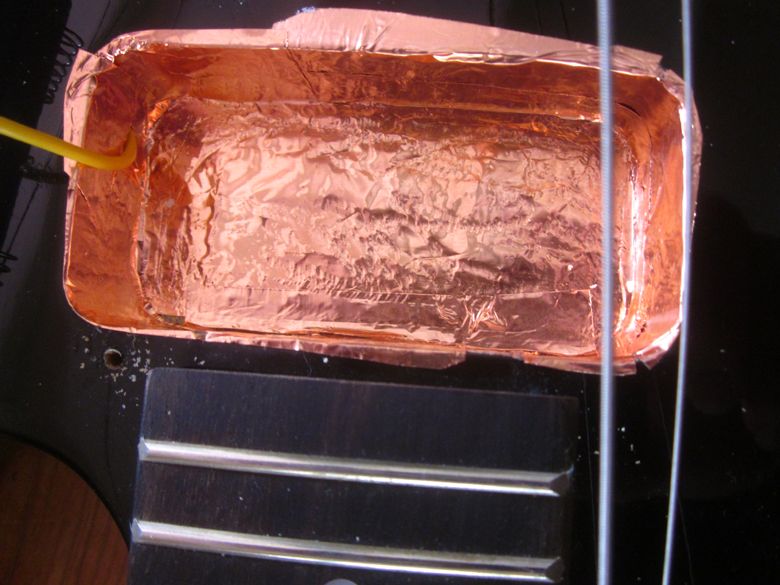
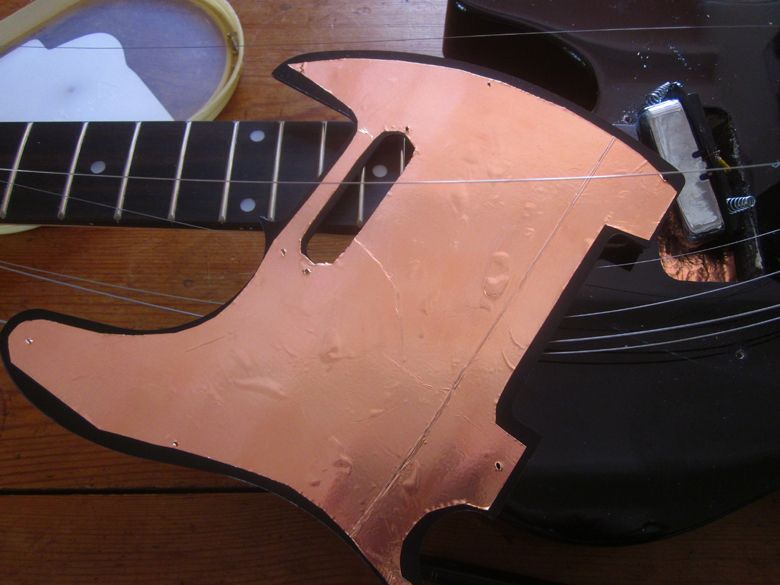
I wasn't going to let this be a problem, and so I bought two sheets of self-adhesive copper foil from another seller on eBay, a very reasonably priced purchase at just over £3 a sheet, and I set about dismantling the guitar and lining the pickup cavities with the foil. Note that the cavity for the neck pickup is large enough to accommodate a humbucker should such an upgrade be required.

I was thinking I'd need to take a wire from the back of the volume pot and ground it to the bridge plate, but I found that (despite the hum) this had already been done. But just to make sure that contact was being made I spread out the individuals strands of wire and then stuck these down in place with another small piece of copper foil. By the way, that copper foil is extremely adhesive and when the backing sheet is peeled away it has a tendency to curl up and stick to itself. I found it easiest to cut and stick very small sections at a time. It was also tricky getting into the pickup cavities seeing as the pickups and controls were still all wired up together, but I really didn't want to completely disassemble the guitar, and de-solder the pickups, etc. That prospect seemed like too much work. This also meant that I had unscrewed components resting on the top of the guitar, and I did manage to make a few small dents between the bridge and the control plate - I'm not too worried about that, you could say I'd begun to "relic" the guitar. (Actually, I think a guitar with this finish would look better "worn-in", but I'm not about to take sandpaper to it, or to knock it about with screwdrivers or whatever. A few natural knocks I am not going to worry about).

I also decided to shield the reverse of the pickguard; perhaps I didn't need to do as much as that considering it's mostly the timber of the guitar beneath the plate other than the neck pickup rout, but I'm sure it can't harm. This would be a better move on a Strat-type guitar where the plate is covering three pickups. And of course, I shielded the inside of the control cavity, but I forgot to take a photo of this stage.

Plugging it in now, it's silent when you want it to be! I'm so pleased that my DIY shielding job, although not the prettiest, worked. And so what if it wasn't the neatest job, you can't see it now the guitar is re-assembled.

So... my cheap no-name eBay Tele... A good buy?

Definitely! I am really pleased with this guitar, and I'm sure it'll prove to be a very useful addition to my small arsenal of guitars. I would recommend these guitars to anyone wanting a cheap T-type, with the only proviso that you need to be prepared to do some tweaking. In my case it was shielding the guitar, but some might have other set-up issues.

As for the blank headstock, I would NEVER put a Fender logo on there. That would just be a lie, whereas I'm happy to tell anyone that this is just a cheap eBay guitar.

G L Wilson

© 2013, Guitarz - The Original Guitar Blog - the blog that goes all the way to 11!
Please read our photo and content policy.
Wednesday, 27 March 2013

Guitar review: Fender Pawn Shop Series Bass VI

guitarz.blogspot.com:
Fender's Pawn Shop series are - in their own words - "guitars that never were but should have been". The concept seems to be that these designs are influenced by weird old modified guitars that you might find in a pawn shop. Hence we see different pickup combinations and trem systems and variations on design that you wouldn't expect to see on stock Fender guitars. In some cases, the Fender Pawn Shop guitars go beyond such minor modifications and we see alterations to actual body designs, e.g. the Mustang Special has a re-designed chunkier body shape, the '72 is essentially a Thinline Strat, and the Offset Special is reminiscent of a Thinline Strat with an offset waist and equipped with a Jaguar/Jazzmaster tremolo.

The model that I was really interested in, however, was the Fender Pawn Shop Bass VI. I've been hankering after a Bass VI for years. I used to have a Hohner Hollywood (so-called) Bass VI but its 25.5" scale length meant that you couldn't really tune it down a full octave below a regular guitar, and so I had to make do with it being tuned down to G. That's still a whole lot lower than most baritone guitars which are often tuned to B or C - or A if you're lucky, but it still wasn't "bass" enough and that always really bugged me.

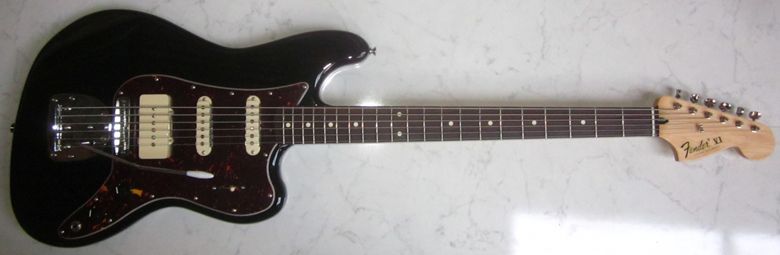
The Pawn Shop Bass VI, like the original, has a 30" scale and so has no such problems with being tuned to E. It differs from the original Fender Bass VI in a number of minor details: most notably it has a JZHB pickup in the bridge position - this does look a lot like a large P90 pickup but my understanding is that it is a double coil version of the Jazzmaster pickup. In the neck and middle positions are a pair of Jaguar pickups. These are all controlled by a Strat-like 5-way switch. It's a disappointment that Fender didn't use the individual pickup on/off switches plus "strangle" switch on a chrome plate as on the classic Bass VI. This doesn't seem so much like a quirky modification, rather a brazen cost-cutting exercise, which is a pity because I think Fender missed a trick here.

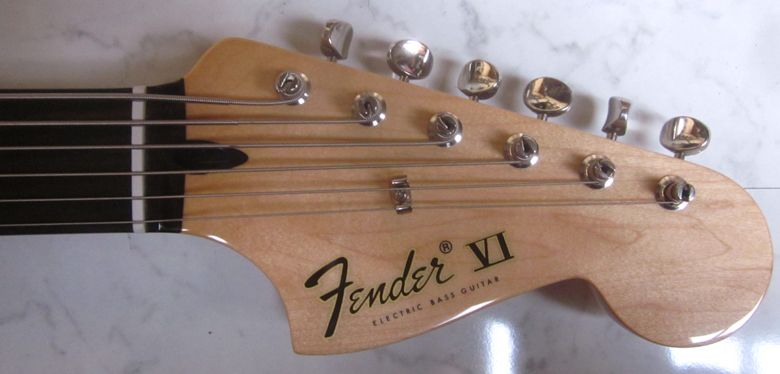
There's another chrome plate missing beneath the volume and tone controls and output jack. Here on the Pawn Shop Bass VI the pickguard has been extended to include this area. Other than that, it's a pretty faithful reproduction of the original. The neck is unbound, but then not all the "originals" had bound necks anyway. Interestingly the headstock bears the legend "Fender VI" (as used on the very first Bass VIs rather than the later "Fender Bass VI") with "Electric Bass Guitar" in smaller lettering beneath.

Part of the reason that I wanted a Bass VI was so as to encourage me to play more melodic parts and lead lines, as so often in a band situation I find myself ending up playing rhythm guitar which - although I am happy to do - I want my share of the limelight too. I also have an album to record and I was looking for new "voices" to use in my music, and decided that a Bass VI could be the very thing.

So, how does it play and sound? Well, the first thing that struck me was that it packs a punch as a bass. Some uninformed people insist on calling the Fender Bass VI a "baritone guitar". Believe me, it is nothing of the sort; indeed I'd go so far as to say that to call it a baritone guitar is an insult. It's as much of a bass as a Fender Precision or a Jazz Bass. Other people say that it's a "bass for guitarists", but I don't think this is so much of an insult - there's a lot of truth in the statement. It has six strings, it is tuned like a guitar only an octave lower, and the string spacing is like that of a guitar. It even has a tremolo (but I'll talk about that some more later). A bassist friend of mine tried out the Fender Bass VI and commented, "I'm not sure how I'm supposed to play it. Do I play it as a bass or as a guitar?"

For the most part I do play it like a guitar, although I expect I'll end up using it for bass lines too. The one thing that took a little getting used to was the extra stretch on a 30" scale. It didn't feel too bad, but when I changed back to playing a regular scale guitar again, that felt really awkward. However, having been changing back and forth between guitar and Bass VI for a month now I have gotten used to the differences in scale length.

It is possible to play guitar chords, but open chords can sound muddy; you wouldn't really want to strum on a Bass VI, but careful arpeggiation of chords can be quite effective. Barre chords are possible too - they sound better the higher up the neck you travel. I've even played the Bass VI using a capo on certain songs so as to put me into baritone guitar range - that has proven to be quite effective.

Initially I was underwhelmed by the JZHB pickup in the bridge position. My initial reaction was that Fender had put it there just for the sake of making it different so as to justify the "Pawn Shop" label. However, I was initially using my guitar amp but after a band performance during which the poor amp struggled, I got myself a most excellent bass amp from Roland's Cube series which complements the Bass VI beautifully. Prior to that I only ever used the bridge JZHB pickup in conjunction with the middle Jaguar pickup through the guitar amp because I thought that on its own it sounded thin and weedy, I have since found that through a proper bass amp it gives me a really usable treble sound that cuts through nicely when playing in a band situation that includes another bass player.

When playing with another bass player, I've been very conscious that I need to dial in a different bass sound so that we don't clash or else end up in one big bassy muddle. Using the JZHB pickup helps cut through, but also choice of effects helps too - and thankfully my Roland Bass Cube has a whole load on-board.

The Bass VI is an instrument crying out to be played with a chorus effect. It really does bring the sound to life. I've also found it best to scoop the middle out on the EQ on the amp, but obviously one can experiment and find out what works best for them.

I love also the sound of the Jaguar pickups, although I think perhaps I would use them more when recording rather than when in a live situation when I want my sound to be distinct from that of the (4-string) bass player in the band.

Now the tremolo... it's the same kind of Fender trem as featured on their Jaguar and Jazzmaster guitars. That, for me, should be a good thing as I've never got on with Strat-style tremolos. However, with this particular instrument I cannot get the trem arm to snap into place. I really don't want to force it into position and possibly break something. I've tried asking Fender in the UK what I might be doing wrong and so far have not received any response. I did wonder if the shop may have given me the wrong arm, but seeing as it was a shop specialising in bass guitars that is rather unlikely (the only other Bass VI they had was the Eastwood Sidejack and I remember that had its trem arm installed - also that's another Fender Jaguar/Jazzmaster type system). [EDIT - 16 April 2013: Today I received a parcel from Fender containing a threaded tremolo arm for Bass VI. It fits and operates percectly. Yes, it does seem that the shop gave me the wrong arm in the first place. A big "thank you" to Michael at Fender Customer Relations for sorting this out for me.]

I've seen the opinion expressed elsewhere thay the tremolo on the Bass VI is no great shakes anyway and is more of a gimmick than a usable trem, but I would like the opportunity to find out for myself. (Earlier I mentioned the Hohner Bass VI I used to own. That had a Wilkinson trem that was very effective in use).

Having seen comments on forums such as offsetguitars.com it seems that some people are buying these Pawn Shop Bass VIs and modifying them to look and function like the originals, which is an irony seeing as the whole point of the Pawn Shop series was to present ready "modified" guitars. I think Fender should have done a straight reissue of the Bass VI rather than a Pawn Shop version. A little bit of chrome shouldn't hike the price up very much.

I know it sounds like I have a few niggles with the Fender Pawn Shop Bass VI, but despite the unnecessary Pawn Shop accoutrements, despite the mix-up with the trem on my example, I do love my Bass VI dearly. I feel as if it might be the perfect instrument for me and can honestly say I haven't been as excited about a guitar purchase as much since I bought my first ever Fender Stratocaster circa 1987.

The Bass VI is a Made in Mexico Fender, which is something a few years back might have caused some to view it with concern, but Fender Mexico have really got their act together now and this is a quality-made and beautifully-finished instrument. Retails in the UK at prices between £601 and £755 so shop around. Colours are black with tortoiseshell pickguard (i.e. mine), sunburst with tortoiseshell pickguard, and candy apple red with matching headstock and white pickguard.

Just DON'T call it a baritone guitar, OK?

G L Wilson

© 2013, Guitarz - The Original Guitar Blog - the blog that goes all the way to 11!
Please read our photo and content policy.
Saturday, 8 December 2012

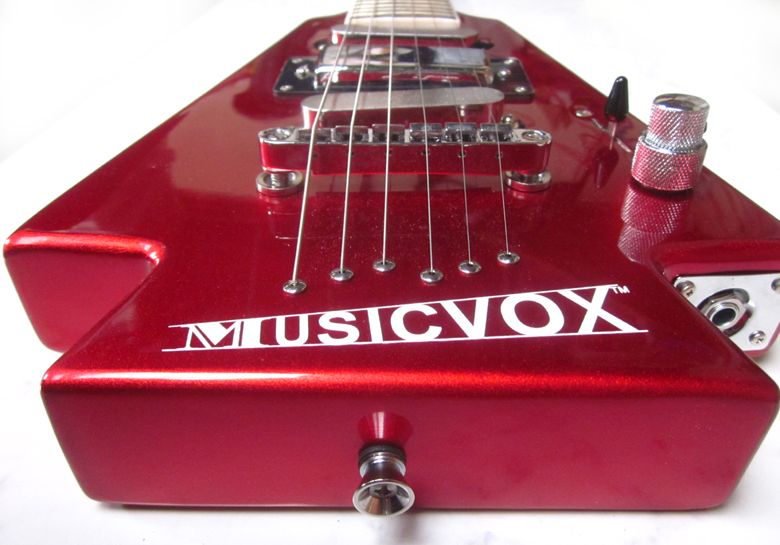
Guitar Review: The Musicvox Space-inator - small-bodied, spear-like and with a really useful pickup layout

guitarz.blogspot.com:
Here at Guitarz we really admire people like Matt Eichen, a vintage guitar enthusiast who loves retro instruments so much that back in 1997 he decided to start his own line of retro-inspired guitars. He wasn't content to merely create another range of Fender or Gibson knock-offs, he wanted to create something quirkily different as a homage to the past but with modern playability and production quality.

And so Musicvox was born, and their first model - the Space Ranger - was quite a head turner - classic singlecut guitar and bass models but with an unfeasibly large lower horn and a very eccentrically-shaped headstock. These weren't guitars for just anybody, certainly not for the hordes of conservative-minded guitarists who can only think in terms of Strat, Tele, Les Paul, SG. With a Musicvox guitar you needed to be in the Matt Eichen mindset; you either "got it" or you didn't.

Finding it difficult to find a distributor for these "wackily"-designed guitars, Musicvox began selling their guitars directly to the public via the internet, and indeed were one of the first guitar brands to do so. Of course this is common practice nowadays.

Musicvox followed the Space Ranger with the Space Cadet - a similar design but with the eccentricities toned down - and models included the Space Cadet 12-string bass which was not only one of the more competitively priced 12-string basses on the market but also highlighted Musicvox's agenda to create instruments that challenged the norm.

In 2002 a pair of Musicvox Space Ranger guitars were featured in Goldmember, the 3rd instalment of the Austin Powers movie series, which exposure should have proved beneficial to Musicvox sales, but soon after for personal family reasons Eichen was forced to wind down the company.

Fast forward best part of a decade, and Eichen - buoyed up by the fact that he noticed that there were still a lot of people out there talking about Musicvox guitars and a continued interest on the internet - decided to re-launch the brand.

Of course the models that got everyone talking in the first place - the Space Ranger and the Space Cadet - were back and were accompanied by some new designs - the MI5 guitar, bass and 12-string guitar, and the spear-like Space-inator guitar and bass (the prototype was named the Strataspear but a certain other company took umbrage and issued a court injunction against the use of the name).

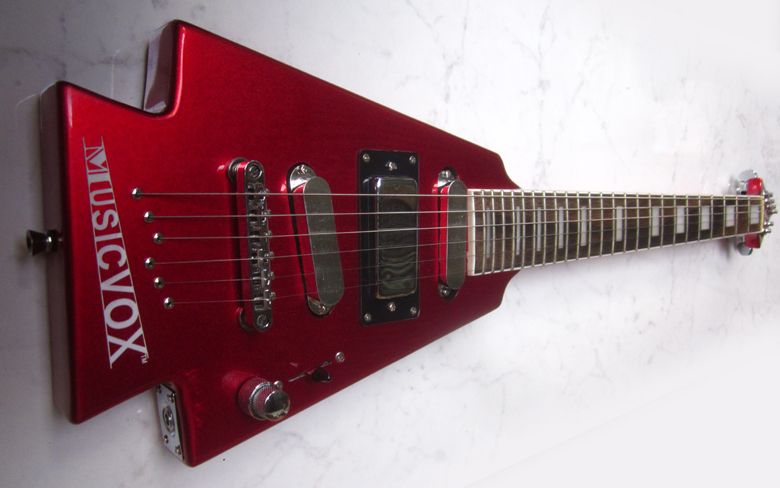
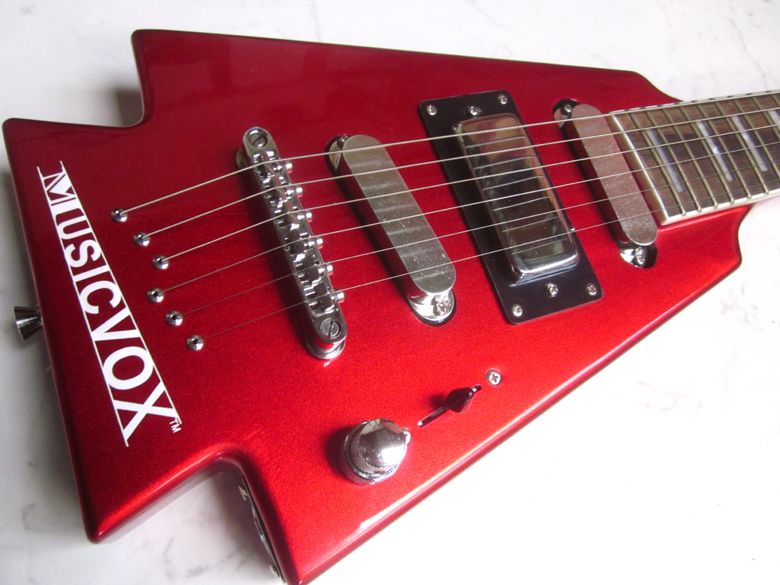
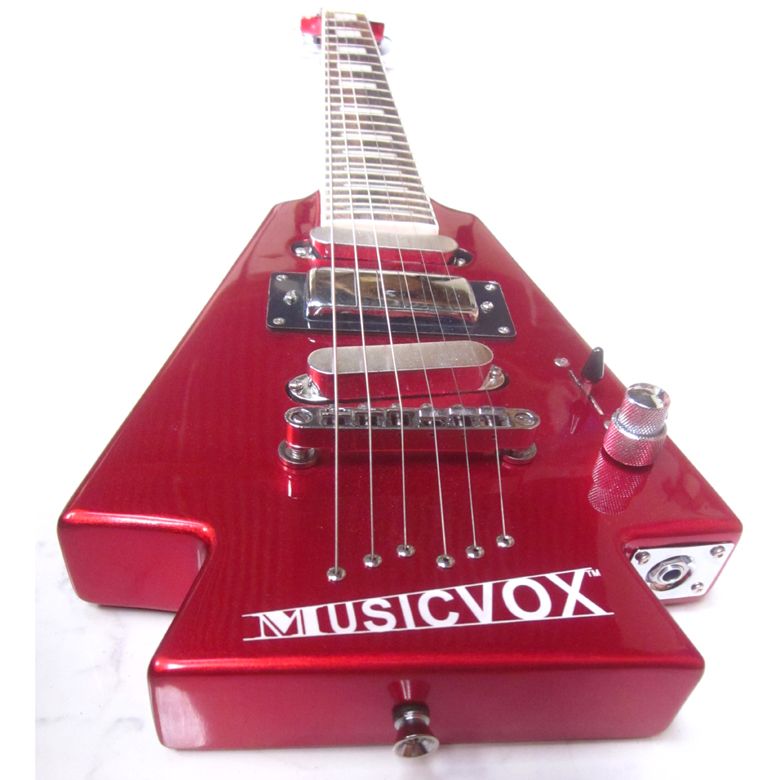
Matt very kindly sent a Space-inator all the way to deepest darkest Pembrokeshire in Wales, UK for Guitarz to review. This particular example is finished in a flawless candy apple red. Other colours I have seen pictured are gold flake, silver flake, and taxi cab yellow - all are extremely eye-catching. Upon taking the guitar out of the box I was immediately struck by the sheer quality of the finish. With the metallic candy apple red I could almost have believed that the Space-inator was made completely of metal. I was also very impressed that it emerged from the box more or less in tune after its Atlantic Ocean crossing; just two strings were slightly flat and needed tweaking.

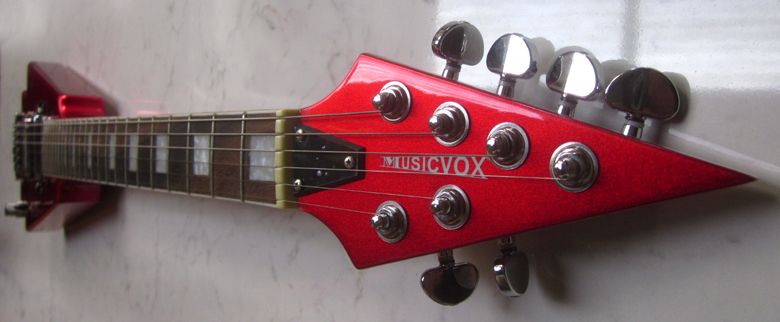
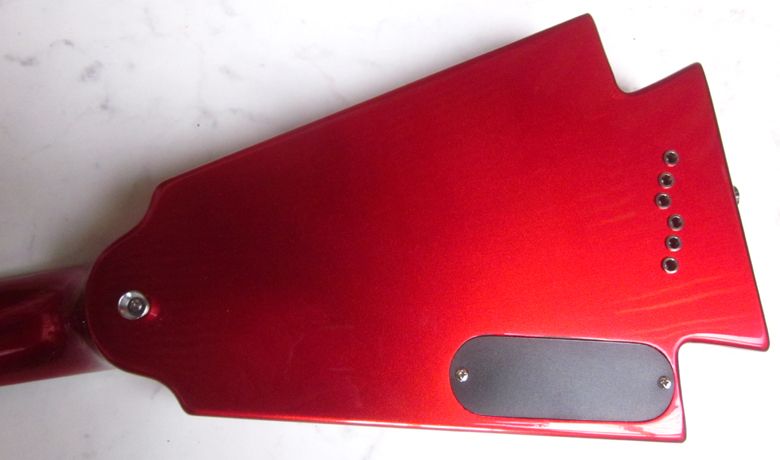
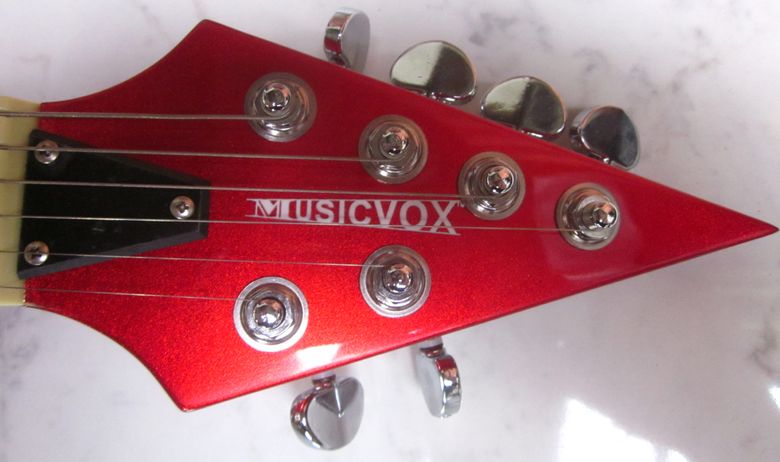
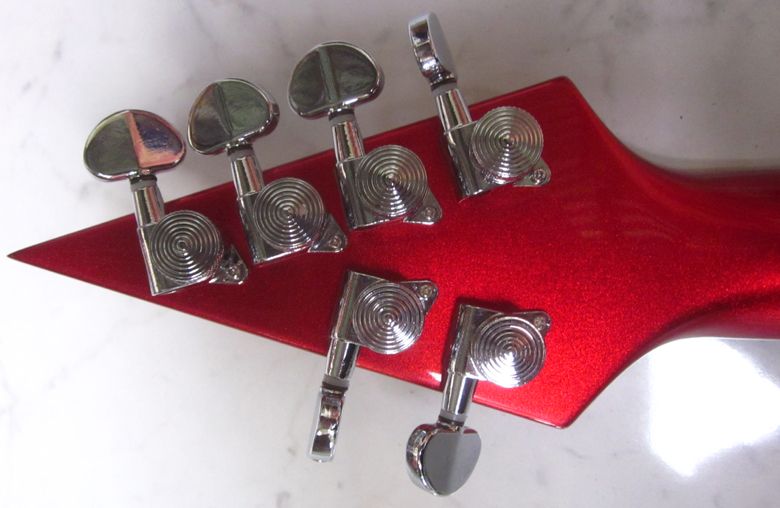
So, let's take a closer look at what we've got here. The Space-inator is a small-bodied guitar weighing in at just over 4 pounds. It has an angular, arrow-shaped body not unlike a more flared-Steinberger shape, and also perhaps vaguely reminiscent of the Burns Flyte, whilst a friend who I showed it to commented that it looked like a "sawn-off Flying V". The headstock is a compact very pointy spear-shaped affair with locking tuners arranged in a 4+2 formation a la Musicman and certain vintage Teisco guitars. This isn't merely a whim of aesthetics; if you look at the back of this very compact headstock you'll see that there would have been no room to facilitate having the G and D string tuners opposite one another in a 3+3 layout.

The neck of the Space-inator has a bound rosewood fingerboard and carries 24 jumbo frets and block pearloid position markers. Of course, because of the minimal body shape, there is no difficulty whatsoever in reaching the highest frets at the body end of the fingerboard. The scale length is 25.5", and the heel of the neck blends smoothly into the underside of the guitar body. The Space-inator is in fact of neck-through construction. That and the through-body stringing behind the Tune-o-matic style bridge ensure that the Space-inator gives plenty of sustain, something which may have so easily have been compromised on such a small bodied guitar.

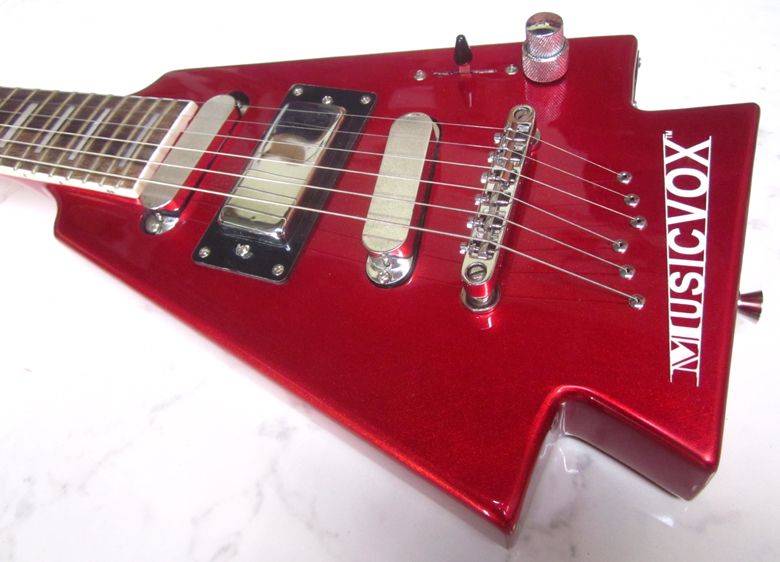
It would have been so easy for Musicvox to unimaginatively equip this guitar with a pair of humbuckers or else three Strat-style single coil pickups, but instead they have chosen to do something much more interestingly versatile. What we have here are three pickups controlled via a 5-way switch, with two low-noise single coils in the neck and bridge positions and a mini-humbucker in the middle position. I have previously commented on this blog about the usefulness of such a rarely-seen layout after having played a friend's Aria "Dragon Strat" which had a stacked humbucker in the middle position. What it means is that you can get the classic single coil sounds in the neck and bridge positions, but you can beef up both of these in the inbetween positions, and of course get a full-throttle humbucker in the middle position. I find that it's a lot more useful say than a SSH pickup layout where you can only use the humbucker in conjunction with one of the other single coils (unless it has individual pickup switching). Note also that the bridge pickup on the Space-inator is angled in the opposite direction to that on a Strat. I found it wasn't as bright sounding as the bridge pickup on a (typical) Strat, but then this guitar is its own animal - if you want Strat tones that badly then use a Strat! I must confess that my favourite pickup selections were the middle three, i.e. all of those utilising the humbucker, but then that's just me.

As for controls, we have the aforementioned 5-way pickup selector switch and a volume and tone on a single concentric stacked pot - very nice and simple to use, maybe too simple for some who like separate controls for each pickup; for myself I'd be happy to sacrifice the tone control altogether and just have a single volume.

In use, the Space-inator does take a little bit of getting used to at first, mainly because of the way it hangs on a strap and because of that and its shape the 24-fret neck does seem to be extremely long - it feels a little like suddenly having a bass neck to contend with. Playing some solos I'd previously been playing on my trusty Aria TA-30 semi I did find I was going to the wrong frets quite often. But of course none of this is the guitar's fault; it's just the learning experience that goes along with anything that is new to you.

I had worried that the minimalistic body would not provide any forearm support for my right arm when playing, but in fact it's very easy to rest your right wrist against the "notch" formed by the shape at the rear of the body and I experienced no arm fatigue whatsoever, unlike that I have experienced playing other small-bodied guitars.

One thing I should mention is that the Space-inator is neck heavy (or "body light", as Bertram put it). Unfortunately this is just about unavoidable on a small bodied guitar such as this, and Musicvox have done all they could to design a compact headstock. Sure, they could have made it headless, but that would likely have limited its appeal to many, and I don't think design-wise it'd have done the Space-inator any favours. But it's not necessarily a problem; it's just something that you need to know about and compensate for when playing. I mentioned resting the right wrist against the rear of the body when playing; this also helps keep the instrument balanced, and 99% of the time your left-hand is holding the neck anyway so that ought to keep it pointing the right way. But I do think it is essential that the Space-inator owner uses some form of strap locking device, just in case the guitar takes a neck-wise tumble. I use the cheap plastic variety that only cost 50 pence each or thereabouts - they are cheap but they do the job well; you don't necessarily have to go to the expense of getting specialist strap locks installed.

Whilst the Space Ranger and Space Cadets will appeal to psychedelic rockers, retro-themed bands, possibly a few krautrockers, rock'n'rollers and rockabillies, the Space-inator is probably the one Musicvox guitar that might appeal to those from the shredding fraternity as it excels at fast lead playing, playing right up at the top of the 24-fret neck, and thanks to that mini-humbucker it has the necessary tones required.

I can also see a use for it in the studio, as not only is it a professional quality instrument with a wide tonal palette, but also the compact body size make it perfect for those times when you have a guitar strapped on at the ready whilst behind a recording console or computer. You could also use it as a travel guitar, although its full scale length and the presence of a headstock mean that it's a lot longer than some.

The Space-inator is available directly from the Musicvox website, but also keep following Musicvox on Facebook where special offers are occasionally announced.

More photos follow:

Note: photos are by G L Wilson, but please feel free to copy and reproduce - although a credit to Guitarz would be appreciated - thanks!

G L Wilson

© 2012, Guitarz - The Original Guitar Blog - 10 years and counting!

Tuesday, 19 April 2011

Fender Cyclone review and demo

guitarz.blogspot.com:
Following on from Bertram's piece on the Fender Cyclone II a few days ago, Guitarz reader Ben Albey has sent us this review of a Fender Cyclone 2-pickup model plus a video demo. Nice one! Over to Ben:

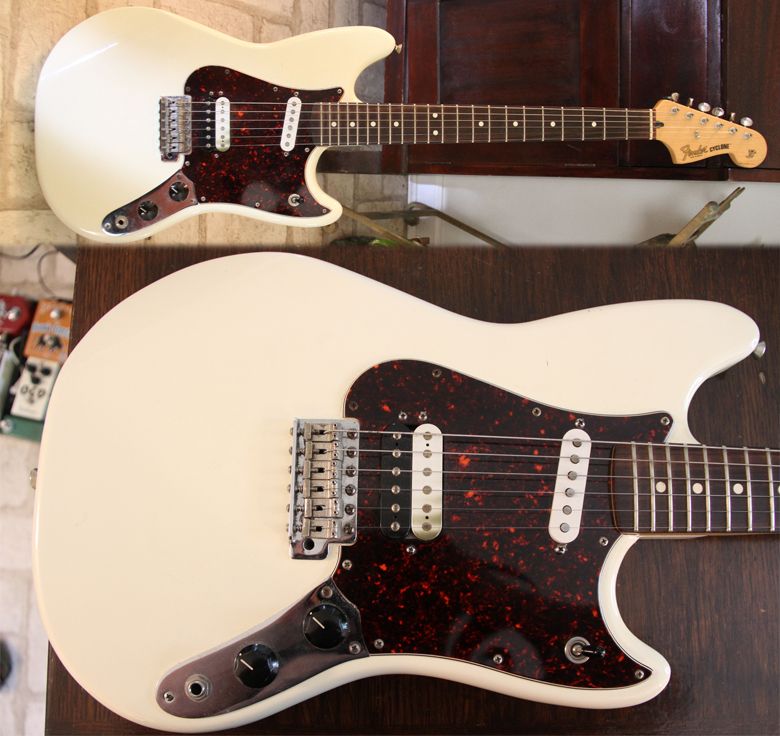
This is my brother in-law's 2001 Mexican made Fender Cyclone. Everything is original except one of the tuners which was replaced by a Grover, then replaced by me with an extra Fender one I had left over from my Nashville Tele when I put Sperzel tuners on. It has the original Atomic humbucker in the bridge, and Tex Mex single coil in the neck, which is really sweet because it has an angle on it that you don't see on many fender neck pickups. It's white, which by now is cream, which is a hard color to find on these Fender Cyclones, a guitar that is already hard to find.

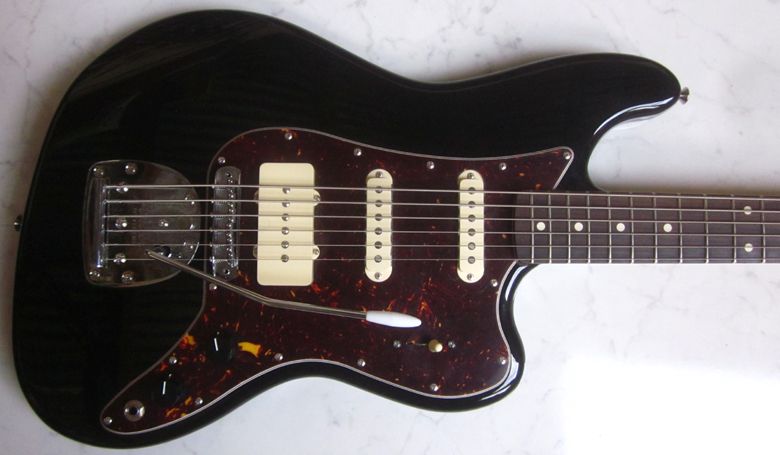
This year of Cyclones came in Candy apple red, black, white, and vintage sunburst. I saw a black one at a music store in Tennessee when I was on my honeymoon for $300; my wife said I could get it, but we were newlyweds and hard up for cash, so I didn't buy it, and I've been kicking myself ever since. It has a Strat tremolo bridge on it, and a 24.75" scale neck. This is a strange scale for a Fender, a scale that is on Gibson Les Pauls. The guitar also features a maple neck, rosewood fretboard, tortoise shell pickguard and a Jaguar-like control plate and a three way toggle like on a Jazzmaster.

The only draw back for me is that the body is made out of poplar, which is why if you find this era of Cyclone you can probably get it for around $300-$600. Poplar is a good enough wood, and a lot of players have poplar bodies; personally I like ash and alder. Over all this is a great, fun, and comfortable guitar. If I ever find another one, I will buy it on the spot.

Ben Albey


© 2011, Guitarz - The Original Guitar Blog - now in its 10th year!

LinkWithin

Related Posts with Thumbnails

ShareThis