Showing posts with label reissue. Show all posts

Thursday, 9 April 2015

Aria Retro Classics 1532J - A tasty Re-issue of one of their 1960s Guitars

guitarz.blogspot.com:


You just have to love Aria guitars. Even if you don't love them, you have to respect them for not having many boundaries.

They are a lot like that friend you had in your early 20s who was up to do anything on any given night out. Sometimes because of them you had the best night of your life, other times you barely escaped with your freedom.

Even if you look at the diversity in the Aria guitars on this blog you see that they are up for anything.

I love the look of this Retro 1532J. It caught my eye as I thought it was a mint condition vintage guitar. But as it turns out, this is a reissue that they introduced in 2010. The shape is clearly to emulate the Jazzmaster or Jaguar, but it has a more pawnshop aesthetic.

Currently Listed on eBay with a price of $320US

Must fight the urge to click "Buy It Now" button..........

R.W. Haller


© 2015, Guitarz - The Original Guitar Blog - the blog that goes all the way to 11!
Please read our photo and content policy.

Wednesday, 31 October 2012

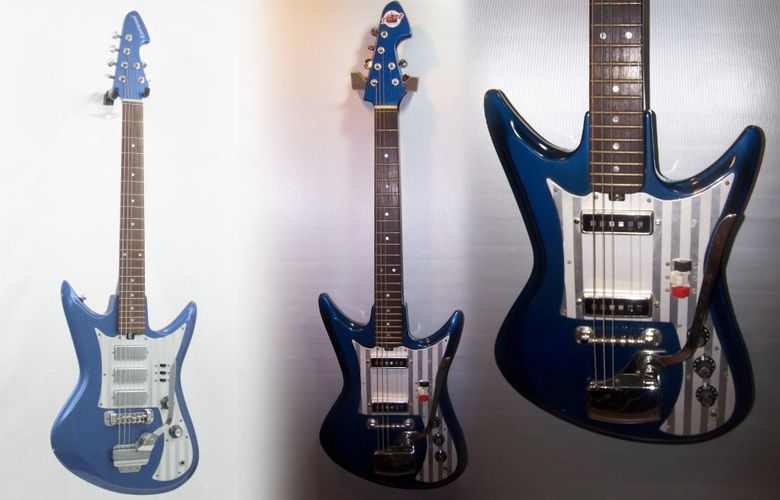
Teisco Del Ray ET-230 vs Eastwood K-65 reissue - but which is better?

guitarz.blogspot.com:
Currently listed on eBay are this Eastwood K-65 (left above), a now discontinued model based on a classic 1960s Japanese Teisco guitar and with a Buy It Now price of $499.95, and also this - the guitar the Eastwood was based on - an original two-pickup Teisco ET-230 (above centre and right) with a Buy It Now price of $325. Some would argue that the more modern Eastwood reissue would be a better player, but wouldn't the original Teisco be much cooler?

Which one would you choose?

G L Wilson

© 2012, Guitarz - The Original Guitar Blog - 10 years and counting!

Thursday, 30 August 2012

2010 Burns Bison 62 Reissue


You have to admit that the Burns Bison 62 is one of the coolest guitars ever - it is on the top on my guitars-I-need-to have-and-play-on-stage-before-I-die list! Like many pioneering guitars of its time, its design proved timeless, however slightly eccentric - and since I have no idea of who the Shadows are and don't want to know, it has no 'surf' connotations to me - and probably most people.

And it's not only the looks, its tri-sonic pickups sounds perfect - and I'm a humbucker kind of guy -, I particularly enjoy the tone selector that makes more sense than tone pots - one switch and you have exactly what you need... I like how some historical brands resurrected and reissued their great guitars of the golden age (see also what Eko has in stock), though some are still missing!

Bertram D

© 2012, Guitarz - The Original Guitar Blog - now in its 10th year!

Sunday, 13 November 2011

2010 Kay Thin Twin Reissue and other stuff

A certain taste for vintage guitars that may transpire in my posts on Guitarz is in no way a nostalgia for a lost golden age, nor a cult of the origins (who could seriously believe that by some miracle the (almost) first three solid body electric guitar models ever conceived and produced in the 1950s by different companies are perfect and unsurpassed since?) It's just that at some point there've been a global explosion of creativity in guitar making following the invention of the instrument and of the music that fit with it, and there is a lot to learn from it.

You had the same happening in the 1910s, within a few years art and history changed radically due to creative emulation of artists all over the world, and one century later people are still trying to digest, explore and expand the potential of the historical avant-gardes: cubism, futurism, constructivism, dada, fauvism, neoplasticism, etc... Same in music with the 1960s British invasion or the late 1980s rise of electronic music.

And something happens in every domain and all the time, you have people who create things, and then you have people who bank on them - these things require different skills and spirits, so it's rarely the same people. You have also times for creativity and then you have times for making money - we're living such times when it comes to guitars... Imagine that in computers: people would buy huge slow square grey IBM PCs because they're so cool, and that's how Don Estridge invented them back in the day!

Anyway, let's go back to vintage guitars: there are roughly four things you can do with vintage guitars: you can preciously collect old instruments, hoping to get one in mint condition but a beaten one is also cool, and worship them while they gain more value year after year and end up keeping them in a safe. You can copy classic models again and again because, you know, that's the way Leo and Les did them and there's nothing more to do - and it sales -, and saturate the market until people cannot even imagine anymore that there are other guitars out there. You can re-issue vintage creative models so you can benefit from the vintage trend while diversifying and rejuvenating the offer, and as wrote 18th century French poet Antoine Houdard de la Motte: "l'ennui naquit un jour de l'uniformité (boredom was born from uniformity)" (now find other guitar blogs quoting 18th century French poets!). Or you can study the great guitars from the past, get inspired by their audacity with the distance given by time, and create the guitars of the 21st century!

The re-issue is a good starting point, and it's happening more and more since Eastwood started the trend in 2001. Now you can find Eko's lovely guitars new and functional, and reissued 1952 Kay Thin Twins.  This is not the original Kay company that provided so many budget guitars to American players between the 1930s and the 1970s (remember that Kay claimed to have produced the first electric guitars, using pickups several years before Gibson - historians must work on that!), but it's not like we're talking about high-end handmade guitars made by master luthiers in an hidden Shaolin temple. The Thin Twin got its name from its thin blade pickups sticking right out of its hollow-body. It's the kind of instrument on which blues became rock'n'roll out of the spot-lights...

Bertram

© 2011, Guitarz - The Original Guitar Blog - now in its 10th year!

Friday, 14 October 2011

Amazing Eko 295 - 1960s original and 2000s reissue


I was making some research on Eko for my previous post, and thought I would check the new Eko website, and I figured out that they discreetly but steadily reissue all their vintage models - without big announcement in guitar magazine and reviews on professional guitar blogs... 

I discovered this crazy guitar, the 295, a so far extremely rare semi-hollow version of the classic Eko 700 model - a dream guitar for all those bored with the classic designs. The reissue model differs from the original, mostly with its humbuckers that are much likely an improvement, and the stop-tail replacing the cool but probably unsteady tremolo.

Strangely the eccentric sound-holes have been modified, and not for the better, and the rotary switch is now a standard one - guitar makers, please reintroduce rotary switches, they are so much cooler and practical (I actually look for a 5 positions one for my next guitar project, anybody knows where to get one?)

You have like usually the best article about Eko 295 on fetishguitars.com and the vintage photos come from guitarage.nl, another good resource for alternative guitar lovers - and you can find the contemporary version on ekoguitars.it. For me I still favor the Eko Kadett 67, it's on my list of must-have guitars, and I'm happy to now have the chance to get a contemporary version of it, for a guitar is meant to be played and I wouldn't be comfortable with a museum piece (and I also think, contrarily to common belief, that most nowadays guitars are better that they used to be).

Bertram

© 2011, Guitarz - The Original Guitar Blog - now in its 10th year!

Thursday, 8 September 2011

1979 Gibson ES-175CC Charlie Christian with rail pickup


Always had a soft spot for hollow body archtops with florentine cutaway (not the budget though), and you cannot do better than the Gibson ES-175 (well yes actually, you could do better by avoiding sunburst finish), but watching at this 1979 Charlie Christian model, I realize that I've always associated rail pickups with loud guitars exclusively aimed at 1990s metal - and almost always see them doubled in humbuckers (or even quadrupled in double humbuckers). 

So I wasn't aware that this elegant one rail pickup in hexagonal art deco casing to which bebop/pre-cool jazz guitar player Charlie Christian gave his name is actually one of the first modern pickups, introduced in 1936 and replacing the previous horseshoe magnet pickup created by Rickenbacker. It equipped the first ES (Electric Spanish) Gibson model - the ES-150 - and allowed Christian to more or less invent guitar soloing due to its louder output. Replaced by subtler six poles pickups, it was reintroduced in 1978 for this ES-175 that is not a signature model of course since Christian passed in 1942, but a tribute.

You will find more information on Charlie Christian pickups here.

Bertram

© 2011, Guitarz - The Original Guitar Blog - now in its 10th year!

Friday, 15 July 2011

Mosrite, Mosrite, Mosrite, who can resist to a Mosrite?


We've been showing our share of cool Mosrite axes on Guitarz (a.o. here, here and here) but not their most classic and famous model, and I cannot do better than to do it with this über-lovely Mosrite Venture Royal Mark I (I'm not sure of the official order of all these names) mid-90s reissue of a 1964 model...

You all know about the characteristic longer lower horn, the slanted P90 style neck pickup, the round pickguard, it's been copied so many times, so I will just focus on the impressive Mosrite trem (yes I'm still in my vintage trem fetish phase), it's not only quite unique, it also survived where so many models gave up and let us with Fender, Floyd Rose and Bigsby and that's all...

I think that I will go out now and rob some helpless old lady so I can finally get me a Mosrite.


© 2011, Guitarz - The Original Guitar Blog - now in its 10th year!

guitarz.blogspot.com

Wednesday, 6 July 2011

2002 Guild Starfire III reissue


It's a pity that Guild restricted their production to acoustic guitars, because during their long history, they've been releasing several iconic electric guitars, including this Starfire III - this one being a 2002 reissue of a 1965 model. Its headstock bears the DeArmond logo together with the Guild brand, at the time these guitars had an in-between status, the company having been sold several times and its production moved around in the US and far-east (it is now the property of Fender) - can't tell more, it is not so easy to find precise information about it. 

I love the florentine cutaway, the art-deco pickguard, the old school pickups, the Bigsby-like trem - all that is very classic but sometimes it's good, if it's what music requires.


© 2011, Guitarz - The Original Guitar Blog - now in its 10th year!

Tuesday, 15 February 2011

Danelectro Longhorn Baritone Reissue

This Danelectro Longhorn Baritone is a guitar about which I can honestly tell: 'I love it', because I do own one and each time I put my fingers on it I feel that it was a good move to get it!

Of course it has the characteristics of Danelectros - super light toy-like body made of masonite, non-versatile lipstick pickups, minimal gear and electronics, but what it does, it does perfectly, its sound is unique, its unusual shape happens to be quite ergonomic, and its extreme 760 mm scale (metric system, yeah) gives it a deep and twangy voice.

This one is a 2007 reissue, a limited edition in mate black finish that you won't find easily already nowadays. Sometimes I think that I should have bought 5 - it's also quite a cheap guitar - because I'm not sure I will find it ever again and I will want to play it always (for my next show I will play a Jacques Brel song in the style of Angelo Badalamenti, and it sounds wicked on the Longhorn)...

Bertram

Guitarz - The Original Guitar Blog - now in its 10th year!

Tuesday, 25 January 2011

Epiphone USA map guitar reissue


This 2005 limited edition 'guitar-of-the-month' Epiphone USA map is a reissue of an early 1980s even more limited model. 

I wonder if this one was made in People's Republic of China, like all the fake GDR memorabilia they sell here in Berlin...

Bertram

Guitarz - The Original Guitar Blog - now in its 10th year!

Saturday, 16 October 2010

The Gibson Moderne. A 1982 reissue of the guitar that never existed.

guitarz.blogspot.com:

The Moderne was the other guitar in the trilogy that included the Explorer and the Flying V but the evidence is that it never made it into production. It's been claimed that a handful were made and either destroyed or somehow "lost". That makes a great story and one that will probably never be truly authenticated as it was fifty odd years ago and most of the people involved are now pushing up daisies. A quick look at the article linked in this sellers text reveals that a few copies have been made, notably Ibanez's recreation of the trilogy in 1975 and Epiphone's (re)issue in 2000. Even this Gibson example at just over £3000 (BIN) is one of just 183 made (that number isn't verified either so even the reissue is continuing the tradition of vagueness and speculation).

The article also talks about Glenn Miller (not the famous bandleader) and his reconstructions of the '82 Modernes at Wrona's House of Violins in New York, from a stock of parts he bought from Gibson in 1984. It seems he is still producing them today from those Gibson parts though it's not clear if they're 100% original. These "made from Gibson parts but not BY Gibson" Modernes are certainly going to cloud the already muddy waters for the future and further enhance the mythology of the Moderne.


David in Barcelona

Guitarz - The Original Guitar Blog - now in its 9th year!

Monday, 21 June 2010

Airline 3P DLX by Eastwood

eastwood airline

OK, it's easy and most of our readers already know Eastwood's reissue of this Airline rejuvenated by Jack White (before he became an idol and switched to custom Gretschs), but I like this guitar a lot.
It's somehow the perfect anti-Fender/Gibson guitar, and Eastwood's replacement of the original Airline 'res-O-glas' body by a chambered mahogany one upgrades the cool but cheap vintage guitar to a modern quality one. And it still has the many Italian style knobs and switches above the strings we enjoy so much, plus the very special shape (who would dare to design this nowadays?), the german carve, and the strong presence of 3 pickups in line with a Bigsby trem.

Some say that Eastwood pickups are not the greatest (the demos I heard convinced me though) but there are many replacement pickups out there - and it would make sense that one wants to personalize this kind of guitar since it's not mainly noticeable for the specificity of its sound!


Guitarz - The Original Guitar Blog - now in its 9th year!

Monday, 8 March 2010

Jerry Jones Danelectro Longhorn Baritone Doubleneck

danelectro longhorn doubleneck

Yes, this guitar is everything the title of this post says: a Danelectro model reissued by Jerry Jones Guitars (who started to build Danelectro models when the brand had disappeared for almost 3 decades - with the claim of actually upgrading them) in 1987, a longhorn guitar - one of the coolest design ever, and quite interesting in term of ergonomics (I'm a longhorn player myself) - and a doubleneck guitar with a baritone neck (only Danelectro and Gretsch do that if I'm not wrong), that is to me the sensible thing to have for a doubleneck guitar...

For those who never played a Danelectro, it's quite an minimalist experience when you're used to heavy body heavy gear guitars, and the lipstick pickups have an unique sound... This is an instrument I'd definitly play, if I could find it with a regular black finish and not this hideous 'copperburst' disaster...

Why, but why do they spoil guitars with these ugly finishes (this applies to several earlier posts too)?

bertram

NB: Please make sure you are reading this Guitarz post at guitarz.blogspot.com and not on a Scraper blog that copies posts without permission (and steals bandwidth) so as to profit from advertising. Please support original bloggers!

Thursday, 8 October 2009

Ibanez Iceman in natural finish

Ibanez Iceman

A couple of months ago I stated in a post about I don't remember what guitar, that any guitar with an eccentric design should be given the opportunity to exist in natural finish to be appreciated for its line only and not some fancy finish what would much likely spoil it.

Well have a look at that beautiful 2003 Ibanez Iceman IC200, one of the best design of Japanese guitars, on the top on my GAS list of dream guitars... It's mostly known in tasteful black or white (and also, contrarily to what I just said before, with a very cool H.R. Giger biomechanical custom paint) and it's the first time I see it in natural brown finish, and it really works!

Just for this guitar (and a couple of semi-hollows), Ibanez stays a great brand, even after two decades of JEMs.


NB: There are a lot of blogs STEALING content and bandwidth. If you read this anywhere else but on guitarz.blogspot.com then you are reading a blog that STEALS content. Please support original bloggers!

Saturday, 1 August 2009

Ampeg Scroll Bass and Legacy


guitarz.blogspot.com
Ampeg basses

This post will be a little bit fatter than usually, because I wanted to share a little inquiries I made about the Italia Imola 6 guitar, that lead me to rediscover the fabulous Ampeg AEB-1 aka the Horizontal Bass aka the Scroll Bass aka the F-hole Bass, and a couple of its descendants.

There was already a post about this bass last year on Guitarz, with a picture that gives a good idea of what wearing it must feel, with its huge double bass headstock. You can also find a very complete database about it on Johnson's Extremely Strange Musical Instrument Company 's website. Bruce Johnson builds nowadays quite acurate copies of the Scroll Bass that you can see on the small picture on the right.

scroll bassThe first big pic shows bass amps builder Ampeg's first series of 'horizontal' basses, starting in 1966 - their previous and first instrument was the 1962 Baby Bass, a small body fiber glass/plastic double bass. There are 3 Scroll Bass models, let's keep the Devil Bass (center) for a future post ; the f-hole models are the 1966 AEB-1 (AUB-1 for the fretless version - the very first fretless electric bass), and its 1968 upgraded version the AMB-1/AMUB-1.

Of course their most remarkable features are the 2 f-holes cut through the solid body, and the headstocks directly inspired by violon family instruments. It's quite of our time that a retro inspiration would result in such an inovative design!

The AEB-1/AUB-1 was designed to be appeal to upright bass players and featured a weird hidden pickup which was essentially a steel diaphragm over two magnetic coils set into epoxy. This meant that the bass could use gut strings. Notice also the way that the tailpiece extends beyond the body - this was so as to achieve the correct string angle over the hidden pickup.

The later AMB-1/AMUB-1 is a logic adaptation to modern rock sound, with more classical humbucker single pickup for metal strings, smaller head and Fender style tailpiece. You will find a very complete description of all these instruments on Bruce Johnson's website linked above.
Bruce Johnson's contemporary versions AEB-2/AUB-2 intend to be humble improvements of the original model, with the benefit of 40 years on electric lutherie. The few changes are meant to - as Johnson puts it - "bring the Scroll Bass design up to its full potential". That is definitely an instrument I'd love to play!


EEB eastwood


This is what Eastwood Guitars made based on the second model of the Scroll Bass - the AMB-1.

Eastwood
's EEB-1 is also a quite faithful reproduction, a noticeable change is the slightly shorter lower f-hole and the pickguard curling around it, and of course you can see that the scroll headstock is gone. I can understand that a modern guitar needs to get rid of vintage oddities - and the replacement headstock has a good design - but you probably loose the feeling of playing a horizontal double bass...

Like Ampeg, Eastwood proposes also a fretless version, the EUB-1.

italia imola 4


Now this is the Italia Imola 4 Deluxe in Cherry Sunburst. As you can see, the shape is the same but the two cut-through-body f-holes have been replaced by a more classical one (I actually read contradictory information about this f-hole, here it's called a "faux f-hole", there a "solid body f-hole", also this bass is said to have a "chambered solid body" but without "glued top", so something like vintage Rickenbackers... if someone knows more, it's welcome).

The big contoured pickguard is also there - without the lower f-hole - and the headstock is more classic (and very 60s - it looks like the one of my Musima ES-335 style bass). The pickups are completely different and are closer to a J-bass than to an Ampeg. This bass exists also fretless and/or 5-string.

No matter how much it betrays its Ampeg model, it's a beautiful instrument.

imola 6 italia


And finally this is the Italia Imola 6 Standard with which the all thing started. For this model Italia didn't try to reproduce a vintage model but extrapolated from their own interpretation of the Ampeg Scroll Bass. The result is a rounded Jaguar shape with a characteristic f-hole partially covered by a large pickguard. The 6 tuners in line headstock is inverted, that seems always to me the logical thing to do - the tuners have easier access and the tension suits better the different string gauges (and it's not only true for metal guitars).

Imola 6 doesn't only stand for 6 strings (as in Imola 4 or 5 for the 4- and 5-string basses) but mostly for the quite original 6 pickups - 3 vintage Teisco style split singlecoils. These pickups and the two 5-way levers allow many combinations - 25 -, some of which are probably quite original and must give this guitar a quite unique sound.

You can find a detailled review on musicradar.com and nothing on italiaguitars.com where the guitar is not even mentioned, though you can find it on their newer (I suppose) JHS website - where the bass models are completely missing... Italia people, please make some maintenance, it's confusing!

Italia
is a brand created by Trevor Wilkinson - THE Wilkinson - and intends to combine vintage creativity (isn't it contradictory to look in the past for creativity?) and contemporary technical qualities.

thanks to blogmaster GL Wilson for his expertise about the Scroll Bass.

EDIT. This is a close-up of the scroll headstock of the 1966 Ampeg model - none of the previous pictures give a clear look of it.

EDIT 2. Just found a blog about the original scroll Bass, it's here.

Tuesday, 26 February 2008

Grand Funk Guitar

Original 1967 Messenger and Eastwood copy
On the left: This 1967 Messenger Panther guitar, as used by Mark Farner of Grand Funk Railroad, is one rare beastie and bidding on this example on eBay is currently at $1,499.99 (approximately £762.38).

On the right: Those masters of the retro reissue, Eastwood Guitars, have just released a Messenger Tribute guitar for about half the price of the example on the left, and which as you can see is available in a very attractive greenburst.

Eastwood are to be congratulated for reinviograting and keeping these funky old guitar designs alive.

LinkWithin

Related Posts with Thumbnails

ShareThis