guitarz.blogspot.com:
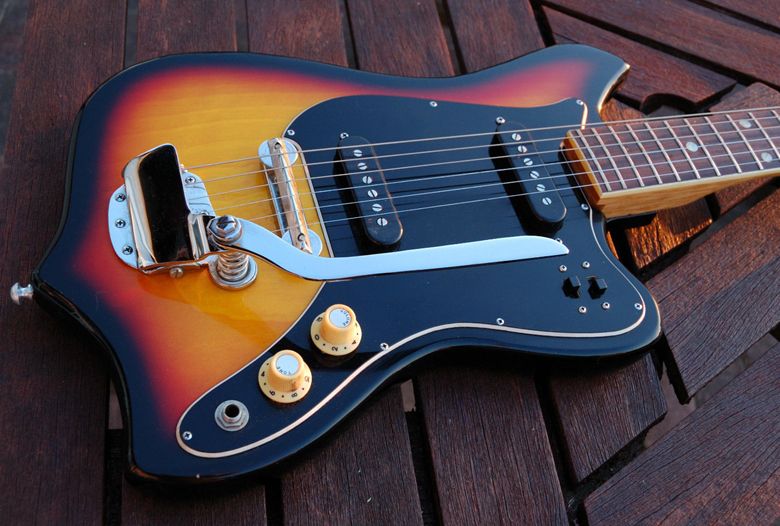
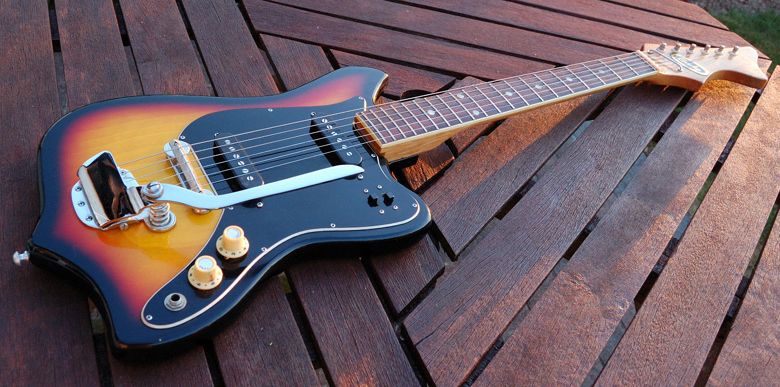
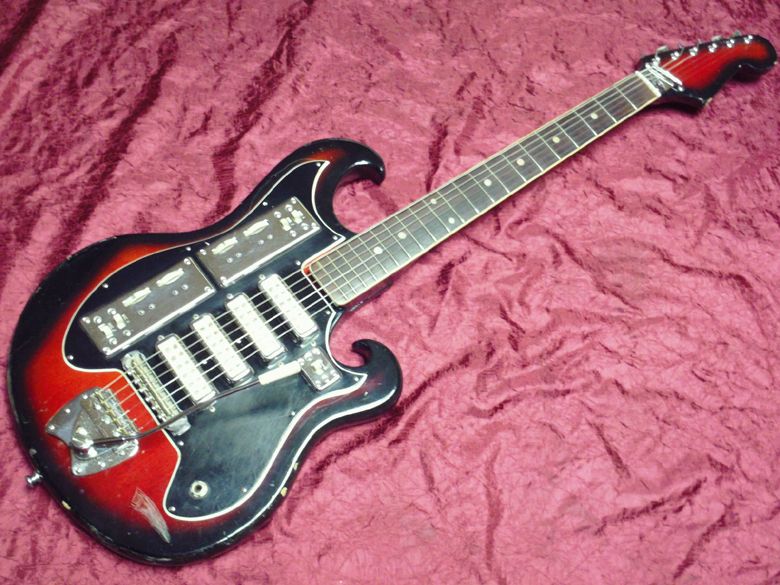
This Sekova Mentor guitar looks almost Italian with its four pickups and metal-covered banks of switches above the pickups. It also has a 26 3/4" scale length and an unusual body shape with a very deep cutaway on the treble-side of the body which is then negated by the inwardly scrolling horn.
Currently listed on eBay with a optimistic Buy It Now price of US $1,500.
For more info see Drowning in Guitars.
G L Wilson
© 2014, Guitarz - The Original Guitar Blog - the blog that goes all the way to 11!
Please read our photo and content policy.
Showing posts with label Sekova. Show all posts
Monday, 17 November 2014
Thursday, 25 September 2014
Barcley-branded Japanese copy of Fender Maverick/Custom
guitarz.blogspot.com:
The Fender Custom - also known as the Maverick (see here) - was a short-lived model "designed" by the CBS-owned incarnation of the Fender Corporation and was really an exercise in using up stock body and neck components for the Fender Electric XII (first produced in 1965) which had not proved to be a big seller. The resulting guitars do appear to our eyes now to be Frankenstein jobs, but perhaps we should applaud Fender who were essentially simply re-cycling (or is that up-cycling) parts. According to Fender, just "several hundred" were made and the model was never popular; it was only produced for one year and managed to hang on in the Fender catalogue until 1972.
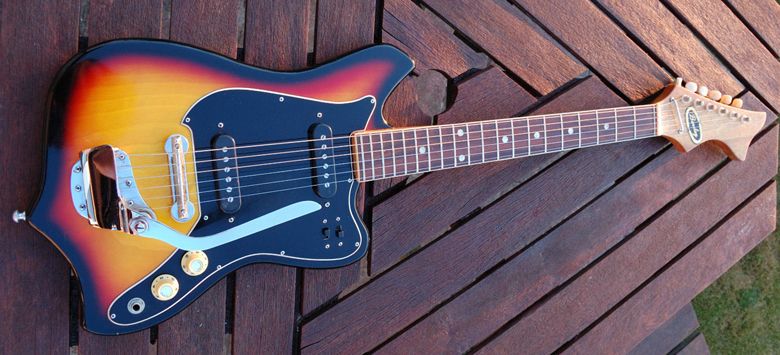
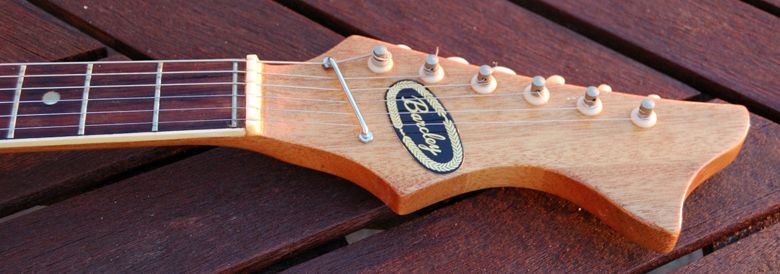
...which makes it all the more bizarre that someone in Japan thought it would be a good guitar to make a copy of. Witness the photos above of this Japanese-made Barcley guitar currently listed on eBay UK. The hardware is pretty standard fodder for cheap Japanese guitars of the time, and the neck makes no attempt to copy the 12-string derived hockeystick headstock of the Fender "original". In fact, here the headstock is a design that some of us might recognise from other Japanese brands such as Greco and Sekova.
The body design, however, is pure Custom/Maverick. It seems strange to think that this body was cut out and shaped deliberately to look like the body of a guitar that took a Fender Electric XII body and cut chunks off of it!
This guitar is currently listed on eBay UK and has a Buy It Now price of £129. Thanks to occasional Guitarz contributor David from Barcelona for bringing this guitar to my attention via the Vintage Japanese Guitar Fanclub group page on Facebook. Incidentally, the discussion on the thread concerning this guitar mentions that the Barcley brandname (spelt with a "E") was for guitars intended for the Canadian market, whereas Barclay (with an "A") was for the USA.
You can read more about the original Fender Custom/Maverick and also the similar "up-cycled" Swinger/Musiclander/Arrow model here.
G L Wilson
© 2014, Guitarz - The Original Guitar Blog - the blog that goes all the way to 11!
Please read our photo and content policy.
The Fender Custom - also known as the Maverick (see here) - was a short-lived model "designed" by the CBS-owned incarnation of the Fender Corporation and was really an exercise in using up stock body and neck components for the Fender Electric XII (first produced in 1965) which had not proved to be a big seller. The resulting guitars do appear to our eyes now to be Frankenstein jobs, but perhaps we should applaud Fender who were essentially simply re-cycling (or is that up-cycling) parts. According to Fender, just "several hundred" were made and the model was never popular; it was only produced for one year and managed to hang on in the Fender catalogue until 1972.
...which makes it all the more bizarre that someone in Japan thought it would be a good guitar to make a copy of. Witness the photos above of this Japanese-made Barcley guitar currently listed on eBay UK. The hardware is pretty standard fodder for cheap Japanese guitars of the time, and the neck makes no attempt to copy the 12-string derived hockeystick headstock of the Fender "original". In fact, here the headstock is a design that some of us might recognise from other Japanese brands such as Greco and Sekova.
The body design, however, is pure Custom/Maverick. It seems strange to think that this body was cut out and shaped deliberately to look like the body of a guitar that took a Fender Electric XII body and cut chunks off of it!
This guitar is currently listed on eBay UK and has a Buy It Now price of £129. Thanks to occasional Guitarz contributor David from Barcelona for bringing this guitar to my attention via the Vintage Japanese Guitar Fanclub group page on Facebook. Incidentally, the discussion on the thread concerning this guitar mentions that the Barcley brandname (spelt with a "E") was for guitars intended for the Canadian market, whereas Barclay (with an "A") was for the USA.
You can read more about the original Fender Custom/Maverick and also the similar "up-cycled" Swinger/Musiclander/Arrow model here.
G L Wilson
© 2014, Guitarz - The Original Guitar Blog - the blog that goes all the way to 11!
Please read our photo and content policy.
Tuesday, 19 March 2013
Sekova Grecian hollowbody electric guitar: six pickup stereo wonder?
guitarz.blogspot.com:
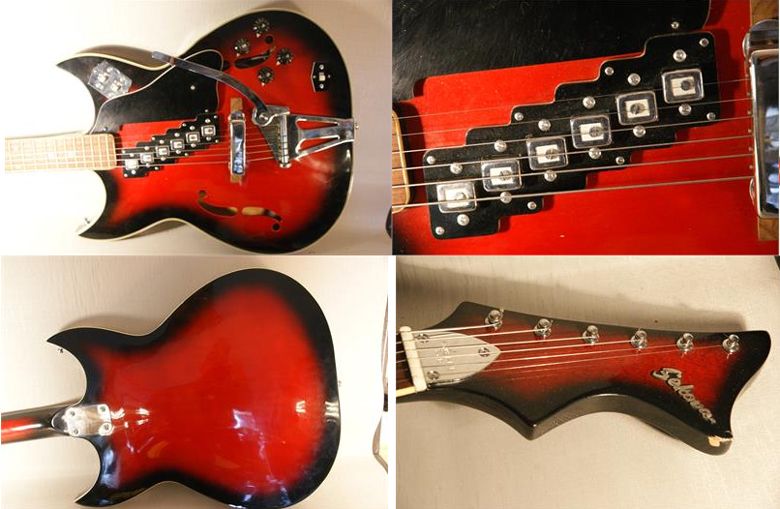
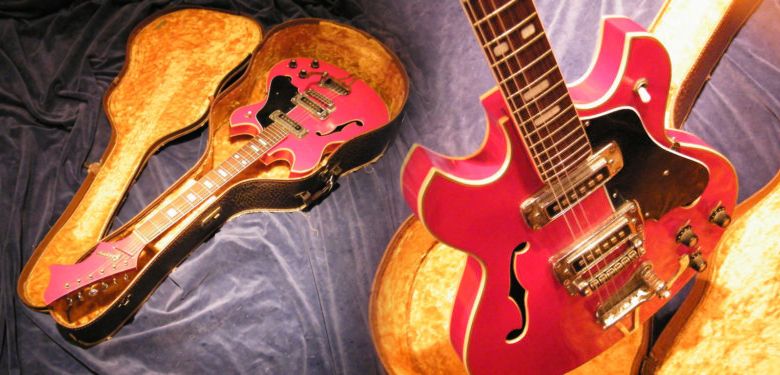
Here's another one you don't see come up for sale very often. It's a circa-1968 Sekova Grecian, made in Japan (although the exact provenance is not known) and imported into the USA by U.S. Musical Merchandise of New York City.
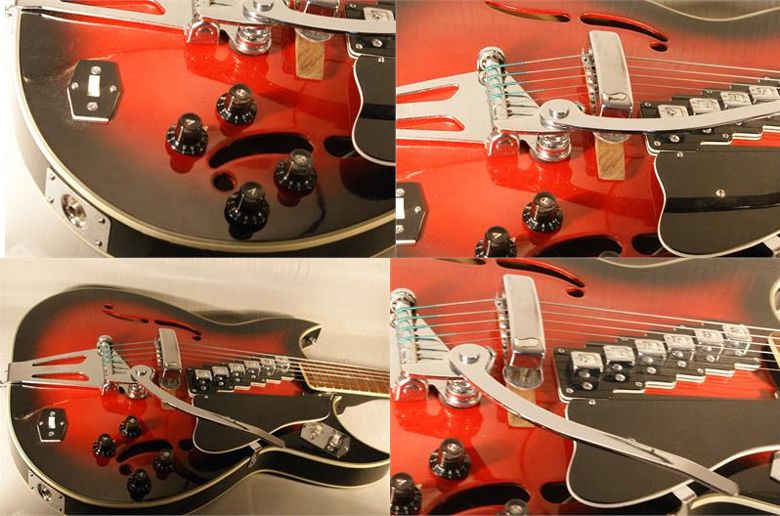
Of course what makes the guitar so spectacularly bizarre and/or wonderful is that it sports SIX pickups, albeit six individual string pickups, i.e. a one for each string. You might think that makes it effectively a one-pickup guitar, but something else is going on here; just witness the number of switches and volume and tone pots. The Grecian is actually wired for stereo with the signals from the 3 bass strings and the 3 treble strings being separated. It's a nice idea, but quite crude compared to latter-day stereo guitar innovations, e.g. the Kramer Ripley guitar or the Gittler guitar where the output from individual strings can be panned wherever desired in the stereo spectrum.
But how does it sound? In an article for My Rare Guitars, Michael Wright ("The Different Strummer") commented:
G L Wilson
© 2013, Guitarz - The Original Guitar Blog - the blog that goes all the way to 11!
Here's another one you don't see come up for sale very often. It's a circa-1968 Sekova Grecian, made in Japan (although the exact provenance is not known) and imported into the USA by U.S. Musical Merchandise of New York City.
Of course what makes the guitar so spectacularly bizarre and/or wonderful is that it sports SIX pickups, albeit six individual string pickups, i.e. a one for each string. You might think that makes it effectively a one-pickup guitar, but something else is going on here; just witness the number of switches and volume and tone pots. The Grecian is actually wired for stereo with the signals from the 3 bass strings and the 3 treble strings being separated. It's a nice idea, but quite crude compared to latter-day stereo guitar innovations, e.g. the Kramer Ripley guitar or the Gittler guitar where the output from individual strings can be panned wherever desired in the stereo spectrum.
But how does it sound? In an article for My Rare Guitars, Michael Wright ("The Different Strummer") commented:
As cool as it looks, this Grecian formula sucks big time. The stereo idea wasn’t terrible, but you always had to have two amps to take advantage of it. Plus, the coils are just not big enough to crank out much sound and, like so many Japanese guitars from this era, the wiring is extremely thin and the pots are crummy, so you’re lucky if the thing plays.The example pictured about is currently being auctioned on eBay with a starting price of $295. Thanks to Steve C for bringing this guitar to my attention.
G L Wilson
© 2013, Guitarz - The Original Guitar Blog - the blog that goes all the way to 11!
Sunday, 30 October 2011
Canora vintage Japanese semi-hollowbody bass guitar
guitarz.blogspot.com:
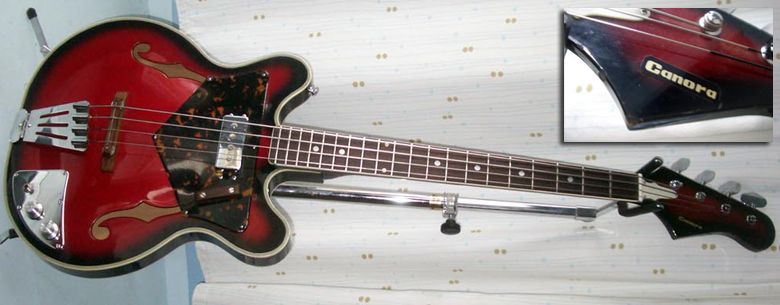
Here's a 1960s Japanese-made Canora semi-hollowbody bass. Anyone out there heard of the Canora brand? It appears to be the same model as the Sekova Vulcan and very likely was available under other brandnames too.
The eBay seller makes some really interesting observations:
This is not a modern-sounding bass. It has that 50s/60s boom to it - as would would expect from a short scale bass with a single pickup mounted in the neck position - but it would probably be invaluable for re-creating that vintage vibe should you desire to do so.
Currently listed on eBay with bidding at $235.50 at the time of writing, and over 2 days left before the end of the auction.
G L Wilson
© 2011, Guitarz - The Original Guitar Blog - now in its 10th year!
Here's a 1960s Japanese-made Canora semi-hollowbody bass. Anyone out there heard of the Canora brand? It appears to be the same model as the Sekova Vulcan and very likely was available under other brandnames too.
The eBay seller makes some really interesting observations:
While it is nearly impossible to exactly pinpoint the manufacturer of this bass, it is clearly an early product of Matsumoku, Kawai and the Teisco guitar factories as it has recognizable parts from each of those plants. It is well known that Matsumoku kept very poor records on the export models they produced, but it is known all of the Univox, Aria, and Guyatone guitars came from them as well as some Ibanez, Electra, Yamaha and dozens of other brands had at least a foothold in production there. It was clearly an odd time unlike anything that happens at US factories, because you'd often see different combinations of factories necks, bodies, pickups, and hardware all on the same guitar. Imagine a Fender neck on a Mosrite body with Gibson pickups and you get the idea of where I am going with this. It seems very strange but I think it went to a different sensibility employed in designing this guitars. There were a lot of orders to fill and many more coming down the pike! It seems that for the lines made for the Japanese market this was less the case, but the US imports often became a free for all. What results is many models with confusing slight or drastic variations in design that has made it almost impossible to get a solid handle on it. The guitars like Kent, Decca, Kingston, Guyatone, Audition, Lyle, and Melody all seem to morph and change model to model and year to year in this way. It is clearly not very easy for me to say with certainty much else about the history of this model...The seller also tells us that the design is based on that of the Gibson EB-2. Personally, I'd have said that there was more of a hint of Kay going on in there. And where have I seen that shield-shaped pickguard before?
This is not a modern-sounding bass. It has that 50s/60s boom to it - as would would expect from a short scale bass with a single pickup mounted in the neck position - but it would probably be invaluable for re-creating that vintage vibe should you desire to do so.
Currently listed on eBay with bidding at $235.50 at the time of writing, and over 2 days left before the end of the auction.
G L Wilson
© 2011, Guitarz - The Original Guitar Blog - now in its 10th year!
Tuesday, 30 August 2011
Sekova hollowbody electric: another 1960s Japanese-made oddity
guitarz.blogspot.com:
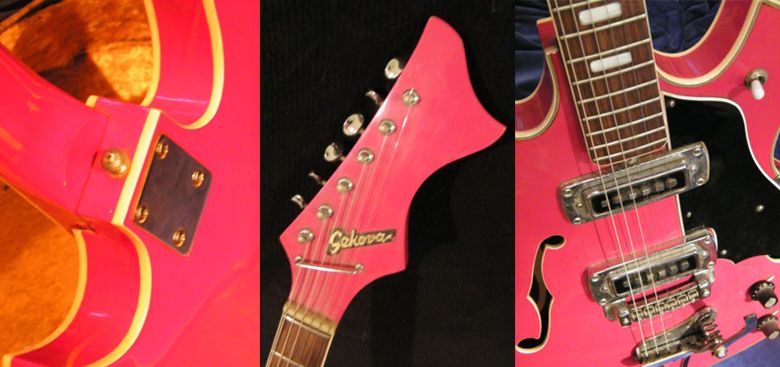
These days I find myself increasingly drawn towards thinline hollowbody or semi-hollowbody guitars than I do to solidbodies. I think it's something about the resonance that the guitar gives when you play it; it feels somehow more alive.
However, I take one look at these photos of this 1960s Japanese-made Sekova and I can't help imagine it rattling like hell when played and producing a boxy tone.
There's something very odd-looking about its construction. Take a look, for instance, at the way that the neck pocket is biased towards the treble-side of the instrument when it looks as if there was plenty of space to have it centred and achieve a better fit.
I confess that I know nearly nothing about the Sekova brand, so I'm not going to throw random Japanese brand names about (Teisco, Kawai, Guyatone, etc...) hoping that one will stick. However, if I was to make an educated guess, I can't help noticing the similarity of the headstock shape with that of this Greco guitar produced by the Kanda Shokai company (which had guitars built at the FujiGen and Teisco factories).
This may be a "rare" or unusual guitar in this day and age, but once again we see a totally unrealistic hyper-inflated Buy It Now price on eBay, a downright crazy $1,440.
G L Wilson
© 2011, Guitarz - The Original Guitar Blog - now in its 10th year!
These days I find myself increasingly drawn towards thinline hollowbody or semi-hollowbody guitars than I do to solidbodies. I think it's something about the resonance that the guitar gives when you play it; it feels somehow more alive.
However, I take one look at these photos of this 1960s Japanese-made Sekova and I can't help imagine it rattling like hell when played and producing a boxy tone.
There's something very odd-looking about its construction. Take a look, for instance, at the way that the neck pocket is biased towards the treble-side of the instrument when it looks as if there was plenty of space to have it centred and achieve a better fit.
I confess that I know nearly nothing about the Sekova brand, so I'm not going to throw random Japanese brand names about (Teisco, Kawai, Guyatone, etc...) hoping that one will stick. However, if I was to make an educated guess, I can't help noticing the similarity of the headstock shape with that of this Greco guitar produced by the Kanda Shokai company (which had guitars built at the FujiGen and Teisco factories).
This may be a "rare" or unusual guitar in this day and age, but once again we see a totally unrealistic hyper-inflated Buy It Now price on eBay, a downright crazy $1,440.
G L Wilson
© 2011, Guitarz - The Original Guitar Blog - now in its 10th year!
Subscribe to:
Posts (Atom)