Showing posts with label vintage modification. Show all posts

Tuesday, 30 October 2018

Burns Weill RP2G Super Streamline bass guitar from 1959

guitarz.blogspot.com:

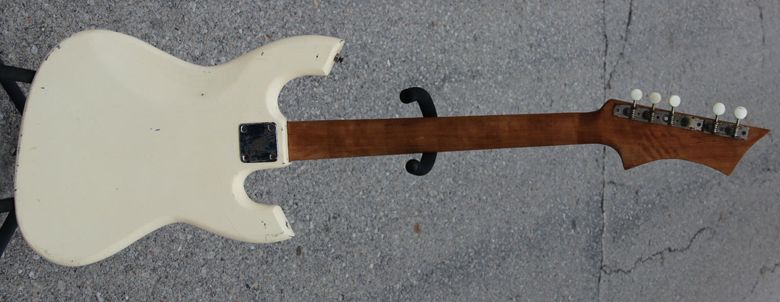
Here's an intriguing and supposedly quite rare bass guitar from Jim Burns and Henry Weill, the Burns Weill RP2G Super Streamline Bass. I suppose that back in 1959 it looked futuristic and space-age. Today it looks ... I don't know what. It's an ugly bass for sure but probably not as hideous looking as those ghastly singlecut jobbies with the bass-side bout extending half way up the neck which seem to be unfathomably popular these days in bass playing circles. It's quite recognisably a design from the Burns stable, displaying future echoes of the Burns Flyte on the treble side of the body.


Here is what the eBay seller has to say about it:
Burns Weill RP2G bass
This is a very rare bass made in 1959 by Jim Burns and Henry Weill. The body, neck etc., were designed and made by Jim Burns and all the electrics and pickups within the scratchplate were designed and made by Henry Weill.
This particular bass came from the collection of Mark Griffiths - bass player for The Shadows.  It was sold in auction some time ago along with many other guitars and basses owned by Mark Griffiths. I did not manage to buy it then but a while ago I contacted the buyer and managed to purchase it.
It is totally original apart from the fact that it had been refinished in the past - possibly when Mark owned it.
It is a very rare bass regardless of previous owners and its actually the only one I have come across. It has two pickups with volume, tone and blend controls plus a pickup selector switch and two-way switch - all working well, and it is a very nice playing bass with a lovely neck, quite narrow but very playable with twenty-two frets with red dot markers and a scale of thirty inches.
Currently listed on eBay UK with a Buy It Now price of £950.

G L Wilson

© 2018, Guitarz - The Original Guitar Blog - the blog that goes all the way to 11!
Please read our photo and content policy.

Thursday, 26 March 2015

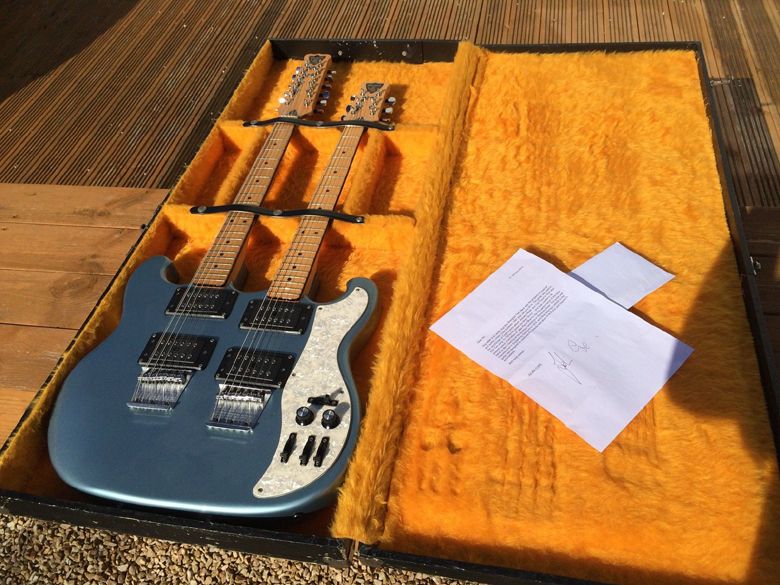
Shergold 6 and 12-string double neck guitar, ex Julian Cope

guitarz.blogspot.com:
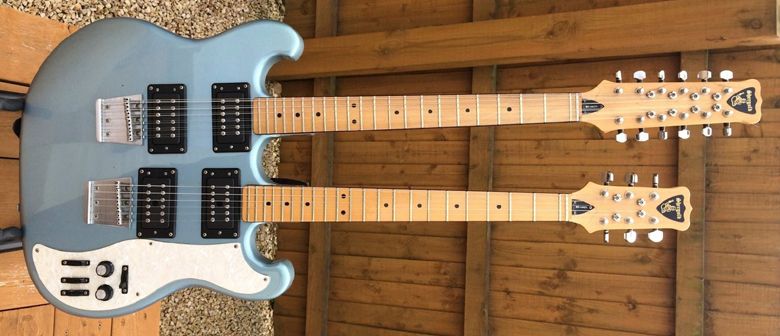
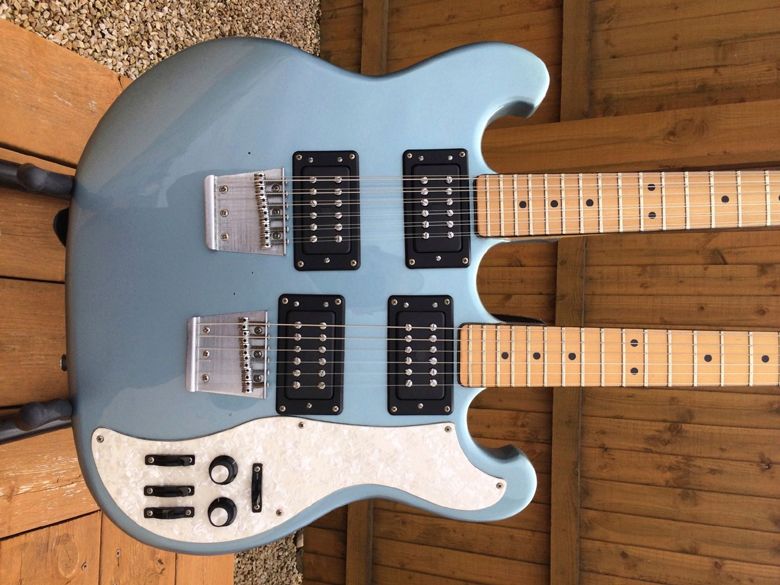
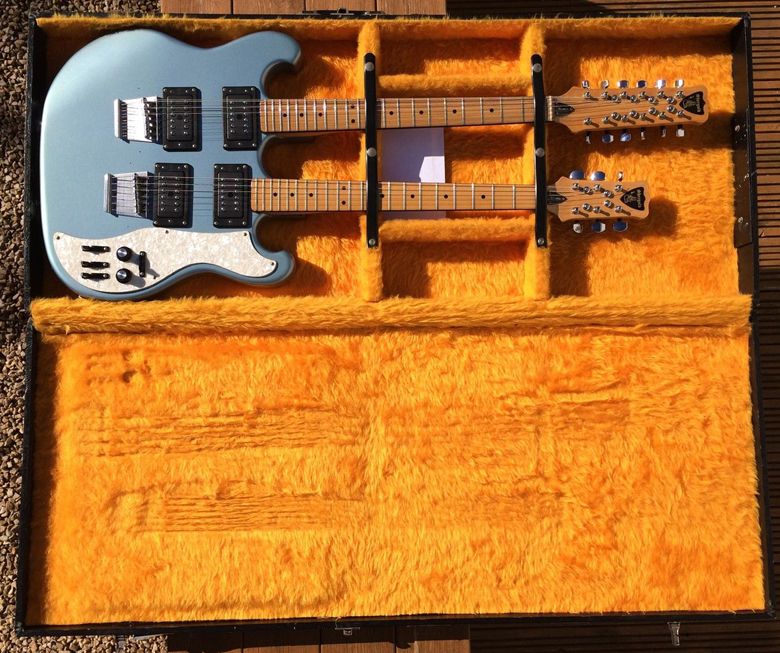
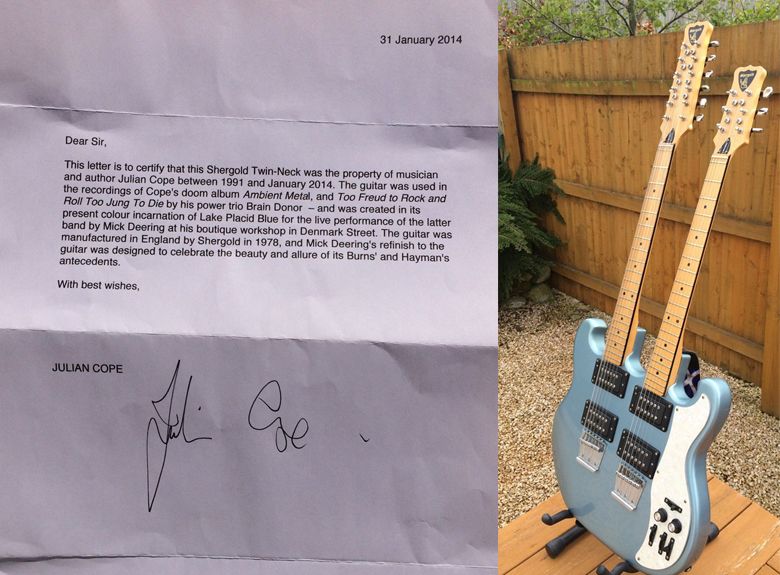
We recently looked at a very fine example of a Shergold doubleneck 4+8 string bass. Now it's time to meet its guitar counterpart, the above pictured Shergold 6+12 string doubleneck which is currently being offered for sale via eBay UK with bids starting at £1,000.

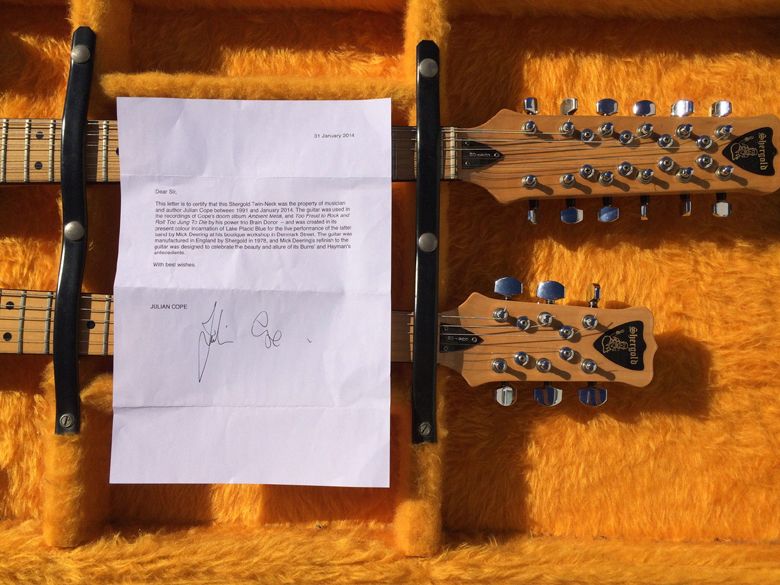
To make it even more interesting, this particular guitar until recently belonged to Julian Cope. I'm pretty sure I've seen it played live at one of his shows that I've attended. The guitar was used on the recording of "Too Freud to Rock'n'Roll, Too Jung to Die" by Cope's power trio Brain Donor. However, the cover of that album features guitarist Doggen Foster holding a totally different doubleneck, namely a Mosrite.

Of course Cope is something of a doubleneck fan. I've seen him playing a customised Danelectrco with guitar and baritone necks, and of course he is the owner of The Beast, an unholy and unwieldy-looking customised Gibson non-reverse Thunderbird/Firebird combination.

G L Wilson

© 2015, Guitarz - The Original Guitar Blog - the blog that goes all the way to 11!
Please read our photo and content policy.
Wednesday, 25 March 2015

1979 Gretsch Committee with a slightly modified body

guitarz.blogspot.com:


This poor Gretsch Committee has been modified to allow reach to the higher frets. It does look like the job was well done at least. To see what it should look like check here for an unmolested version.

I do admit though that the offset nature does not bother me that much and if it would help with negotiating a cheaper price it would be possible to get a nice Gretsch solidbody at a deal.

My "kijiji trade" wheels are turning.

R.W. Haller


© 2015, Guitarz - The Original Guitar Blog - the blog that goes all the way to 11!
Please read our photo and content policy.
Wednesday, 30 July 2014

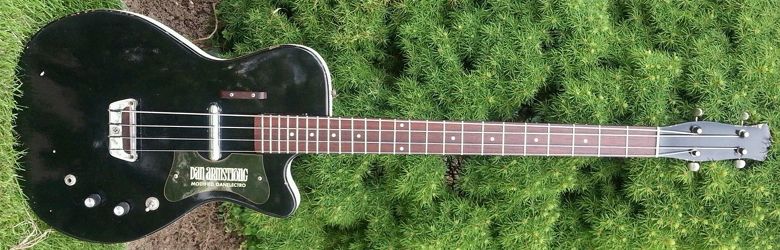
Ampeg Dan Armstrong-modified Danelectro bass, circa 1969-70

guitarz.blogspot.com:

Dan Armstrong, the man who created the line of clear lucite-bodied guitars and basses bearing his name for Ampeg, freely admits that he was influenced by Danelectro:
Danelectro® instruments served as far more than merely inspiration for the clear guitars and basses, as Dan virtually built his business on these guitars practically from day one. When Dan opened up his shop on 48th Street he almost immediately began taking Danelectro instruments and stabilizing them to make them play better. 

According to the book Electric Rock© by Richard Robinson - Jesse Colin Young used a Danelectro bass in the Youngbloods® that Dan had modified. 

In the same book Dan went on to say "I was in the repair business in '65. I had a repair shop and wanted something to sell and due to all the stiff competition on 48th Street I couldn't sell Fenders® and Gibsons®, there was no way to do it. I could improve the ones that people brought to me but there was no way to buy them new." The problem here was the fact that the large musical stores already held the franchise on these instruments. 

Still Dan wanted something to sell, and later said "Danelectros were so doggone cheap. I could buy them new and they were basically pretty doggone good. Most of the good parts on those things were engineered in the design which I always appreciated, and with some finishing up they could have been really done well, even out of the factory. But they just didn't have time, it was an economy instrument. I've always been an improver anyway. I enjoy that kind of thing, to find something that's made almost well and try to fix it up. It was all basically right so I just took them apart and cleaned them up a little bit."

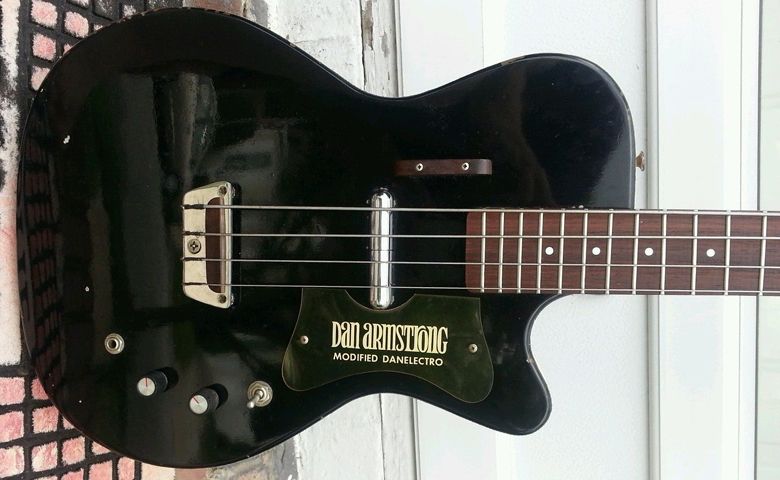
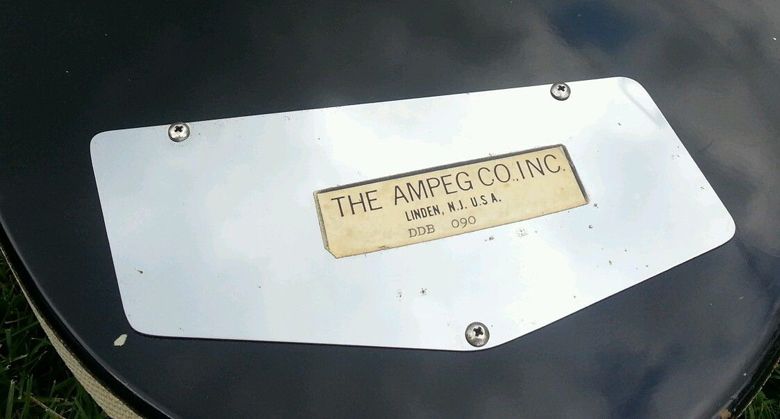
Here we see a Dan Armstrong modified Danelectro bass currently being offered for sale on eBay. This is the AMPEG tagged version with serial # DDB 90, which means it's the 90th one made. DDB=Dan Armstrong Danelectro Bass. 

Modifications made by Armstrong to the original Danelectro design include Kluson tuners, rewound pickups,upgraded electronics, reshaped headstock, re-shaped  smoother cutaway, branded pickguard, micro tilt neck, and double strap buttons on bottom so the guitar can be stood upright more safely.

Currently listed on eBay with a Buy It Now price of S $1,499.99.

G L Wilson

© 2014, Guitarz - The Original Guitar Blog - the blog that goes all the way to 11!
Please read our photo and content policy.
Sunday, 29 June 2014

Bernd 's Klira Patricia 196X jazz box renovation project

guitarz.blogspot.com:  Bernd writes to tell us about his renovation project as follows:
Bernd D.: Archtop Restoration Project &emdash; Klira Patricia 196X as I bought it ... Bernd D.: Archtop Restoration Project &emdash; the original headstock
I am Bernd from Straubing in Bavaria, Germany. I found a 196X Klira Patricia Archtop at an auction and decided to "restore" it to a blue Jazz-Machine with abalone-celluloid inlays.

Some people think, those old Kliras (and Lindbergs and Triumphators) should stay in the cellar - others think, they have some worth. As I didn't have such a Jazz-Box, I was ready to invest a few Euros and some elbow grease. The lacquer and the whole finish was very bad, and it seems to have been in a very humid environment for a few years. But the neck was straight and the frets were OK.

The headstock inlay was already dissolving - what looks like a kind of pearl inlay was in fact some kind of laquer, also in a very bad shape. The guitar looks much better on the images, as it was in reality.

Problem: I don't have a workshop, don't have any woodworking tools and I don't have any woodworking experience ...

Bernd D.: Archtop Restoration Project &emdash; Bling Bling ... Bernd D.: Archtop Restoration Project &emdash; Stained
So I stripped her and gave her some new abalone-celluloid inlays and also an abalone headstock and some "new clothes" - a RAL 5005 stain.

Bernd D.: Archtop Restoration Project &emdash; Playable ... Bernd D.: Archtop Restoration Project &emdash; Some More Bling Bling
Added a little make-up - two sheets of teak oil (I will add some more in the future ...) and some Grover like tuners from a Guild F130, a Gretsch bridge and her old tailpiece.

Now she sounds very loud and clear ... Great tone ...

Bernd D.: Archtop Restoration Project &emdash; Neck Pickup Bernd D.: Archtop Restoration Project &emdash; Controls
As she is a modern girl now, she gets some electronics - a Schaller Vintage 44 floating single coil and a volume and tone control. With a Yamaha THR 10c, she sounds absolutely stunning.

Bernd D.: Archtop Restoration Project &emdash; Nearly Ready
OK. This is in no way a perfect restoration. I did a lot of mistakes and everbody who takes a closer (and even a not so close) look will find some. But I like her, wife and daughter like her, people like her and she has great sound ...

Bernd D.: Archtop Restoration Project &emdash; The Very First Time ...
Already looking for the next old guitar ...

Bernd

Many thanks to Bernd for sharing his guitar renovation project with us. I'd like to congratulate him on tastefully bringing an old guitar that has seen better days back to life. - GLW

© 2014, Guitarz - The Original Guitar Blog - the blog that goes all the way to 11!
Please read our photo and content policy.
Wednesday, 11 June 2014

Eko doubleneck guitar / mandolin solidbody

guitarz.blogspot.com:
Whilst it's neither as cool nor as radical as this other Eko doubleneck, the above-pictured Eko guitar / mandolin doubleneck does at least seem to be of practical proportions and shouldn't break your back having to gig with it. However, of course, Eko of Italy never made such a doubleneck guitar/mando combination. This is a Brandoni creation. Roberto Brandoni acquired Eko's remaining stock when they closed down back in 1987. Stock included bodies and necks and other assorted parts from vintage 1960s Eko and Vox guitars and from Eko models produced into the 1980s. Eko in the early 1980s produced two solidbody mandolins - an 8-string and a 12-string "mandoguitar" model. This Brandoni-customised Eko doubleneck would appear to have been made by joining together two separate mandolin bodies.

Currently listed on eBay UK with a Buy It Now price of £635.

G L Wilson

© 2014, Guitarz - The Original Guitar Blog - the blog that goes all the way to 11!
Please read our photo and content policy.
Wednesday, 16 April 2014

Unknown 1960s four-pickup leftie guitar - Can anyone help identify?

guitarz.blogspot.com:
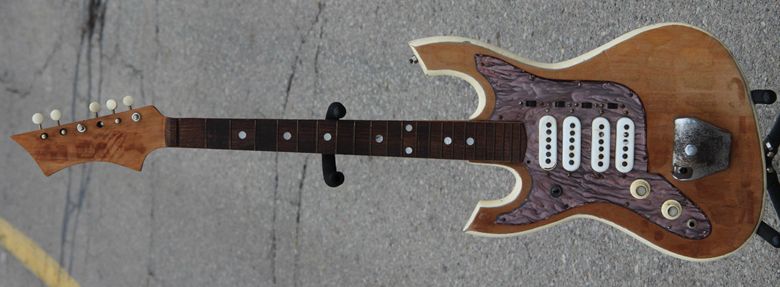
This 1960s four-pickup leftie solidbody guitar looks in need of a little TLC and a renovation! But what is it? Does anyone out there recognise it? My thinking is that it is probably Japanese, but I'm going mainly by the headstock shape which does seem strangely familiar. The finish on the front of the guitar and the face of the headstock has been stripped. I'm wondering if it may have had some kind of plastic/celluloid coating - could those strange marks on the stripped surface be where it was glued?

Currently being auctioned on eBay with bidding at US $109.26 at the time of writing.

G L Wilson

© 2014, Guitarz - The Original Guitar Blog - the blog that goes all the way to 11!
Please read our photo and content policy.
Friday, 21 February 2014

1971 Gibson Les Paul Custom with MSA Pedal Attachment

guitarz.blogspot.com:
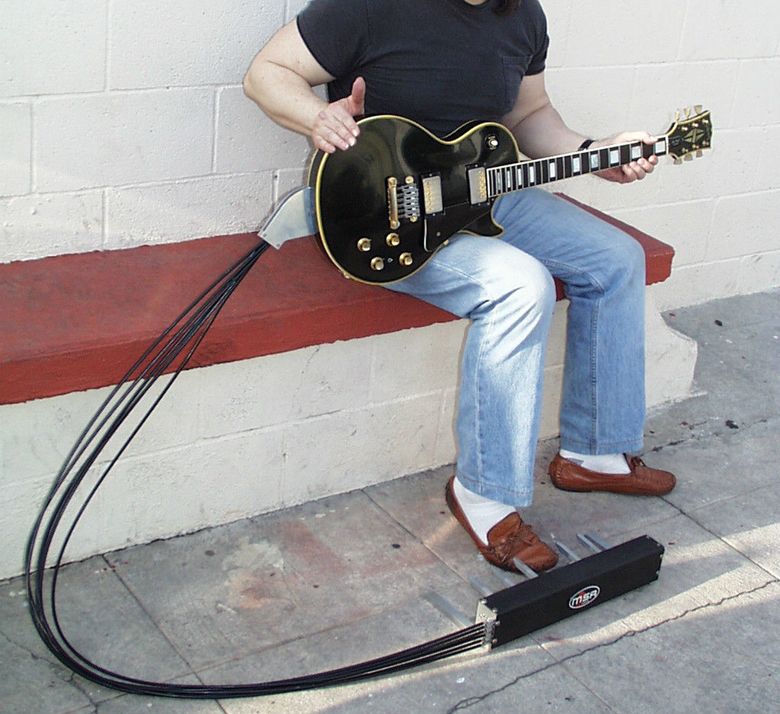
Never mind your Tele with B-Bender, this 1971 Gibson Les Paul can do all that and more. It does look a bit cumbersome with all those cables coming out of it though. Anyway, here's the story from the eBay seller:
The Les Paul [Serial #686339] is in real nice shape and before all you vintage freaks, freak out, the MSA mod was done in 1979 before this instrument was considered vintage and/or important. So take a deep breath and read about this very unique piece of guitar history.

The guitar belongs to a prominent Los Angeles studio session player from Dallas, Texas. He is retiring and selling many of the instruments that he no longer has a call for. Being in Texas put him in the circle of players that were doing a wide range of commercial music and Steel Guitar was one of the more prominent flavors in the air. Maurice Anderson and Tom Morell (of Dallas) created MSA Steel Guitars and were crazy enough to develop this pedal system for six-string guitar. Phil Baugh was an early adopter and can be heard on George Jones “HE STOPPED LOVING HER TODAY” and “IF DRINKING DON'T KILL ME, HER MEMORY WILL” playing his modified instrument. Here is a link that features Phil playing his MSA modified Peavey.

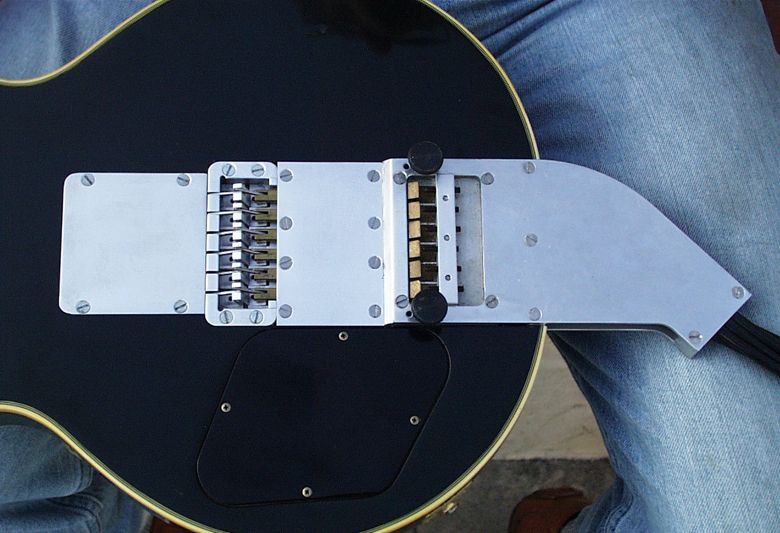
This Gibson Les Paul Custom is the only one like it in the world that has this MSA attachment, that Maurice Anderson personally installed in 1979 [may've been 1980]. There were 24 more installed on Peavey guitars, but only the first one of those was sold [for $10,000] to the Austin, Texas friend of Reese who coerced him into developing this MSA unit. The others were never sold, because they were locked up in a warehouse in receivership,as MSA went bankrupt, & the Peavey's were never seen again as far as I know [this might have changed, since MSA re-emerged from bankruptcy about a decade ago]. There was also a Gibson L-5s modified for Phil Baugh.

Here is a link to a discussion about this instrument.

The only other mods on this Les Paul are coil taps & a phase switch, for more sound variety, since it was never gonna sell as "original" anyway.

The MSA attachment comes off or goes on in ten seconds with thumb screws, & it stays in tune, unlike the permanently attached precursor that Reese made for Phil Baugh, 40 some odd years ago, for his fender Jazzmaster. The six pedals can be adjusted to vary pitch on each string, individually, anywhere from a half step to 6 half steps up or down, depending on which end of the levers on back of the guitar you attach the string to [pretty ingenious].

The winning bidder can specify the type of strings and other parameters for a complete professional (no charge) set-up before the guitar is shipped.
Currently listed on eBay with a Buy It Now this of US $10,650.

G L Wilson

© 2014, Guitarz - The Original Guitar Blog - the blog that goes all the way to 11!
Please read our photo and content policy.

Sunday, 22 December 2013

Modified Silvertone / Danelectro U1 with dolphin nose headstock

guitarz.blogspot.com:
Bruno writes:
I just found an interesting guitar on ebay, it looks like a Danelectro 56 U1 with double cutaway, I wanted to show it to you since I have never seen one before, and you'll maybe find it interesting.
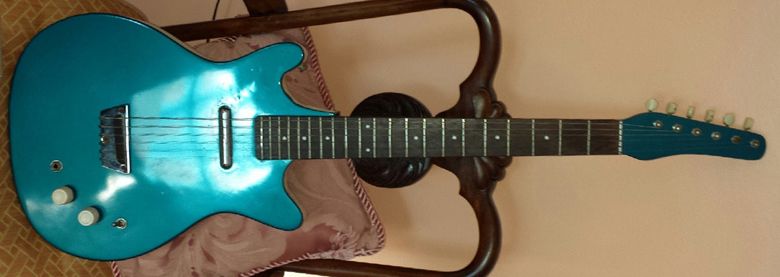
Hey Bruno, thanks for the email. It certainly does look like a Silvertone / Danelectro U1 - the seller says it appears that the original colour was copper which sounds about correct for this guitar. However, I'm 99.9% certain that the upper cutaway is a DIY modification. The shape of that upper horn is quite crudely fashioned.

The photo showing the control cavity is interesting also, because it illustrates quite nicely the kind of materials these Danelectro guitars were made from. Note the texture of the underside of the masonite top.

Currently being auctioned on eBay with bidding at $112.49 at the time of writing.

G L Wilson

© 2013, Guitarz - The Original Guitar Blog - the blog that goes all the way to 11!
Please read our photo and content policy.

Tuesday, 11 September 2012

Yikes! The things some people do to guitars could almost make you weep!

guitarz.blogspot.com:
I nearly decided to offer up this photo to you as some kind of competition, as in "What guitar is this?" but I think it's probably too easy a question - not that the shape of the guitar is any giveaway, but rather the pickguard, control layout and tremolo speak volumes as to its true identity before someone took a saw to it and stuck furniture tacks all over it.

What a ghastly thing to do to a 1964 Fender Mustang. I suppose it's no worse than the way in which John Mayall cuts his Strats down to minimal bodies, but it still causes me to shudder. Someone out there is going to say, "I like it", I can just tell. But it's not my idea of customisation.

Currently being offered for sale on eBay - it'll be interesting to see how much this fetches.

G L Wilson

© 2012, Guitarz - The Original Guitar Blog - 10 years and counting!

Tuesday, 26 June 2012

1929 Gibson L5 with 1971 neck and pickup


Sometimes it's good to just contemplate the most classic vintage electric guitar model, the Gibson L5 - here with a Johnny Smith replacement neck with beautiful inlays... My next guitar will be something like this (just 10 times cheaper)!


Bertram D

© 2012, Guitarz - The Original Guitar Blog - now in its 10th year!

Monday, 2 April 2012

Hofner archtop with a Gibson headstock


I like this slightly bizarre modification of an unidentified old Hofner archtop guitar from the late 1950s. It has now a dog-ear P90 pickup in neck position, smartly outlined in white to recall the white binding - a little bit like a Charlie Christian pickup that P90s replaced around 1950 on Gibson archtops.

It also sports a Gibson logo on the headstock but the photo is too small to figure out how it's done - it looks like a real mother-of-pearl inlay but the neck itself and fretboard are typically Hofner so it is not a neck swapping...

The result is nice and I've considered bidding on this guitar on sale on eBay, but I'm uncertain of the quality of this guitar mod, so I will stick to the plan and save my money for a brand new Godin 5th Avenue Kingpin...

What do you think of this guitar? 

Bertram

© 2012, Guitarz - The Original Guitar Blog - now in its 10th year!

Wednesday, 25 January 2012

Guyatone LG-11W - another forgotten 1960s Japanese guitar

guitarz.blogspot.com:
Joshua writes:
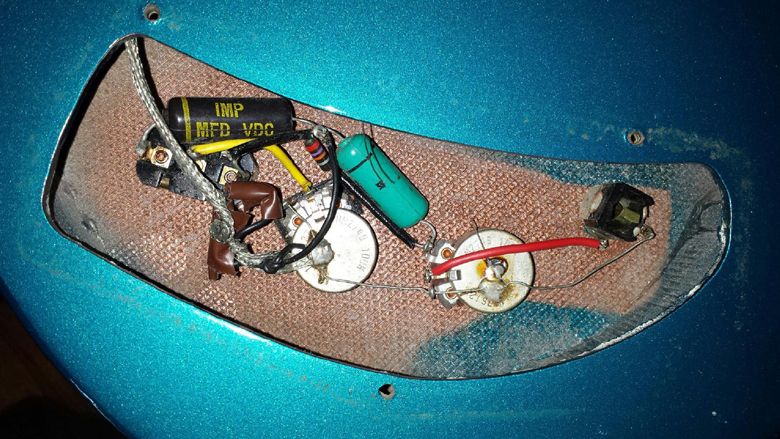
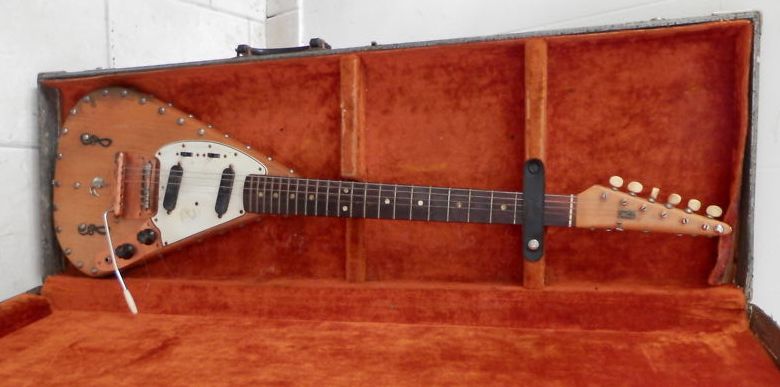
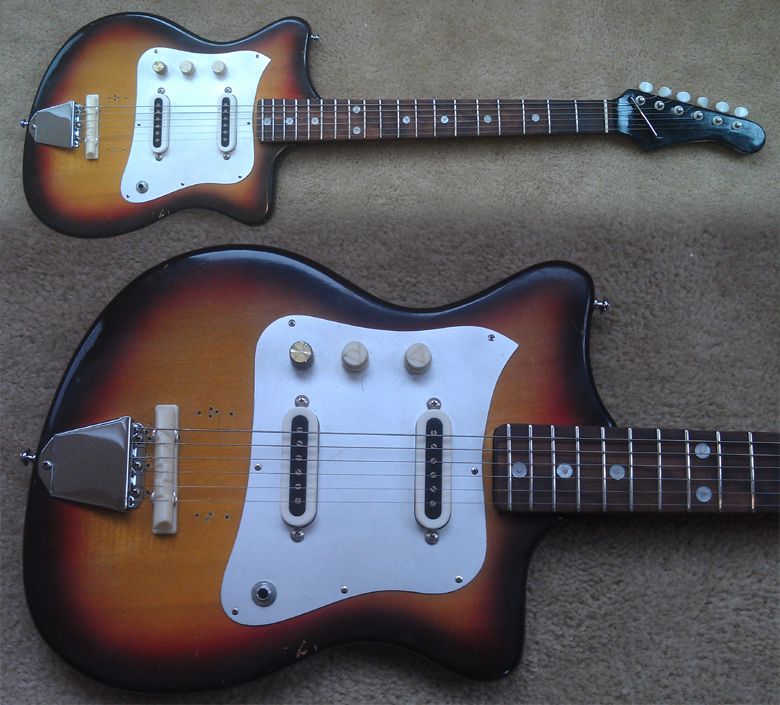
I recently saw your post about the JVC Balladeer and I was surprised to see that I have a Guyatone in this (I think) same body/headstock design. The major difference is the pickguard configuration and it is certainly of a lower level model with no tremolo system. The pickguard is still of metal construction, just a flat finish and the controls on top of the pickups, which is actually quite comfortable. I have looked and looked all over the web and I've yet to see any Kawai/Teisco/Guyatone Japanese guitars with this same exact body design.

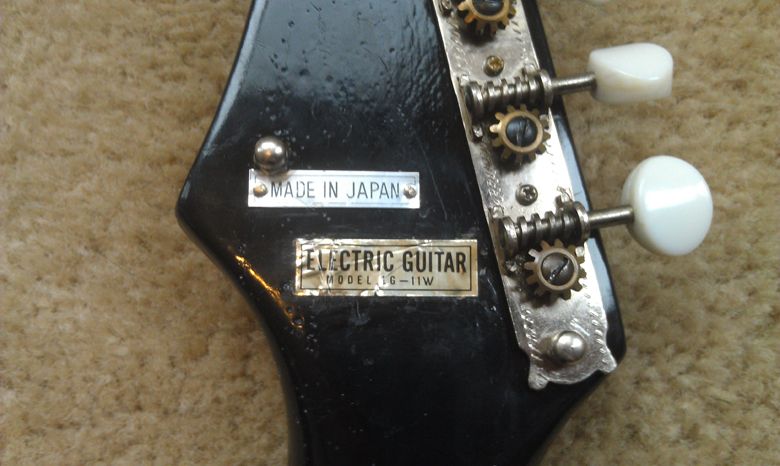
It has model number of LG-11W, which falls in line with Guyatone model numbers and of course has a 'Made in Japan' sticker, but unfortunately it no longer has its headstock badge (just a sticky residue of where one used to live).

In fact, I'm in the middle of refurbishing the neck and fingerboard due to too much lovin'! This thing was played to death and I'm certain whoever attempted to refret the fingerboard was not a pro, as there where large chips in the dried out rosewood. I decided to refinish the black neck paint while I was at it, which showed large stress cracks through the finish. I'm by no means a "pro" luthier, but I am an inspiring luthier who has made his own guitars. And as some may think this is sacrilege, I've decided to turn this 24.5" scale into a 25.5" scale and move the bridge/tail back that extra inch. I liked the feel of 24.5" but it was way too narrow for my liking. If I had any intention of selling the guitar, I would have of course kept it to its original scale.

Joshua
Here's a YouTube video of Joshua demoing the guitar. It just goes to show there's life in some of those old Japanese "pawn shop" guitars, although some of them might need some resuscitation.


We're always happy to see readers' guitars - the more interesting or unusual the model, the better - so please do keep sending in your photos and stories. Contrary to widely held belief, we at Guitarz can appreciate a nice Strat, Tele, Les Paul or SG the same as the next man, woman or dog; however, I think all our readers already know what they look like and what they can do, so we would prefer to see something just a little bit different from the run-of-the-mill guitars you see everywhere. Having said that, if you do have a Strat, Tele, Les Paul, SG, etc, with a particular story to tell, or an unusual variant or finish, then we wouldn't rule out including it on the blog.

G L Wilson

© 2012, Guitarz - The Original Guitar Blog - now in its 10th year!

Monday, 2 January 2012

Japanese Mustang copy with Competition stripe converted to fretless

guitarz.blogspot.com:
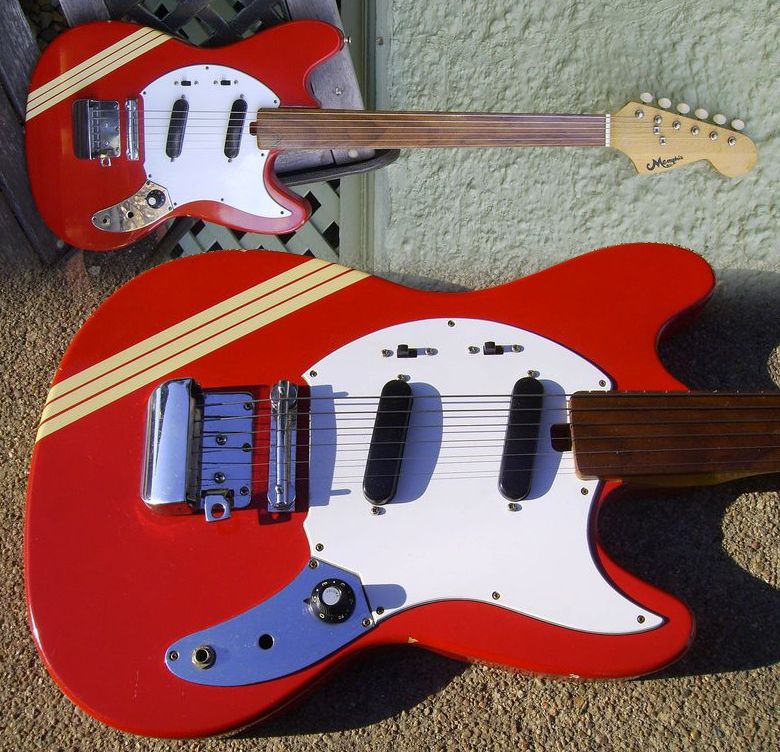
We've looked at a 1960s/70s Japanese-made Mustang copy before here on Guitarz but this Memphis-branded example currently listed on eBay is a bit more interesting. The body shape  on the Memphis is still too crude and slab-like with not enough rounding over of the edges, and the pickguard looks like it should belong to an even-waisted guitar rather than one with an offset body like this. However, the guitar has been converted to fretless and this is what makes it interesting. Whoever has done this conversion seems to have made a nice job of it. They haven't merely lifted out the old frets and filled in the slots; it would appear that the whole fingerboard (you can't call it a fretboard on a fretless!) has been replaced. Note the discreet fret position markers along the bass edge of the fingerboard.

I understand I might be confusing some readers out there. In the previous post I was complaining about the desecration of vintage guitars with thoughtless customisations, but here I would seem to be applauding it. It's a very difficult topic, I guess, and we need to remember that often when such "customisations" were carried out a long time ago before the guitars in question could even have been considered one-day potentially "vintage" material by anyone. In my eyes the Japanese Mustang copy, being a real cheapy and not a particularly good "copy", would have been fair game for modification. If I wanted to customise a guitar today, I would avoid what were obviously quality instruments and choose something generic and commonplace from China or Korea perhaps. I guess that back when the Yamaha SG-12 we looked at yesterday was originally modified it wasn't considered to be a guitar of any particular importance or rarity because it was only something "Made in Japan".

But there's Made in Japan and there's Made in Japan. There are the quality guitars and then there's the cheap rubbish. Sometimes it can take some finesse to spot which is which as it is not always screamingly obvious. For example, some early Japanese Telecaster copies are not copied too accurately but are very nice players. (I wouldn't be too surprised if someone comments below that these Memphis Mustangs are also "nice little players", but I still wouldn't consider them the most exciting of "vintage" finds.) In fact, nowadays, I would be wary of butchering any MIJ guitar, because it seems that even the lowliest unplayable Teiscos (or Woolworths guitars as we used to call them) have their fans and now can fetch more money than they originally retailed for.

There are, I'm afraid, no definitive answers about which guitars are ripe for modification; which of today's guitars might be future classics, highly sought after "Holy Grails" even, and which will be considered firewood. I guess it all boils down to the fact that the owner has paid money for the guitar and it is theirs to do with as they  please; some people will like it, others won't.

I have to wonder if in 20 or 30 years time, guitar enthusiasts will be searching vainly for an unadulterated Squier '51 and bemoaning the fact that this guitar was a favourite for modification and that an example in original factory condition is near impossible to find.

I suppose that on the Memphis Mustang, if a collector wanted it badly enough in near to original condition as possible, it would be possible to re-fret it. The fingerboard wouldn't be original but it would almost certainly be of better quality than the original! Anyway, this guitar is currently listed on eBay - the auction finishes later today and bidding is at $142.50 at the time of writing.

G L Wilson

© 2012, Guitarz - The Original Guitar Blog - now in its 10th year!

Friday, 11 November 2011

11 on 11/11/11: #6 - Vintage Danelectro doubleneck guitar and bass

OK, it's the 11th November 2011, that is 11/11/11, and as such today has been designated Nigel Tufnel Day. To celebrate this day of Maximum Elevenness, we here at Guitarz - for this day only - will be posting an unprecedented ELEVEN blog posts! So, keep tuned throughout the day for eleven weird and wonderful guitars!
Danelectro guitars should be familiar enough to all Guitarz readers. The most famous models are known not only for their very cheap construction methods (the bodies consisted of a simple pine frame with the front and back being made from Masonite) but also, conversely, for the great sounds they made.

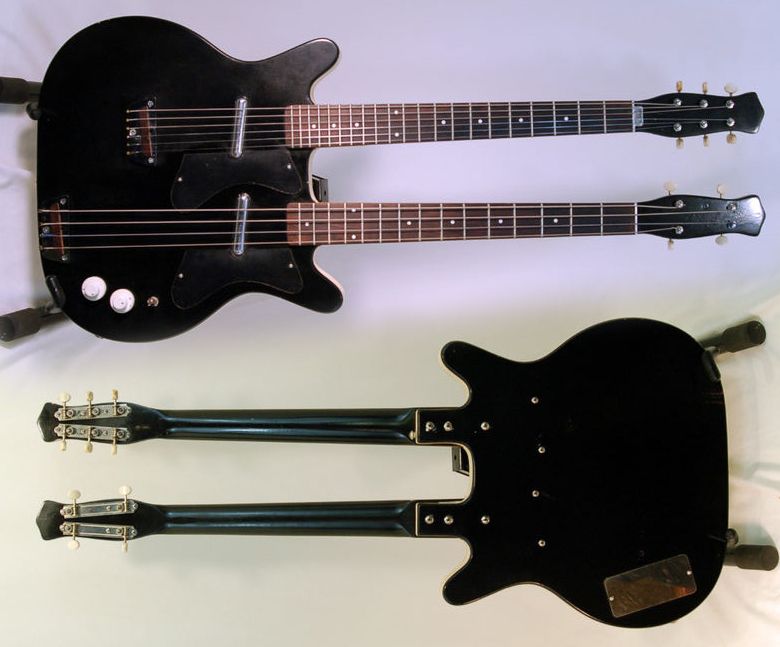
This Danelectro guitar and bass doubleneck circa 1961 is a particularly nice example despite the obvious black refinish. In fact I'd go as far to say that the black refinish adds to the road-worn character and vintage vibe of the guitar. Notice how the bass neck is identical in length to the guitar neck, but how the bass bridge is set as far back as the body will allow so as to adhere to the usual short-scale bass length of 30".

This item is located in West Des Moines, Iowa, and currently listed on ebay with a Buy It Now price of $1,599.88.

G L Wilson

© 2011, Guitarz - The Original Guitar Blog - now in its 10th year!

LinkWithin

Related Posts with Thumbnails

ShareThis