guitarz.blogspot.com:
I'm only an amateur musician but even I find that whenever I'm going out to practice, to guitar clubs, open mic sessions, or whatever, I inevitably have to cart around a whole bunch of gear with me: there are usually two or three guitars (acoustic, electric, sometimes a bass VI); amplifiers; my pedal board and various effects pedals; my song books; and of course all sorts of accessories, capos, tuners, leads, etc. This usually involves a lot of trudging back and forth, to and from the car at either end of the journey and having to carry large, heavy, and often awkward-shaped pieces of gear. So, I'm all for anything that helps minimise this kind of baggage.
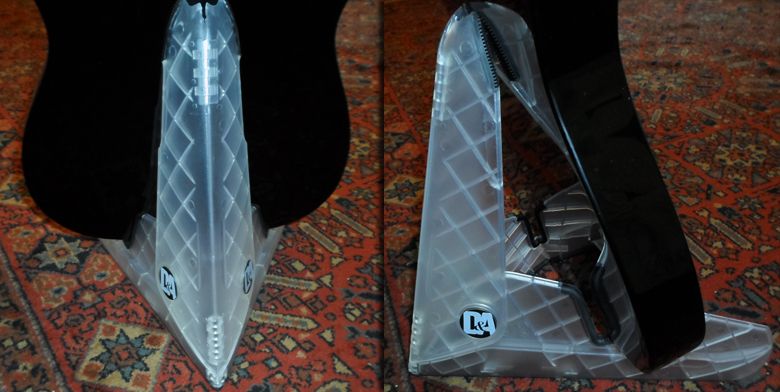
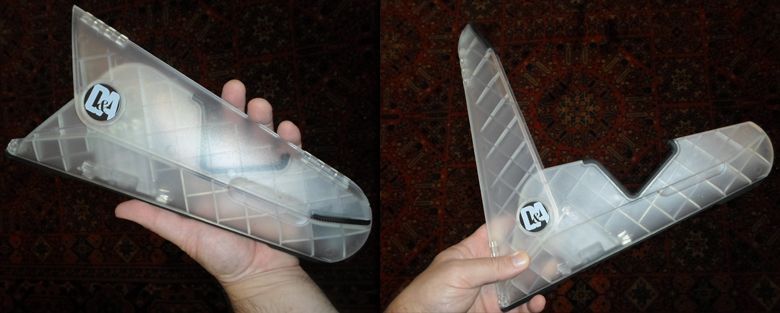
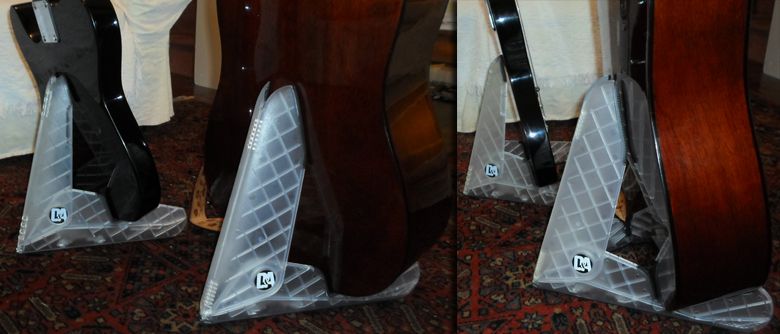
I've been really impressed with the D&A Guitar Gear Icestand. The Icestand is a very conveniently-sized portable guitar stand which, although made from plastic, utilises lattice ribbing and reinforced joints so that it is able to support even the very heaviest of guitars. The manufacturers claim that it has an "insane strength" and indeed are so confident in this product that they guarantee it for a lifetime. The Icestand itself weighs approx 20 ounces (that's less than 0.6 kg) and in its folded-up state is small enough to fit inside your guitar case. Other guitar stands are often very awkward shapes to be carrying around, and are one of those items that because of their inconvenient shape that I personally find I overlook and end up forgetting because they don't fit nicely into my box of accessories.
It's also safe to use with any vintage guitars you may have in your collection, for the Icestand has a soft polymer material covering all points of contact between itself and the guitar, ensuring that your guitar’s finish is protected. It is safe for all guitar finishes.
The Icestand comes in two models, one for electric guitars and the other slightly larger version for acoustics.
I ought to point out that the Icestand is not suitable for all guitars; I briefly tried standing my Fender Bass VI on the Icestand and it was immediately apparent that it was going to fall over as soon as I took my hand away from the neck of the instrument. So, I do not recommend it for guitars with offset bodies (e.g. Fender Bass VI, Jaguar, Jazzmaster, Jazz Bass) and I wasn't even going to try it with my Ovation Breadwinner, but of course for the majority of electric guitars and basses it will be fine, e.g. Strat, Tele, Precision Bass, SG, Les Paul, and most other designs that don't feature irregular or offset shaped bodies.
D&A Guitar Gear, by the way, is the brainchild of RKS Design, a research, strategy and design firm. Some of you may recall their sadly discontinued venture into their own line of innovative guitars.
G L Wilson
© 2013, Guitarz - The Original Guitar Blog - the blog that goes all the way to 11!
Please read our photo and content policy.
Showing posts with label reviews. Show all posts
Tuesday, 17 September 2013
Sunday, 2 June 2013
Effects Review [with video]: Magnetic Effects ELECTROCHOP pedal
guitarz.blogspot.com:
Magnetic Effects are a small company in the UK specialising in handmade boutique effects pedals. Their latest pedal, the Electrochop, has a really cool vintage-sounding vibe. To quote from their own press release:
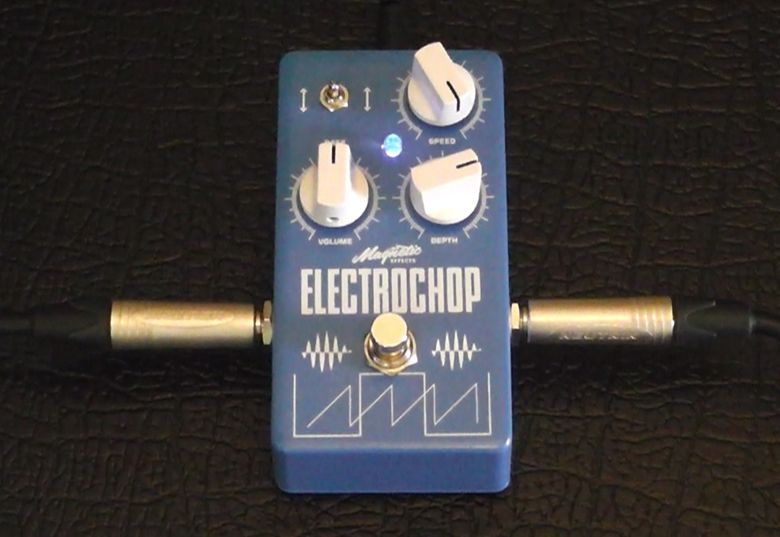
The Electrochop is housed in a sturdy metal casing, and the three control knobs are of excellent design allowing even those of us with rapidly failing eyesight to be able to ascertain the various settings at a glance. I also like the use of a blue LED for the power indicator (i.e. pedal ON) as opposed to the usual red we see on effects pedals. The blue nicely complements the colour scheme of the casing too.
Now, while I freely admit that I am not overly comfortable about getting myself out in front of a video camera, I decided that what we really needed here was a demo video, so please watch the below YouTube clip. Please note, that for review purposes I am using the Electrochop as the sole effect on the guitar's tone. Even though Magnetic Effects recommend using it in conjunction with a quality fuzz pedal, I wanted to demonstrate the sounds as produced by the Electrochop alone. As I say in the video, of course you can use it with other effects, you are only limited by your imagination.
By the way, in the video I mention the clarity and silent operation of the Electrochop. Please note that the hum you hear in the video is from my amp, NOT the effects pedal.
The Electrochop is priced at £89 and is available from the following retailers:
G L Wilson
© 2013, Guitarz - The Original Guitar Blog - the blog that goes all the way to 11!
Please read our photo and content policy.
Magnetic Effects are a small company in the UK specialising in handmade boutique effects pedals. Their latest pedal, the Electrochop, has a really cool vintage-sounding vibe. To quote from their own press release:
The Magnetic Effects Electrochop is a super choppy tremolo that features the classic, unique LFO section from the Vox Repeat Percussion. A new audio circuit has been designed around the LFO, resulting in a tremolo that sounds like the Repeat Percussion but with a fuller, louder sound and more controls. All the classic throb but with more user friendly features!Magnetic Effects very kindly let us borrow an Electrochop for review, and I can honestly say I've had great fun playing with it. I'm going to be sad to have to box this one up and send it back. Having had a taste of what it can do, if I wasn't so utterly broke right now I'd buy this immediately.
The controls are: Volume, Depth and Speed plus a toggle switch that alters the overall speed range.
The speed range goes from very slow to crazy fast. At higher speeds the sound morphs into a ring modulator type effect.
Features:
- High input impedance and low output impedance
- True Bypass switching
- 9V DC adapter or battery powered
- Rate Toggle switch
- Volume, Depth and Speed controls
The Electrochop is housed in a sturdy metal casing, and the three control knobs are of excellent design allowing even those of us with rapidly failing eyesight to be able to ascertain the various settings at a glance. I also like the use of a blue LED for the power indicator (i.e. pedal ON) as opposed to the usual red we see on effects pedals. The blue nicely complements the colour scheme of the casing too.
Now, while I freely admit that I am not overly comfortable about getting myself out in front of a video camera, I decided that what we really needed here was a demo video, so please watch the below YouTube clip. Please note, that for review purposes I am using the Electrochop as the sole effect on the guitar's tone. Even though Magnetic Effects recommend using it in conjunction with a quality fuzz pedal, I wanted to demonstrate the sounds as produced by the Electrochop alone. As I say in the video, of course you can use it with other effects, you are only limited by your imagination.
By the way, in the video I mention the clarity and silent operation of the Electrochop. Please note that the hum you hear in the video is from my amp, NOT the effects pedal.
The Electrochop is priced at £89 and is available from the following retailers:
G L Wilson
© 2013, Guitarz - The Original Guitar Blog - the blog that goes all the way to 11!
Please read our photo and content policy.
Friday, 26 April 2013
Guitar review: cheap Chinese-made "no-name" unbranded Tele from eBay
guitarz.blogspot.com:
We've all seen these cheap guitars on eBay, often with prices that seem too good to be true. If you're like me you'll have said to yourself that one day you'll buy one and give it a whirl, see if it really is as good as the eBay seller claims (and don't they always claim they are wonderful?).
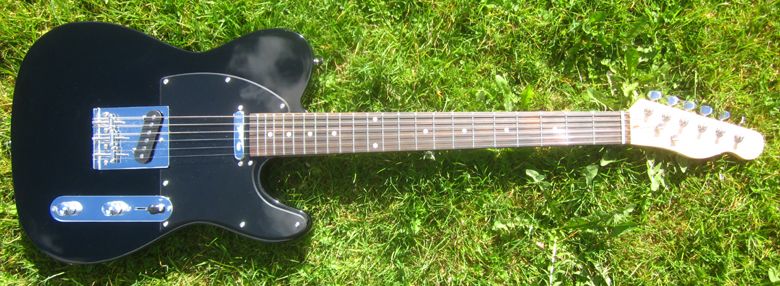
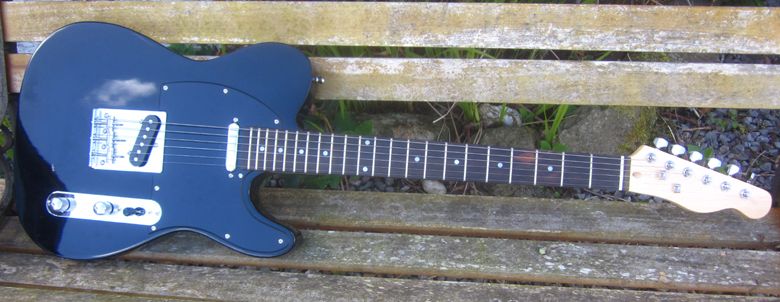
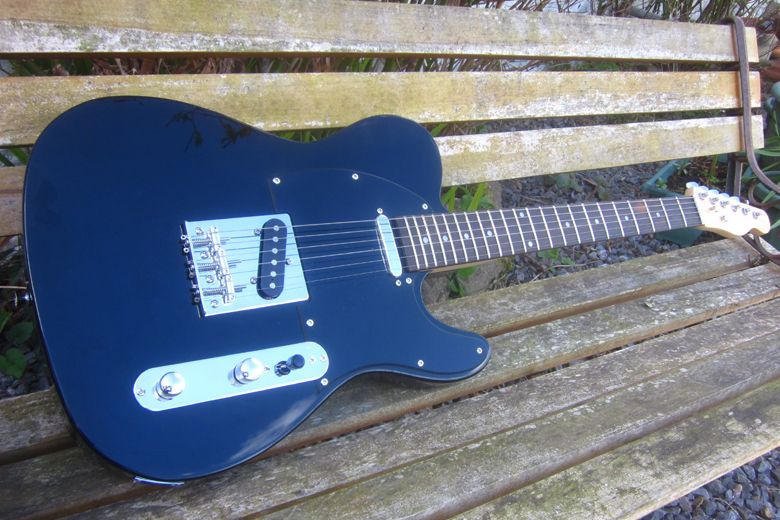
Leo Fender's famous Telecaster design is still as popular as ever after more than 60 years, and is a design that is ripe for copyists. Recently I've noticed several eBay sellers here in the UK who have been importing cheap Telecaster copies in from China and who seemed to be making quite a killing selling them on at sub-£100 prices. Checking the feedback on the sellers' accounts would seem to confirm that these guitars are worth having a look at, so when I saw this black no-name Tele offered at a special knock-down price (i.e. even cheaper than usual from this particular seller), I hit the Buy It Now button straight away.
The guitar arrived two days later, which was quite impressive, and removing if from the box, it looked to be a fairly faithful replica of the Fender original. The seller had made claims about the impressive weight of the guitar (apparently with a body made of basswood) and that it could "demolish a house". I must say I didn't quite see eye to eye with him on this particular claim, I think there's a certain amount of advertising BS that we as buyers need to spot and ignore, but the guitar did seem solid enough, nicely put together and finished. It even came complete with a (cheap) guitar cable and a pair of Allen keys, one each for the adjustment of the truss rod and bridge saddles.
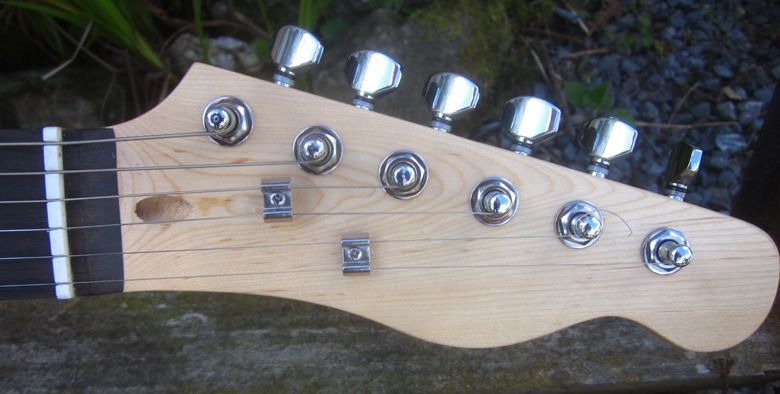
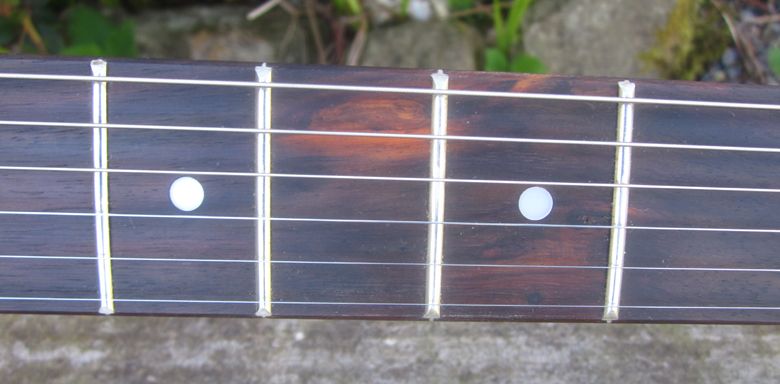
The eBay listing already mentioned that "guitars may have minor assembly marks or imperfections as are a custom made item" and whilst I didn't really follow the logic behind that statement, at least it prepared me for a few minor imperfections, most notably a couple of dents in the top edge of the headstock and also the slightly erratic placement of the dots along the top of the fretboard - they were all at the correct positions, but several were not centred very well and the 12th fret double-dot was decidedly askew. But really, these are very minor quibbles and hardly noticeable. Slightly more noticeable was the discolouration of the rosewood(?) fingerboard at the 4th fret beneath the bass strings. A guitar with a fretboard like this would be consigned as a "second" with many quality guitar manufacturers, but it's only a visual imperfection and not something I could care less about. In fact I think it gives the guitar a little bit of character.
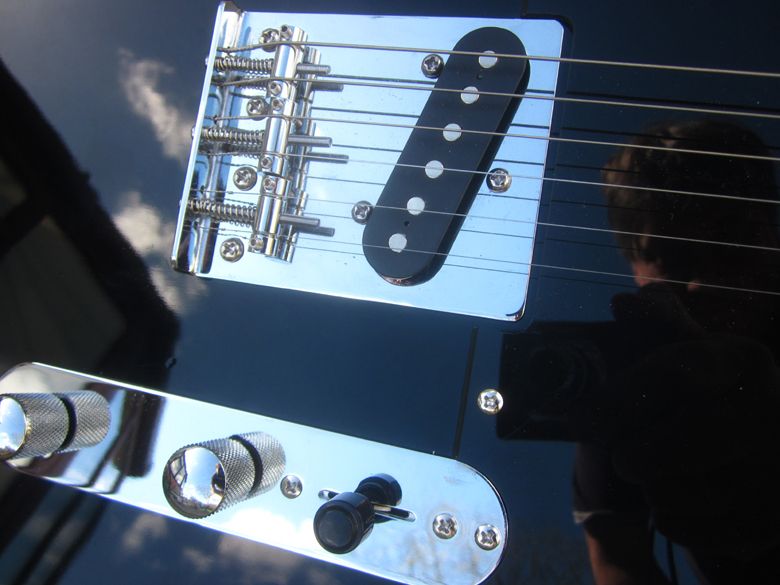
While the bridge is of the three saddle Telecaster variety, it does feature the more modern flat bridge plate rather than the "ashtray" type with an upturned lip on three sides. I must say that I would have preferred the latter as I automatically wanted to rest my right hand against the top side of the bridge but kept ending up gouging my thumb on the threaded inserts protruding from the bridge saddles. It's not really much to worry about and I'm sure I can train myself not to put my hand there.
So far, so good. I'm thinking at this point that the guitar is easily comparable to a Squier-branded Tele, and at a fraction of the price. Even the action and the intonation seem OK; I'm not saying they couldn't be improved upon, but essentially the guitar was ready to go right out of the box. Perhaps it could do with a light fret-dress, a few of the fret ends were slightly rough, but I've known other guitars costing considerably more that far more urgently needed attention in this area.
So, how does it sound plugged in?
Well, it sounds Tele-like, no surprises there. Of course these pickups are not going to be the world's best, but having said that they don't sound bad. If anything they are a little too harsh. I used this guitar at band practice this week and I found I was having to roll off the tone all the time, especially on the bridge pickup (hey, good thing this wasn't a Strat-type guitar!). But yeah, it gives a good Tele twang, and I guess the pickups could always be upgraded if so desired, although a new set of pickups could easily cost more than the guitar itself!
On a less positive note, I noticed considerable hum from the guitar, especially when I removed my hands from the strings. Uh-oh! It's that old problem of a guitar not being properly shielded and/or grounded.
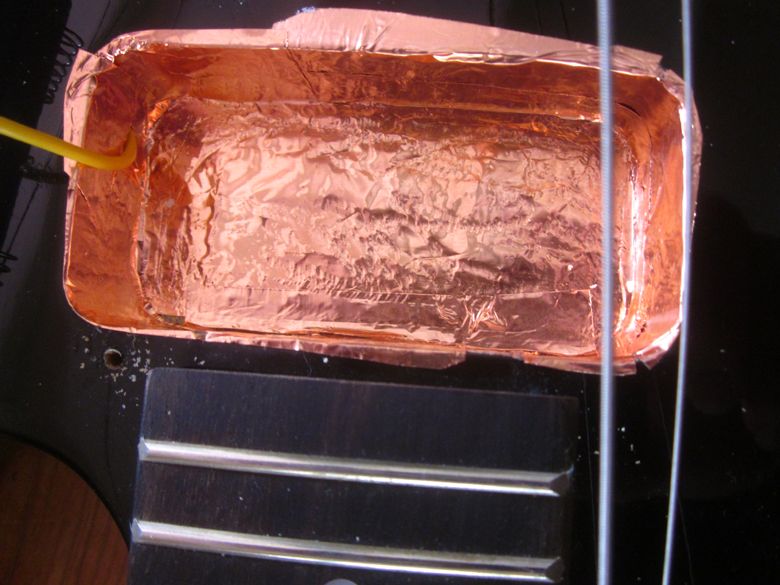
I wasn't going to let this be a problem, and so I bought two sheets of self-adhesive copper foil from another seller on eBay, a very reasonably priced purchase at just over £3 a sheet, and I set about dismantling the guitar and lining the pickup cavities with the foil. Note that the cavity for the neck pickup is large enough to accommodate a humbucker should such an upgrade be required.
I was thinking I'd need to take a wire from the back of the volume pot and ground it to the bridge plate, but I found that (despite the hum) this had already been done. But just to make sure that contact was being made I spread out the individuals strands of wire and then stuck these down in place with another small piece of copper foil. By the way, that copper foil is extremely adhesive and when the backing sheet is peeled away it has a tendency to curl up and stick to itself. I found it easiest to cut and stick very small sections at a time. It was also tricky getting into the pickup cavities seeing as the pickups and controls were still all wired up together, but I really didn't want to completely disassemble the guitar, and de-solder the pickups, etc. That prospect seemed like too much work. This also meant that I had unscrewed components resting on the top of the guitar, and I did manage to make a few small dents between the bridge and the control plate - I'm not too worried about that, you could say I'd begun to "relic" the guitar. (Actually, I think a guitar with this finish would look better "worn-in", but I'm not about to take sandpaper to it, or to knock it about with screwdrivers or whatever. A few natural knocks I am not going to worry about).
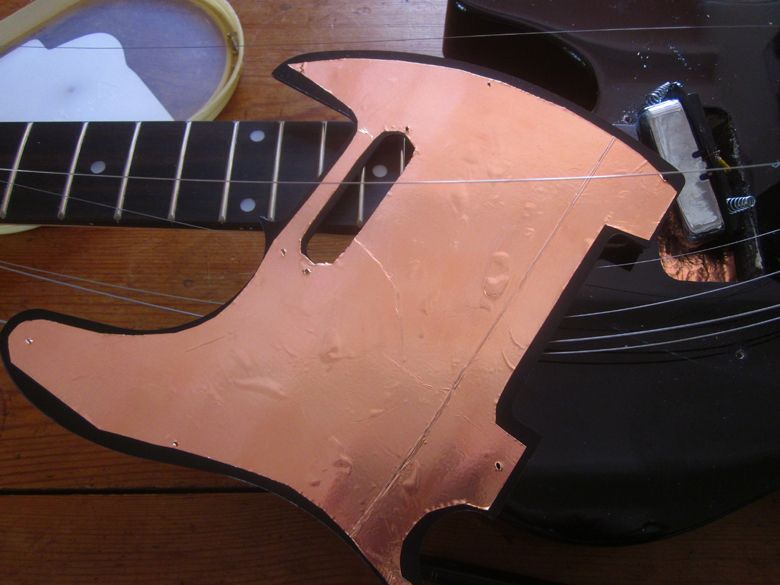
I also decided to shield the reverse of the pickguard; perhaps I didn't need to do as much as that considering it's mostly the timber of the guitar beneath the plate other than the neck pickup rout, but I'm sure it can't harm. This would be a better move on a Strat-type guitar where the plate is covering three pickups. And of course, I shielded the inside of the control cavity, but I forgot to take a photo of this stage.
Plugging it in now, it's silent when you want it to be! I'm so pleased that my DIY shielding job, although not the prettiest, worked. And so what if it wasn't the neatest job, you can't see it now the guitar is re-assembled.
So... my cheap no-name eBay Tele... A good buy?
Definitely! I am really pleased with this guitar, and I'm sure it'll prove to be a very useful addition to my small arsenal of guitars. I would recommend these guitars to anyone wanting a cheap T-type, with the only proviso that you need to be prepared to do some tweaking. In my case it was shielding the guitar, but some might have other set-up issues.
As for the blank headstock, I would NEVER put a Fender logo on there. That would just be a lie, whereas I'm happy to tell anyone that this is just a cheap eBay guitar.
G L Wilson
© 2013, Guitarz - The Original Guitar Blog - the blog that goes all the way to 11!
Please read our photo and content policy.
We've all seen these cheap guitars on eBay, often with prices that seem too good to be true. If you're like me you'll have said to yourself that one day you'll buy one and give it a whirl, see if it really is as good as the eBay seller claims (and don't they always claim they are wonderful?).
Leo Fender's famous Telecaster design is still as popular as ever after more than 60 years, and is a design that is ripe for copyists. Recently I've noticed several eBay sellers here in the UK who have been importing cheap Telecaster copies in from China and who seemed to be making quite a killing selling them on at sub-£100 prices. Checking the feedback on the sellers' accounts would seem to confirm that these guitars are worth having a look at, so when I saw this black no-name Tele offered at a special knock-down price (i.e. even cheaper than usual from this particular seller), I hit the Buy It Now button straight away.
The guitar arrived two days later, which was quite impressive, and removing if from the box, it looked to be a fairly faithful replica of the Fender original. The seller had made claims about the impressive weight of the guitar (apparently with a body made of basswood) and that it could "demolish a house". I must say I didn't quite see eye to eye with him on this particular claim, I think there's a certain amount of advertising BS that we as buyers need to spot and ignore, but the guitar did seem solid enough, nicely put together and finished. It even came complete with a (cheap) guitar cable and a pair of Allen keys, one each for the adjustment of the truss rod and bridge saddles.
The eBay listing already mentioned that "guitars may have minor assembly marks or imperfections as are a custom made item" and whilst I didn't really follow the logic behind that statement, at least it prepared me for a few minor imperfections, most notably a couple of dents in the top edge of the headstock and also the slightly erratic placement of the dots along the top of the fretboard - they were all at the correct positions, but several were not centred very well and the 12th fret double-dot was decidedly askew. But really, these are very minor quibbles and hardly noticeable. Slightly more noticeable was the discolouration of the rosewood(?) fingerboard at the 4th fret beneath the bass strings. A guitar with a fretboard like this would be consigned as a "second" with many quality guitar manufacturers, but it's only a visual imperfection and not something I could care less about. In fact I think it gives the guitar a little bit of character.
While the bridge is of the three saddle Telecaster variety, it does feature the more modern flat bridge plate rather than the "ashtray" type with an upturned lip on three sides. I must say that I would have preferred the latter as I automatically wanted to rest my right hand against the top side of the bridge but kept ending up gouging my thumb on the threaded inserts protruding from the bridge saddles. It's not really much to worry about and I'm sure I can train myself not to put my hand there.
So far, so good. I'm thinking at this point that the guitar is easily comparable to a Squier-branded Tele, and at a fraction of the price. Even the action and the intonation seem OK; I'm not saying they couldn't be improved upon, but essentially the guitar was ready to go right out of the box. Perhaps it could do with a light fret-dress, a few of the fret ends were slightly rough, but I've known other guitars costing considerably more that far more urgently needed attention in this area.
So, how does it sound plugged in?
Well, it sounds Tele-like, no surprises there. Of course these pickups are not going to be the world's best, but having said that they don't sound bad. If anything they are a little too harsh. I used this guitar at band practice this week and I found I was having to roll off the tone all the time, especially on the bridge pickup (hey, good thing this wasn't a Strat-type guitar!). But yeah, it gives a good Tele twang, and I guess the pickups could always be upgraded if so desired, although a new set of pickups could easily cost more than the guitar itself!
On a less positive note, I noticed considerable hum from the guitar, especially when I removed my hands from the strings. Uh-oh! It's that old problem of a guitar not being properly shielded and/or grounded.
I wasn't going to let this be a problem, and so I bought two sheets of self-adhesive copper foil from another seller on eBay, a very reasonably priced purchase at just over £3 a sheet, and I set about dismantling the guitar and lining the pickup cavities with the foil. Note that the cavity for the neck pickup is large enough to accommodate a humbucker should such an upgrade be required.
I was thinking I'd need to take a wire from the back of the volume pot and ground it to the bridge plate, but I found that (despite the hum) this had already been done. But just to make sure that contact was being made I spread out the individuals strands of wire and then stuck these down in place with another small piece of copper foil. By the way, that copper foil is extremely adhesive and when the backing sheet is peeled away it has a tendency to curl up and stick to itself. I found it easiest to cut and stick very small sections at a time. It was also tricky getting into the pickup cavities seeing as the pickups and controls were still all wired up together, but I really didn't want to completely disassemble the guitar, and de-solder the pickups, etc. That prospect seemed like too much work. This also meant that I had unscrewed components resting on the top of the guitar, and I did manage to make a few small dents between the bridge and the control plate - I'm not too worried about that, you could say I'd begun to "relic" the guitar. (Actually, I think a guitar with this finish would look better "worn-in", but I'm not about to take sandpaper to it, or to knock it about with screwdrivers or whatever. A few natural knocks I am not going to worry about).
I also decided to shield the reverse of the pickguard; perhaps I didn't need to do as much as that considering it's mostly the timber of the guitar beneath the plate other than the neck pickup rout, but I'm sure it can't harm. This would be a better move on a Strat-type guitar where the plate is covering three pickups. And of course, I shielded the inside of the control cavity, but I forgot to take a photo of this stage.
Plugging it in now, it's silent when you want it to be! I'm so pleased that my DIY shielding job, although not the prettiest, worked. And so what if it wasn't the neatest job, you can't see it now the guitar is re-assembled.
So... my cheap no-name eBay Tele... A good buy?
Definitely! I am really pleased with this guitar, and I'm sure it'll prove to be a very useful addition to my small arsenal of guitars. I would recommend these guitars to anyone wanting a cheap T-type, with the only proviso that you need to be prepared to do some tweaking. In my case it was shielding the guitar, but some might have other set-up issues.
As for the blank headstock, I would NEVER put a Fender logo on there. That would just be a lie, whereas I'm happy to tell anyone that this is just a cheap eBay guitar.
G L Wilson
© 2013, Guitarz - The Original Guitar Blog - the blog that goes all the way to 11!
Please read our photo and content policy.
Wednesday, 27 March 2013
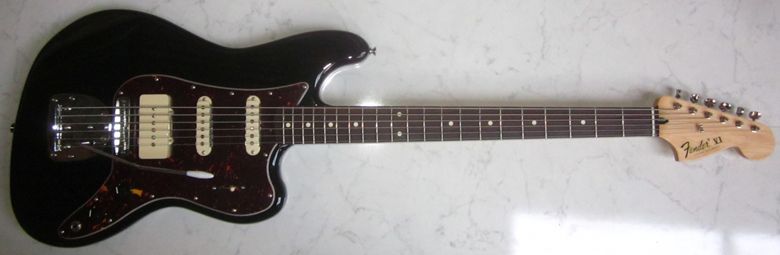
Guitar review: Fender Pawn Shop Series Bass VI
guitarz.blogspot.com:
Fender's Pawn Shop series are - in their own words - "guitars that never were but should have been". The concept seems to be that these designs are influenced by weird old modified guitars that you might find in a pawn shop. Hence we see different pickup combinations and trem systems and variations on design that you wouldn't expect to see on stock Fender guitars. In some cases, the Fender Pawn Shop guitars go beyond such minor modifications and we see alterations to actual body designs, e.g. the Mustang Special has a re-designed chunkier body shape, the '72 is essentially a Thinline Strat, and the Offset Special is reminiscent of a Thinline Strat with an offset waist and equipped with a Jaguar/Jazzmaster tremolo.
The model that I was really interested in, however, was the Fender Pawn Shop Bass VI. I've been hankering after a Bass VI for years. I used to have a Hohner Hollywood (so-called) Bass VI but its 25.5" scale length meant that you couldn't really tune it down a full octave below a regular guitar, and so I had to make do with it being tuned down to G. That's still a whole lot lower than most baritone guitars which are often tuned to B or C - or A if you're lucky, but it still wasn't "bass" enough and that always really bugged me.
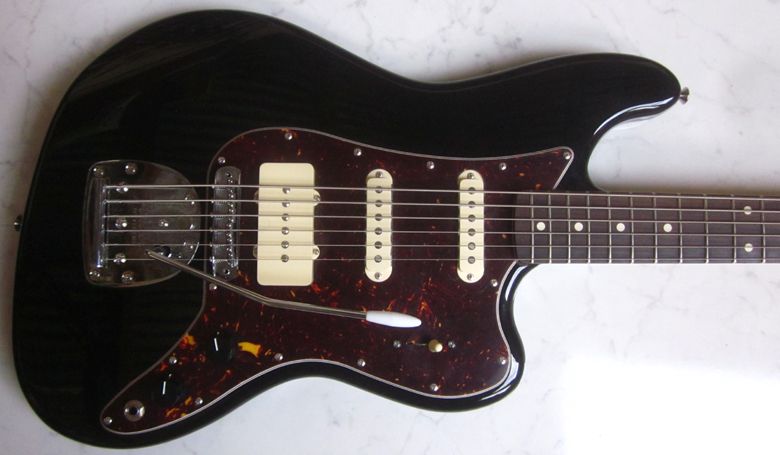
The Pawn Shop Bass VI, like the original, has a 30" scale and so has no such problems with being tuned to E. It differs from the original Fender Bass VI in a number of minor details: most notably it has a JZHB pickup in the bridge position - this does look a lot like a large P90 pickup but my understanding is that it is a double coil version of the Jazzmaster pickup. In the neck and middle positions are a pair of Jaguar pickups. These are all controlled by a Strat-like 5-way switch. It's a disappointment that Fender didn't use the individual pickup on/off switches plus "strangle" switch on a chrome plate as on the classic Bass VI. This doesn't seem so much like a quirky modification, rather a brazen cost-cutting exercise, which is a pity because I think Fender missed a trick here.
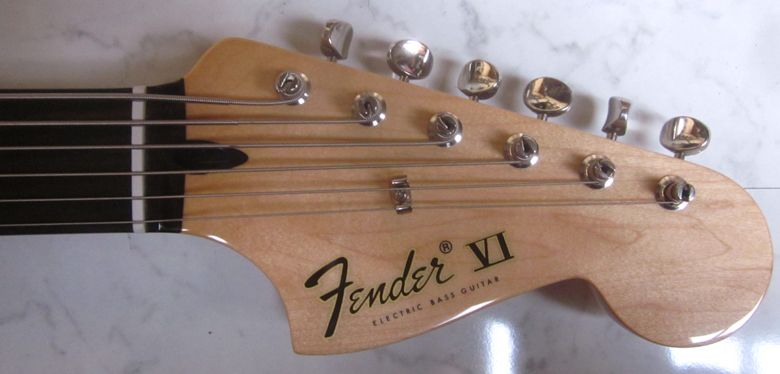
There's another chrome plate missing beneath the volume and tone controls and output jack. Here on the Pawn Shop Bass VI the pickguard has been extended to include this area. Other than that, it's a pretty faithful reproduction of the original. The neck is unbound, but then not all the "originals" had bound necks anyway. Interestingly the headstock bears the legend "Fender VI" (as used on the very first Bass VIs rather than the later "Fender Bass VI") with "Electric Bass Guitar" in smaller lettering beneath.
Part of the reason that I wanted a Bass VI was so as to encourage me to play more melodic parts and lead lines, as so often in a band situation I find myself ending up playing rhythm guitar which - although I am happy to do - I want my share of the limelight too. I also have an album to record and I was looking for new "voices" to use in my music, and decided that a Bass VI could be the very thing.
So, how does it play and sound? Well, the first thing that struck me was that it packs a punch as a bass. Some uninformed people insist on calling the Fender Bass VI a "baritone guitar". Believe me, it is nothing of the sort; indeed I'd go so far as to say that to call it a baritone guitar is an insult. It's as much of a bass as a Fender Precision or a Jazz Bass. Other people say that it's a "bass for guitarists", but I don't think this is so much of an insult - there's a lot of truth in the statement. It has six strings, it is tuned like a guitar only an octave lower, and the string spacing is like that of a guitar. It even has a tremolo (but I'll talk about that some more later). A bassist friend of mine tried out the Fender Bass VI and commented, "I'm not sure how I'm supposed to play it. Do I play it as a bass or as a guitar?"
For the most part I do play it like a guitar, although I expect I'll end up using it for bass lines too. The one thing that took a little getting used to was the extra stretch on a 30" scale. It didn't feel too bad, but when I changed back to playing a regular scale guitar again, that felt really awkward. However, having been changing back and forth between guitar and Bass VI for a month now I have gotten used to the differences in scale length.
It is possible to play guitar chords, but open chords can sound muddy; you wouldn't really want to strum on a Bass VI, but careful arpeggiation of chords can be quite effective. Barre chords are possible too - they sound better the higher up the neck you travel. I've even played the Bass VI using a capo on certain songs so as to put me into baritone guitar range - that has proven to be quite effective.
Initially I was underwhelmed by the JZHB pickup in the bridge position. My initial reaction was that Fender had put it there just for the sake of making it different so as to justify the "Pawn Shop" label. However, I was initially using my guitar amp but after a band performance during which the poor amp struggled, I got myself a most excellent bass amp from Roland's Cube series which complements the Bass VI beautifully. Prior to that I only ever used the bridge JZHB pickup in conjunction with the middle Jaguar pickup through the guitar amp because I thought that on its own it sounded thin and weedy, I have since found that through a proper bass amp it gives me a really usable treble sound that cuts through nicely when playing in a band situation that includes another bass player.
When playing with another bass player, I've been very conscious that I need to dial in a different bass sound so that we don't clash or else end up in one big bassy muddle. Using the JZHB pickup helps cut through, but also choice of effects helps too - and thankfully my Roland Bass Cube has a whole load on-board.
The Bass VI is an instrument crying out to be played with a chorus effect. It really does bring the sound to life. I've also found it best to scoop the middle out on the EQ on the amp, but obviously one can experiment and find out what works best for them.
I love also the sound of the Jaguar pickups, although I think perhaps I would use them more when recording rather than when in a live situation when I want my sound to be distinct from that of the (4-string) bass player in the band.
Now the tremolo... it's the same kind of Fender trem as featured on their Jaguar and Jazzmaster guitars. That, for me, should be a good thing as I've never got on with Strat-style tremolos. However, with this particular instrument I cannot get the trem arm to snap into place. I really don't want to force it into position and possibly break something. I've tried asking Fender in the UK what I might be doing wrong and so far have not received any response. I did wonder if the shop may have given me the wrong arm, but seeing as it was a shop specialising in bass guitars that is rather unlikely (the only other Bass VI they had was the Eastwood Sidejack and I remember that had its trem arm installed - also that's another Fender Jaguar/Jazzmaster type system). [EDIT - 16 April 2013: Today I received a parcel from Fender containing a threaded tremolo arm for Bass VI. It fits and operates percectly. Yes, it does seem that the shop gave me the wrong arm in the first place. A big "thank you" to Michael at Fender Customer Relations for sorting this out for me.]
I've seen the opinion expressed elsewhere thay the tremolo on the Bass VI is no great shakes anyway and is more of a gimmick than a usable trem, but I would like the opportunity to find out for myself. (Earlier I mentioned the Hohner Bass VI I used to own. That had a Wilkinson trem that was very effective in use).
Having seen comments on forums such as offsetguitars.com it seems that some people are buying these Pawn Shop Bass VIs and modifying them to look and function like the originals, which is an irony seeing as the whole point of the Pawn Shop series was to present ready "modified" guitars. I think Fender should have done a straight reissue of the Bass VI rather than a Pawn Shop version. A little bit of chrome shouldn't hike the price up very much.
I know it sounds like I have a few niggles with the Fender Pawn Shop Bass VI, but despite the unnecessary Pawn Shop accoutrements, despite the mix-up with the trem on my example, I do love my Bass VI dearly. I feel as if it might be the perfect instrument for me and can honestly say I haven't been as excited about a guitar purchase as much since I bought my first ever Fender Stratocaster circa 1987.
The Bass VI is a Made in Mexico Fender, which is something a few years back might have caused some to view it with concern, but Fender Mexico have really got their act together now and this is a quality-made and beautifully-finished instrument. Retails in the UK at prices between £601 and £755 so shop around. Colours are black with tortoiseshell pickguard (i.e. mine), sunburst with tortoiseshell pickguard, and candy apple red with matching headstock and white pickguard.
Just DON'T call it a baritone guitar, OK?
G L Wilson
© 2013, Guitarz - The Original Guitar Blog - the blog that goes all the way to 11!
Please read our photo and content policy.
Fender's Pawn Shop series are - in their own words - "guitars that never were but should have been". The concept seems to be that these designs are influenced by weird old modified guitars that you might find in a pawn shop. Hence we see different pickup combinations and trem systems and variations on design that you wouldn't expect to see on stock Fender guitars. In some cases, the Fender Pawn Shop guitars go beyond such minor modifications and we see alterations to actual body designs, e.g. the Mustang Special has a re-designed chunkier body shape, the '72 is essentially a Thinline Strat, and the Offset Special is reminiscent of a Thinline Strat with an offset waist and equipped with a Jaguar/Jazzmaster tremolo.
The model that I was really interested in, however, was the Fender Pawn Shop Bass VI. I've been hankering after a Bass VI for years. I used to have a Hohner Hollywood (so-called) Bass VI but its 25.5" scale length meant that you couldn't really tune it down a full octave below a regular guitar, and so I had to make do with it being tuned down to G. That's still a whole lot lower than most baritone guitars which are often tuned to B or C - or A if you're lucky, but it still wasn't "bass" enough and that always really bugged me.
The Pawn Shop Bass VI, like the original, has a 30" scale and so has no such problems with being tuned to E. It differs from the original Fender Bass VI in a number of minor details: most notably it has a JZHB pickup in the bridge position - this does look a lot like a large P90 pickup but my understanding is that it is a double coil version of the Jazzmaster pickup. In the neck and middle positions are a pair of Jaguar pickups. These are all controlled by a Strat-like 5-way switch. It's a disappointment that Fender didn't use the individual pickup on/off switches plus "strangle" switch on a chrome plate as on the classic Bass VI. This doesn't seem so much like a quirky modification, rather a brazen cost-cutting exercise, which is a pity because I think Fender missed a trick here.
There's another chrome plate missing beneath the volume and tone controls and output jack. Here on the Pawn Shop Bass VI the pickguard has been extended to include this area. Other than that, it's a pretty faithful reproduction of the original. The neck is unbound, but then not all the "originals" had bound necks anyway. Interestingly the headstock bears the legend "Fender VI" (as used on the very first Bass VIs rather than the later "Fender Bass VI") with "Electric Bass Guitar" in smaller lettering beneath.
Part of the reason that I wanted a Bass VI was so as to encourage me to play more melodic parts and lead lines, as so often in a band situation I find myself ending up playing rhythm guitar which - although I am happy to do - I want my share of the limelight too. I also have an album to record and I was looking for new "voices" to use in my music, and decided that a Bass VI could be the very thing.
So, how does it play and sound? Well, the first thing that struck me was that it packs a punch as a bass. Some uninformed people insist on calling the Fender Bass VI a "baritone guitar". Believe me, it is nothing of the sort; indeed I'd go so far as to say that to call it a baritone guitar is an insult. It's as much of a bass as a Fender Precision or a Jazz Bass. Other people say that it's a "bass for guitarists", but I don't think this is so much of an insult - there's a lot of truth in the statement. It has six strings, it is tuned like a guitar only an octave lower, and the string spacing is like that of a guitar. It even has a tremolo (but I'll talk about that some more later). A bassist friend of mine tried out the Fender Bass VI and commented, "I'm not sure how I'm supposed to play it. Do I play it as a bass or as a guitar?"
For the most part I do play it like a guitar, although I expect I'll end up using it for bass lines too. The one thing that took a little getting used to was the extra stretch on a 30" scale. It didn't feel too bad, but when I changed back to playing a regular scale guitar again, that felt really awkward. However, having been changing back and forth between guitar and Bass VI for a month now I have gotten used to the differences in scale length.
It is possible to play guitar chords, but open chords can sound muddy; you wouldn't really want to strum on a Bass VI, but careful arpeggiation of chords can be quite effective. Barre chords are possible too - they sound better the higher up the neck you travel. I've even played the Bass VI using a capo on certain songs so as to put me into baritone guitar range - that has proven to be quite effective.
Initially I was underwhelmed by the JZHB pickup in the bridge position. My initial reaction was that Fender had put it there just for the sake of making it different so as to justify the "Pawn Shop" label. However, I was initially using my guitar amp but after a band performance during which the poor amp struggled, I got myself a most excellent bass amp from Roland's Cube series which complements the Bass VI beautifully. Prior to that I only ever used the bridge JZHB pickup in conjunction with the middle Jaguar pickup through the guitar amp because I thought that on its own it sounded thin and weedy, I have since found that through a proper bass amp it gives me a really usable treble sound that cuts through nicely when playing in a band situation that includes another bass player.
When playing with another bass player, I've been very conscious that I need to dial in a different bass sound so that we don't clash or else end up in one big bassy muddle. Using the JZHB pickup helps cut through, but also choice of effects helps too - and thankfully my Roland Bass Cube has a whole load on-board.
The Bass VI is an instrument crying out to be played with a chorus effect. It really does bring the sound to life. I've also found it best to scoop the middle out on the EQ on the amp, but obviously one can experiment and find out what works best for them.
I love also the sound of the Jaguar pickups, although I think perhaps I would use them more when recording rather than when in a live situation when I want my sound to be distinct from that of the (4-string) bass player in the band.
Now the tremolo... it's the same kind of Fender trem as featured on their Jaguar and Jazzmaster guitars. That, for me, should be a good thing as I've never got on with Strat-style tremolos. However, with this particular instrument I cannot get the trem arm to snap into place. I really don't want to force it into position and possibly break something. I've tried asking Fender in the UK what I might be doing wrong and so far have not received any response. I did wonder if the shop may have given me the wrong arm, but seeing as it was a shop specialising in bass guitars that is rather unlikely (the only other Bass VI they had was the Eastwood Sidejack and I remember that had its trem arm installed - also that's another Fender Jaguar/Jazzmaster type system). [EDIT - 16 April 2013: Today I received a parcel from Fender containing a threaded tremolo arm for Bass VI. It fits and operates percectly. Yes, it does seem that the shop gave me the wrong arm in the first place. A big "thank you" to Michael at Fender Customer Relations for sorting this out for me.]
I've seen the opinion expressed elsewhere thay the tremolo on the Bass VI is no great shakes anyway and is more of a gimmick than a usable trem, but I would like the opportunity to find out for myself. (Earlier I mentioned the Hohner Bass VI I used to own. That had a Wilkinson trem that was very effective in use).
Having seen comments on forums such as offsetguitars.com it seems that some people are buying these Pawn Shop Bass VIs and modifying them to look and function like the originals, which is an irony seeing as the whole point of the Pawn Shop series was to present ready "modified" guitars. I think Fender should have done a straight reissue of the Bass VI rather than a Pawn Shop version. A little bit of chrome shouldn't hike the price up very much.
I know it sounds like I have a few niggles with the Fender Pawn Shop Bass VI, but despite the unnecessary Pawn Shop accoutrements, despite the mix-up with the trem on my example, I do love my Bass VI dearly. I feel as if it might be the perfect instrument for me and can honestly say I haven't been as excited about a guitar purchase as much since I bought my first ever Fender Stratocaster circa 1987.
The Bass VI is a Made in Mexico Fender, which is something a few years back might have caused some to view it with concern, but Fender Mexico have really got their act together now and this is a quality-made and beautifully-finished instrument. Retails in the UK at prices between £601 and £755 so shop around. Colours are black with tortoiseshell pickguard (i.e. mine), sunburst with tortoiseshell pickguard, and candy apple red with matching headstock and white pickguard.
Just DON'T call it a baritone guitar, OK?
G L Wilson
© 2013, Guitarz - The Original Guitar Blog - the blog that goes all the way to 11!
Please read our photo and content policy.
Saturday, 8 December 2012
Guitar Review: The Musicvox Space-inator - small-bodied, spear-like and with a really useful pickup layout
guitarz.blogspot.com:
Here at Guitarz we really admire people like Matt Eichen, a vintage guitar enthusiast who loves retro instruments so much that back in 1997 he decided to start his own line of retro-inspired guitars. He wasn't content to merely create another range of Fender or Gibson knock-offs, he wanted to create something quirkily different as a homage to the past but with modern playability and production quality.
And so Musicvox was born, and their first model - the Space Ranger - was quite a head turner - classic singlecut guitar and bass models but with an unfeasibly large lower horn and a very eccentrically-shaped headstock. These weren't guitars for just anybody, certainly not for the hordes of conservative-minded guitarists who can only think in terms of Strat, Tele, Les Paul, SG. With a Musicvox guitar you needed to be in the Matt Eichen mindset; you either "got it" or you didn't.
Finding it difficult to find a distributor for these "wackily"-designed guitars, Musicvox began selling their guitars directly to the public via the internet, and indeed were one of the first guitar brands to do so. Of course this is common practice nowadays.
Musicvox followed the Space Ranger with the Space Cadet - a similar design but with the eccentricities toned down - and models included the Space Cadet 12-string bass which was not only one of the more competitively priced 12-string basses on the market but also highlighted Musicvox's agenda to create instruments that challenged the norm.
In 2002 a pair of Musicvox Space Ranger guitars were featured in Goldmember, the 3rd instalment of the Austin Powers movie series, which exposure should have proved beneficial to Musicvox sales, but soon after for personal family reasons Eichen was forced to wind down the company.
Fast forward best part of a decade, and Eichen - buoyed up by the fact that he noticed that there were still a lot of people out there talking about Musicvox guitars and a continued interest on the internet - decided to re-launch the brand.
Of course the models that got everyone talking in the first place - the Space Ranger and the Space Cadet - were back and were accompanied by some new designs - the MI5 guitar, bass and 12-string guitar, and the spear-like Space-inator guitar and bass (the prototype was named the Strataspear but a certain other company took umbrage and issued a court injunction against the use of the name).
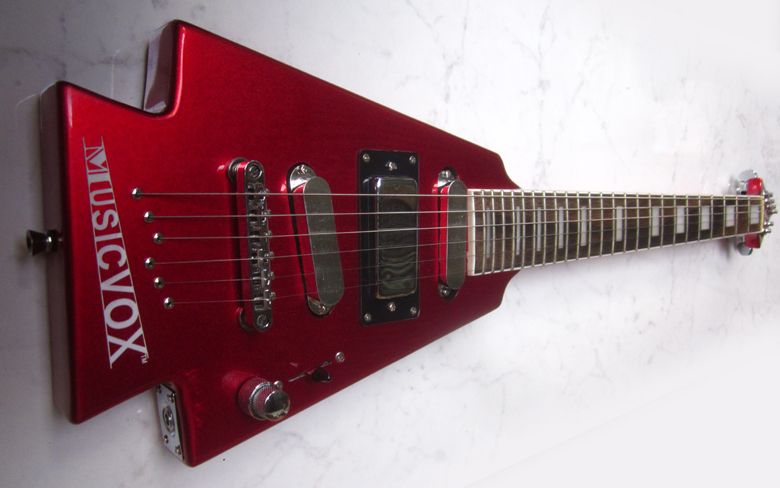
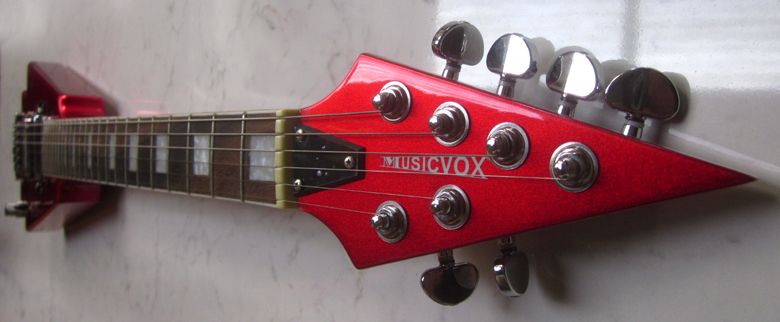
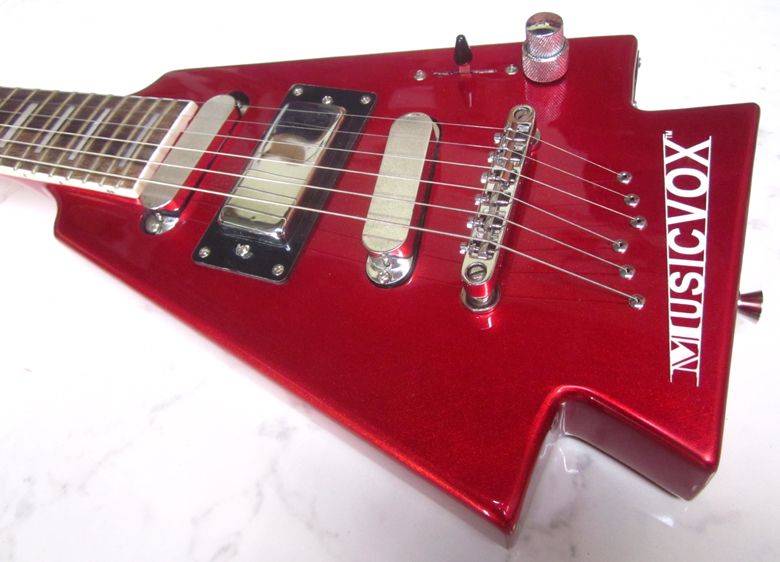
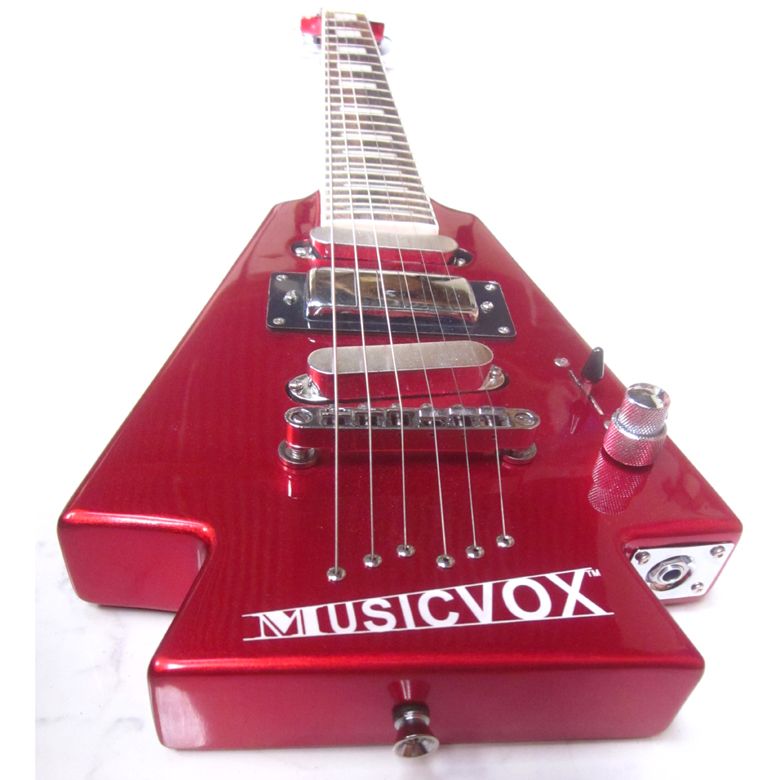
Matt very kindly sent a Space-inator all the way to deepest darkest Pembrokeshire in Wales, UK for Guitarz to review. This particular example is finished in a flawless candy apple red. Other colours I have seen pictured are gold flake, silver flake, and taxi cab yellow - all are extremely eye-catching. Upon taking the guitar out of the box I was immediately struck by the sheer quality of the finish. With the metallic candy apple red I could almost have believed that the Space-inator was made completely of metal. I was also very impressed that it emerged from the box more or less in tune after its Atlantic Ocean crossing; just two strings were slightly flat and needed tweaking.
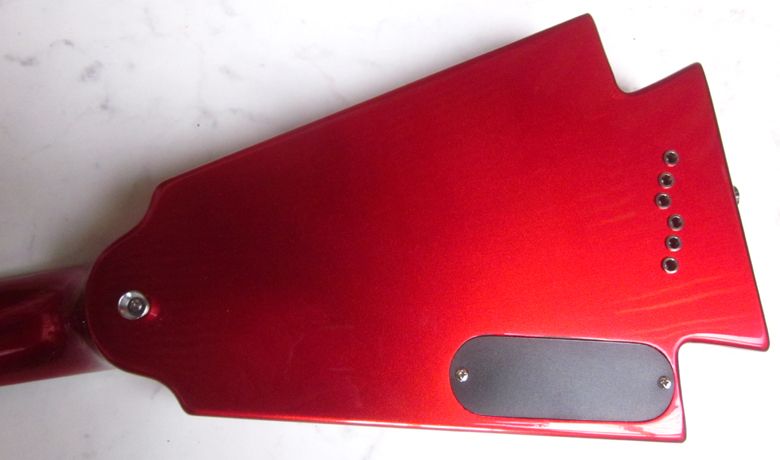
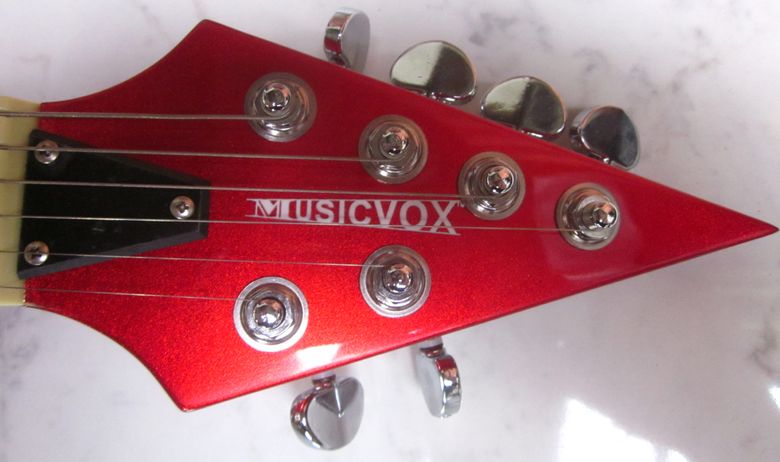
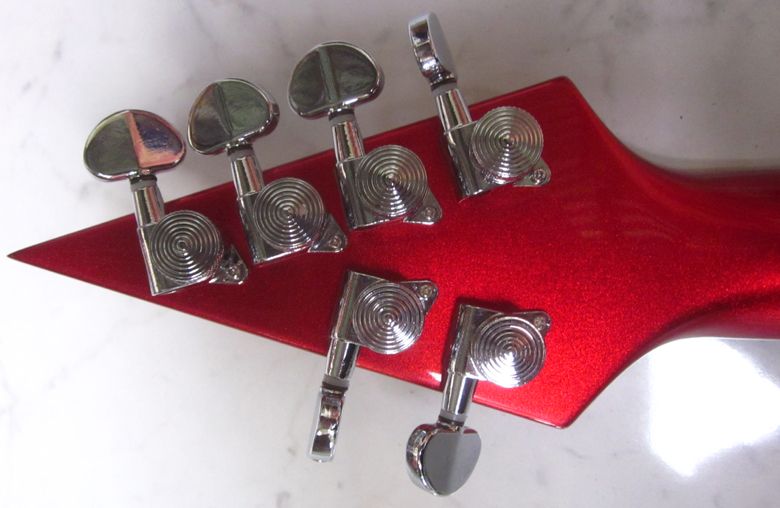
So, let's take a closer look at what we've got here. The Space-inator is a small-bodied guitar weighing in at just over 4 pounds. It has an angular, arrow-shaped body not unlike a more flared-Steinberger shape, and also perhaps vaguely reminiscent of the Burns Flyte, whilst a friend who I showed it to commented that it looked like a "sawn-off Flying V". The headstock is a compact very pointy spear-shaped affair with locking tuners arranged in a 4+2 formation a la Musicman and certain vintage Teisco guitars. This isn't merely a whim of aesthetics; if you look at the back of this very compact headstock you'll see that there would have been no room to facilitate having the G and D string tuners opposite one another in a 3+3 layout.
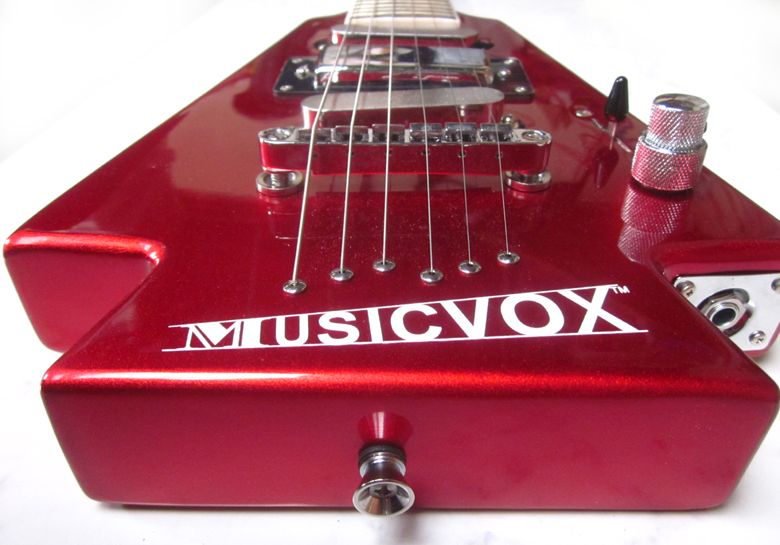
The neck of the Space-inator has a bound rosewood fingerboard and carries 24 jumbo frets and block pearloid position markers. Of course, because of the minimal body shape, there is no difficulty whatsoever in reaching the highest frets at the body end of the fingerboard. The scale length is 25.5", and the heel of the neck blends smoothly into the underside of the guitar body. The Space-inator is in fact of neck-through construction. That and the through-body stringing behind the Tune-o-matic style bridge ensure that the Space-inator gives plenty of sustain, something which may have so easily have been compromised on such a small bodied guitar.
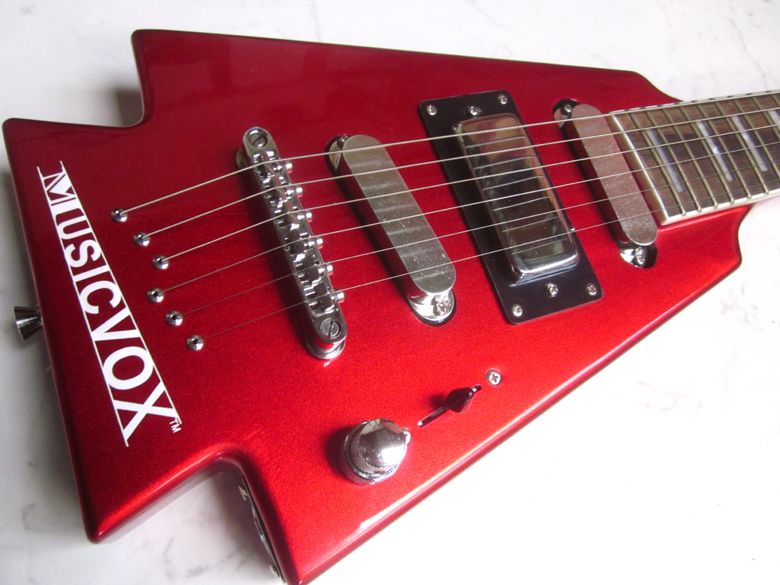
It would have been so easy for Musicvox to unimaginatively equip this guitar with a pair of humbuckers or else three Strat-style single coil pickups, but instead they have chosen to do something much more interestingly versatile. What we have here are three pickups controlled via a 5-way switch, with two low-noise single coils in the neck and bridge positions and a mini-humbucker in the middle position. I have previously commented on this blog about the usefulness of such a rarely-seen layout after having played a friend's Aria "Dragon Strat" which had a stacked humbucker in the middle position. What it means is that you can get the classic single coil sounds in the neck and bridge positions, but you can beef up both of these in the inbetween positions, and of course get a full-throttle humbucker in the middle position. I find that it's a lot more useful say than a SSH pickup layout where you can only use the humbucker in conjunction with one of the other single coils (unless it has individual pickup switching). Note also that the bridge pickup on the Space-inator is angled in the opposite direction to that on a Strat. I found it wasn't as bright sounding as the bridge pickup on a (typical) Strat, but then this guitar is its own animal - if you want Strat tones that badly then use a Strat! I must confess that my favourite pickup selections were the middle three, i.e. all of those utilising the humbucker, but then that's just me.
As for controls, we have the aforementioned 5-way pickup selector switch and a volume and tone on a single concentric stacked pot - very nice and simple to use, maybe too simple for some who like separate controls for each pickup; for myself I'd be happy to sacrifice the tone control altogether and just have a single volume.
In use, the Space-inator does take a little bit of getting used to at first, mainly because of the way it hangs on a strap and because of that and its shape the 24-fret neck does seem to be extremely long - it feels a little like suddenly having a bass neck to contend with. Playing some solos I'd previously been playing on my trusty Aria TA-30 semi I did find I was going to the wrong frets quite often. But of course none of this is the guitar's fault; it's just the learning experience that goes along with anything that is new to you.
I had worried that the minimalistic body would not provide any forearm support for my right arm when playing, but in fact it's very easy to rest your right wrist against the "notch" formed by the shape at the rear of the body and I experienced no arm fatigue whatsoever, unlike that I have experienced playing other small-bodied guitars.
One thing I should mention is that the Space-inator is neck heavy (or "body light", as Bertram put it). Unfortunately this is just about unavoidable on a small bodied guitar such as this, and Musicvox have done all they could to design a compact headstock. Sure, they could have made it headless, but that would likely have limited its appeal to many, and I don't think design-wise it'd have done the Space-inator any favours. But it's not necessarily a problem; it's just something that you need to know about and compensate for when playing. I mentioned resting the right wrist against the rear of the body when playing; this also helps keep the instrument balanced, and 99% of the time your left-hand is holding the neck anyway so that ought to keep it pointing the right way. But I do think it is essential that the Space-inator owner uses some form of strap locking device, just in case the guitar takes a neck-wise tumble. I use the cheap plastic variety that only cost 50 pence each or thereabouts - they are cheap but they do the job well; you don't necessarily have to go to the expense of getting specialist strap locks installed.
Whilst the Space Ranger and Space Cadets will appeal to psychedelic rockers, retro-themed bands, possibly a few krautrockers, rock'n'rollers and rockabillies, the Space-inator is probably the one Musicvox guitar that might appeal to those from the shredding fraternity as it excels at fast lead playing, playing right up at the top of the 24-fret neck, and thanks to that mini-humbucker it has the necessary tones required.
I can also see a use for it in the studio, as not only is it a professional quality instrument with a wide tonal palette, but also the compact body size make it perfect for those times when you have a guitar strapped on at the ready whilst behind a recording console or computer. You could also use it as a travel guitar, although its full scale length and the presence of a headstock mean that it's a lot longer than some.
The Space-inator is available directly from the Musicvox website, but also keep following Musicvox on Facebook where special offers are occasionally announced.
More photos follow:
Note: photos are by G L Wilson, but please feel free to copy and reproduce - although a credit to Guitarz would be appreciated - thanks!
G L Wilson
© 2012, Guitarz - The Original Guitar Blog - 10 years and counting!
Here at Guitarz we really admire people like Matt Eichen, a vintage guitar enthusiast who loves retro instruments so much that back in 1997 he decided to start his own line of retro-inspired guitars. He wasn't content to merely create another range of Fender or Gibson knock-offs, he wanted to create something quirkily different as a homage to the past but with modern playability and production quality.
And so Musicvox was born, and their first model - the Space Ranger - was quite a head turner - classic singlecut guitar and bass models but with an unfeasibly large lower horn and a very eccentrically-shaped headstock. These weren't guitars for just anybody, certainly not for the hordes of conservative-minded guitarists who can only think in terms of Strat, Tele, Les Paul, SG. With a Musicvox guitar you needed to be in the Matt Eichen mindset; you either "got it" or you didn't.
Finding it difficult to find a distributor for these "wackily"-designed guitars, Musicvox began selling their guitars directly to the public via the internet, and indeed were one of the first guitar brands to do so. Of course this is common practice nowadays.
Musicvox followed the Space Ranger with the Space Cadet - a similar design but with the eccentricities toned down - and models included the Space Cadet 12-string bass which was not only one of the more competitively priced 12-string basses on the market but also highlighted Musicvox's agenda to create instruments that challenged the norm.
In 2002 a pair of Musicvox Space Ranger guitars were featured in Goldmember, the 3rd instalment of the Austin Powers movie series, which exposure should have proved beneficial to Musicvox sales, but soon after for personal family reasons Eichen was forced to wind down the company.
Fast forward best part of a decade, and Eichen - buoyed up by the fact that he noticed that there were still a lot of people out there talking about Musicvox guitars and a continued interest on the internet - decided to re-launch the brand.
Of course the models that got everyone talking in the first place - the Space Ranger and the Space Cadet - were back and were accompanied by some new designs - the MI5 guitar, bass and 12-string guitar, and the spear-like Space-inator guitar and bass (the prototype was named the Strataspear but a certain other company took umbrage and issued a court injunction against the use of the name).
Matt very kindly sent a Space-inator all the way to deepest darkest Pembrokeshire in Wales, UK for Guitarz to review. This particular example is finished in a flawless candy apple red. Other colours I have seen pictured are gold flake, silver flake, and taxi cab yellow - all are extremely eye-catching. Upon taking the guitar out of the box I was immediately struck by the sheer quality of the finish. With the metallic candy apple red I could almost have believed that the Space-inator was made completely of metal. I was also very impressed that it emerged from the box more or less in tune after its Atlantic Ocean crossing; just two strings were slightly flat and needed tweaking.
So, let's take a closer look at what we've got here. The Space-inator is a small-bodied guitar weighing in at just over 4 pounds. It has an angular, arrow-shaped body not unlike a more flared-Steinberger shape, and also perhaps vaguely reminiscent of the Burns Flyte, whilst a friend who I showed it to commented that it looked like a "sawn-off Flying V". The headstock is a compact very pointy spear-shaped affair with locking tuners arranged in a 4+2 formation a la Musicman and certain vintage Teisco guitars. This isn't merely a whim of aesthetics; if you look at the back of this very compact headstock you'll see that there would have been no room to facilitate having the G and D string tuners opposite one another in a 3+3 layout.
The neck of the Space-inator has a bound rosewood fingerboard and carries 24 jumbo frets and block pearloid position markers. Of course, because of the minimal body shape, there is no difficulty whatsoever in reaching the highest frets at the body end of the fingerboard. The scale length is 25.5", and the heel of the neck blends smoothly into the underside of the guitar body. The Space-inator is in fact of neck-through construction. That and the through-body stringing behind the Tune-o-matic style bridge ensure that the Space-inator gives plenty of sustain, something which may have so easily have been compromised on such a small bodied guitar.
It would have been so easy for Musicvox to unimaginatively equip this guitar with a pair of humbuckers or else three Strat-style single coil pickups, but instead they have chosen to do something much more interestingly versatile. What we have here are three pickups controlled via a 5-way switch, with two low-noise single coils in the neck and bridge positions and a mini-humbucker in the middle position. I have previously commented on this blog about the usefulness of such a rarely-seen layout after having played a friend's Aria "Dragon Strat" which had a stacked humbucker in the middle position. What it means is that you can get the classic single coil sounds in the neck and bridge positions, but you can beef up both of these in the inbetween positions, and of course get a full-throttle humbucker in the middle position. I find that it's a lot more useful say than a SSH pickup layout where you can only use the humbucker in conjunction with one of the other single coils (unless it has individual pickup switching). Note also that the bridge pickup on the Space-inator is angled in the opposite direction to that on a Strat. I found it wasn't as bright sounding as the bridge pickup on a (typical) Strat, but then this guitar is its own animal - if you want Strat tones that badly then use a Strat! I must confess that my favourite pickup selections were the middle three, i.e. all of those utilising the humbucker, but then that's just me.
As for controls, we have the aforementioned 5-way pickup selector switch and a volume and tone on a single concentric stacked pot - very nice and simple to use, maybe too simple for some who like separate controls for each pickup; for myself I'd be happy to sacrifice the tone control altogether and just have a single volume.
In use, the Space-inator does take a little bit of getting used to at first, mainly because of the way it hangs on a strap and because of that and its shape the 24-fret neck does seem to be extremely long - it feels a little like suddenly having a bass neck to contend with. Playing some solos I'd previously been playing on my trusty Aria TA-30 semi I did find I was going to the wrong frets quite often. But of course none of this is the guitar's fault; it's just the learning experience that goes along with anything that is new to you.
I had worried that the minimalistic body would not provide any forearm support for my right arm when playing, but in fact it's very easy to rest your right wrist against the "notch" formed by the shape at the rear of the body and I experienced no arm fatigue whatsoever, unlike that I have experienced playing other small-bodied guitars.
One thing I should mention is that the Space-inator is neck heavy (or "body light", as Bertram put it). Unfortunately this is just about unavoidable on a small bodied guitar such as this, and Musicvox have done all they could to design a compact headstock. Sure, they could have made it headless, but that would likely have limited its appeal to many, and I don't think design-wise it'd have done the Space-inator any favours. But it's not necessarily a problem; it's just something that you need to know about and compensate for when playing. I mentioned resting the right wrist against the rear of the body when playing; this also helps keep the instrument balanced, and 99% of the time your left-hand is holding the neck anyway so that ought to keep it pointing the right way. But I do think it is essential that the Space-inator owner uses some form of strap locking device, just in case the guitar takes a neck-wise tumble. I use the cheap plastic variety that only cost 50 pence each or thereabouts - they are cheap but they do the job well; you don't necessarily have to go to the expense of getting specialist strap locks installed.
Whilst the Space Ranger and Space Cadets will appeal to psychedelic rockers, retro-themed bands, possibly a few krautrockers, rock'n'rollers and rockabillies, the Space-inator is probably the one Musicvox guitar that might appeal to those from the shredding fraternity as it excels at fast lead playing, playing right up at the top of the 24-fret neck, and thanks to that mini-humbucker it has the necessary tones required.
I can also see a use for it in the studio, as not only is it a professional quality instrument with a wide tonal palette, but also the compact body size make it perfect for those times when you have a guitar strapped on at the ready whilst behind a recording console or computer. You could also use it as a travel guitar, although its full scale length and the presence of a headstock mean that it's a lot longer than some.
The Space-inator is available directly from the Musicvox website, but also keep following Musicvox on Facebook where special offers are occasionally announced.
More photos follow:
Note: photos are by G L Wilson, but please feel free to copy and reproduce - although a credit to Guitarz would be appreciated - thanks!
G L Wilson
© 2012, Guitarz - The Original Guitar Blog - 10 years and counting!
Wednesday, 22 February 2012
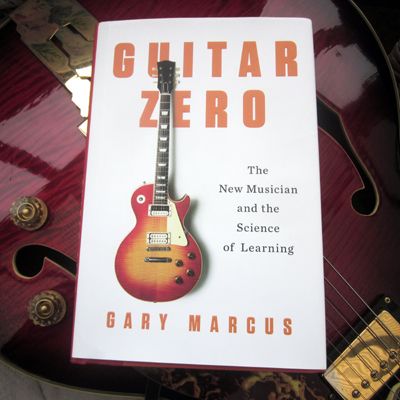
Book review: Guitar Zero by Gary Marcus
guitarz.blogspot.com:
Gary Marcus is a professor of psychology at New York University, studying evolution, language and cognitive behaviour. Claiming to have no musical ability but a deep desire to make music, Marcus took advantage of the free time available to him during a sabbatical from work in which to get to grips with his instrument of choice, the guitar.
Guitar Zero documents his musical journey but also delves into the science of learning to play a musical instrument. It asks - and provides answers to - questions like: How did music evolve?; Are some people born to make music or is it a skill anyone can learn?; Is there such a thing as a natural talent?; and Is it only possible to learn to play an instrument at an early age or, contrary to popular opinion, can an old dog learn new tricks?
Marcus seeks out thoughts and advice from professional musicians, music teachers and scientists to help him answer these questions and makes some quite interesting discoveries. I don't think I'm going to spoil anyone's enjoyment of the book by giving away that one very interesting conclusion was that there is no cut-off age for mastering a new skill such as learning to play a musical instrument, and that there is no truth in the argument that you have to be a youngster to learn to play. However, a child learning an instrument is more likely to persevere than an adult because they simply do not have all the other distractions in life that an adult has.
I do worry that someone hitherto unmusical but with a desire to make music might be put off by reading this book, because it constantly stresses the hard work, the mental processes involved and the sheer number of hours of practice necessary. It, unfortunately, manages to make the whole process seem quite daunting and may indeed have the effect of conveying that there is simply too much effort involved. Yes, learning to play an instrument proficiently is demanding, but I feel that Marcus needed to stress more how rewarding it can be, and how much fun you can have with it.
Not enough is made of the fact that there are different levels of playing. You might not want to be proficient as such. Perhaps you just want to learn some basic chords so you can accompany yourself singing songs with friends, around the camp fire, or at an open mic event.
For the guitarist (and perhaps the readership of this blog), this isn't really a very guitary book. The guitar is there only really because it was the instrument that Marcus chose to learn. It could just as easily have been the piano or the saxophone; the book would have been essentially the same. The narrative seems to swing between two poles: the anecdotal stuff about Marcus's own personal quest (including an entertaining section on how as the only adult he joined a bunch of kids in a band at a rock camp), and the more sciencey bits about how the brain works and processes music. There was a whole chapter about how and why learning music is like learning a language and conversely how and why it isn't, much of which went straight over my head and during which I did find myself nodding off to sleep once or twice. It may be part of the bigger picture, but I could have skipped this whole chapter and still have taken away the same amount of meaning from the book.
My conclusions are that while the book sends out some very important and encouraging messages to anyone who's ever wanted to take up an instrument but always thought that they were inherently unmusical, that perhaps it is a bit too sciencey in places and needs to stress the rewards and benefits of learning to play rather than the colossal investment in time, hard work and patience.
Guitar Zero
Gary Marcus
The Penguin Press
ISBN 978-1-59420-317-6
G L Wilson
© 2012, Guitarz - The Original Guitar Blog - now in its 10th year!
Gary Marcus is a professor of psychology at New York University, studying evolution, language and cognitive behaviour. Claiming to have no musical ability but a deep desire to make music, Marcus took advantage of the free time available to him during a sabbatical from work in which to get to grips with his instrument of choice, the guitar.
Guitar Zero documents his musical journey but also delves into the science of learning to play a musical instrument. It asks - and provides answers to - questions like: How did music evolve?; Are some people born to make music or is it a skill anyone can learn?; Is there such a thing as a natural talent?; and Is it only possible to learn to play an instrument at an early age or, contrary to popular opinion, can an old dog learn new tricks?
Marcus seeks out thoughts and advice from professional musicians, music teachers and scientists to help him answer these questions and makes some quite interesting discoveries. I don't think I'm going to spoil anyone's enjoyment of the book by giving away that one very interesting conclusion was that there is no cut-off age for mastering a new skill such as learning to play a musical instrument, and that there is no truth in the argument that you have to be a youngster to learn to play. However, a child learning an instrument is more likely to persevere than an adult because they simply do not have all the other distractions in life that an adult has.
I do worry that someone hitherto unmusical but with a desire to make music might be put off by reading this book, because it constantly stresses the hard work, the mental processes involved and the sheer number of hours of practice necessary. It, unfortunately, manages to make the whole process seem quite daunting and may indeed have the effect of conveying that there is simply too much effort involved. Yes, learning to play an instrument proficiently is demanding, but I feel that Marcus needed to stress more how rewarding it can be, and how much fun you can have with it.
Not enough is made of the fact that there are different levels of playing. You might not want to be proficient as such. Perhaps you just want to learn some basic chords so you can accompany yourself singing songs with friends, around the camp fire, or at an open mic event.
For the guitarist (and perhaps the readership of this blog), this isn't really a very guitary book. The guitar is there only really because it was the instrument that Marcus chose to learn. It could just as easily have been the piano or the saxophone; the book would have been essentially the same. The narrative seems to swing between two poles: the anecdotal stuff about Marcus's own personal quest (including an entertaining section on how as the only adult he joined a bunch of kids in a band at a rock camp), and the more sciencey bits about how the brain works and processes music. There was a whole chapter about how and why learning music is like learning a language and conversely how and why it isn't, much of which went straight over my head and during which I did find myself nodding off to sleep once or twice. It may be part of the bigger picture, but I could have skipped this whole chapter and still have taken away the same amount of meaning from the book.
My conclusions are that while the book sends out some very important and encouraging messages to anyone who's ever wanted to take up an instrument but always thought that they were inherently unmusical, that perhaps it is a bit too sciencey in places and needs to stress the rewards and benefits of learning to play rather than the colossal investment in time, hard work and patience.
Guitar Zero
Gary Marcus
The Penguin Press
ISBN 978-1-59420-317-6
G L Wilson
© 2012, Guitarz - The Original Guitar Blog - now in its 10th year!
Tuesday, 19 April 2011
Fender Cyclone review and demo
guitarz.blogspot.com:
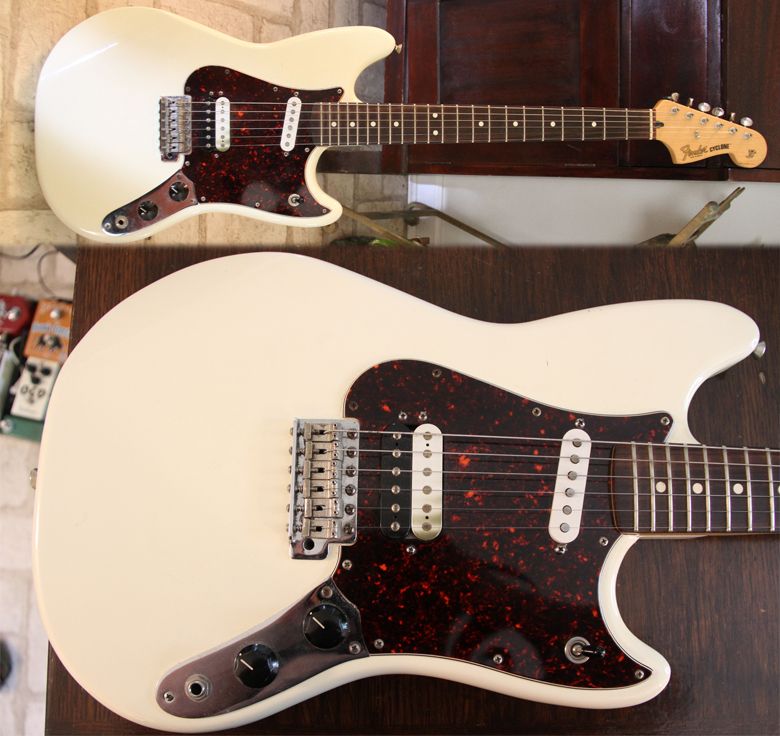
Following on from Bertram's piece on the Fender Cyclone II a few days ago, Guitarz reader Ben Albey has sent us this review of a Fender Cyclone 2-pickup model plus a video demo. Nice one! Over to Ben:
© 2011, Guitarz - The Original Guitar Blog - now in its 10th year!
Following on from Bertram's piece on the Fender Cyclone II a few days ago, Guitarz reader Ben Albey has sent us this review of a Fender Cyclone 2-pickup model plus a video demo. Nice one! Over to Ben:
This is my brother in-law's 2001 Mexican made Fender Cyclone. Everything is original except one of the tuners which was replaced by a Grover, then replaced by me with an extra Fender one I had left over from my Nashville Tele when I put Sperzel tuners on. It has the original Atomic humbucker in the bridge, and Tex Mex single coil in the neck, which is really sweet because it has an angle on it that you don't see on many fender neck pickups. It's white, which by now is cream, which is a hard color to find on these Fender Cyclones, a guitar that is already hard to find.
This year of Cyclones came in Candy apple red, black, white, and vintage sunburst. I saw a black one at a music store in Tennessee when I was on my honeymoon for $300; my wife said I could get it, but we were newlyweds and hard up for cash, so I didn't buy it, and I've been kicking myself ever since. It has a Strat tremolo bridge on it, and a 24.75" scale neck. This is a strange scale for a Fender, a scale that is on Gibson Les Pauls. The guitar also features a maple neck, rosewood fretboard, tortoise shell pickguard and a Jaguar-like control plate and a three way toggle like on a Jazzmaster.
The only draw back for me is that the body is made out of poplar, which is why if you find this era of Cyclone you can probably get it for around $300-$600. Poplar is a good enough wood, and a lot of players have poplar bodies; personally I like ash and alder. Over all this is a great, fun, and comfortable guitar. If I ever find another one, I will buy it on the spot.
Ben Albey
© 2011, Guitarz - The Original Guitar Blog - now in its 10th year!
Saturday, 25 October 2008
CD Review: AC/DC - Black Ice
And why not? After all it is AC/DC's first album since 2000's "Stiff Upper Lip". In a crazy world full of manufactured pop stars, plastic celebrities and endless TV talent shows and their vile supposedly musical offspring, a new album by a much-loved no-nonsense rock band is surely something to celebrate.
But do you really need me to review this for you? You know what it is. You know what it's going to sound like. It sounds like AC/DC. You know exactly what you're getting when you see those four capital letters on the front cover.
And that's not to say that it's a bad thing. This is what people want from AC/DC. How alarming would it have been if they'd decided to change their style and produce an experimental electro jazz fusion concept album? Or something? AC/DC's motto must be "if it ain't broke, don't fix it" and this album delivers 15 cuts of no-nonsense straight-ahead riff-tastic rock 'n' roll boogie. On one track I thought I could hear a similarity with early Status Quo, whilst another was reminiscent of ZZ Top. But of course, it's just AC/DC doing their thing.
You've got to hand it to the brothers Malcolm and Angus Young who penned the 15 songs here. Along with Black Sabbath's Tony Iommi they surely must be Undisputed Masters Of The Guitar Riff. How they keep coming up with riff after riff after riff (which of course leads to song after song after song) I really don't know.
So, to sum up: no surprises but thorougly enjoyable.
AC/DC. Does exactly what it says on the tin.
Monday, 20 October 2008
CD Review: Greg Pearle and John Illsley - Beautiful You
The press release that came with this CD likens Pearle's voice to Tom Waits, Van Morrison and Chris Rea, and I can certainly agree with the latter. However, I know I shouldn't really make such obvious comparisons, call it sloppy reviewing if you will, I can't help feeling that Pearle's gravelly voice occasionally reminds me of Mark Knopfler, although I think he's actually a much better singer. You can imagine that he'd do justice to any Dire Straits songs these two choose to perform live. In other places such as on "Got No Plans" you could almost mistake him for a younger Neil Diamond.
Both Pearle and Illsley play acoustic guitars throughout the album, whilst Illsely also provides lead and bass guitars. I'd always thought of him as a bassist and was thus a little surprised at the quality of his tasteful lead guitar playing. He's a nice understated player - nothing too flash - just adding what is required by the song. Sorry - but making the obvious comparisons again - sometimes I think I can detect a certain Dire Straits-ish quality to the guitar. Perhaps the fact that the album was recorded in Mark Knopfler's studio meant that Illsley was able to use Knopfler's set-up or perhaps I'm just imagining this.
Guy Fletcher from Dire Straits is also on board providing keyboards, string arrangements and some lap steel guitar on "Precious". His keyboards on "Love Let Me Breathe" remind me of Steve Winwood and his Hammond organ, which is no bad thing.
The opening cut "Secret Garden" is one of my favourites - acoustic guitar driven and embellished by a gorgeous sounding horn section. My only problem with this song is that is fades out far too quickly.
Of the other tracks, "One" starts off with some folksy Irish whistle playing but turns into a rock ballad with that (possible) Straits-esque lead guitar sound and "Loving You" has yet more of that gorgeous Stratocaster tone. "Got No Plans" features cittern playing by John McClusker. It's quite an exotic sound, almost middle-eastern in feel and takes the song in an unexpected but welcome direction. "Demons" reminds me of Phil Lynott's "Diary of a Blues Singer" - it must contain a similar chord progression. Complete with a smoky sax solo this a song that you could imagine listening to late at night at a sophisticated club. It oozes class.
Actually the whole album has that late night laid-back mood. I didn't originally think it would be my kind of thing, but I was very pleasantly surprised at the quality of the songs, the production, and at how much I ended up enjoying it.
Why not hear for yourself? The tracks "Secret Garden" and "One" are available as free download from www.johnillsley.com.
Tuesday, 7 October 2008
CD Review: David Gilmour - Live in Gdansk
Anyway, as I said, I have the bog-standard two-disc version with no DVD, so that's what I'm going to be talking about here. Roughly speaking Disc 1 seems to be mainly Gilmour solo material (lots of tracks from "On An Island" which are all nice enough although not earth-shattering) whilst Disc 2 is largely composed of Pink Floyd numbers. This caused me to ponder the fact that with Richard Wright on board on this tour, it's more or less latter-day Pink Floyd in all but name anyway. They just have a different drummer, and of course Roger Waters was long gone in the latter-day Floyd anyway. (On a sad note, this release has become the swansong for Richard Wright who died last month).
So, what's it like? Well, if you are a fan of Pink Floyd and/or David Gilmour then you'll probably love it. You might even want to buy the posher editions with the extra bits and pieces. It sounds like a really atmospheric concert. The audience are clearly loving it. The sound is absolutely faultless. The playing is all perfectly executed.
So why did I find the whole thing so dull?
I'm not saying that it's a bad set, it's just for me that it lacks excitement. It just isn't stimulating. Perhaps you had to be there. Perhaps I needed the visuals and would have found the DVD edition more to my liking.
This is the sort of music that I'd put on as background music if I wanted to chill out. Somehow that seems wrong for someone from Pink Floyd.
If you are a fan, ignore me, you'll probably love it.
Buy it here.
Sunday, 5 October 2008
DVD Review: Lou Reed - Berlin
So, as you can imagine, I approached this DVD with a certain amount of trepidation. And you know what? I reckon my friend was thinking of the wrong album. Surely he was referring to "Metal Machine Music" which was a double-album of guitar feedback loops (and didn't I hear somewhere that this has now been arranged as an orchestral piece?). Anyway, I really couldn't see what my friend's problem with "Berlin" was.
Sure, it's a bleak piece subject-wise, dealing as it does with the inevitable self-destruction of two drug addicts, Jim and Caroline. However, the music is classic Lou Reed and as a performance piece I found it highly engaging.
The visuals of the band on stage are punctuated with specially-shot film footage depicting the characters in the story. This works very effectively as it takes it away from being an ordinary concert video. The camera also gives us some very interesting angles. It seems at times like we're up there on stage with Lou Reed and his band, moving between them and behind them. What we don't get are irrelevant shots of the audience enjoying themselves. That may be all well and good on an AC/DC live video, but here it's really not needed and frankly the film is all the better for it.
Reed and his band - led by guitarist Steve Hunter (who also played back on the original 1973 album) - are joined on stage by a string section, a brass section and the Brooklyn Youth Chorus, and the sound is magnificient.
Reed hardly seems to touch his guitar on the first few songs, but as things progress he plays some incredible solos and duets with Hunter. I'd quite forgotten what a good guitarist he is.
I'm not going to do a song by song breakdown. Let's just say that it's a great performance from all concerned. Having the Brooklyn Youth Chorus along for the ride was a stroke of genius, especially in those somewhat disturbing moments in the narrative when the children's distress at losing their mother is conveyed.
I'd say this was an essential purchase for all Lou Reed fans and those of the Velvet Underground too (seeing as some Velvets songs had been re-worked as songs in "Berlin"). It also shows quite nicely what a music film can look like given a little imagination.
Visually and musically rich, but not one to view if you're feeling depressed.
Saturday, 20 September 2008
DVD Review: AC/DC - No Bull (The Director's Cut)
The footage on this DVD was filmed at the Plaxa De Toros De Las Ventas bullfighting arena in Madrid on the Ballbreaker tour in 1996, and was originally released to video shortly after. The director David Mallet was never happy with the results and so for this new DVD edition the film has been completely re-edited in HD and the audio remixed in both Stereo and 5.1 Surround Sound.
The results are quite spectacular, it has to be said. For starters, the venue is amazing (introducing "Hail Caesar", singer Brian Johnson comments that its the perfect setting for that song), the picture is crystal clear, there are seemingly cameras EVERYWHERE so that we get viewpoints from all over the place, and the band appear to be on top form too.
I approached this video as someone who was not a fan of the band as such, although I bear them no malice, they were just a band I'd never followed. Let's just say, I've been converted. I would have loved to have been at this show, to have seen the spectacle and have witnessed the band working their arses off!
The rhythm section - Malcolm Young on rhythm guitar, Cliff Williams on bass and Phil Rudd on drums - are AD/DC's secret weapon. Those guys are so tight and together they form the powerhouse that drives the whole band along. Brian Johnson's vocals at times resemble a strangled croak, but so what? - it suits the songs - and he has the capability to produce a dirty bluesy growl on songs like "Boogie Man".
Obviously the star of the show is the SG-wielding lead guitarist Angus Young. He is just incredible, and I marvelled at how he could play a guitar solo with apparent ease whilst bombing about from one side of the stage to the other like a demented toddler. His now legendary school uniform only lasted until seven songs into the set, when he interrupted his own guitar solo in order to perform a strip tease. Now that's not the kind of entertainment you get from the likes of Eric Clapton.
There was a fair amount of OTT theatricality to this show what with giant demolition balls, Brian Johnson swinging from the clapper of a giant bell Quasimodo-stylee ("Hells Bells"), cannons firing into the audience ("For Those About To Rock (We Salute You)"), and a monolithically pneumatic Rosie making an appearance in "Whole Lotta Rosie". Somehow all this fails to detract from the band just blasting out their own brand of riff-tastic rock'n'roll. After all, the venue's big enough for all of this.
What more can I say? I think this is the kind of thing that you're either going to love or you're going to hate. I thought it was fantastic, but all the fans are going to buy it anyway. All the big hits are there. It's well-directed, well-produced. I think it's a winner.
At two hours for the main feature I'd say it was good value for money too. Additionally the special features include a couple of bonus performances from other shows on the same tour - these renditions seem somehow rawer to my mind, and are intriguing when contrasted with the Madrid show. Then there are also the alternate "Angus-cam" versions of four songs from the Madrid show, for those of you who'd like to study his technique on a Gibson SG guitar or else to copy his trademarked "spasm".
Buy it here.
Saturday, 30 August 2008
CD Review: Blackmore's Night - Secret Voyage
Now the music press has been rather unkind to Ritchie Blackmore in recent years. He's been portrayed as a nutter who has forsaken his once-beloved Fender Stratocaster and has taken to prancing around dressed up as a court jester whilst playing the lute.
With this imagery in mind I approached this latest release from Blackmore's Night with caution. I really wasn't sure quite what to expect or what I'd make of it. I was prepared to be confused and dumbfounded.
I don't know what I was worried about. I loved it.
Now to start with, let me say that the cover art could have been straight from a Rainbow LP! So, no change there then.
Onto the music... The album opener, the instrumental "God Save The Keg", is a pompous overture if I've ever heard one! It erroneously and worryingly hints that it's going to be an album of progressive rock, but despite this it's good fun all the same.
Next we're neatly segued into "Locked Within The Crystal Ball" which begins serenely with with monks chanting, but soon a galloping beat deveops and we're off. Now Blackmore's Night isn't just Ritchie Blackmore's baby. It's a joint project with singer Candice Night (see how they got both their names into the band name? Clever, eh?) and she has the voice of an angel. The song fairly gallops along and has oodles of Blackmore's trademark guitar and what sounds like a hurdy gurdy and a harp. It's very poppy and radio-friendly despite being a whole eight minutes long.
"Gilded Cage", a folky ballad, slows the pace down with acoustic guitars and a violin solo, and is followed by "Toast To Tomorrow" which begins with a hammer-dulcimer intro, and then fiddles, accordions and mandolins(?) start up in what could be a Grecian or Russian dance. Listening to it you can just imagine the cossack dancers. It's a triumphant track!
The pace slows once again for Ritchie's solo piece, "Prince Waldeck's Galliard", renaissance-style acoustic guitar with birds tweeting in the background. It sounds naff when I put it like that, but is quite lovely.
On "Rainbow Eyes" Blackmore cheekily covers himself, as this song was originally by a certain band called Rainbow. It's a ballad with some gorgeous slide electric guitar from Blackmore.
"The Circle" is medium-paced folk rock with a slight mediterranean flavour. There's more slide guitar and an electric solo during the rising crescendo at the song's finish.
"Sister Gypsy" is a medieval sounding folk song with guitar (or lute?), fiddle and basic percussion. It's simple but very effective and beautiful.
Now when I heard the opening bars of "Can't Help Falling In Love" - Yes, the Elvis song - at first I thought "WHY?" but then I found myself quite enjoying it. Again we have the galloping rhythm from "Crystal Ball". Oh, and a widdly solo!
"Peasant's Promise" opens with some more lute-esque renaissance guitar. Then the beat of a bodhran-style drum comes in and we get a renaissance folk dance with pipes and/or recorders(?). It's quite hypnotic.
"Far Far Away" is a much more up-to-date sounding folky ballad in 3/4. It's still an excellent song, with accomplished playing and singing but somehow, for me, is not as enjoyble as the other tracks.
Finally, we have "Empty Words", a brief track with begins with a lone acoustic guitar, which is then joined by Candice Night's vocal, and gradually strings come in as further accompaniment. It possibly ends the album on a downbeat. When I first listened to this album I was playing it on my iPod in the office, and I inadvertantly had "shuffle" selected so that after the first track, all the following songs were in the wrong order. On that occasion the album finished with "Locked Within The Crystal Ball" which, I thought, was an excellent way in which to finish the album - on a high note and leaving the audience wanting more!
All in all, I think this is a fantastic album and I would give it a full 5 out of 5. Now Ritchie Blackmore has over the years earned himself the reputation of being - how shall we say? - a moody git, and I always felt that he was never happy in Deep Purple or Rainbow. Somehow, through the medium of this music of Blackmore's Night, I get the impression he's now doing what he really wants to do and that it makes him happy. And you can only wish him the best of luck in that, can't you?
Now I must apologise for not saying much about Candice Night throughout this review. I confess I know very little about her. She has what I like to call an "English folk-singing voice" (and that is not meant in any detrimental way) and I hope it's sufficient to say that her voice is equally suited to the folk, medieval and rock tracks on offer here. I'd say that she was the perfect vocal foil to Blackmore's guitar. I hope that their relationship continues to be a harmonious and happy one.
Buy it here!
Tuesday, 8 July 2008
CD & DVD Review: John Mayer - Where The Light Is - Live in Los Angeles
Let me just say right at the start of this review that prior to this, I had absolutely no idea who John Mayer was. Had you mentioned him to me I would most likely have thought you were talking about John Mayall and that I had misheard you, or else you had developed some species of speech impediment. Quite how John Mayer has managed to slip under my radar, I don't know. An easy answer would be to say that he simply isn't that big over here in the UK, but to be perfectly honest I couldn't tell you how true that actually is.
This double CD set and/or DVD would appear to be the perfect introduction to John Mayer. Each has the same track listing and is divided into three distinct parts in which we see John Mayer perform firstly an acoustic set, secondly a set with the John Mayer Trio, and finally a set with his full band, all recorded at a show at the Nokia Theatre, Los Angeles, last December. As Mayer jokes in the DVD film, he is effectively his own support act.
So, to start, I uploaded the CD into iTunes and gave it an intensive listening to on my iPod.
But, oh dear! "Oh my God, how am I going to review this?", I said to myself. "I don't like it!"
I forgot about the album for a while, and listened to some other bits and pieces. As often happens when I don't have an inkling to listen to any particular album, I set my iPod to "Shuffle" whilst working one afternoon, and one song - with some great guitar playing - shuffled up and caught my attention. "Wow! What's that?" I said, and checking the iPod discovered it was one of the John Mayer Trio songs from the album that I had previously dismissed. The one song played in isolation from the rest of the album had made my prick up my ears, whereas when I'd played the two CDs straight through I found it all a bit too much to take in.
I decided it would be easier to review the DVD. Watching an artist play is nearly always interesting to me. I like watching what a guitarist does, how he plays, what techniques he uses. It's one reason I love to get up front and close to the stage at gigs.
The DVD is subtitled "A film by Danny Clinch", which to my mind is a bit pretentious. It's a live music video, so let's have less of this "film" talk. Unfortunately because there are pretensions at work here, we get unnecessary scenes of Mayer talking utter shite whilst driving his car and with a small yappy-type dog on his lap (is that legal?) and various backstage scenes interspersed between the songs every now and again. These I find highly annoying. He doesn't say anything particularly insightful or interesting, he's just providing inane soundbites probably on-cue from the film maker. This is not the kind of thing I want from a music video. I want the music, so let's have the songs uninterrupted please! Save the silly backstage stuff (e.g. Mayer choosing a wrist watch to wear on stage from a selection of about 20 or so) and the scenes of Mayer and his dog driving about talking bollocks to the DVD extras.
Or as the late Frank Zappa once said, "Shut up and play your guitar!"
Now the music is really quite good. The first three acoustic tracks are Mayer on his own and it's clear from the offset that his guitar playing is quite outstanding. It's fascinating to watch his fingers move and I'm dead jealous of the way he hooks his thumb over the top of the neck to play the bass notes on the low E string. He's joined by Robbie Macintosh on Dobro on the fourth song, and on the next David Ryan Harris joins in on additional guitar. (I'm reminded of The Talking Heads "Stop Making Sense" which begins with David Byrne playing guitar along to a ghettoblaster for the first song, and with each subsequent song an additonal band member joins him until the full band is present.)
The next section features the John Mayer Trio, which is Mayer on guitar and vocals, Steve Jordan on drums, and Pino Palladino on bass. Pino Palladino is a name I know from way back. He famously played the fretless "yoobeeedooo" bass on Paul Young's "Wherever I Lay My Hat (That's My Home)" back in the 80s, and in more recent years has joined Pete Townshend and Roger Daltry on stage with The Who following the sad demise of John Entwistle.
From this section it's obvious that John Mayer's guitar playing is not only informed by Jimi Hendrix, but that he must have studied Hendrix's playing in intricate detail. It's obvious from his playing, his mannerisms, his phrasing and on a visual level in his choice of guitars (e.g. Hendrix "Monterey" Strat replica, and Voodoo Strat with reverse headstock). Oh, that and the fact that he pulls off two very well executed Hendrix covers, "Wait Until Tomorrow" and "Bold As Love". All in all, the Trio set works incredibly well. It's exciting, the playing is fantastic from each of the three musicians, and there's lots of eye candy for guitar enthusiasts as Mayer plays a different guitar for each song (seven different Strats and a Guild Starfire). Yessir, this boy can play the blues.
The last three tracks see the band joined by Pino Palladino, so there's two bass players. I was trying to work out if they were playing different parts or just doubling up the same bass line, but I couldn't really tell. I've gotta say, the show was dragging on for me a bit by this stage. Mayer was thanking the audience for staying so late (the show must have been over-running). I was just sorry for those of them who had missed their ride home (I know what that's like, trying not to miss the last train).
So, to sum up...
He's a brilliant guitarist, let's make no mistake about that. I'm not decided on whether or not I like his voice, the jury is still out on that point, and I find some of the things he says to the audience and to the camera to be quite cringeworthy. (But then, at 30 years old, he's still a kid, right?)
John Mayer fans will love this CD and DVD, but they won't need me to tell them that. As a showcase for Mayer's music, it's a great collection, and the three sets idea is a neat one. I can also see that either the CD or DVD would be a good introduction to John Mayer for the curious.
Guitar fans will most likely get a lot out of the DVD in particular if they are like me and enjoy watching other guitarists play. And of course there are plenty of guitars to drool over (I counted at least eight Strats, one Guild, a Gibson semi, three Martins, and possibly a few others that I've forgotten about).
As I've already said, the Trio section was the most enjoyable for me, but I suppose that's what's good about this collection. Different people will like different parts.
Buy it here: CD / LP / DVD / Blu-ray
Tuesday, 17 June 2008
Book Review: "GUITARS - A Celebration of Pure Mojo" by David Schiller
Now I've noticed that a number of the other Guitar Blogs have been reviewing this small tome, but here is my take on it. I've not read any of the other reviews so as not to be influenced.
Anyway, let's begin. This small but perfectly formed book is laid out in a landscape orientation, and the dimensions are postcard size by approx 3 cm thick (520 pages), so it's pocket-sized so long as you have reasonably large pockets.
Now, this book works on a couple of levels. You can, as is the traditional way, start at the beginning and read right through to the end, or - if you are like me - you can dip in and out at various pages at random. The book is absolutely full of full colour pictures of guitars, all beautifully photographed, so it'll even appeal to the lazy amongst you who can't be bothered to read the text, but to do so would be doing the book a disservice as the text is well thought out and informative.
If you are a regular reader of my blog or one or more of the other guitar blogs listed on my blog-roll, then you will love this book as it essentially covers much of the same ground featuring classic guitars, vintage guitars, weird guitars, bizarre guitars, wonderful guitars, etc. Possibly the more rabid shredders may think there are too many acoustics featured, but to get it in perspective the acoustic guitar does have a lot more history than the electric. And anyway, it's all interesting stuff. You may not be into baroque, classical or jazz guitar, but it's all part of the bigger picture, so any prejudices need to be forgotten.
Without wanting to sound arrogant, I thought I was quite well up on all things guitar and had more or less seen it all, but there were plenty of instruments featured in here that were new to me such as the Vivi-Tone electric guitar from 1933, Gibson's sheet metal experimental electric guitar from 1935, the Gretsch Rumba round-bodied acoustic from 1933 (made to appeal to banjo players), among others.
There's plenty in here to fascinate: I particularly like the Stroh guitar with a megaphone horn in place of its body, and the various different styles of harp guitar which never fail to captivate my interest. Willie Nelson's legendary guitar "Trigger" is also a sight to behold!
My only gripe with the book is that some photos are printed over two facing pages - which may look great in the galleys when proofing the book in the production stages - but seeing as the finished book is perfect-bound and about an inch and a quarter thick, you cannot lay the pages flat to view these pictures properly. Not without destroying the book in the process. A whole area in the middle gets lost in the inner curvature of the pages. For example, what would have been a very attractive picture of a 1968 vintage paisley Fender Telecaster (pp. 344-345) is spoilt in this manner.
But that's a minor complaint. This is a perfect book for anyone who loves guitars. I can't praise it any more than that.
One other point, and this isn't a complaint, but merely an observation: there are no bass guitars featured. Could this mean another bass-specific volume will be forthcoming? (I hope so!)
On a final note, I must add that the book comes with the warning that the book may cause G.A.S. (Guitar Acquisition Syndrome). I think I was afflicted before anyway, so I can't blame David Schiller, or Workman Publishing of New York for that.
Saturday, 7 June 2008
CD Review: Love - Forever Changes (2 Disc Collector's Edition)
I've been meaning to review this CD for about a month or so now, but somehow procrastination has been getting the better of me. It shouldn't be a difficult CD for me to review because it is one of my very favourite albums of all time, albeit it in a sumptuous new Collector's Edition with bonus tracks and alternate mixes. As this album has been around since 1967, I guess that me being slightly late in reviewing this edition doesn't really matter that much. It's one of those records that's just not going to go away and be forgotten in five minutes.
Of all the fantastic albums to have come out of the 1960s, you can forget The Beatles, The Stones, The Who, Hendrix, The Kinks and everyone else. My absolute favourite is "Forever Changes" by Love, the band fronted by the now legendary Arthur Lee. Love were not only contemporaries and label mates of The Doors, but they were also the ones who introduced Jim Morrison et al to the Elektra Records founder Jaz Holzman. The cruel irony was, of course, that The Doors surpassed Love in terms of both record company support and commercial success. Personally, I'd take Love over The Doors any day of the week.
I'm not going to do a track by track breakdown of this album. It's actually one of those records where I don't even know the titles of each and every track without looking at the sleeve, but I do know every note of it because the record is so ingrained into my consciousness. For me, it works beautifully as a whole, and in a way this release is an improvement on the 2001's Remastered and Expanded edition because the eleven songs making up the original album are kept intact on one disc of their own, whilst all the extraneous alternate stuff, studio outtakes, bonus tracks and the like are on a second disc rather than being tacked on the end and so spoiling the integrity of the album proper.
The songs are a glorious mix of acoustic psychedelia, garage rock, baroque pop and poetry. The song arrangements are adventurous, not following any predictable verse, chorus, verse, chorus, middle eight, verse, chorus structure. They twist and turn and sometimes shoot off into unexpected directions. These are intelligent, grown-up compositions, and could go some way to explaining "Forever Changes"' enduring longevity. It still sounds as fresh as ever, as anyone who caught Arthur Lee's Love (a new line-up of the band which he toured with before his sad death in 2006) performing the album in its entirety a few years back should be able to atest.
Lyrically, it's very interesting too, but I'm not going to pretend that I know what the songs are about. The liner notes, among other sources that you may care to seek out, give some insights into the lyrics but ultimately it doesn't matter. In some ways not knowing what it's all about make these songs all the more fascinating and magical. Where else would you hear a song that begins with such surreal imagery as "Oh, the snot has caked against my pants / It's turned into Crystal / There's a bluebird sitting on a branch / I guess I'll take my pistol..." ("Live and Let Live")?
The album closer, "You Set The Scene", couldn't be more perfect. It's a complete symphony inside a pop song and proof that complex but exquisite song arrangements did not start with Queen's "Bohemian Rhapsody" in 1975.
Disc 2 of this Collector's Edition contains the whole album, again, but here in an alternate mix that was, I suppose, rejected for release way back. To be honest, for the average listener, these bonus tracks are superfluous and won't really add anything to your enjoyment of the record. To the fanatic, they are intriguing, but you'll need to listen closely to detect differences in the mix. The most obvious give-aways that it isn't the regular edition are that a couple of the songs start or finish slightly differently. ("Old Man" has a spoken count-in, for instance. So what?) In the album notes Arthur Lee is quoted saying how he hadn't remembered doing a rap at the end of the alternate take of "You Set The Scene". I have to confess that I didn't even notice it, despite having read the sleeve notes before listening for the first time.
The other bonus material is nearly almost the same as that that appeared on the previously issued single disc Remastered and Expanded edition of "Forever Changes", so if you've already got that CD then probably you won't benefit a great deal from this latest reissue. There are a couple of outtakes, an instrumental demo called "Hummingbirds" (which later, with lyrics, became "The Good Humor Man He Sees Everything Like This"), a mono mix of "Alone Again Or" (so that song, as good as it is, appears three times on this release), and also - as on the previous release - we have the both sides of a single not included on the original album, "Your Mind And We Belong Together" and "Laughter Stock" both of which are pretty damn good. For the former, we are first of all treated to "Tracking Sessions Highlights", which give a fly-on-the-wall insight into the recording process, before hearing the result on the following track (listen out for a fantastic guitar solo, guitar fans!). The tracking sessions are definitely something that is far better off being placed on a second disc and not grouped together with the album proper, because despite it being very interesting and entertaining listening, it doesn't really bear very many repeated listenings. It is very funny, however, especially when Arthur Lee chides lead guitarist Johnny Echols about his guitar solo, "Echols, maaaan, I don't understand your trip, man... You stay in one range of the guitar throughout the whole thing, man. You're the one who says you can blow in the studio; nobody to bug you. You gotta blow, man!".
To summarize, I love - no pun intended - this album. It's definitely one to take to the desert island (although I think we're only allowed to take one-sided singles, if I remember the rules of the game). However, if you already have a copy of 2001's single disc Remastered and Expanded edition, you might not want to bother with this unless you are really desperate to hear the alternate mixes and a bizarre studio outtake of "Woolly Bully". For anyone who doesn't already have this in their collection, and thinks they may enjoy some 1967 era psychedelic garage rock baroque pop protopunk, then go for it. It's a glorious album!
Disc: 1
1. Alone Again Or
2. A House Is Not A Motel
3. Andmoreagain
4. Daily Planet
5. Old Man
6. The Red Telephone
7. Maybe The People Would Be The Times Or Between Clark And Hilldale
8. Live And Let Live
9. The Good Humor Man He Sees Everything Like This
10. Bummer In The Summer
11. You Set The Scene
Disc: 2
1. Alone Again Or (Alternate Mix)
2. A House Is Not A Motel (Alternate Mix)
3. Andmoreagain (Alternate Mix)
4. Daily Planet (Alternate Mix)
5. Old Man (Alternate Mix)
6. The Red Telephone (Alternate Mix)
7. Maybe The People Would Be The Times Or Between Clark And Hilldale (Alternate Mix)
8. Live And Let Live (Alternate Mix)
9. The Good Humor Man He Sees Everything Like This (Alternate Mix)
10. Bummer In The Summer (Alternate Mix)
11. You Set The Scene (Altenate Mix)
12. Wonder People (I Do Wonder) (Outtake - Original Mix)
13. Hummingbirds (Demo)
14. A House Is Not A Motel (Backing Track)
15. Andmoreagain (Alternate Electric Backing Track)
16. The Red Telephone (Tracking Sessions Highlights)
17. Woolly Bully (Outtake)
18. Alone Again Or (Mono Single Remix)
19. Your Mind And We Belong Together (Tracking Session highlights)
20. Your Mind And We Belong Together
21. Laughing Stock
Buy it here!
Saturday, 17 May 2008
CD Review: Neil Diamond - Home Before Dark
"Home Before Dark" sees Neil Diamond get back to basics and start sounding like the classic Neil Diamond of yesteryear once again. Included are extensive sleeve notes from Diamond describing the writing and recording of the album. He makes it sound such an ordeal, and surprisingly expresses his concerns that others wouldn't think he songs were up to scratch. He also reveals that his fellow musicians on the album nicknamed him "Basher" because of his guitar-playing technique.
Diamond and his producer Rick Rubin have assembled a very competent band to back him up on this album, which they do quite admirably, never taking the limelight. This is not a band album, it's a solo album; Diamond's voice and guitar take centre stage, and this is especially apparent on the opening cut "If I Don't See You Again".
Despite repeated listenings of the album as a whole, I have to admit that the single, "Pretty Amazing Grace" (click to watch the video), is for me the standout track. I wondered if I'd been conditioned into this way of thinking having heard it numerous times on Ken Bruce's BBC Radio 2 show which featured the song as "Single of the Week" about a month ago. But no, I think now I've given the rest of the album a good auditioning, and this song is my favourite. It's essentially classic Neil Diamond.
"Don't Go There" gives another nod to the past with a very familiar sounding chord change that again screams classic Neil Diamond. There's also quite an interesting solo that I can't decide whether or not it is a Coral Sitar or similar.
"Another Day (That Time Forgot)", a duet with Dixie Chick Natalie Maines, is surely candidate for a follow-up single. It's a great arrangement, the two voices, piano, softly-strummed guitar and some other subtle keyboard textures. As with the rest of this album it's a far cry from the overblown production of mid-career Neil Diamond and is all the better for it.
"One More Bite Of The Apple", again, sounds like it could be an old Neil Diamond song from way back, although the subject matter (starting a new relationship with someone when not exactly in the first flush of one's youth) implies that this is a song written by someone of more mature years.
"Forgotten" is a song I like a lot. I really enjoy the shuffle-feel of the guitars, and is that a little percussion I can hear? (There are no drums on the album). The song starts softly and builds quite nicely. Some nice Hammond too.
"Act Like A Man" is another one that gives that déjà vu feeling. That sense of "I've heard this before, surely?" There's nice interplay between the piano and guitar on "Whose Hands Are These" - it's all the orchestration that is needed - and again there are some familiar sounding chord changes.
"No Words" is a more up-tempo number and has more of an upbeat feel to it and Neil Diamond-isms a-plenty. Isn't it great that he can write songs that make him sound just like him!
The band are much more evident on "The Power Of Two". The bass is much more prominent and the chiming guitars are positively exquisite. This tracks showcasses the talents of his backing musicians quite nicely.
"Slow It Down" starts with piano intro and the closest Diamond will ever get to doing a rap! Which isn't as bad as it sounds. Then, as the title suggests the song slows right down and adopts a lazy, almost bluesy feel which feels quite effortless, almost soporific.
The album's title track closes the album. "Home Before Dark" feels like it's an intensely personal song for Diamond. In his sleeve notes he mentions that it was inspired by a note he'd left himself to make sure his daughter was home before dark. He's tried using some different chord changes here from what you might expect, and it works quite well when the song doesn't take the predicted route. It's a soft and
personal song and sets the right tone for closing the set.
Unless, that is, you have the deluxe edition (which I didn't) then you'd have two cover versions following this song: Harry Nilsson's "Without Her" and Bob Dylan's "Make You Feel My Love". Whether or not this is a good thing, I cannot say as I have heard neither, but it seems strange to put bonus tracks after a song which definitely feels like it signals the end of the album. The deluxe edition also includes a DVD, but again I can't comment on this.
All in all, I think this is an excellent album. I have to confess that it did require repeated listenings for me to get into it (which is why it's taken me about two weeks since receiving it before I could write this review). It's not an album that I instantly liked, and wouldn't normally be my choice of music if I were CD shopping. But, having grown up hearing my Dad play Neil Diamond's records over and over (his favourite was the overture on the "Hot August Night" album - it was pretty dramatic to be fair) I do feel qualified to review this CD. It won't appeal to the more rabid fans of the electric guitar, but if you want to hear what a master songwriter can come up with on his acoustic guitar, then give it a listen.
Buy it here.
Subscribe to:
Posts (Atom)