guitarz.blogspot.com:
Fender's Pawn Shop series are -
in their own words - "guitars that never were but should have
been". The concept seems to be that these designs are influenced by weird old
modified guitars that you might find in a pawn shop. Hence we see different pickup combinations
and trem systems and variations on design that you wouldn't expect to see on stock Fender guitars.
In some cases, the Fender Pawn Shop guitars go beyond such minor modifications and we see alterations to actual
body designs, e.g. the
Mustang Special has a re-designed chunkier body shape, the
'72 is essentially a
Thinline Strat, and the
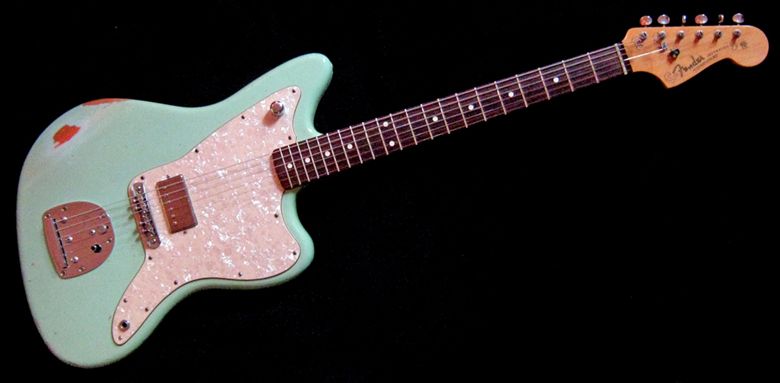
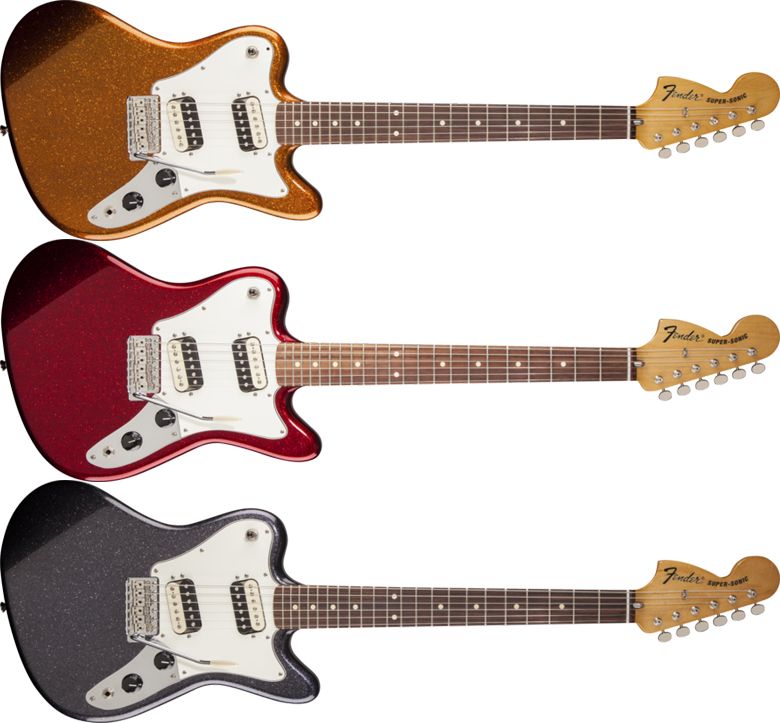
Offset Special is reminiscent of a Thinline Strat with an offset waist and
equipped with a Jaguar/Jazzmaster tremolo.
The model that I was really interested in, however, was the
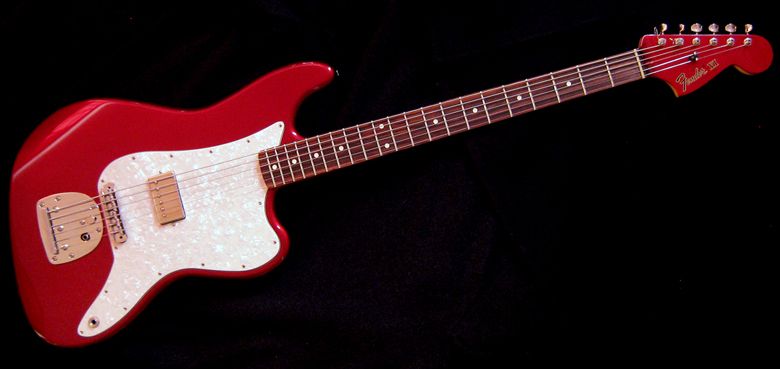
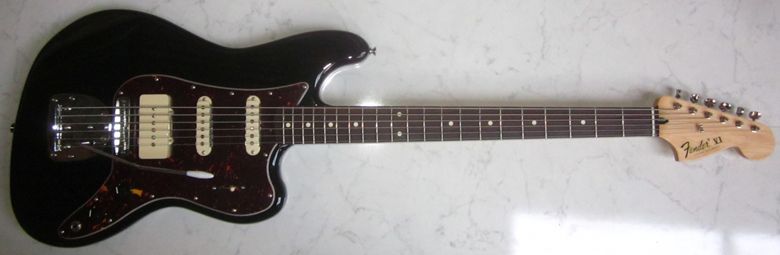
Fender Pawn Shop Bass VI.
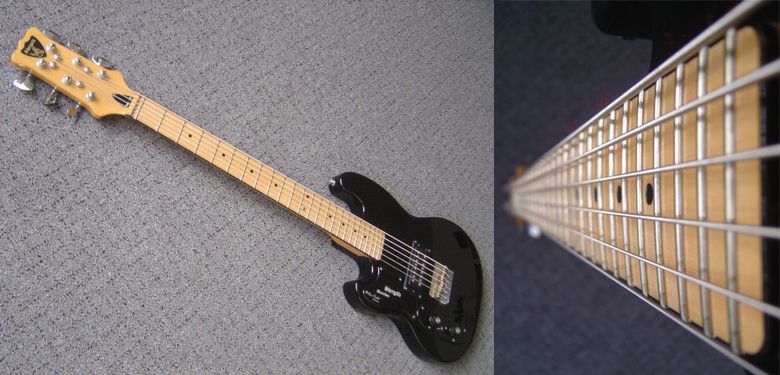
I've been hankering after a Bass VI for years. I used to have a
Hohner Hollywood (so-called) Bass VI but its 25.5"
scale length meant that you couldn't really tune it down a full octave below a regular guitar, and
so I had to make do with it being tuned down to G. That's still a whole lot lower than most
baritone guitars which are often tuned to B or C - or A if you're lucky, but it still wasn't "bass" enough and that
always really bugged me.
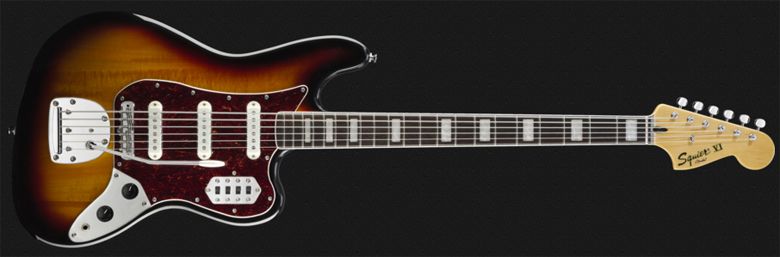
The Pawn Shop Bass VI, like the original, has a 30" scale and so has no such problems with being
tuned to E. It differs from the original Fender Bass VI in a number of minor details: most notably
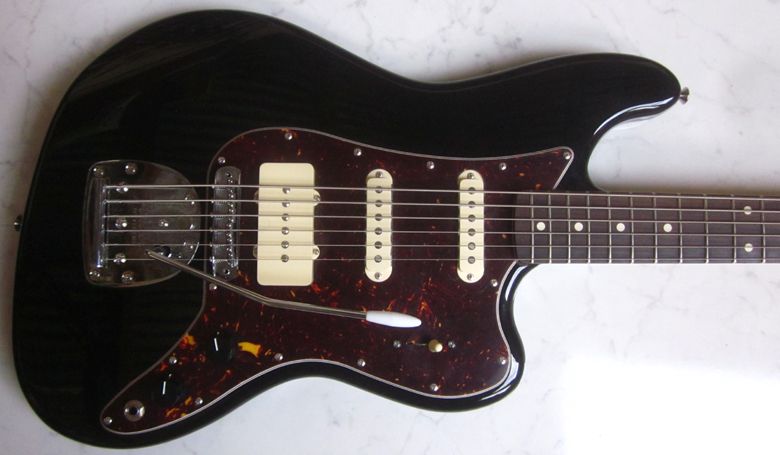
it has a JZHB pickup in the bridge position - this does look a lot like a large P90 pickup but my
understanding is that it is a double coil version of the Jazzmaster pickup. In the neck and middle
positions are a pair of Jaguar pickups. These are all controlled by a Strat-like 5-way switch.
It's a disappointment that Fender didn't use the individual pickup on/off switches plus "strangle"
switch on a chrome plate as on the classic Bass VI. This doesn't seem so much like a quirky
modification, rather a brazen cost-cutting exercise, which is a pity because I think Fender
missed a trick here.
There's another chrome plate missing beneath the volume and tone controls and output jack. Here on
the Pawn Shop Bass VI the pickguard has been extended to include this area.
Other than that, it's a pretty faithful reproduction of the original. The neck is unbound, but
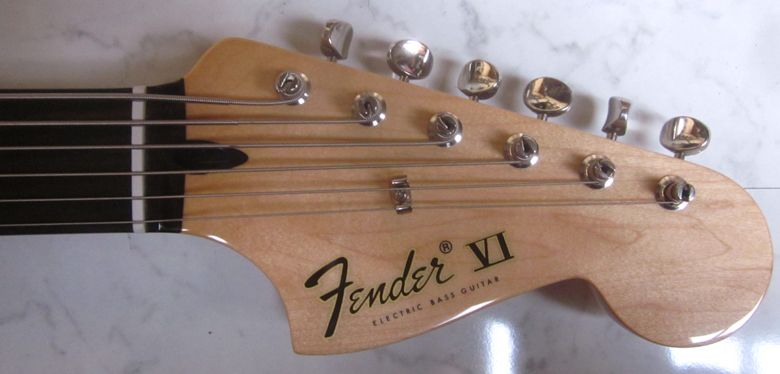
then not all the "originals" had bound necks anyway. Interestingly the headstock bears the legend
"Fender VI" (as used on the very first Bass VIs rather than the later "Fender Bass VI") with
"Electric Bass Guitar" in smaller lettering beneath.
Part of the reason that I wanted a Bass VI was so as to encourage me to play more melodic parts
and lead lines, as so often in a band situation I find myself ending up playing rhythm guitar
which - although I am happy to do - I want my share of the limelight too. I also have an album to
record and I was looking for new "voices" to use in my music, and decided that a Bass VI could be
the very thing.
So, how does it play and sound? Well, the first thing that struck me was that it packs a punch as
a bass. Some uninformed people insist on calling the Fender Bass VI a "baritone guitar". Believe me, it is
nothing of the sort; indeed I'd go so far as to say that to call it a baritone guitar is an
insult. It's as much of a bass as a Fender Precision or a Jazz Bass. Other people say that it's a
"bass for guitarists", but I don't think this is so much of an insult - there's a lot of truth in
the statement. It has six strings, it is tuned like a guitar only an octave lower, and the string
spacing is like that of a guitar. It even has a tremolo (but I'll talk about that some more
later). A bassist friend of mine tried out the Fender Bass VI and commented, "I'm not sure how I'm
supposed to play it. Do I play it as a bass or as a guitar?"
For the most part I do play it like a guitar, although I expect I'll end up using it for bass
lines too. The one thing that took a little getting used to was the extra stretch on a 30" scale.
It didn't feel too bad, but when I changed back to playing a regular scale guitar again, that felt
really awkward. However, having been changing back and forth between guitar and Bass VI for a
month now I have gotten used to the differences in scale length.
It is possible to play guitar chords, but open chords can sound muddy; you wouldn't really want to
strum on a Bass VI, but careful arpeggiation of chords can be quite effective. Barre chords are
possible too - they sound better the higher up the neck you travel. I've even played the Bass VI
using a capo on certain songs so as to put me into baritone guitar range - that has proven to be
quite effective.
Initially I was underwhelmed by the JZHB pickup in the bridge position. My initial reaction was
that Fender had put it there just for the sake of making it different so as to justify the "Pawn
Shop" label. However, I was initially using my guitar amp but after a band performance during
which the poor amp struggled, I got myself a most excellent bass amp from Roland's Cube series
which complements the Bass VI beautifully. Prior to that I only ever used the bridge JZHB pickup in
conjunction with the middle Jaguar pickup through the guitar amp because I thought that on its own it
sounded thin and weedy, I have since found that through a proper bass amp it gives me a really usable
treble sound that cuts through nicely when playing in a band situation that includes another bass
player.
When playing with another bass player, I've been very conscious that I need to dial in a different
bass sound so that we don't clash or else end up in one big bassy muddle. Using the JZHB pickup
helps cut through, but also choice of effects helps too - and thankfully my Roland Bass Cube has a
whole load on-board.
The Bass VI is an instrument crying out to be played with a chorus effect. It really does bring
the sound to life. I've also found it best to scoop the middle out on the EQ on the amp, but
obviously one can experiment and find out what works best for them.
I love also the sound of the Jaguar pickups, although I think perhaps I would use them more when
recording rather than when in a live situation when I want my sound to be distinct from that of
the (4-string) bass player in the band.
Now the tremolo... it's the same kind of Fender trem as featured on their Jaguar and Jazzmaster guitars.
That, for me, should be a good thing as I've never got on with Strat-style tremolos. However, with
this particular instrument I cannot get the trem arm to snap into place. I really don't want to force
it into position and possibly break something. I've tried asking Fender in the UK what I might be doing
wrong and so far have not received any response. I did wonder if the shop may have given me the wrong
arm, but seeing as it was a shop specialising in bass guitars that is rather unlikely (the only other
Bass VI they had was the Eastwood Sidejack and I remember that had its trem arm installed - also that's
another Fender Jaguar/Jazzmaster type system).
[EDIT - 16 April 2013: Today I received a parcel from Fender containing a threaded tremolo arm for
Bass VI. It fits and operates percectly. Yes, it does seem that the shop gave me the wrong arm in the first
place. A big "thank you" to Michael at Fender Customer Relations for sorting this out for me.]
I've seen the opinion expressed elsewhere thay the tremolo on the Bass VI is no great shakes anyway
and is more of a gimmick than a usable trem, but I would like the opportunity to find out for
myself. (Earlier I mentioned the Hohner Bass VI I used to own. That had a Wilkinson trem that was
very effective in use).
Having seen comments on forums such as
offsetguitars.com
it seems that some people are buying these Pawn Shop Bass VIs and modifying them to look and function like the
originals, which is an irony seeing as the whole point of the Pawn Shop series was to present
ready "modified" guitars. I think Fender should have done a straight reissue of the Bass VI rather
than a Pawn Shop version. A little bit of chrome shouldn't hike the price up very much.
I know it sounds like I have a few niggles with the Fender Pawn Shop Bass VI, but despite the unnecessary
Pawn Shop accoutrements, despite the mix-up with the trem on my example, I do love my Bass VI dearly. I feel as if it might be the perfect instrument for
me and can honestly say I haven't been as excited about a guitar purchase as much since I bought
my first ever Fender Stratocaster circa 1987.
The Bass VI is a Made in Mexico Fender, which is something a few years back might have caused some to
view it with concern, but Fender Mexico have really got their act together now and this is a quality-made
and beautifully-finished instrument.
Retails in the UK at prices between £601 and £755 so shop around. Colours are black with tortoiseshell
pickguard (i.e. mine), sunburst with tortoiseshell pickguard, and candy apple red with matching headstock
and white pickguard.
Just DON'T call it a baritone guitar, OK?
G L Wilson
© 2013, Guitarz - The Original Guitar Blog - the blog that goes all the way to 11!
Please read our photo and content policy.