guitarz.blogspot.com:
If any of you still regularly tune into Guitarz these days, you may have noticed that when I'm not posting about piglet-shaped guitars, that more often than not my attention will be on basses. There's a good reason for this as some might call me a "born again bassist". But yes, this is where my main interest lies as the bass is what I like playing the best.
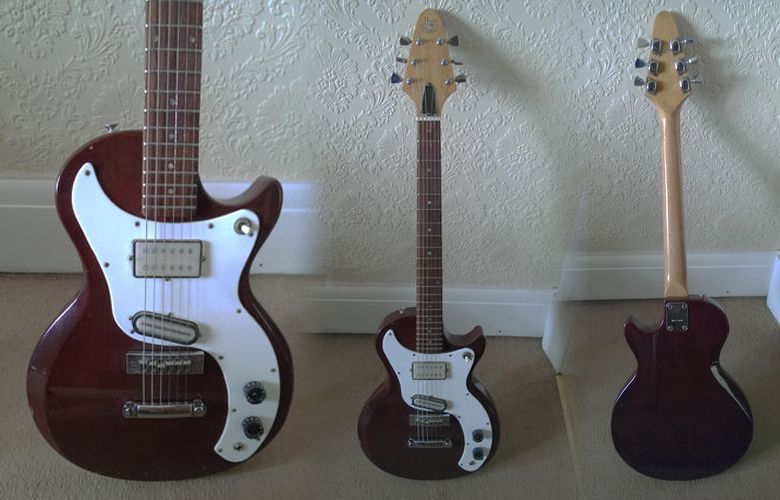
Now, moving on to the matter in hand, although we have looked at the Gibson Grabber bass before on this blog, what we have here is a cheaper copy which I'd imagine was contemporaneous to the Gibson Grabber itself, produced between 1973 to 1983. (I can't imagine that copies were being produced after the real deal had ceased production, but you never know). My feelings are that this particular example would have been produced in the latter end of that period, probably more towards the beginning of the 1980s. This gut feeling is mainly based on the headstock logo, a stylised letter "M" which does have a distinct 1980s vibe to it and which replaced the "Melody Guitars" italic script as seen on earlier examples.
Of course, the Grabber was famous for - and named after - its single sliding pickup, which admittedly doesn't have a lot of travel, and on this copy the sliding pickup is all present and correct and seems to be working properly. In the above two photographs we see the pickup in its forward and rear positions respectively.
The metal pickup cover does appear that someone may have painted it at some point, or else removed paint from the upper surface which is now bare metal whereas the sides show scrappy black paintwork. The pickguard itself seems to be made out of... well, I want to call it bakelite; it has all the appearance and texture of that very dense black proto-plastic as famously used for the manufacture of 1950s-style dial telephones.
Here's that Flying V style headstock with the 1980s-style "M" for Melody logo.
The bass is very heavy. The neck and fingerboard are Maple, and I suspect that the body is likewise. The neck is chunky and highly reminiscent of a baseball bat. Scale length is a un-Gibson-like 34", but the fact that they were playing around with several bolt-on neck designs during that whole period was another un-Gibson-like characteristic. Underneath the cover (often removed and thrown away) the bridge is a 2-saddle affair reminiscent of the Fender '51 Precision/Tele-bass style.
But of course, this isn't a Gibson, it's a Melody.
Melody were actually an Italian guitar manufacturer, and had affiliation with Eko guitars. For some history the company, I couldn't tell it any better than FetishGuitars.com, so pop on over there and have a little read up!
However, this is one of Melody's later range of guitars and basses when they moved away from original designs and got onto the whole copy guitar bandwagon, that era of instrument production often erroneously referred to as "lawsuit" guitars. It's also highly doubtful that this is an Italian-made Melody. It's much more likely this is a Melody branded instrument originating in Japan (Dare I say "Matsumoku"? I don't know, but I have seem that name bandied about on forums discussing Melody guitars). Identical guitars and basses from the same production line would also have been badged up with other brand names. Grabber basses such as this were also offered with Aria, Avon, Cimar, MIA and Eagle branding.
I'm lucky to have been given this bass by a friend, a dealer who got it as part of a job-lot of guitars he was buying. It needs some cleaning and some TLC. The action isn't too horrendous and hopefully it can be tweaked to make it more playable. The pickup seems to work fine but I had trouble differentiating between the tone of the pickup in its different positions; admittedly I haven't trialled the bass properly through my gigging bass rig yet, I merely used a practice amp to check it was working. Pots are scratchy, but you'd expect that on an old instrument like this. The E-tuner is a bit dodgy too. If this bass looks like a keeper, I'll consider swapping the machine heads for something more modern and more reliable. (Note also, by the way, the different size screw-head on the rear of the tuners in the above photo. Looks like some tinkering has taken place).
And of course, the finish could be cleaned up as well, which shouldn't be too great a problem.
All in all, a very interesting piece, and very nice for a freebie.
G L Wilson
© 2018, Guitarz - The Original Guitar Blog - the blog that goes all the way to 11!
Please read our photo and content policy.
Showing posts with label replicas. Show all posts
Tuesday, 5 June 2018
Tuesday, 22 April 2014
1960s Ibanez "handcrafted by Goldentone" Model 5902 Bison Bass
guitarz.blogspot.com:
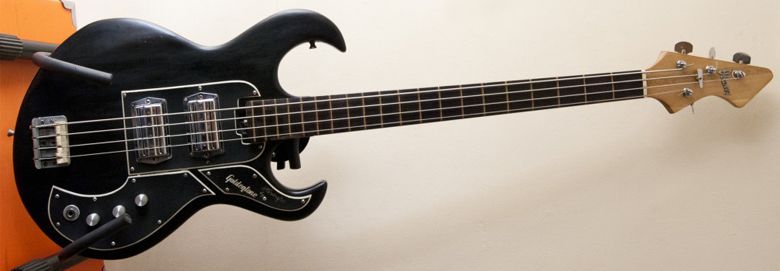
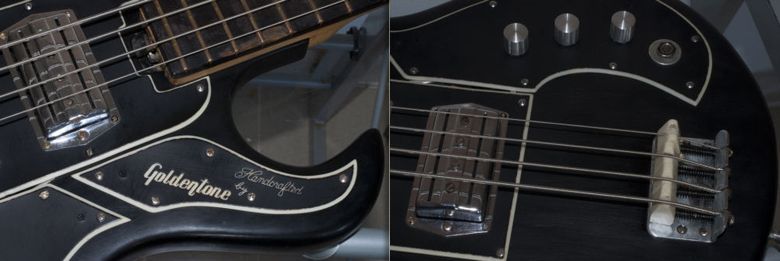
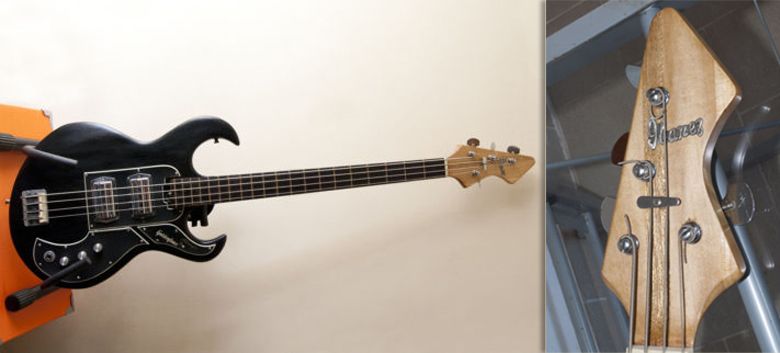
It seems funny to think that Ibanez - now a high prestige guitar manufacturer - were once just yet another Japanese brand churning out "copy" guitars. Here we see Ibanez copy a British manufacturer with this 1960s-era Ibanez Model 5902 Bass which appears to be an amalgam of several Burns designs, although it is particularly Bison-like in the horns. Quite who "Goldentone" were supposed to be, I couldn't say. It's probably just another random brand name that the Japanese factory thought would look impressive. Note the headstock with its 3+1 tuner layout - yet ANOTHER design pre-dating Music Man but that doesn't stop Ernie Ball thinking it's their intellectual property.
Currently listed on eBay UK with a starting bid of £400 and a Buy It Now price of £599.
G L Wilson
© 2014, Guitarz - The Original Guitar Blog - the blog that goes all the way to 11!
Please read our photo and content policy.
It seems funny to think that Ibanez - now a high prestige guitar manufacturer - were once just yet another Japanese brand churning out "copy" guitars. Here we see Ibanez copy a British manufacturer with this 1960s-era Ibanez Model 5902 Bass which appears to be an amalgam of several Burns designs, although it is particularly Bison-like in the horns. Quite who "Goldentone" were supposed to be, I couldn't say. It's probably just another random brand name that the Japanese factory thought would look impressive. Note the headstock with its 3+1 tuner layout - yet ANOTHER design pre-dating Music Man but that doesn't stop Ernie Ball thinking it's their intellectual property.
Currently listed on eBay UK with a starting bid of £400 and a Buy It Now price of £599.
G L Wilson
© 2014, Guitarz - The Original Guitar Blog - the blog that goes all the way to 11!
Please read our photo and content policy.
Tuesday, 11 March 2014
Hoyer German-made copy of a R-style stereo bass
guitarz.blogspot.com:
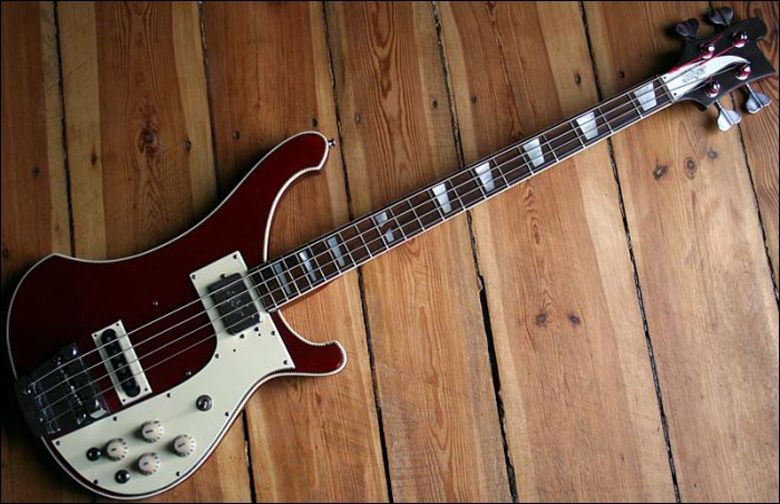
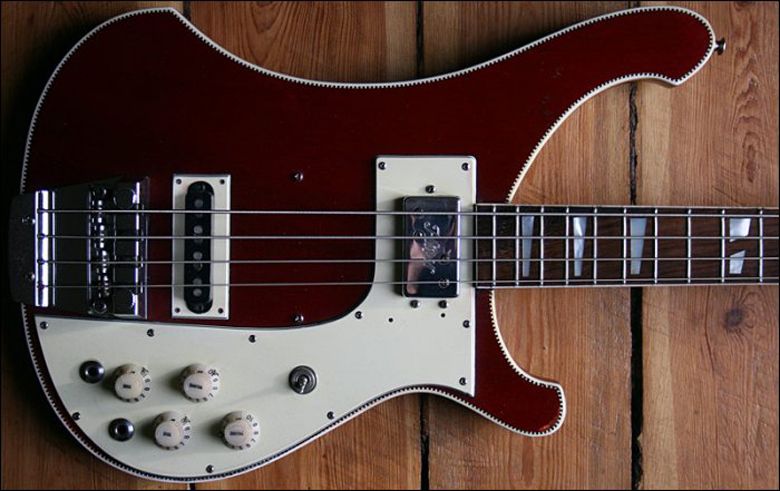
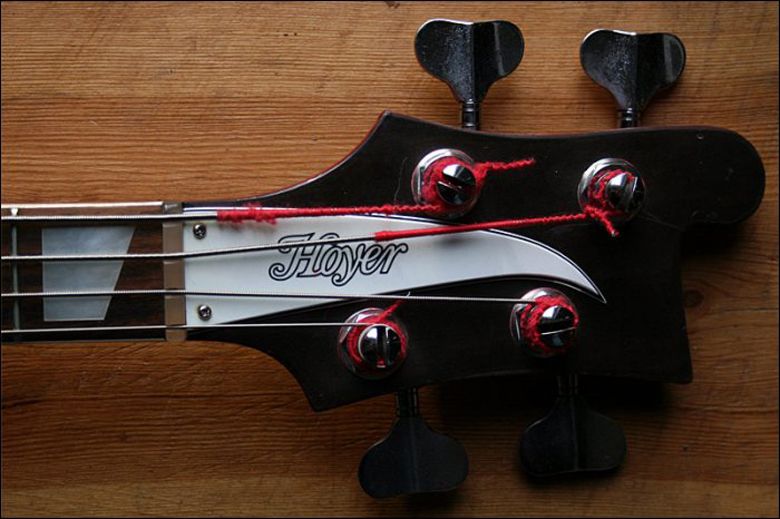
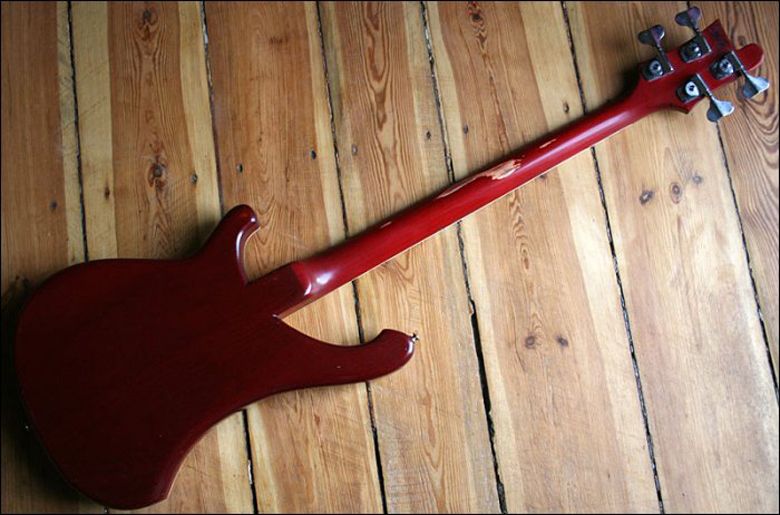
I think just about everyone viewing this blog will know immediately what kind of bass it is that this 1970s Hoyer is copying in its design. Somehow it seems almost righteous that an instrument designed by the company founded by Adolf Rickenbacker should end up being copied in Germany. And although it isn't the most accurate copy, it does seem to be beautifully made; witness the checkered binding, the glued in neck, and note the stereo outputs on the pickguard. The seller insists that this is "one of the most hard to find basses made by Hoyer and extremely rare" and goes on to sing its praises as regards playability and performance.
Currently listed on eBay with a Buy It Now price of €1,249 (item currently located in Berlin).
G L Wilson
© 2014, Guitarz - The Original Guitar Blog - the blog that goes all the way to 11!
Please read our photo and content policy.
I think just about everyone viewing this blog will know immediately what kind of bass it is that this 1970s Hoyer is copying in its design. Somehow it seems almost righteous that an instrument designed by the company founded by Adolf Rickenbacker should end up being copied in Germany. And although it isn't the most accurate copy, it does seem to be beautifully made; witness the checkered binding, the glued in neck, and note the stereo outputs on the pickguard. The seller insists that this is "one of the most hard to find basses made by Hoyer and extremely rare" and goes on to sing its praises as regards playability and performance.
Currently listed on eBay with a Buy It Now price of €1,249 (item currently located in Berlin).
G L Wilson
© 2014, Guitarz - The Original Guitar Blog - the blog that goes all the way to 11!
Please read our photo and content policy.
Saturday, 1 March 2014
Vox-inspired guitars from 1960s Japan
guitarz.blogspot.com:
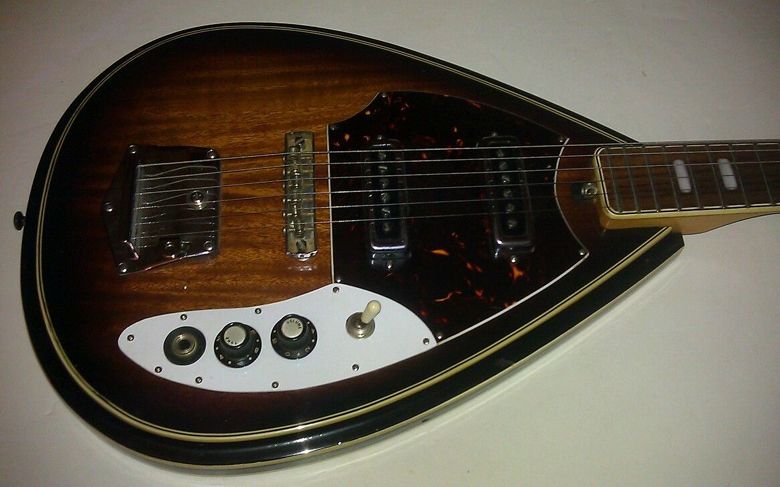
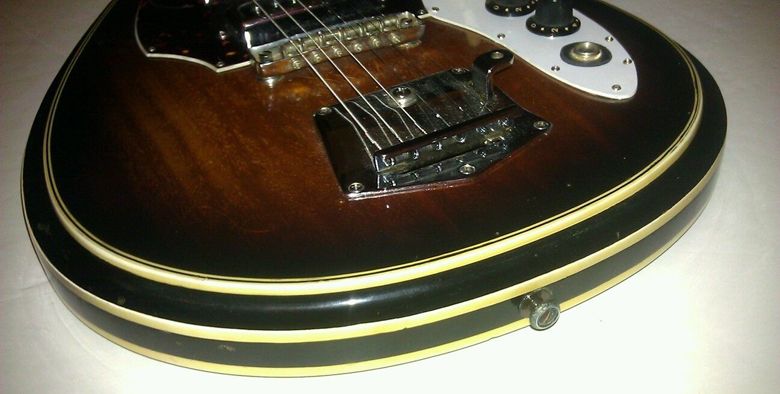
Here's a 1960s Japanese copy of a Vox Teardrop style guitar that I've not seen before. It's not that accurate a copy having quite a few features that are a distinct departure from the original. Most notably, the body has a German carve to the top and a triple-bound body.
Don't be fooled by the Vox name on the headstock, which has almost certainly been added at a later date by someone owning this guitar. The eBay seller claims (quite predictably) that the guitar may be a Teisco. It's not a model that I have seen before, but it is plausible.
Below we see a 1960s guitar that is definitely a Teisco-made Vox copy. The Teisco EV-2T is based (loosely) on the Vox Phantom. As with the Teardrop guitar, the resemblance is quite superficial.
The necks of the two guitars are very similar. Note the multi-laminate construction, the shape of the headstock, and the position of the bolts for the string retainer. Here is the Teisco EV-2T (Phantom):
And here is the Teardrop:
If anyone out there has any further information on these guitars - particularly the Teardrop - then please leave a comment below.
The Teardrop is currently listed on eBay with a Buy It Now price of US $649.99, and the Teisco EV-2T (Phantom) is similarly listed at US $539.96.
G L Wilson
© 2014, Guitarz - The Original Guitar Blog - the blog that goes all the way to 11!
Please read our photo and content policy.
Here's a 1960s Japanese copy of a Vox Teardrop style guitar that I've not seen before. It's not that accurate a copy having quite a few features that are a distinct departure from the original. Most notably, the body has a German carve to the top and a triple-bound body.
Don't be fooled by the Vox name on the headstock, which has almost certainly been added at a later date by someone owning this guitar. The eBay seller claims (quite predictably) that the guitar may be a Teisco. It's not a model that I have seen before, but it is plausible.
Below we see a 1960s guitar that is definitely a Teisco-made Vox copy. The Teisco EV-2T is based (loosely) on the Vox Phantom. As with the Teardrop guitar, the resemblance is quite superficial.
The necks of the two guitars are very similar. Note the multi-laminate construction, the shape of the headstock, and the position of the bolts for the string retainer. Here is the Teisco EV-2T (Phantom):
And here is the Teardrop:
If anyone out there has any further information on these guitars - particularly the Teardrop - then please leave a comment below.
The Teardrop is currently listed on eBay with a Buy It Now price of US $649.99, and the Teisco EV-2T (Phantom) is similarly listed at US $539.96.
G L Wilson
© 2014, Guitarz - The Original Guitar Blog - the blog that goes all the way to 11!
Please read our photo and content policy.
Saturday, 18 January 2014
Gitison Les Paul "The Paul" copy from Hungary
guitarz.blogspot.com:
The headstock logo kinda makes you do a double take, doesn't it? Walking a very fine line between copy guitars and outright forgery, this Gitison "The Paul" copy is a Hungarian made guitar, the work of one Mr. Tibor Turcsak (see another one of his guitars here).
This particular example of his work has a Honduras mahogany body, a flamed maple neck, and German-made Shadow humbuckers.
Currently listed on eBay with a starting price of €350.
Thanks again to Zirig Árpád for alerting me to this eBay auction.
G L Wilson
© 2014, Guitarz - The Original Guitar Blog - the blog that goes all the way to 11!
Please read our photo and content policy.
The headstock logo kinda makes you do a double take, doesn't it? Walking a very fine line between copy guitars and outright forgery, this Gitison "The Paul" copy is a Hungarian made guitar, the work of one Mr. Tibor Turcsak (see another one of his guitars here).
This particular example of his work has a Honduras mahogany body, a flamed maple neck, and German-made Shadow humbuckers.
Currently listed on eBay with a starting price of €350.
Thanks again to Zirig Árpád for alerting me to this eBay auction.
G L Wilson
© 2014, Guitarz - The Original Guitar Blog - the blog that goes all the way to 11!
Please read our photo and content policy.
Wednesday, 28 August 2013
1970s JHS copy of a Gibson Marauder
guitarz.blogspot.com:
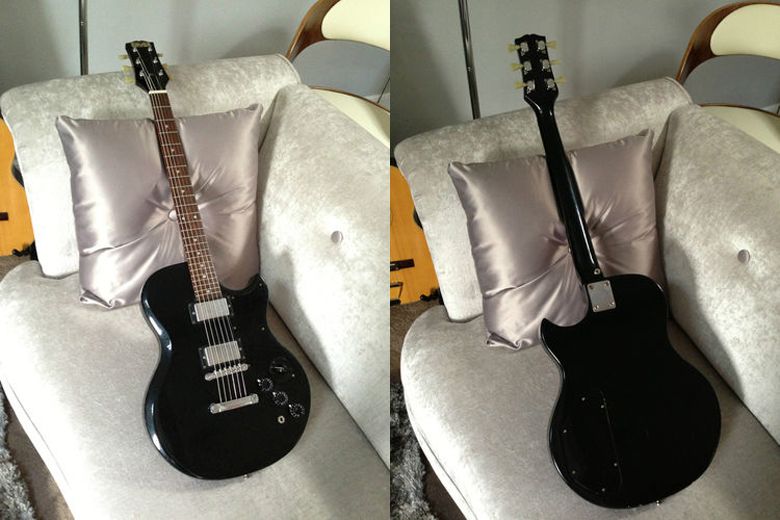
This 1970s-era JHS branded guitar is another copy of one of the lesser known - and certainly more unpopular - Gibson solidbodies. I always used to like the Gibson Marauder design back in the day; I think The Buzzcocks used them and to me they were very punk rock. I also liked the use of a Flying V type headstock on an LP shaped body.
The seller of this JHS copy, however, makes some very weird claims about it:
This guitar is currently listed on eBay UK with a Buy It Now price of £180.
G L Wilson
© 2013, Guitarz - The Original Guitar Blog - the blog that goes all the way to 11!
Please read our photo and content policy.
This 1970s-era JHS branded guitar is another copy of one of the lesser known - and certainly more unpopular - Gibson solidbodies. I always used to like the Gibson Marauder design back in the day; I think The Buzzcocks used them and to me they were very punk rock. I also liked the use of a Flying V type headstock on an LP shaped body.
The seller of this JHS copy, however, makes some very weird claims about it:
I bought this fantastic guitar off a friend about a year ago, who didn't know a lot about it.I find it very hard to believe that these copy guitars would be made in the same factory as the Gibson originals. Surely the copies are Japanese in origin, and outside of Gibson's Orville and Orville by Gibson brands, Gibson guitars have always been made in the USA. Can anyone confirm or deny the seller's claims here, or at least explain where his story has gone off the rails?
Once I acquired the guitar, I did some research into its history and I was pleasantly surprised!
It turns out that in the late 1970s, there were a lot of Gibson Marauder copies being sold under different brand names such as Avon, Cimar, ESP, Maya, Rose Morris, CSL and finally JHS (now known as Vintage & Encore).
After digging a little deeper I found out on a forum that all of these guitars were made in the same factory where the Gibson Marauders were made in the late 70s.
This leads me to believe that the spec of the guitar is very similar if not completely the same as the Gibson's. This is because it would be very odd for them to have separate production lines because of pricing and tooling etc.
This guitar is currently listed on eBay UK with a Buy It Now price of £180.
G L Wilson
© 2013, Guitarz - The Original Guitar Blog - the blog that goes all the way to 11!
Please read our photo and content policy.
Tuesday, 27 August 2013
CMI 1970s Japanese-made Gibson L6S copy
guitarz.blogspot.com:
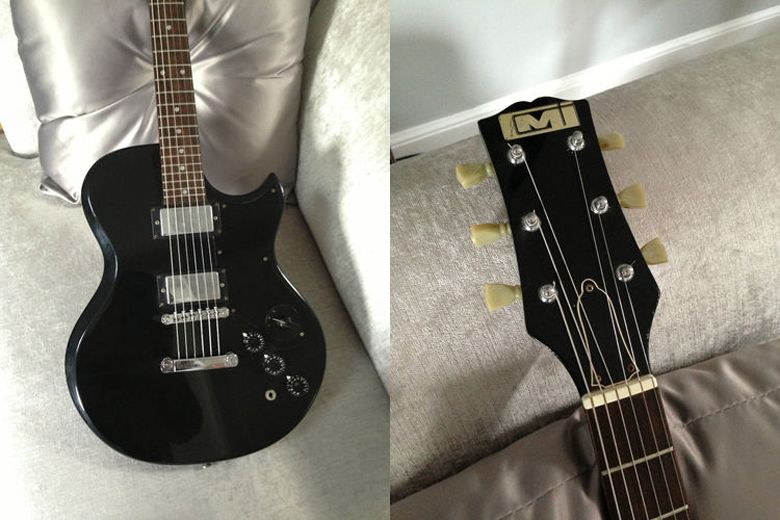
Here's a 1970s Japanese-made guitar bearing the CMI brand (I believe I once read that there were two separate brands known as CMI on guitars of this era, something which causes much confusion amongst guitar aficionados even today). The seller refers to it as an "LP style guitar", but rather than being a Les Paul copy it's actually quite a faithful replica of a Gibson L6S. The original, first introduced in 1973, was Gibson's then budget model guitar and was conceived by the collaboration of Gibson and Bill Lawrence as a the working man's answer to the Gibson L5S jazz guitar. The guitar was known for its versatility and featured a 6-way rotary pickup selector allowing the pickups to be switched in series, in parallel and out of phase. Notable players include Al Di Meola, Carlos Santana, Pat Martino, John McLaughlin, Keith Richards and Mike Oldfield. Most examples featured a set neck, although the Midnight Special series did have a bolt-on neck, as does this Japanese CMI copy (it's not an exact copy, you'll notice, as the Midnight Special also had through-body stringing). This CMI L5S also, sadly, only seems to have the three-way pickup selector switch.
Currently listed on eBay UK with a very reasonable sounding Buy It Now price of £125.
G L Wilson
© 2013, Guitarz - The Original Guitar Blog - the blog that goes all the way to 11!
Please read our photo and content policy.
Here's a 1970s Japanese-made guitar bearing the CMI brand (I believe I once read that there were two separate brands known as CMI on guitars of this era, something which causes much confusion amongst guitar aficionados even today). The seller refers to it as an "LP style guitar", but rather than being a Les Paul copy it's actually quite a faithful replica of a Gibson L6S. The original, first introduced in 1973, was Gibson's then budget model guitar and was conceived by the collaboration of Gibson and Bill Lawrence as a the working man's answer to the Gibson L5S jazz guitar. The guitar was known for its versatility and featured a 6-way rotary pickup selector allowing the pickups to be switched in series, in parallel and out of phase. Notable players include Al Di Meola, Carlos Santana, Pat Martino, John McLaughlin, Keith Richards and Mike Oldfield. Most examples featured a set neck, although the Midnight Special series did have a bolt-on neck, as does this Japanese CMI copy (it's not an exact copy, you'll notice, as the Midnight Special also had through-body stringing). This CMI L5S also, sadly, only seems to have the three-way pickup selector switch.
Currently listed on eBay UK with a very reasonable sounding Buy It Now price of £125.
G L Wilson
© 2013, Guitarz - The Original Guitar Blog - the blog that goes all the way to 11!
Please read our photo and content policy.
Tuesday, 23 July 2013
"The Handle" (rough) copy guitar on a Dutch auction site
guitarz.blogspot.com:
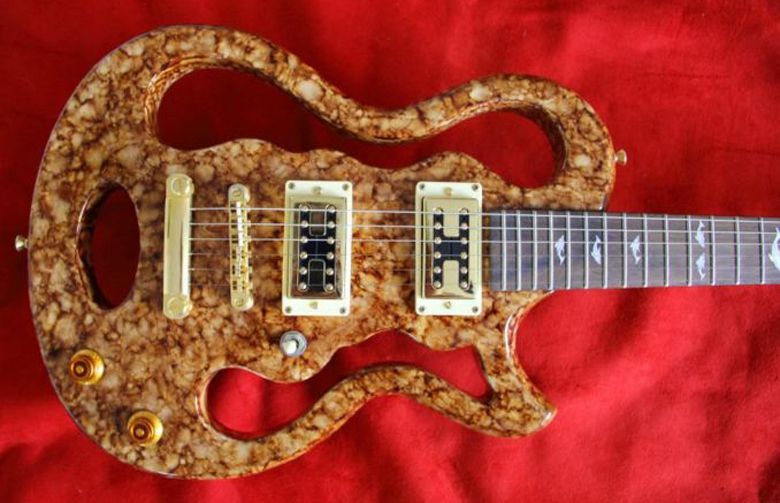
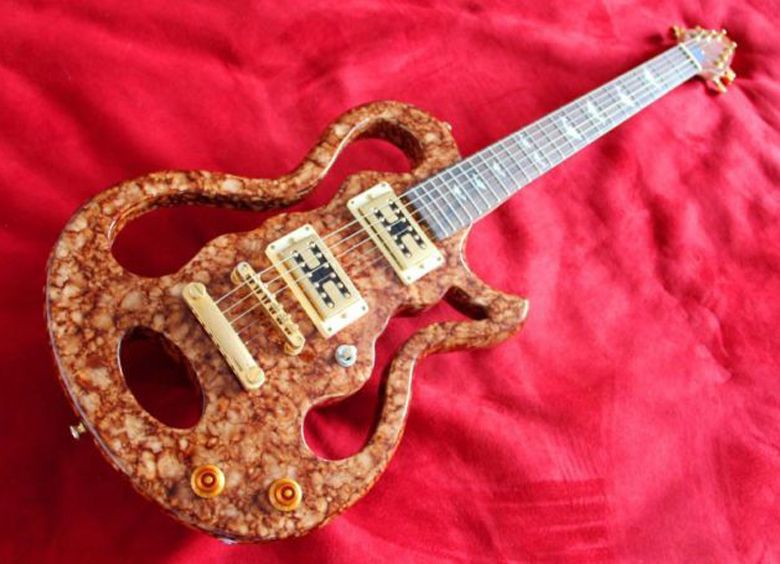
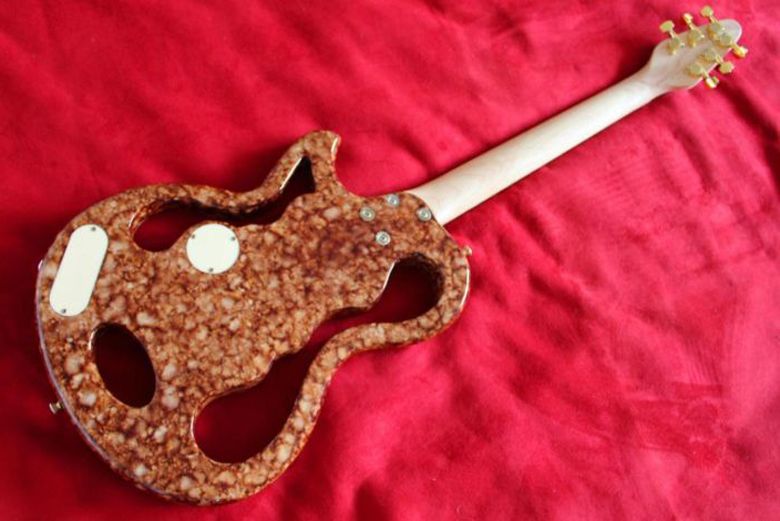
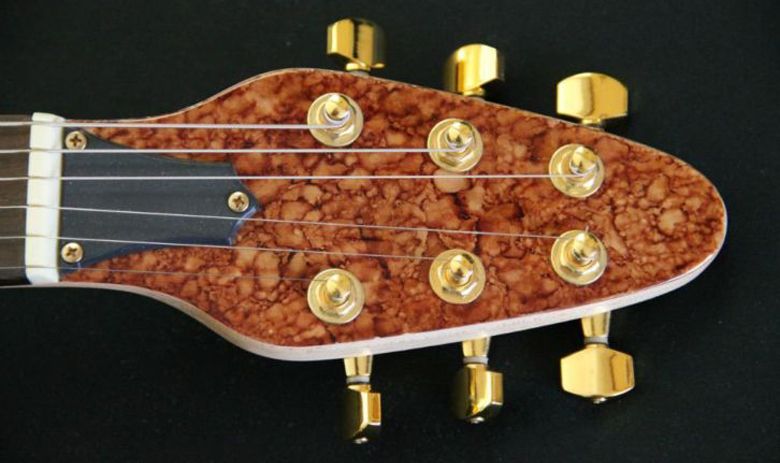
Now here's quite a curious guitar currently listed on a Dutch auction site priced at €250,00. Of course, the holey shape makes much more sense when you realise that the entire design has been copied from the fantastic XOX Audio Tools "The Handle" which is a guitar I have been coveting now for several years. Bear in mind, of course, that the XOX Handle is a cutting edge technologically advanced guitar made from carbon fibre with a hollow tube body, whereas this guitar on the Dutch site is merely a cheap approximation of the same shape made in Taiwan. Oh, and it has Wilkinson pickups too and dolphin inlays on the fingerboard (quite what the relevance is, I do not know). The body finish is unusual, I'm guessing it's supposed to suggest that the body is made from marble but even without seeing this guitar in the flesh I can 99.9% guarantee that it's made entirely from wood. If the body were made from stone, you think the seller might mention it. And can you imagine how heavy such a guitar would be, even with the holes in the body?
Thanks to Eric for bringing this guitar to my attention.
G L Wilson
© 2013, Guitarz - The Original Guitar Blog - the blog that goes all the way to 11!
Please read our photo and content policy.
Now here's quite a curious guitar currently listed on a Dutch auction site priced at €250,00. Of course, the holey shape makes much more sense when you realise that the entire design has been copied from the fantastic XOX Audio Tools "The Handle" which is a guitar I have been coveting now for several years. Bear in mind, of course, that the XOX Handle is a cutting edge technologically advanced guitar made from carbon fibre with a hollow tube body, whereas this guitar on the Dutch site is merely a cheap approximation of the same shape made in Taiwan. Oh, and it has Wilkinson pickups too and dolphin inlays on the fingerboard (quite what the relevance is, I do not know). The body finish is unusual, I'm guessing it's supposed to suggest that the body is made from marble but even without seeing this guitar in the flesh I can 99.9% guarantee that it's made entirely from wood. If the body were made from stone, you think the seller might mention it. And can you imagine how heavy such a guitar would be, even with the holes in the body?
Thanks to Eric for bringing this guitar to my attention.
G L Wilson
© 2013, Guitarz - The Original Guitar Blog - the blog that goes all the way to 11!
Please read our photo and content policy.
Sunday, 30 June 2013
Electra Japanese-made copy of a Hagstrom II
guitarz.blogspot.com:
Today I'm showing you this 1970s(?) Electra guitar just to prove that once upon a time it wasn't just the likes of Fender, Gibson and Rickenbacker that were being copied en masse by Far Eastern manufacturers*. It's a copy of one of Sweden's finest, the Hagstrom II. It seems quite unusual to see copies of European guitars, but of course guitars from Hofner, Vox and Burns have had their imitators over the years. This Electra Hagstrom II copy even features a replica of Hagstrom's "Tremar" vibrato arm - these days a replica would most likely feature generic hardware and you'd end up with a Strat-style trem irrespective of what the original was like.
Currently listed on eBay UK with a Buy It Now price of £350.
* OK, I'm generalising a little here, these days we have brands such as Eastwood and Pure Salem who are reissuing all sorts of cool designs, but the big distinction here is that these guitars are deliberately and joyfully retro. Back in the day when Electra copied Hagstrom, it was a copy of a then contemporary guitar. Just thought I ought to mention it before someone said "Hey, what about Eastwood?" in the comments!
G L Wilson
© 2013, Guitarz - The Original Guitar Blog - the blog that goes all the way to 11!
Please read our photo and content policy.
Today I'm showing you this 1970s(?) Electra guitar just to prove that once upon a time it wasn't just the likes of Fender, Gibson and Rickenbacker that were being copied en masse by Far Eastern manufacturers*. It's a copy of one of Sweden's finest, the Hagstrom II. It seems quite unusual to see copies of European guitars, but of course guitars from Hofner, Vox and Burns have had their imitators over the years. This Electra Hagstrom II copy even features a replica of Hagstrom's "Tremar" vibrato arm - these days a replica would most likely feature generic hardware and you'd end up with a Strat-style trem irrespective of what the original was like.
Currently listed on eBay UK with a Buy It Now price of £350.
* OK, I'm generalising a little here, these days we have brands such as Eastwood and Pure Salem who are reissuing all sorts of cool designs, but the big distinction here is that these guitars are deliberately and joyfully retro. Back in the day when Electra copied Hagstrom, it was a copy of a then contemporary guitar. Just thought I ought to mention it before someone said "Hey, what about Eastwood?" in the comments!
G L Wilson
© 2013, Guitarz - The Original Guitar Blog - the blog that goes all the way to 11!
Please read our photo and content policy.
Tuesday, 1 January 2013
Goran Malmberg's Abba "Star" guitar replica
guitarz.blogspot.com:
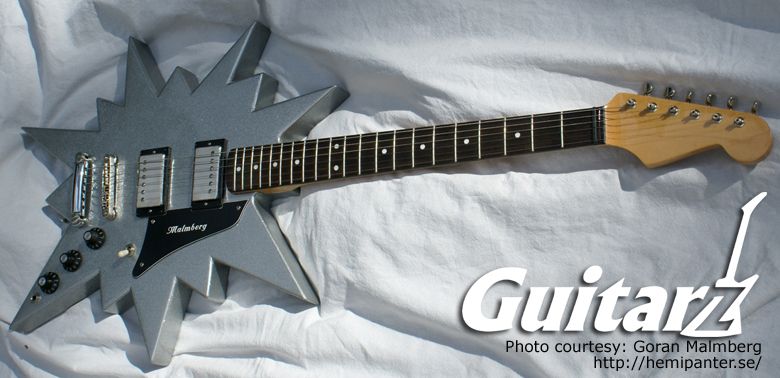
Happy New Year to all our readers. Those of you who had a copy of our Guitarz 2012 calendar on their wall over the last year will recognise the above guitar as our guitar for April (although in the spirit of keeping the calendar photos exclusive, this is an alternate photograph). To copy from my own blurb in the calendar:
Malmberg kindly took some time to tell us about the guitar when I emailed him back in 2008:
Speaking of calendars, unfortunately - as some of you may have realised by now - we weren't able to put together a calendar for 2013. I'm sorry, and despite the offer of assistance from one enthusiastic Guitarz reader, I just haven't had the time over the last few months to get my arse into gear and even get the ball rolling in this department. Thanks also to Bertram and David who have been posting solidly these last few weeks whilst I've been out working anti-social hours.
So what have we lined up for 2013? Well, to be honest, I don't know for sure yet, but you can expect even more of the same, i.e. weird and wonderful guitars! We also enjoy seeing your guitars, so if you have any that are that little bit different from the same old guitars we see everywhere else, please get in touch!
G L Wilson
© 2013, Guitarz - The Original Guitar Blog - the blog that goes all the way to 11!
Happy New Year to all our readers. Those of you who had a copy of our Guitarz 2012 calendar on their wall over the last year will recognise the above guitar as our guitar for April (although in the spirit of keeping the calendar photos exclusive, this is an alternate photograph). To copy from my own blurb in the calendar:
The Swedish pop group ABBA won the 1974 Eurovision Song Contest, held in Brighton, UK, with the song "Waterloo". For the contest and for subsequent TV appearances and public appearances around the world, Abba member Björn Ulvaeus played a multi-pointed star-shaped guitar created by Goran Malmberg. Unfortunately, the orignal guitar is now missing, but Malmberg has created this replica for the ABBA Museum in Stockholm.I don't care about ABBA's "pop" credentials, or the (im)practicalities of such a very pointy guitar design, this is one of my favourite iconic guitar designs and along with the John Birch Superyob as played by Slade's Dave Hill it epitomises the whole glam rock era.
Malmberg kindly took some time to tell us about the guitar when I emailed him back in 2008:
I designed the entire guitar shape. The original question from Bjorn was that they liked a guitar in the shape of a star, and I made a few baseline drawings for him to look at. If you look at the shape it is not symmetrical. We have the Gibson guitar "Flying V" and "Explorer" from the time that has "horns" in different directions. A common thing with those guitars along with my star guitar is that it has to serve a practical purpose, therefore the horns are pointing logical directions. The strap has to be fastened in a good balance position. There should be no horn where one has its right arm. There has to be a horn to place tone and volume knobs. So the design issue was to find a design balance that included those features. I have seen copies of the guitar. No criticism, but if the builder does not has a very good picture to make a copy from, he will surely miss the geometric figures behind the design. And the guitar will not show the same harmony as the original.For more see this post.
About the "player" issue, it is just about the same as a Strat with patent number pickups. The body is laminate plywood, for the reason that the edge of the horns should not break. It is all solid as a Strat. Good sustain. However, the guitar main purpose was for image, and even if Bjorn had come "asking" for it as an instrument, there was newer any time for fine tune adjustments.
Speaking of calendars, unfortunately - as some of you may have realised by now - we weren't able to put together a calendar for 2013. I'm sorry, and despite the offer of assistance from one enthusiastic Guitarz reader, I just haven't had the time over the last few months to get my arse into gear and even get the ball rolling in this department. Thanks also to Bertram and David who have been posting solidly these last few weeks whilst I've been out working anti-social hours.
So what have we lined up for 2013? Well, to be honest, I don't know for sure yet, but you can expect even more of the same, i.e. weird and wonderful guitars! We also enjoy seeing your guitars, so if you have any that are that little bit different from the same old guitars we see everywhere else, please get in touch!
G L Wilson
© 2013, Guitarz - The Original Guitar Blog - the blog that goes all the way to 11!
Wednesday, 7 November 2012
When is a Burns Bison not a Burns Bison?...
guitarz.blogspot.com:
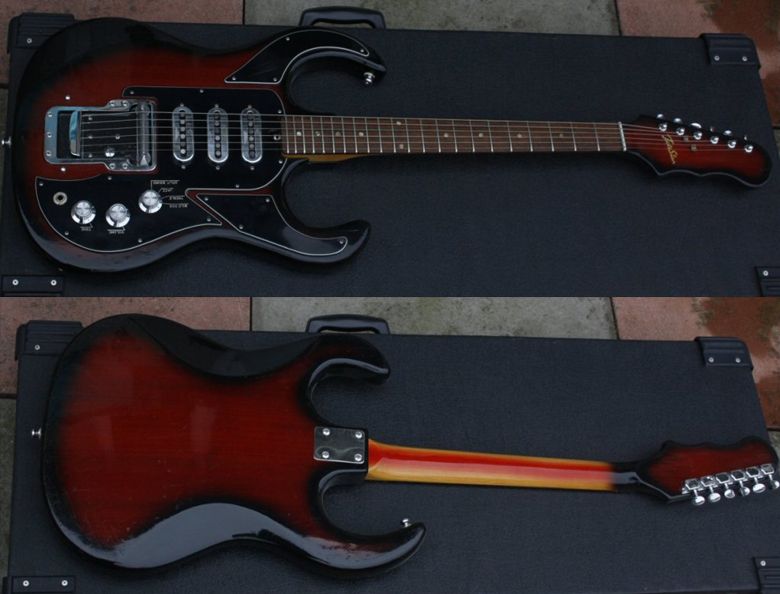
...when it's a 1960s Japanese-made Kawai Telestar!
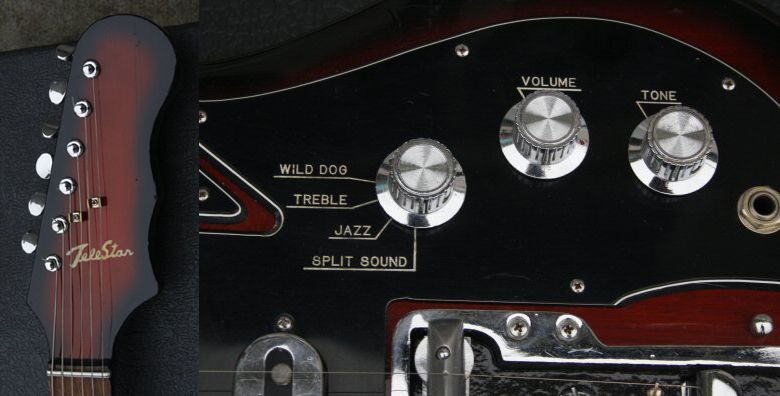
These days it seems the only guitars that get copied are the same tired old designs from the likes of Fender or Gibson (and throw Martin into the mix too when considering acoustic guitars), but not too many decades ago the Far Eastern copyists (in those days, Japanese) were much more adventurous. This Telestar is a beautfiul recreation of the Burns Bison, complete with batwing headstock shape, TriSonic lookalike pickups, split pickguard (or should I say "scratchplate" seeing as it's a British design), and even Burns' trademark Wild Dog, Treble, Jazz, and Split Sound tone settings.
This guitar, which surely must be as collectable as the real thing, is currently listed on eBay UK with a starting bid of £249.
G L Wilson
© 2012, Guitarz - The Original Guitar Blog - 10 years and counting!
...when it's a 1960s Japanese-made Kawai Telestar!
These days it seems the only guitars that get copied are the same tired old designs from the likes of Fender or Gibson (and throw Martin into the mix too when considering acoustic guitars), but not too many decades ago the Far Eastern copyists (in those days, Japanese) were much more adventurous. This Telestar is a beautfiul recreation of the Burns Bison, complete with batwing headstock shape, TriSonic lookalike pickups, split pickguard (or should I say "scratchplate" seeing as it's a British design), and even Burns' trademark Wild Dog, Treble, Jazz, and Split Sound tone settings.
This guitar, which surely must be as collectable as the real thing, is currently listed on eBay UK with a starting bid of £249.
G L Wilson
© 2012, Guitarz - The Original Guitar Blog - 10 years and counting!
Monday, 15 October 2012
Motorik Guitar Works SD-40 - Yamaha SG-2 replica
guitarz.blogspot.com:
Long-term followers of Guitarz will know by now that I am great fan of early Yamaha electric guitars, especially the SG-2, SG-3 and SG-12 models. (If you'd like more info on these guitars, please read my article on the Vintage & Rare blog).
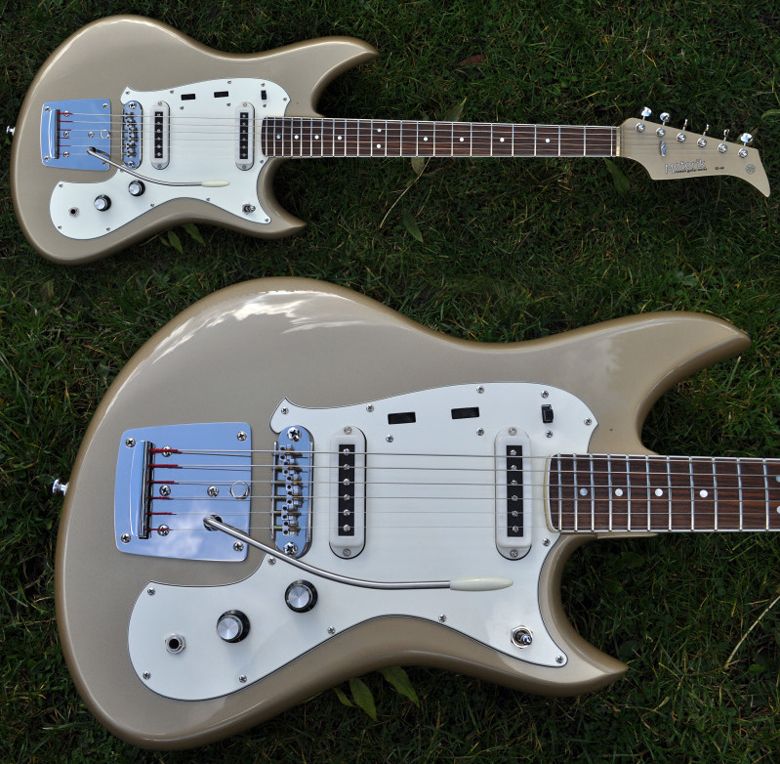
The above pictured SG-2 looks like it must have been preserved in a time capsule for the last 44 years. However, Yamaha enthusiasts might have spotted that shoreline gold was not a colour option, these guitars only being produced in pearl white, sunburst, and coral red.
But neither is this an original SG-2 that has been refinished. It is actually a brand new guitar, a replica of the SG-2 painstakingly and lovingly built by Ben of Motorik Guitar Works, a regular contributor to the OffsetGuitars.com forums. The attention to detail on this build is quite outstanding, even down to the hardware used, much of which had to be custom-made by specialist suppliers. The guitar, which Ben has named the Motorik Guitar Works SD-40, was commisioned by the wife of a very good friend of Ben's for his 40th Birthday. (And where can I meet a woman like that?)
Ben also has a second Yamaha replica in the works, this time it's an SG-3 replica and this one he's going to be keeping for himself. When it is finished, it'd be very interesting to compare it side by side against my own Yamaha SG-3 original (and why do I get the sneaking feeling that it might possibly sound better?).
For more photos of Ben's SG-2 replica and to follow the complete build, see the Yamaha SG-3 & SG-2 replica project builds thread on OffsetGuitars.com. Take some time out, read it from the beginning and marvel.
G L Wilson
© 2012, Guitarz - The Original Guitar Blog - 10 years and counting!
Long-term followers of Guitarz will know by now that I am great fan of early Yamaha electric guitars, especially the SG-2, SG-3 and SG-12 models. (If you'd like more info on these guitars, please read my article on the Vintage & Rare blog).
The above pictured SG-2 looks like it must have been preserved in a time capsule for the last 44 years. However, Yamaha enthusiasts might have spotted that shoreline gold was not a colour option, these guitars only being produced in pearl white, sunburst, and coral red.
But neither is this an original SG-2 that has been refinished. It is actually a brand new guitar, a replica of the SG-2 painstakingly and lovingly built by Ben of Motorik Guitar Works, a regular contributor to the OffsetGuitars.com forums. The attention to detail on this build is quite outstanding, even down to the hardware used, much of which had to be custom-made by specialist suppliers. The guitar, which Ben has named the Motorik Guitar Works SD-40, was commisioned by the wife of a very good friend of Ben's for his 40th Birthday. (And where can I meet a woman like that?)
Ben also has a second Yamaha replica in the works, this time it's an SG-3 replica and this one he's going to be keeping for himself. When it is finished, it'd be very interesting to compare it side by side against my own Yamaha SG-3 original (and why do I get the sneaking feeling that it might possibly sound better?).
For more photos of Ben's SG-2 replica and to follow the complete build, see the Yamaha SG-3 & SG-2 replica project builds thread on OffsetGuitars.com. Take some time out, read it from the beginning and marvel.
G L Wilson
© 2012, Guitarz - The Original Guitar Blog - 10 years and counting!
Sunday, 13 March 2011
AEB-2 scroll bass - Ampeg tribute by Bruce Johnson
guitarz.blogspot.com:
Here's an email from Jeremiah:
G L Wilson
Guitarz - The Original Guitar Blog - now in its 10th year!
Here's an email from Jeremiah:
I finally saw something on eBay that breaks my heart not to have, and thought might be shared with the blog. eBay has a Bruce Johnston AEB-2 - new and direct from Bruce, himself. The serial is 073, and build date is this last Feb, 2011.Fantastic stuff. Thanks for sharing!
Johnston's scroll bass is a direct continuation of the classic Ampeg scroll bass, and was initially produced under a license. Bruce has steadily improved and modernised his builds, while remaining true to the original appeal and characteristics of the vintage Ampeg models.
G L Wilson
Guitarz - The Original Guitar Blog - now in its 10th year!
Friday, 10 December 2010
Knutsen Dyer-style harp guitar
guitarz.blogspot.com:
Here we have a very nice example of a Knutsen Dyer-style harp guitar built by Alejandro Vasquez Rubio. The design of this "one-arm harp guitar" was patented in 1897 by Chris Knutsen, who was contracted to build guitars for W.J. Dyer & Bro in 1899. However Dyer switched to the services of the Larson Brothers in 1902, allegedly because their guitars were more consistent whereas Knutsens were all one-offs and could vary considerably from one example to the next.
G L Wilson
Guitarz - The Original Guitar Blog - now in its 9th year!
Here we have a very nice example of a Knutsen Dyer-style harp guitar built by Alejandro Vasquez Rubio. The design of this "one-arm harp guitar" was patented in 1897 by Chris Knutsen, who was contracted to build guitars for W.J. Dyer & Bro in 1899. However Dyer switched to the services of the Larson Brothers in 1902, allegedly because their guitars were more consistent whereas Knutsens were all one-offs and could vary considerably from one example to the next.
G L Wilson
Guitarz - The Original Guitar Blog - now in its 9th year!
Subscribe to:
Posts (Atom)