I know a few other blogs have been featuring this bass and whilst I usually strive for original content on this blog, I wanted to feature the log bass simply because it gives me an excuse to show the following clip courtesy of Ren and Stimpy:
Thursday, 12 March 2009
Log - it's better than bad, it's good!
I know a few other blogs have been featuring this bass and whilst I usually strive for original content on this blog, I wanted to feature the log bass simply because it gives me an excuse to show the following clip courtesy of Ren and Stimpy:
Wednesday, 11 March 2009
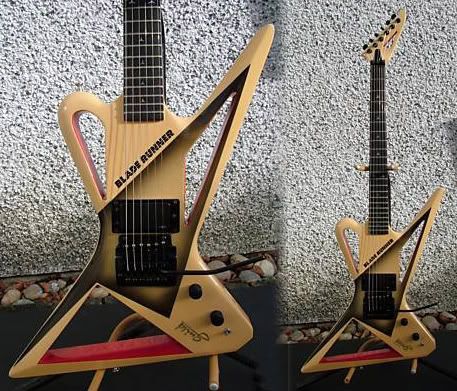
Guild X100 Blade Runner
It's a Guild X100 Blade Runner and its "Explorer with holes" design puts me in mind of the Schecter Genesis, but I wonder which one came first?
Apparently this Guild, equipped with Kahler trem and single EMG pickup, dates back to 1985 when less than 100 such guitars were produced. Whether that makes it worth £7000 (approx $9,681.25 USD as I type this), I really couldn't say.
And before you say it, I have already seen Gibson's recent limited edition Holy Explorer.
Tuesday, 10 March 2009
Gene Autry Cowboy Guitar
If black isn't to your liking, then the same seller has a bunch of other cowboy guitars for sale at the moment.
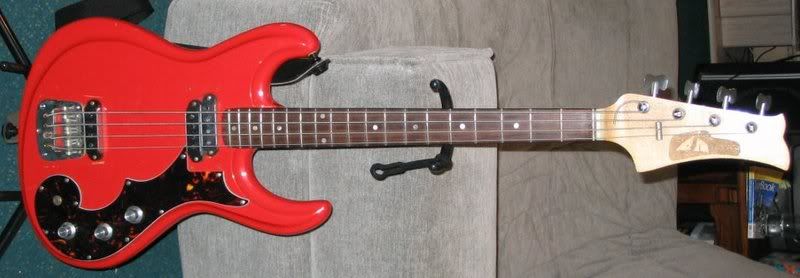
Can you help idendify Kurt's bass?
I picked this short scale bass at a garage sale in New York and don't know the make. It's got a 2 digit serial number on the bottom of the fingerboard and a round black pad on the back. It looks like a sticker on the headstock was peeled off leaving some residue. I was hoping you might have seen one before and could help me with the history.Well... It's not one that I recognize, although the Mosrite influence is obvious with the bodyshape with the longer lower horn and the carving on the top edges. It could be of European origin, although what with the Mosrite influence my inclination would be that it was Japanese. I may well be very wrong, so please feel free to correct me!
http://www.flickr.com/photos/chichiohanlon/
Any info would be appreciated.
I wonder if the pickups are original. The pickguard looks like it was cut to fit around a much larger pickup in the neck position, or else there is a pickup surround or cover missing. The existing neck pickup is weird - it looks like two single coils staggered alongside one another.
If anyone recognizes the bass, then let us know!
Sunday, 8 March 2009
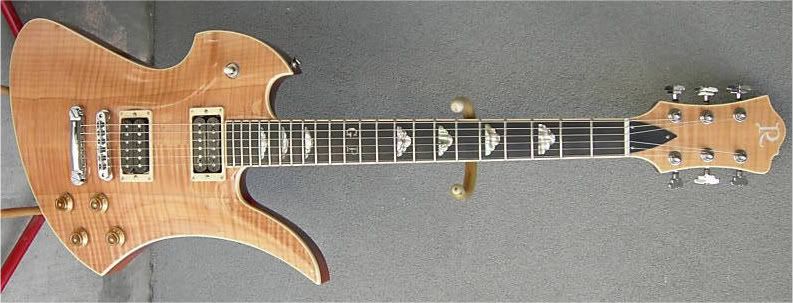
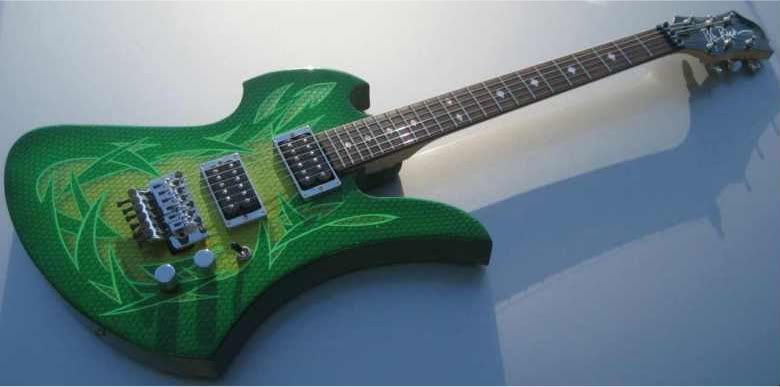
A pair of Mockingbirds
The above-pictured Mockingbird is custom order from 1999. It was built by Bernie Rico for a well known industry insider (I guess someone with the initials "GP" judging by the 12h fret inlay). The customer wanted "Les Paul" specs on a Mockingbird and so the guitar features a stunning bound flame Maple top with a Mahogany neck-through, koa wings, ebony fretboard, and a scale length of 24.75.
Friday, 6 March 2009
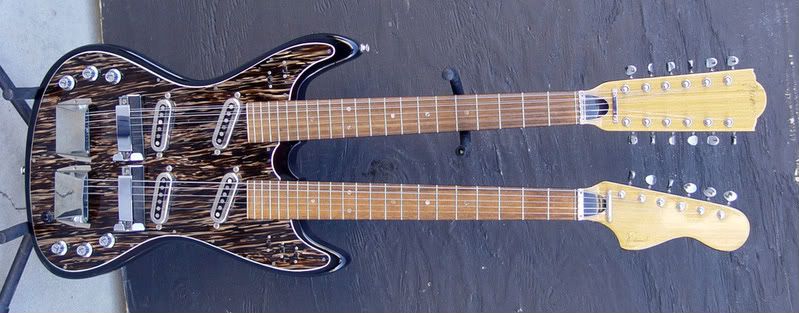
1963 Framus Doubleneck
Thursday, 5 March 2009
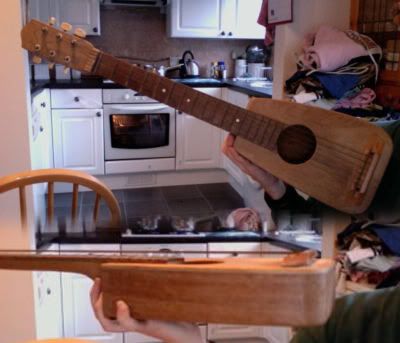
Diminuitive homemade acoustic guitar
The seller rather curiously descibes it as a "Handmade Lapsteel Guitar". I can't see why he thinks it might be a lapsteel guitar as it has a round-backed neck and it has FRETS. Perhaps, he's an estate agent and used to trying to turn negatives into positives, so that when he says it's a lapsteel what he really means is that the action is horrendously high. (He does mention that the bridge has lifted).
It also appears to be strung left-handed.
It's a pity the photos aren't better, as it looks to be quite nicely made, despite the dodgy bridge.
Edit: Sold for just £15. Someone got a bargain. Perhaps.
Wednesday, 4 March 2009
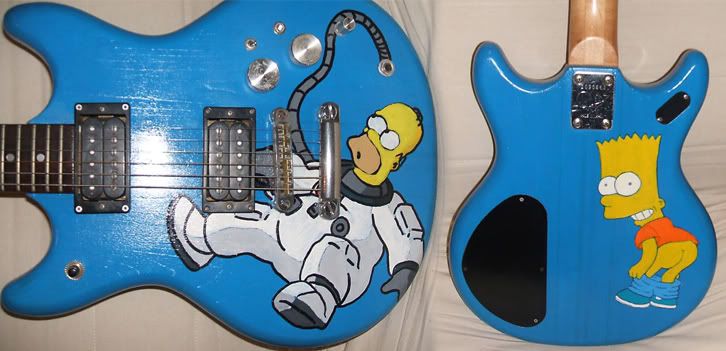
Sssshhhh... no-one tell Matt Groening...
Tuesday, 3 March 2009
1982 G&L SC-2
The following is an article written by Glynn from the Generally Electric guitar blog, and concerns an unassuming-looking but highly desirable guitar from the genius that was Leo Fender:

They’re perhaps best known as Bob Mothersbaugh of Devo’s guitar of choice but, for me, inspiration came from early Helmet and Band Of Susans records. The latter even used SC-1s, customised with pick-guards, in their album photography and on posters, apparently catching the attention of Leo Fender himself. Nevertheless they remain a relatively obscure guitar.
G&L was founded by George Fullerton and a certain Leo Fender in the late 1970s following the deterioration of Fender’s relationship with Musicman, and the SC-2 was one of G&L’s earliest production guitars.
They’re perhaps best known as Bob Mothersbaugh of Devo’s guitar of choice but, for me, inspiration came from early Helmet and Band Of Susans records. The latter even used SC-1s, customised with pick-guards, in their album photography and on posters, apparently catching the attention of Leo Fender himself. Nevertheless they remain a relatively obscure guitar.
Being of rather Spartan design, the SC models are often thought of as “student” or "economy" guitars, though I’ve heard a conflicting story along the lines that G&L's intention was to produce a reasonably priced, high quality US built instrument to compete with inexpensive instruments from the Far East. Whatever the motivations, the SC’s utilitarian appearance is perhaps an acquired taste and, possibly as a result of this, it was never a terribly popular guitar. In fact, by 1984 the body shape had been completely re-designed, supposedly at the behest of a G&L sales team who were struggling to convince buyers with the original design.
Nonetheless, there's nothing budget about the construction, specification or tone of these guitars. Body, neck and fingerboard are all of high quality maple, while the hardware and Magnetic Field Design pickups are the same as those used on G&L's more expensive guitars. In fact the only area where any obvious financial savings have been made in the guitar's construction, other than the function over form design, is the use of fairly cheap looking plastic tone and volume controls which, if the owner found them particularly offensive, could be replaced for pocket change. Really, the SCs remain an outstanding example of how to make a no-frills affordable guitar, and it's a shame that, these days, manufacturers concentrate their efforts on making their entry level instruments ape the slick appearance of their pricier models, rather than focusing on build and component quality.
Ultimately, only around 600 SC-2s were made, and the registry at G&L owners’ site Guitars by Leo records only 100 or so, many of which have been modified to varying degrees, and often to their detriment. Mine, a lucky eBay find, was no exception, but too good an opportunity to miss all the same.
On first opening the case the smell of paint was overpowering. It had been treated to a rather uneven spray-can paint job and the fretboard, including the fret wire itself, had been varnished with a brush. Worse yet, there was a tellingly humbucker shaped indentation between the two original pickups and, more tellingly still, the control plate had two additional holes drilled into it.
With the SC-2’s rare-bird status in mind, I decided to set about restoring my SC-2 to its original condition, or as close to it as possible. This began with the painstaking task of gently removing the excess varnish from the fret wire with a razor blade and cleaning the tarnished hardware with Brasso. I then managed to source a replacement control plate from a 1983 SC-3 body I found on eBay.
Having never refinished a guitar before, and concerned about what I’d find under the existing paint, I decided to let a professional finish the job. In the end, I settled on David Ridgeway of Ridgeway Guitars who, over the course of a couple of months, made me very grateful I didn’t try to do the work myself.
Having stripped the spray paint, David discovered an unevenly gouged hole between the pickups which had been filled with soft putty. Having removed the putty, he re-routed the hole and then filled it with a properly sized block of maple. After sanding and priming, the guitar was finally finished in blue.
Ultimately, only around 600 SC-2s were made, and the registry at G&L owners’ site Guitars by Leo records only 100 or so, many of which have been modified to varying degrees, and often to their detriment. Mine, a lucky eBay find, was no exception, but too good an opportunity to miss all the same.
On first opening the case the smell of paint was overpowering. It had been treated to a rather uneven spray-can paint job and the fretboard, including the fret wire itself, had been varnished with a brush. Worse yet, there was a tellingly humbucker shaped indentation between the two original pickups and, more tellingly still, the control plate had two additional holes drilled into it.
With the SC-2’s rare-bird status in mind, I decided to set about restoring my SC-2 to its original condition, or as close to it as possible. This began with the painstaking task of gently removing the excess varnish from the fret wire with a razor blade and cleaning the tarnished hardware with Brasso. I then managed to source a replacement control plate from a 1983 SC-3 body I found on eBay.
Having never refinished a guitar before, and concerned about what I’d find under the existing paint, I decided to let a professional finish the job. In the end, I settled on David Ridgeway of Ridgeway Guitars who, over the course of a couple of months, made me very grateful I didn’t try to do the work myself.
Having stripped the spray paint, David discovered an unevenly gouged hole between the pickups which had been filled with soft putty. Having removed the putty, he re-routed the hole and then filled it with a properly sized block of maple. After sanding and priming, the guitar was finally finished in blue.
Oddly, as this work was being done, G&L re-issued the SC-2 in updated form. Well, actually G&L say that it’s “not a re-issue” and is, in fact, an “evolution”, but I think their efforts to evolve the design have robbed it of all the charm that made the original truly special. If you want one, my advice is to keep your eye on eBay in the US and buy the real deal.
Labels:
cool guitars,
G+L,
guest blogger,
vintage guitars,
Your Guitars
Monday, 2 March 2009
Handmade Pickguards By me!
Labels:
Accessories,
For Sale,
guest blogger,
handmade,
Luthiers
Subscribe to:
Posts (Atom)