Monday, 17 August 2009

Les Paul - Guitarist Extraordinaire

I've only just heard about this, but I'm sure you've all heard about Les Paul's passing by now. This kind of sad news has an uncanny knack of happening whenever I go away for a few days leaving the blog untended.

G L Wilson

Saturday, 15 August 2009

Heavily Modified Unknown Guitar

philomod

Recently I asked my friend Philo what was his trick to play guitar with a bow, something I know he does frequently. It's been a few years since I met him and saw him on stage, so I forgot his "secret", and I understood when he sent me this picture and a detailed description.

So he rebuilt a guitar to make this hybrid: he carved a bridge inspired by cello's, just wider and shorter, raised the tail piece with a block of wood, changed the inclination of the neck, unfretted the fingerboard, moved the neck pickup and put a piezzo at the bridge. From the pic it seems that this guitar had also a little bit sawed off but I don't know if it was part of this process! He mixes bass and guitar strings and created his own open tuning.

The mod looks a little bit rough, but Philo is a musician and not a fetishist, so once he has the sound (and the sound he has!), how it looks doesn't matter (I hope I was so free minded!). Philo is a French guitar improviser, a hero of the shade haunting the impro noise free jazz French scene for two decades, he's also an excellent photographer dedicated to impro, who shot the greatest musicians and dancers in a very personal way, and - nobody's perfect - a clown. And he's my friend, though it's been years since last time we had a good dueling guitar concert together.

(I didn't put any effort into identifying the guitar, it's not so important, but I'm sure that someone will and tell it in the comments).

Bertram

Wednesday, 12 August 2009

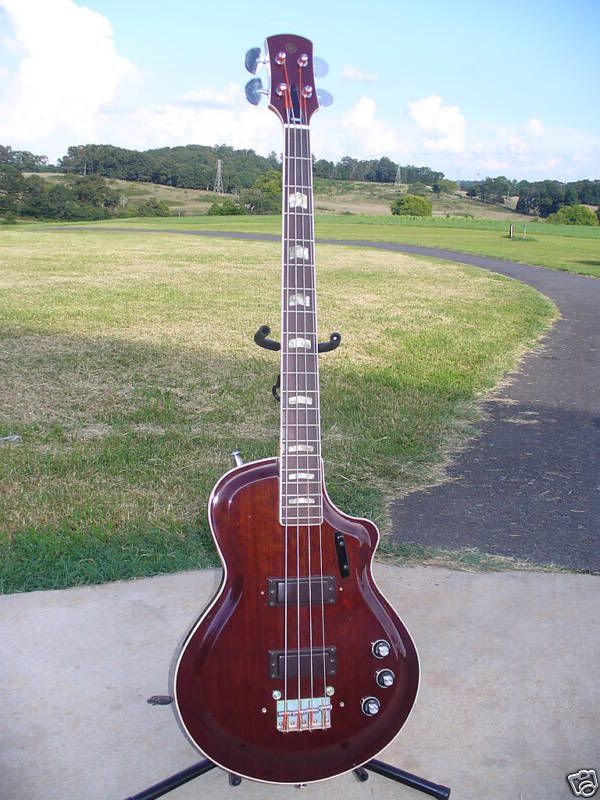
Yamaha SB-50 Bass

OK, so the Kavkaz bass went down like a lead balloon. Don't like Russian, eh?

How about a very nice vintage Japanese bass from 1972? I've not seen a bass like this Yamaha SB-50 before and I must say that I like it.

It has a National/Valco/Supro look to it, and if it weren't for the grain of the wood clearly visible on the top, you could believe that that body with its german carve could be made from fibreglass.

This particular bass looks to be in beautiful condition, which isn't bad for a 37-year old instrument. I'm not sure, but I'd guess it's a short-scale bass - I've always had a bit of a soft-spot for the much maligned short-scale bass. If I were in the market for a bass at the moment I'd certainly consider this.

G L Wilson

Tuesday, 11 August 2009

Flight of the Conchords bass guitar

Here's one for all fans of Flight of the Conchords - it's a Russian-built Kavkaz bass as used by Jemaine Clement in the TV series, and is currently for sale on eBay. It even has the green pickguard, just like Jemaine's, although it seems to have an extra pickup in the bridge position - or possibly those two coils are wired together as a humbucker. I'm not sure what happened to tbe volume and tone pots and why the output jack is positioned where you'd expect to find the volume control. Also, it looks like someone's had a go at earthing the tailpiece with a piece of wire.

It might look like a piece of junk, but as a big Conchords fan I was seriously considering buying this, although seeing as I'm out of work at the moment, now probably isn't the best time to be spending money.

Monday, 10 August 2009

Kawai Aquarius, blogs and stuff


Hi, this is Bertram.
As GLW pointed out in the previous post, I've been posting regularly here in the last weeks and it's been a very interesting experience, full of learning, sharing, exchange and - well - discipline; finding something interesting to post everyday is not always easy!
Anyway, I will keep posting once in a while when I find something worthwhile...

But I also have my own blogs, and I take the opportunity to advertise them to the Guitarz many readers.

First (and you will now understand why there is this bizarre picture on the right), I just started a blog about Kawai Aquarius guitars. This is not the greatest or most famous guitar, but I have a soft spot for it and it's very difficult to find information about it on the Web. So I call for contribution and invite players and owners of Kawai Aquarius guitars (and bass) to send me pictures, stories, tracks, videos... to feed this blog.

But my main blog stays gUitarREN (it's a mix of German, French and English for guitar - of course), a blog about guitar design and projects. From my background as a musician and a visual artist, I started one year ago to study thoroughly about guitars, first to master new aspects of guitar playing, then in the idea that I want to make guitars myself, then I got really involved (I mean even more than before) and went into drawing guitars every day as a creative design process and post them on my blog. I also started building my projects, but I have to learn everything while doing it, and have not so much time and will never have enough to actualize all my ideas...

So I'd love to meet a guitar maker who needs a designer and try a collaboration, if you are interested you can contact me via my profile (you know what? I contacted some companies already and Fender answered, they do have an office to receive suggestions from people like me, interesting, isn't it?).

Thank you for your attention.

Saturday, 8 August 2009

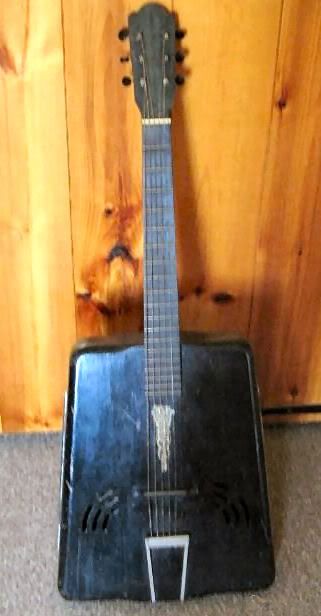
Old Kraftsman square acoustic guitar

I've made no deliberate secret of the fact that between mid-June and July of this year I was very busily employed writing a book about guitars (yes, it was a very tight deadline, imposed by the publishers), which is why Bertram was looking after this blog almost single-handedly during that period. However, this may have escaped your attention as I haven't been harping on about the book mainly because I was waiting for it to be published in December before making a big noise about it.

Anyway, you know the kind of book it is. Lots of pictures and descriptions of guitars and basses, old and new, classics and modern innovative designs, the weird and wacky, etc. In fact, it's a lot like a book version of this blog.

The first job I had to do was to come up with a list of 500 different guitars. I needed a fair representation of everything. As well as the guitars everyone expects to see, I wanted to include a fair selection of oddities, and hopefully some that aren't in all the other guitar books. I think I suceeded fairly well, but you'll have to decide for yourselves in December when the book is released.

The reason I mention this all now, is that occasionally - as happened last night - I'm trawling eBay looking for an interesting guitar to feature on this blog, and I see something like this Old Kraftsman square acoustic guitar which makes me want to kick myself that I hadn's seen it earlier and included it in the book.

I have to confess, though, that I know nearly nothing about this guitar and had I needed to write about it I would have been scratching my head for a fair while trying to think of something to say, which isn't good when you're on a tight deadline.

What I do know is that Old Kraftsman is a brand name for the Spiegal department store and that the guitars were built by the Kay guitar company.

The design of this square guitar is quite unusual. It has a art deco feel to it, especially with the radiogram-styled soundholes, and the smooth contoured edges give it the appearance of having been built from bakelite. However, the close-up photos on the eBay listing show cracking in what must be a wooden body.

I have no idea what it would sound like, and confess that I can't get the idea out of my head that it must sound "boxy", however corny that comment might sound.

Note also that the body is not a geometrically precise rectangle and that it is tapered. The body shape is reminiscent of, although it pre-dates, the classic Steinberger bass and guitar from the early 80s.

Friday, 7 August 2009

Beano Guitar

Beano GuitarI very much doubt it's worth the fifty quid starting price, but I love stuff like this. This looks to me very like an old Classico brand guitar, just like the one I took lessons on when I was 11 (my sister still has mine at her house).

As to The Beano comic, well it was a British instituion. Absolutely fantastic! Don't accept any Dennis the Menace imposters with yellow hair, the real Dennis the Menace wore a red and black striped jersey, had black spiky hair and a dog called Gnasher.

Wednesday, 5 August 2009

Jazzgitarren website

jazzgitarren1

I found lately an amazing Japanese website about German vintage guitars, Jazzgitarren, and it's absolutely baffling. A complete unknown part of modern guitar history is suddenly revealed to me.

So far I just believed (more or less) in the widely accepted but limited view of electric guitar history - Gibson invented the archtop mandolin then guitar then added pickups then made the semi-hollow then the Les Paul solid body. And then Fender found out how to make a guitar from a plank, and then the Japaneses started to copy American guitars and the Italians had a burst of creativity (this I still have to understand how and why)...

But all these German guitars were completely out of the picture, and they are so beautiful, so creative that I can't understand how I never heard of them before - though I've been curious about European vintage guitars for a while.

Anyway, I'm happy to share this discovery here. The Jazzgitarren website shows the early production (50s, 60s) of most famous German brands such as Höfner, Framus, Hoyer or Dynacord, and many more, both from BRD and DDR. I extracted a few pictures of of these guitars - left to right and up to down: Musima Record, Neubauer Thinline, Hoyer Bianka, Hopf Explorer Standard, Shadow Violin Guitar, Höfner 175. Your can really spend a few hours on this site, believe me!

There is something similar for Italian vintage guitars, the quite famous fetishguitars.com.


jazzgitarren2

Monday, 3 August 2009

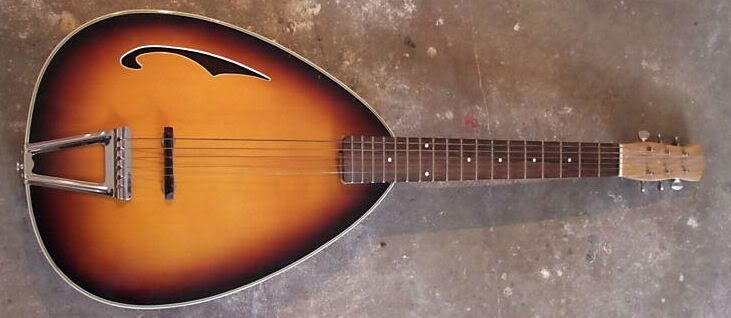
Danelectro Teardrop acoustic

This teardrop-shaped guitar from Danelectro looks like it has something missing. "Where are the pickups and volume and tone controls?", I want to ask. Of course, it's an acoustic guitar - the teardrop shape is reminiscent of a lute, but I'm not used to the idea of Danelectro acoustics - I'm more used to their masonite-on-a-pine-frame-bodied electrics. It looks to be a nicely-made guitar with no masonite to be seen, but I wonder about how full an acoustic tone it has.

Saturday, 1 August 2009

Ampeg Scroll Bass and Legacy


guitarz.blogspot.com
Ampeg basses

This post will be a little bit fatter than usually, because I wanted to share a little inquiries I made about the Italia Imola 6 guitar, that lead me to rediscover the fabulous Ampeg AEB-1 aka the Horizontal Bass aka the Scroll Bass aka the F-hole Bass, and a couple of its descendants.

There was already a post about this bass last year on Guitarz, with a picture that gives a good idea of what wearing it must feel, with its huge double bass headstock. You can also find a very complete database about it on Johnson's Extremely Strange Musical Instrument Company 's website. Bruce Johnson builds nowadays quite acurate copies of the Scroll Bass that you can see on the small picture on the right.

scroll bassThe first big pic shows bass amps builder Ampeg's first series of 'horizontal' basses, starting in 1966 - their previous and first instrument was the 1962 Baby Bass, a small body fiber glass/plastic double bass. There are 3 Scroll Bass models, let's keep the Devil Bass (center) for a future post ; the f-hole models are the 1966 AEB-1 (AUB-1 for the fretless version - the very first fretless electric bass), and its 1968 upgraded version the AMB-1/AMUB-1.

Of course their most remarkable features are the 2 f-holes cut through the solid body, and the headstocks directly inspired by violon family instruments. It's quite of our time that a retro inspiration would result in such an inovative design!

The AEB-1/AUB-1 was designed to be appeal to upright bass players and featured a weird hidden pickup which was essentially a steel diaphragm over two magnetic coils set into epoxy. This meant that the bass could use gut strings. Notice also the way that the tailpiece extends beyond the body - this was so as to achieve the correct string angle over the hidden pickup.

The later AMB-1/AMUB-1 is a logic adaptation to modern rock sound, with more classical humbucker single pickup for metal strings, smaller head and Fender style tailpiece. You will find a very complete description of all these instruments on Bruce Johnson's website linked above.
Bruce Johnson's contemporary versions AEB-2/AUB-2 intend to be humble improvements of the original model, with the benefit of 40 years on electric lutherie. The few changes are meant to - as Johnson puts it - "bring the Scroll Bass design up to its full potential". That is definitely an instrument I'd love to play!


EEB eastwood


This is what Eastwood Guitars made based on the second model of the Scroll Bass - the AMB-1.

Eastwood
's EEB-1 is also a quite faithful reproduction, a noticeable change is the slightly shorter lower f-hole and the pickguard curling around it, and of course you can see that the scroll headstock is gone. I can understand that a modern guitar needs to get rid of vintage oddities - and the replacement headstock has a good design - but you probably loose the feeling of playing a horizontal double bass...

Like Ampeg, Eastwood proposes also a fretless version, the EUB-1.

italia imola 4


Now this is the Italia Imola 4 Deluxe in Cherry Sunburst. As you can see, the shape is the same but the two cut-through-body f-holes have been replaced by a more classical one (I actually read contradictory information about this f-hole, here it's called a "faux f-hole", there a "solid body f-hole", also this bass is said to have a "chambered solid body" but without "glued top", so something like vintage Rickenbackers... if someone knows more, it's welcome).

The big contoured pickguard is also there - without the lower f-hole - and the headstock is more classic (and very 60s - it looks like the one of my Musima ES-335 style bass). The pickups are completely different and are closer to a J-bass than to an Ampeg. This bass exists also fretless and/or 5-string.

No matter how much it betrays its Ampeg model, it's a beautiful instrument.

imola 6 italia


And finally this is the Italia Imola 6 Standard with which the all thing started. For this model Italia didn't try to reproduce a vintage model but extrapolated from their own interpretation of the Ampeg Scroll Bass. The result is a rounded Jaguar shape with a characteristic f-hole partially covered by a large pickguard. The 6 tuners in line headstock is inverted, that seems always to me the logical thing to do - the tuners have easier access and the tension suits better the different string gauges (and it's not only true for metal guitars).

Imola 6 doesn't only stand for 6 strings (as in Imola 4 or 5 for the 4- and 5-string basses) but mostly for the quite original 6 pickups - 3 vintage Teisco style split singlecoils. These pickups and the two 5-way levers allow many combinations - 25 -, some of which are probably quite original and must give this guitar a quite unique sound.

You can find a detailled review on musicradar.com and nothing on italiaguitars.com where the guitar is not even mentioned, though you can find it on their newer (I suppose) JHS website - where the bass models are completely missing... Italia people, please make some maintenance, it's confusing!

Italia
is a brand created by Trevor Wilkinson - THE Wilkinson - and intends to combine vintage creativity (isn't it contradictory to look in the past for creativity?) and contemporary technical qualities.

thanks to blogmaster GL Wilson for his expertise about the Scroll Bass.

EDIT. This is a close-up of the scroll headstock of the 1966 Ampeg model - none of the previous pictures give a clear look of it.

EDIT 2. Just found a blog about the original scroll Bass, it's here.

LinkWithin

Related Posts with Thumbnails

ShareThis