guitarz.blogspot.com:
Here's another one of Ian Schneller's creations, seen here in this video clip being played by the guy who commissioned the instrument in the first place, Michiel Niessen, in March 2009. Read more about it here.
G L Wilson
Guitarz - The Original Guitar Blog - now in its 10th year!

Thursday, 3 March 2011


Specimen aluminium-bodied Selmer-style jazz guitar
guitarz.blogspot.com:
 This Specimen aluminium-bodied guitar is currently being offered for sale on eBay with a starting price of $2,500. It is styled after the Selmer oval-hole gypsy jazz guitars (although with a scaled-down body size) as used by the likes of Django Reinhardt. The seller refers to it as "Maccaferri" but this appellation is a total misnomer. Selmer Maccaferri guitars featured a larger D-shaped soundhole (originally conceived to house an internal resonator device which eventually proved unpopular), and by the time that the Selmer company had brought out the oval-soundhole guitar they had ceased all connection with Mario Maccaferri himself.
Anyway, as for this Specimen "tribute", I'll borrow from the eBay listing and let the seller explain all:
See also: www.specimenproducts.com
G L Wilson
Guitarz - The Original Guitar Blog - now in its 10th year!
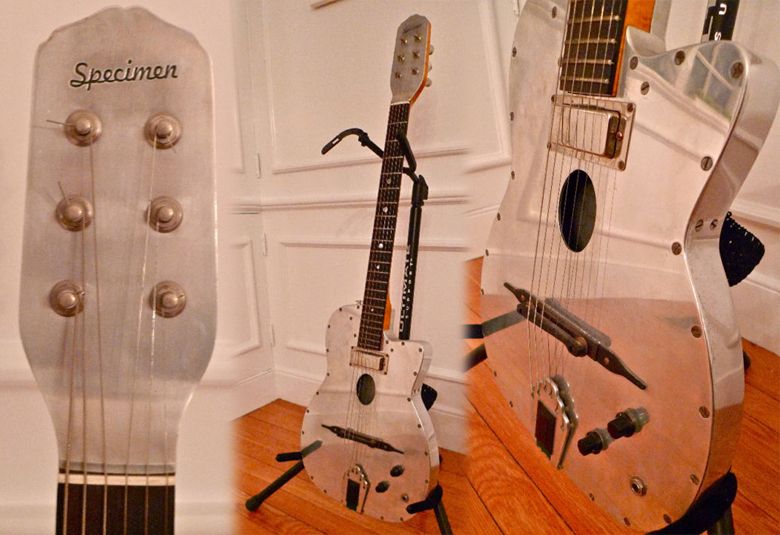
Anyway, as for this Specimen "tribute", I'll borrow from the eBay listing and let the seller explain all:
This one-of-a-kind guitar was built in Chicago about ten years ago by Ian Schneller, founder of Specimen Products and the Chicago School of Guitar Making. In the event you are familiar with Specimen, you don't need me to say much of anything here. This is a very serious guitar, for serious bidders only. Do not bid prior to researching Specimen Products--you will be glad you did, as it is quite an amazing operation. Assuming you are not familiar with Specimen, here is the description from the Specimen website of this guitar, and whereas Specimen has produced many guitars over the years, they've only produced one Maccaferri, and this is it:
Maccaferri.
"A nod to another point in history — Django Reinhardt, Mario Maccaferri. This fully-acoustic aluminum Specimen guitar has quite a usable volume unamplified. When plugged in with a regular mono cable, its mini-humbucker provides a feedback resistant electric signal. When used with a stereo 1/4-inch cable plugged into a Fishman Power Blend pedal, its transducer in the bridge surreptitiously accompanies the humbucker via a third wire. This enables either a stereo or combined output with a broad and complex tone pallet. I have always been critical of transducer units, but I believe that the technology has finally matured. And, coupled with the sustain of aluminum, the sound of this instrument is truly stunning. It's like listening to a guitar through a microscope. A tiny drop of water teaming with life."
The only blemishes on this guitar are a very small knick in the back of the neck about halfway up--doesn't impair the instrument but you can feel it when the left hand is moving to various positions on the neck. Otherwise, there is slight corrosion on a few of the screw heads at both the pickup and bridge. It appears that whereas the larger screws holding the body together are stainless, the smaller screws holding the components (i.e. bridge, pick-up, are not). This is a NO-RESERVE auction for a very rare and very special guitar.
[...] [A] Fishman Powerblend pedal--barely used, with all original paperwork and packaging--is included. [...]
Features of the guitar are as follows:
• Fully-acoustic aluminum body(Ignore all reference to Maccaferri - as already noted above, this is incorrect).
• Bird's eye maple neck with aluminum facing on headstock
• Ebony fretboard
• Banjo tuners
• Mini- humbucking pickup in neck position
• Fishman Transducer pickup in ebony bridge
• Volume and tone controls
• Custom-made aluminum tailpiece with sculpted ebony insert
See also: www.specimenproducts.com
G L Wilson
Guitarz - The Original Guitar Blog - now in its 10th year!
Wednesday, 2 March 2011
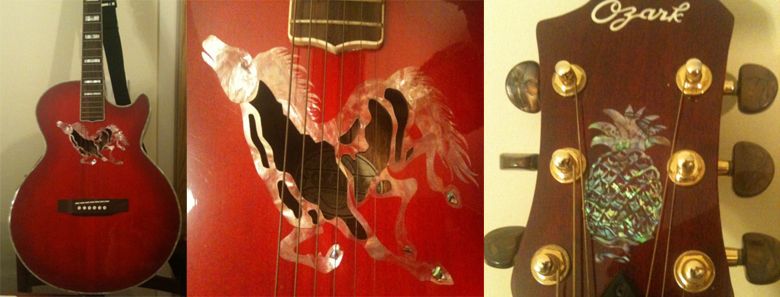
Ozark Galloping Horse acoustic
guitarz.blogspot.com:
 Ozark Guitars produce a fine range of budget to medium-priced acoustic and resonator guitars and other folk instruments such as banjos, mandolins, mandolas and bouzoukis. It's nice to see that they have been having fun with some of their designs, such as the above pictured acoustic with a "galloping horse" soundhole design picked out in inlaid mother of pearl and abalone. Other soundhole designs have included a dolphin, an eagle, and a butterfly. It seems the horse and dolphin designs are now discontinued. I'm not quite sure what relevance the pineapple on the headstock has.
G L Wilson
Guitarz - The Original Guitar Blog - now in its 10th year!
G L Wilson
Guitarz - The Original Guitar Blog - now in its 10th year!
1960s Vox Clubman bass
guitarz.blogspot.com:
 I think in the early days Vox must have been rather slapdash about the names they applied to their guitars, as I had previously thought that the above-pictured bass was the Vox Bassmaster and not the Vox Clubman Bass which is the name that appears on the headstock on this example currently for sale on eBay. To confuse things even more, the name Vox Bassmaster also appeared on a completely different design of bass.
These early Voxes, made in Dartford, Kent, in the UK, were essentially student model guitars with a very thin plywood body. It looks as if the original finish (most likely red) was removed from this example a long time ago. Note also the jack socket, which would have been added later. Early Voxes such as this had a TV-like co-axial socket, as did the Vox Clubman II guitar I used to own (before I upgraded it).
Despite their student status, these basses are known for their distinctive sound and playability. Personally, because of their cheap construction, I wouldn't have thought they were eminently gig-worthy but perhaps to get that certain sound in the studio they would be desireable.
G L Wilson
Guitarz - The Original Guitar Blog - now in its 10th year!
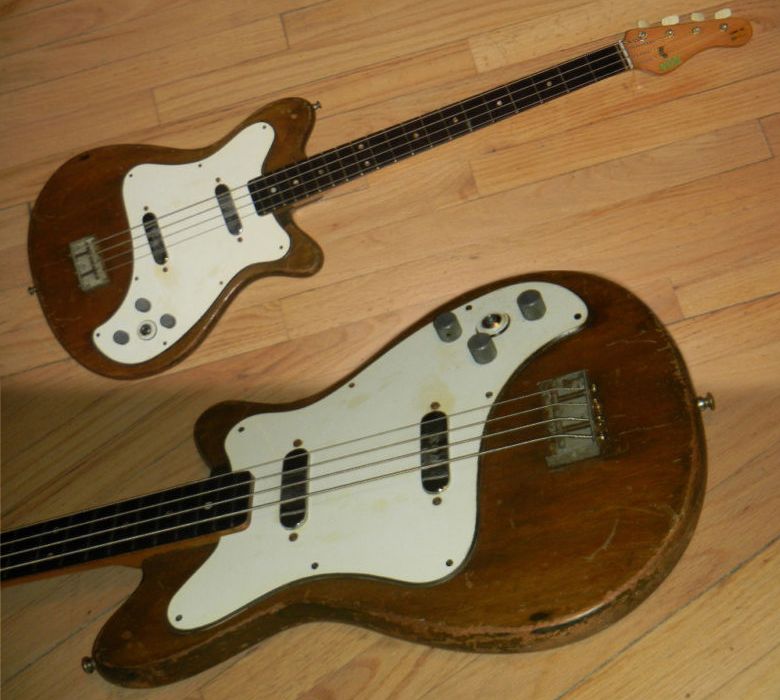
These early Voxes, made in Dartford, Kent, in the UK, were essentially student model guitars with a very thin plywood body. It looks as if the original finish (most likely red) was removed from this example a long time ago. Note also the jack socket, which would have been added later. Early Voxes such as this had a TV-like co-axial socket, as did the Vox Clubman II guitar I used to own (before I upgraded it).
Despite their student status, these basses are known for their distinctive sound and playability. Personally, because of their cheap construction, I wouldn't have thought they were eminently gig-worthy but perhaps to get that certain sound in the studio they would be desireable.
G L Wilson
Guitarz - The Original Guitar Blog - now in its 10th year!
Tuesday, 1 March 2011
Guild B-301 Bass
guitarz.blogspot.com:
 Here's a classic bass design that you don't see too often these days. Regarded as a reliable workhorse of a bass, the Guild B-301 was in production from 1977 through to 1980. It features a mahogany body with a set 3-piece mahogany neck. Pickups and controls were all mounted to the pickguard, meaning that the body only needed routing on the front side. This was an economical exercise in order to speed up and simplify mass production.
The B-301 was the single pickup model and the two pickup model was named - wait for it - the B-302. This example, with "B-301" on its truss rod cover, has two pickups - but one of these has been added by a previous owner.
G L Wilson
Guitarz - The Original Guitar Blog - now in its 10th year!
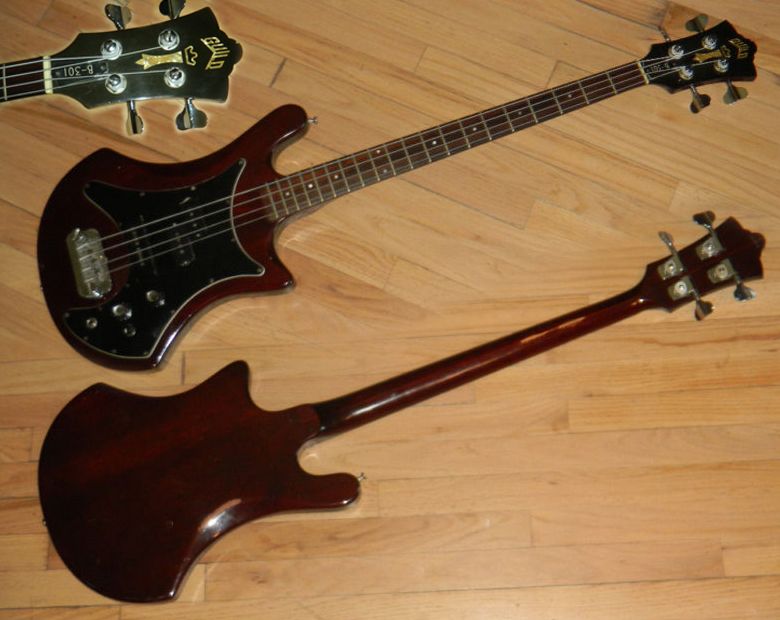
The B-301 was the single pickup model and the two pickup model was named - wait for it - the B-302. This example, with "B-301" on its truss rod cover, has two pickups - but one of these has been added by a previous owner.
G L Wilson
Guitarz - The Original Guitar Blog - now in its 10th year!
1980s Jolana Disco

This one is a cool one! A Jolana Disco with a double florentine cutaway between a SG and a Bison, a huge humbucker in middle position, and the strange pickguard resulting. If I wasn't saving for another guitar, I'd jump on this one - and not just for the look, remember that Jolana was probably the best guitar brand in communist Europe...
Bertram
Guitarz - The Original Guitar Blog - now in its 10th year!
Monday, 28 February 2011
Hurricane Model BF-402
guitarz.blogspot.com:
 These photos illustrate quite nicely the evil presented by stickers and why they should never be allowed to sully a guitar's appearance. This guitar had its stickers removed after many years and whilst the uncovered finish of the guitar's top had changed to a more golden colour with age, the area beneath the stickers has remained the original colour.
Actually, this is my guitar. I bought it in this condition last week, and despite the above little rant I really am not bothered by its appearance. In a way, it adds character, but more to the point I really don't care because I got an absolute bargain here. It only cost me £20 (OK, call it £30 with post and packing). I don't think anyone else was bidding because of the appearance of the guitar. But, it's a really nice player (much better than my Ovation "thing" with the horrible action and which set me back between £300-£400 a few years back). I can't tell you how pleased I am with this guitar.
But... Has anyone heard of Hurricane guitars? The name sounds familiar, but I can't find out anything much about them. Apparently they made a few of the usual Fender and Gibson solidbody knock-offs. This acoustic was made in Japan - the seller reckoned 1970s but I tend to think 1980s is more likely - and the label inside the soundhole tells us that it's the Model BF-402. It's quite obviously a Martin copy, but its not a top of the range guitar. Witness the simple black binding on the body and total lack of neck binding. The tuners are also of the open-back type, although they function perfectly competently. The Hurricane logo is a quite a simple affair, if you could even call it a logo. It's just the name set in a particular font, and with the individual characters at different heights it looks as if it was designed using LetraSet letters (who remembers LetraSet? They were sheets of transfers that you had to apply to a surface by rubbing and peeling away the backing sheet).
So, anyway, the lesson is keep checking those auctions, and try to see beyond initial appearances.
G L Wilson
Guitarz - The Original Guitar Blog - now in its 10th year!
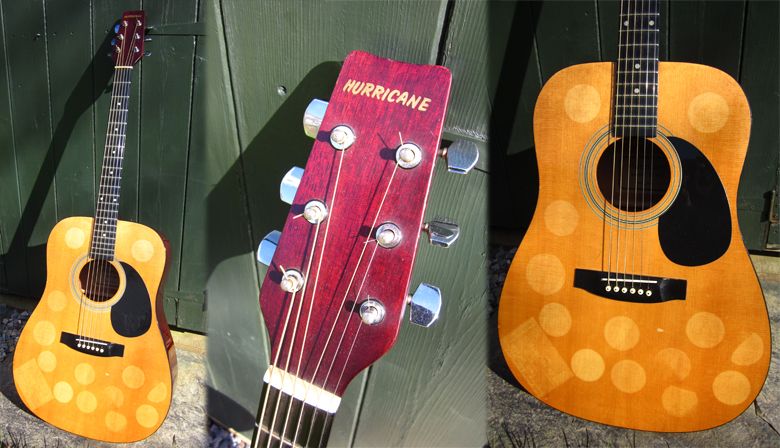
Actually, this is my guitar. I bought it in this condition last week, and despite the above little rant I really am not bothered by its appearance. In a way, it adds character, but more to the point I really don't care because I got an absolute bargain here. It only cost me £20 (OK, call it £30 with post and packing). I don't think anyone else was bidding because of the appearance of the guitar. But, it's a really nice player (much better than my Ovation "thing" with the horrible action and which set me back between £300-£400 a few years back). I can't tell you how pleased I am with this guitar.
But... Has anyone heard of Hurricane guitars? The name sounds familiar, but I can't find out anything much about them. Apparently they made a few of the usual Fender and Gibson solidbody knock-offs. This acoustic was made in Japan - the seller reckoned 1970s but I tend to think 1980s is more likely - and the label inside the soundhole tells us that it's the Model BF-402. It's quite obviously a Martin copy, but its not a top of the range guitar. Witness the simple black binding on the body and total lack of neck binding. The tuners are also of the open-back type, although they function perfectly competently. The Hurricane logo is a quite a simple affair, if you could even call it a logo. It's just the name set in a particular font, and with the individual characters at different heights it looks as if it was designed using LetraSet letters (who remembers LetraSet? They were sheets of transfers that you had to apply to a surface by rubbing and peeling away the backing sheet).
So, anyway, the lesson is keep checking those auctions, and try to see beyond initial appearances.
G L Wilson
Guitarz - The Original Guitar Blog - now in its 10th year!
Harmony H59 Rocket in Hotrod finish
guitarz.blogspot.com:
 I think I've gone on record before as saying I am not a fan of pin-striping, hotrod finishes and all that kind of thing, but - cliché or not - on this Harmony H59 Rocket I simply cannot deny that it looks fantastic. I'm going to borrow from the eBay listing and allow the seller to tell you about it:
Thanks to Julian Woods for pointing this one out.
G L Wilson
Guitarz - The Original Guitar Blog - now in its 10th year!
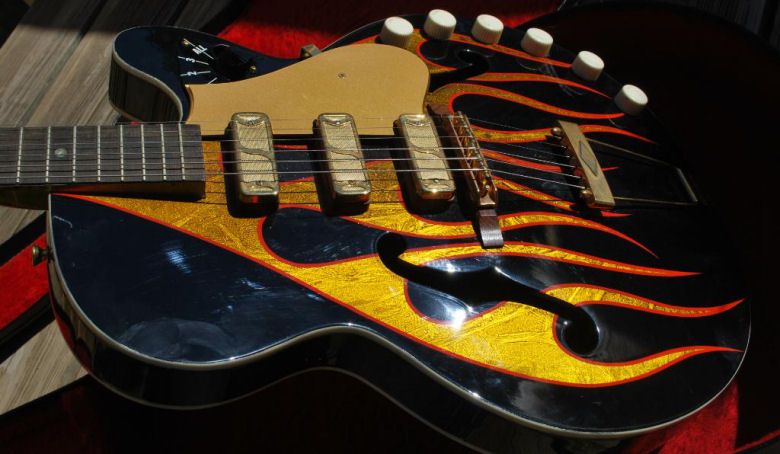
This is a unique opportunity to own an amazing completely redone Harmony Rocket. I purchased this from an avid collector who loved rockabilly music and hot rods. He took his favorite vintage rocket and had it “hot rodded”. He had his luthier overhaul everything. He redressed the frets, he replaced the floating wooden bridge with a modern roller bridge, he replaced the original tuners with a set of Grovers and readjusted everything to maximize playability. To complete his rockabilly/hot rod project he sent the guitar a custom bike shop in California to paint an amazing professional hot rod flame job paint on the body. The paint metallic paint just leaps out and in the light and looks incredible. The back of the neck is super smooth and plays like butter. Overall the guitar plays and sounds phenomenal! This is easily the best playing Harmony or Silvertone I’ve ever encountered.It just screams "Rockabilly" at you, doesn't it? (I have to admit that I do hate that expression "plays like butter". That seems to be one of those eBay guitar listing clichés. For me, it just conjures up an image of a really digustingly greasy guitar.)
The guitar’s neck is very comfortable and is shaped like a 59’ roundback, it isn’t super large like the old Silvertone archtops and it isn’t skinny either…just nice and meaty. There are no dead spots on the neck and no buzzing along the board. The frets are vintage and are shaped like the thin/wide vintage Gibson style. The famous Dearmond gold foil pickups sound big and bold clean and thick and juicy when overdriven. All the tone/volume knobs work and are not scratchy, however two of them don’t turn as easily as the others. They still turn just fine but just not as freely as the others. The pickup selector works and feels very solid. The guitar stays in tune like a dream. Overall an incredible instrument that is perfect for the studio or the stage.
To my knowledge everything is original except for the paint finish, the headstock decal, the replaced tuners, the replaced bridge, and the matching pick gold pickguard. The guitar is in very good condition, all the binding is very tight with no cracking. No major dings, scratches or blemishes...
Thanks to Julian Woods for pointing this one out.
G L Wilson
Guitarz - The Original Guitar Blog - now in its 10th year!
Sunday, 27 February 2011
1960s Klira with cool gear

Usually I would not have posted about this 1960s Klira because I didn't find a photo of the whole guitar, but actually I mostly wanted to focus on the gear - particularly the tremelo!
I know I told this many times but I really love these old German trems - it seems that each company did create a new one for each model - this is quite different nowadays!
This very vintage hollow body guitar has other cool stuff - the mini-humbuckers, the rotating switch... It's a pity that the top is warped and sagging, I wonder if it's fixable...
Bertram
Guitarz - The Original Guitar Blog - now in its 10th year!
Friday, 25 February 2011
Another mystery guitar needs identifying
guitarz.blogspot.com:
 Here's an email from Jack:
G L Wilson
EDIT: It's a Roberts Iris and the band are called JetKing. Thanks to Bid Red X for that info!
Guitarz - The Original Guitar Blog - now in its 10th year!

Thanks for the praise, but I don't think I'm going to come up trumps in this case. This is a design that I feel I should know and am sure I have seen somewhere before, but unfortunately I cannot put a name to it. If any of our readers can help, please tell us what you know via the comments.Hi Gavin
I've been an avid follower of your blog for a few years now and I have always admired your ability to identify random guitars!
Attached is a pic I took at a gig in Bristol earlier this week. It was the support band for Morning Parade and the guitar was seriously unusual.
Don't know if its that obvious from my (very bad) pic but the guitar had slanted lipstick pickups on humbucker sized plates, an old varitone switch on it and what looked like a small pushbutton switch, in addition to a pickup selector and volume. Tune-o-matic and then through body stringing. Unusual finish too. Not sure if it was modern or vintage... not a lot of help I know! I couldn't read what it said on the headstock, annoyingly!
I think the support band was called Jet something but I didn't quite catch it. Probably not a lot of use but you never know, someone may know what it was. It sounded awesome, by the way!
Thanks for any help you can give.
Jack Floyd
G L Wilson
EDIT: It's a Roberts Iris and the band are called JetKing. Thanks to Bid Red X for that info!
Guitarz - The Original Guitar Blog - now in its 10th year!
Subscribe to:
Posts (Atom)
LinkWithin
